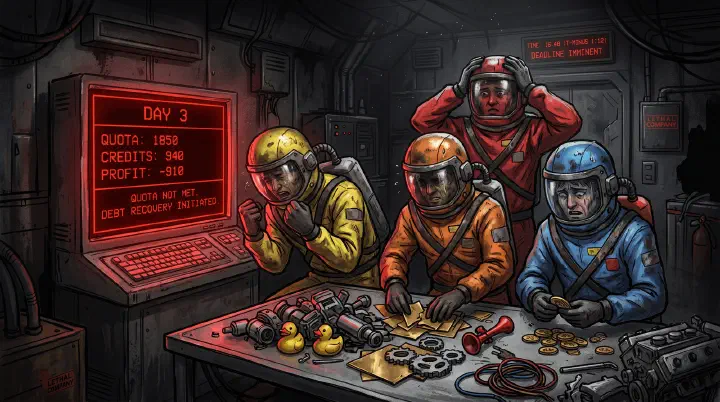
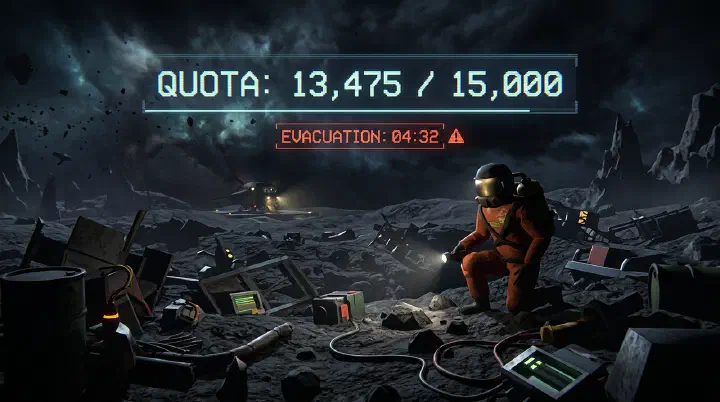
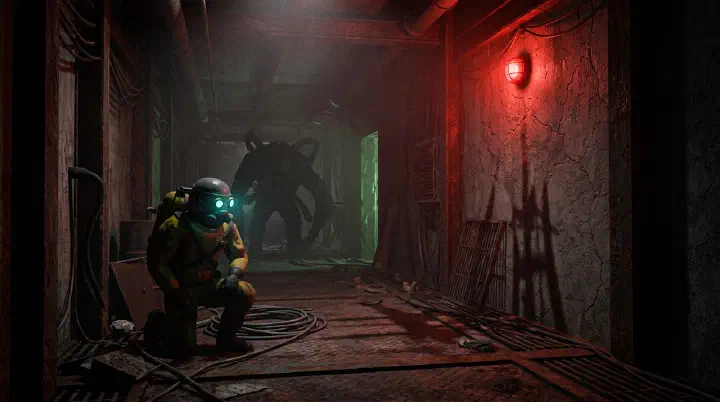
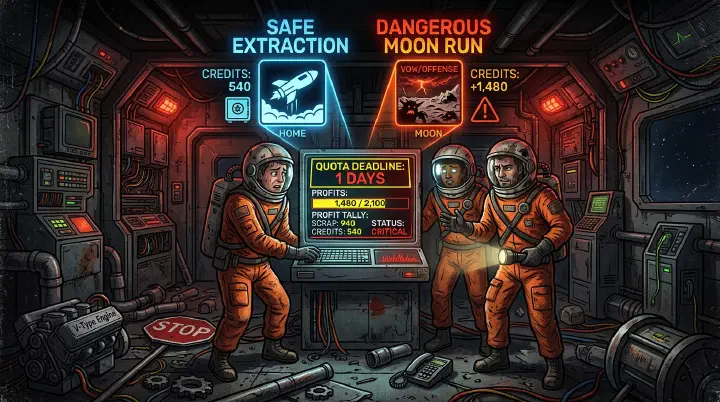
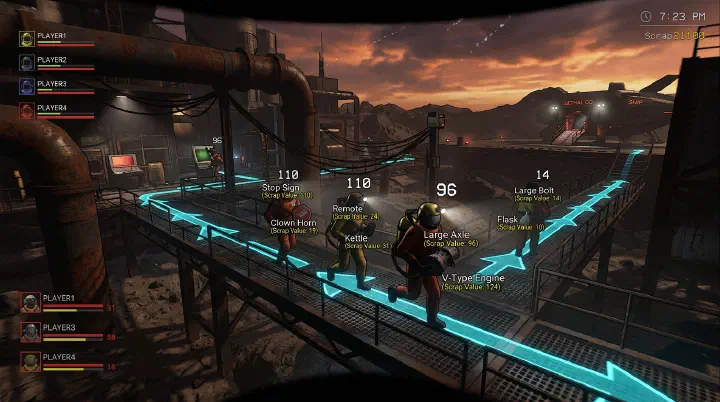
Lethal Company is a co-op survival horror game where crews scavenge abandoned moons for scrap while evading deadly creatures. Team coordination, equipment management, and knowing when to run are everything.
Quick Answers
The key facts from every DungeonPath guide on this game, condensed into one place. Tap a topic below for the full detail that lives in the individual guides.
Lethal Company Advanced Strategies — Quota Scaling Math, Moon Rotations & Pro Techniques (2026)
How does quota scaling actually work in Lethal Company?
Each quota is roughly 1.3x the previous one, with a random variance of ±20%. The formula is: next quota ≈ current quota × (1.1 to 1.5, average 1.3). This means quota 5 (~500) becomes quota 6 (~650), quota 7 (~850), quota 8 (~1,100). By quota 10, you need roughly 2,000-2,500 credits every 3 days. The scaling eventually outpaces what’s possible to collect from moons — the game is designed to eventually kill you. The goal isn’t to survive forever. It’s to survive as many quotas as possible.
Lethal Company Beginner Guide — Survive Your First Quota, Day by Day (2026)
What should I buy before my first landing in Lethal Company?
Buy 2 Flashlights (30 credits) and 1 Shovel (30 credits). That’s 60 credits — leave the remaining 100 credits in the bank for next quota. The Flashlights are non-negotiable (interiors are pitch black without them). The Shovel lets you fight Thumpers and Bunker Spiders instead of dying to them. Skip the Walkie-Talkie for your very first run — learn to stay together as a group before adding the complexity of split communication.
When should I leave the facility and return to the ship?
Return by 5 PM in-game time — no later. At 5 PM, outdoor enemies (Eyeless Dogs, Forest Keepers) begin spawning and the walk back becomes lethal. A good internal alarm: when your inventory is 3/4 full or the in-game clock shows 4 PM, start heading back. Losing 20 credits of scrap in your inventory because you died at 6 PM is worse than leaving 20 credits of scrap in the facility because you left early.
Lethal Company Equipment Economy — What to Buy First, What’s a Credit Trap & the Per-Quota Math (2026)
What should I buy before my first landing?
Two Flashlights (30 credits total) and one Shovel (30 credits). That’s it — 60 credits. Flashlights are non-negotiable because the facility interior is pitch black. The Shovel is your only counter to Thumpers and Bunker Spiders, which are the only dangerous entities on Assurance, your first moon. Skip the Walkie-Talkie for your very first run — you should be staying together as a group, not splitting up and needing radios. Skip the Pro-Flashlight — it costs 3x more for marginal brightness improvement and you’ll lose it when you die anyway.
When should I upgrade from Flashlight to Pro-Flashlight?
Only after your crew has survived 5+ consecutive quotas without losing gear to deaths. The standard Flashlight provides enough brightness to navigate and spot threats. The Pro-Flashlight costs 3x more for roughly 30% more range, and every death drops the item permanently. Upgrade when deaths are rare, not when you’re still learning entity patterns.
Why is the Zap Gun a bad purchase for new crews?
The Zap Gun requires two coordinated players — one to maintain the zap beam, one to attack or loot. Beginner crews panic, break the beam, and die with a 50-credit item. It also requires precise timing against specific entities. Until your crew can communicate calmly under pressure, the Zap Gun is an expensive liability.
Lethal Company Ship Operator Guide — Radar, Teleporter, Terminal Commands & Why You Are the Most Valuable Player (2026)
Is the ship operator role actually useful or just for players scared to enter the facility?
The ship operator is the single most impactful role in the game. The radar terminal shows real-time positions of every enemy as red dots and every piece of scrap as yellow dots. A good operator warns the team about Coil-Heads before anyone sees them, directs the team to high-value scrap rooms and tells them to skip dead ones, and teleports players out the instant they are in danger. Two identical crews were tracked over five quotas: the crew with a dedicated operator lost 2 members and averaged 310 scrap per entry. The crew without an operator lost 11 members and averaged 180 scrap. The only variable was the ship operator.
How to Survive Lethal Company Solo — Best Moons, Loadouts & Enemy Counters (2026)
Can you play Lethal Company solo?
Yes, but the game is significantly harder solo. Monster aggro is not reduced for player count — enemies that would split their attention across 4 players focus entirely on you. Quota scaling is the same regardless of player count, so you need to collect the same amount of scrap as a full crew. Solo play is a challenge mode, but it’s entirely beatable with the right strategies.
What’s the best moon for solo Lethal Company?
Assurance is the best solo moon. It’s free, hazard level C, has a fire exit shortcut, and the map is small enough that you can make multiple quick trips. The scrap pool (350-500 average) is enough to meet early quotas. March is the backup free moon — slightly more scrap but a bigger map. Avoid all paid moons solo until you can consistently survive 5+ Assurance runs.
How do you deal with Coil-Heads solo?
You can’t — that’s the point. Coil-Heads require one player to stare at them while another loots. Solo, you can’t do both. If a Coil-Head spawns, your run is effectively over. The solo counterplay is prevention: avoid moons where Coil-Heads spawn (Titan, Rend, Dine) and leave immediately if you see one. Check the moon’s hazard level before landing — anything A-tier or above can spawn Coil-Heads.
Lethal Company Weather Guide — How Every Weather Type Changes Your Moon Strategy & Which to Avoid (2026)
Which Lethal Company weather should I avoid at all costs?
Eclipsed. Outdoor enemies — Eyeless Dogs and Forest Keepers — spawn from the moment you land, with no daytime safety window at all. On high-hazard moons like Rend, Titan, or Dine, an Eclipsed landing is essentially unplayable unless your entire crew has 50+ hours of experience. Stormy is second-worst: mud slows movement by 40% everywhere, and lightning strikes random outdoor positions. If you absolutely must land during Stormy, everyone sprints to the facility entrance together — no stopping for ground items, no looking around, just sprint.
Start Here
- Monster Bestiary — Every creature and how to survive them
- Moon Guide — Which moons to visit and when
Explore More
- DOORS vs Pressure: Horror Showdown — How Lethal Company compares