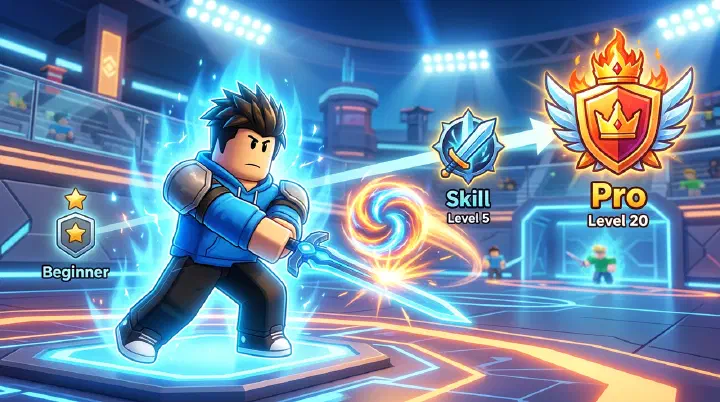
Scene: The Two Matches That Define Everything
You queue into Blade Ball for the first time. The countdown hits zero. A ball materializes in the center of the arena, drifts toward a player across from you, and they bat it back. It comes to you. You press the block button. You miss. The ball clips your shoulder and you evaporate. The entire exchange took eleven seconds. You don’t even know if you swung too early or too late.
One hundred matches later, you’re different. You see the white flash around your character. You deflect at deflection 6 with your eyes closed — not because you’re good, but because your hands finally trust the cue. You survive until there are three players left. Then you lose anyway. The opponent who wins doesn’t have better reflexes. They positioned themselves where you weren’t looking. They saved their ability for the exact moment you burned yours. They played a different game than the one you practiced.
That gap — between surviving and winning, between reacting and deciding — is the entire journey from beginner to pro. Most guides teach you how to block. This guide teaches you the progression: what to learn first, why you will stall at deflection 5, how to think in deflection 8+ lobbies, and the competitive mindset that turns a player who can block into a player who can’t be beaten.
Failure Analysis: Why Players Stall at Every Phase
Blade Ball has four distinct failure walls. Hitting one doesn’t mean you’re bad — it means you’ve outgrown your current approach and haven’t switched to the next one yet.
Phase 1: The Panic Wall (Matches 1–30)
New players don’t die because they lack reflexes. They die because their brain treats the ball as a threat instead of a rhythm cue. The result is a cascade of bad decisions: you swing at the ball’s position instead of the flash, you burn your ability the instant you feel unsafe, and you drift to the edge of the arena because the center feels exposed.
The panic wall is emotional, not mechanical. Your reaction time is fast enough to block deflection 3 cleanly on your first day. The problem is that waiting feels like dying. So you swing early. The early swing whiffs. The whiff kills you. Then you conclude “I’m too slow” instead of “I’m too eager.”
The fix: Play your first 20 matches with one rule — do not use your ability at all. Just block. Die at deflection 4. Die at deflection 5. Each death trains your eyes to wait for the flash instead of chasing the ball. Ability usage is a crutch that delays this lesson.
Phase 2: The Illusion of Skill (Matches 30–100)
You can flash-block now. You survive to deflection 6 regularly. You bought Infinity and it saved you twice. You feel like you understand the game.
You don’t. What you have is mechanical repetition in a narrow band of situations. You haven’t played against someone who reads your deflect angle. You haven’t faced a lobby where three players intentionally bounce the ball off walls to curve its trajectory. You don’t track opponent cooldowns because you’ve never needed to — casual lobbies let you survive on mechanics alone.
The illusion of skill is dangerous because it feels like progress. You play 50 matches doing the same thing, and your win rate stays flat at 15%. You tell yourself you’re “grinding.” You’re not. You’re rehearsing a script that stops working the moment an opponent adapts.
The fix: After every death, ask one question: “Did I die because my timing failed, or because my decision failed?” If it’s timing, practice. If it’s decision — wrong angle, bad positioning, ability used too early — that’s your real bottleneck.
Phase 3: The Ranked Wall (First 50 Ranked Matches)
Ranked mode is not casual with a scoreboard. The ball accelerates faster because players deflect more consistently. Opponents don’t just react — they predict. The psychological weight of losing MMR makes you play 10-15% worse than your true skill level without you noticing.
The ranked wall hits when your casual habits become liabilities. In casual, center positioning is “safe.” In ranked, center positioning makes you the closest target to four players who angle their deflects toward the nearest body. In casual, saving your ability is “smart.” In ranked, holding Infinity for six deflections while an Aggressor chains bounces off walls means you never got to use it.
The fix: Play ranked exclusively for two weeks. Accept that your first 30 ranked matches will have a negative win rate. You are paying tuition to learn how the game is actually played under pressure.
Phase 4: The Predictability Plateau (Gold to Diamond)
At this level, your mechanics are solid. You can flash-block to deflection 8. You know the maps. You die because your opponents know what you will do before you do it.
The predictability plateau manifests in three ways. First, you deflect toward the same angle every time — usually center or the nearest player — and better opponents pre-position to intercept your return. Second, you use your ability at the same deflection count every match (deflection 4 for Infinity, deflection 5 for Dash) and opponents time their aggression to the moment your ability is on cooldown. Third, you position the same way in every round — center at spawn, retreat to edge at deflection 6 — and opponents don’t even need to read you; they just aim at your spot.
The fix: Intentionally vary one thing every match. Deflect left instead of center. Use your ability at deflection 3 instead of 5. Start at the edge and move center instead of the reverse. The goal isn’t to find a new “best” pattern — it’s to prove to yourself that you can break your own habits when the opponent demands it.
The Skill Progression Ladder: What to Learn in What Order
Blade Ball rewards sequential learning. Skipping steps creates gaps that show up later as mysterious deaths.
Step 1: Flash Recognition (Hours 1–5)
Before you learn abilities, maps, or positioning, you must internalize the flash. The white ring around your character when the ball enters parry range is the only cue that works at every speed. Everything else — ball color, sound, opponent animation — becomes unreliable past deflection 4.
Practice method: Stand still in a lobby. Let the ball come to you. Block only when you see the flash, not when you think the ball is close. Ignore whether you die. You’re training your visual cortex, not your win rate.
Step 2: Spacing Awareness (Hours 5–15)
Once you can block on flash, you need to stop putting yourself in positions where blocking is impossible. The edge of the arena is a trap — walls reduce escape routes and make deflect angles predictable. The center is also a trap if three players are there. The correct distance is 10-15 studs from the nearest player, adjusted dynamically as players die.
Step 3: Ability Timing (Hours 15–30)
Abilities are not panic buttons. They are investments with cooldowns. Infinity is a safety net, but if you use it at deflection 2 because you panicked, you don’t have it at deflection 6 when the ball is actually dangerous. Dash is an escape tool, but if you dash when the ball is already aimed at you, the recovery animation kills you.
The rule: use defensive abilities when the ball targets you at deflection 5+. Use mobility abilities when you are cornered before the ball is aimed. Using them earlier is a mistake even if you survive the exchange.
Step 4: Angle Control (Hours 30–60)
Where you deflect the ball matters more than whether you deflect it. A deflect toward center puts the ball in play for eight players. A deflect toward an edge narrows the return angle to one player — and if that player dies, the ball bounces unpredictably off the wall.
Learn two angles: the “safe angle” (toward open space, no players nearby) and the “pressure angle” (toward a specific player who is cornered or ability-less). Beginners should default to safe angles. Intermediate players should learn when to apply pressure.
Step 5: Prediction and Pre-Swing (Hours 60+)
At deflection 8+, the ball moves too fast for reaction. You must predict where it will be and swing before it arrives. This is not guesswork — it’s pattern recognition based on the ball’s last trajectory, the arena geometry, and the opponent’s body angle.
Pre-swinging feels wrong. It feels like you’re swinging at air. But at high deflection counts, the player who waits to see the ball is already dead.
Decision Framework: How to Think at Each Stage of a Match
Mechanics get you to deflection 6. Decisions get you to the win screen. Here is the framework pros use, broken down by match phase.
Early Game: Deflections 1–3 (Information Phase)
Your goal is not to kill anyone. Your goal is to gather data while staying alive.
- Deflect toward open space, not players. Aggressive early deflects tell the lobby you’re a threat, which makes you a target.
- Watch who uses their ability early. Anyone who burns Infinity or Dash in the first three deflections is vulnerable later. Mental note their name and skin.
- Check your own positioning every 5 seconds. If you’re within 8 studs of a wall, move. If two players are closer than 10 studs to you, create distance.
- Do not pre-swing. The ball is slow enough to react to. Save your prediction for later.
Mid Game: Deflections 4–6 (Pressure Phase)
The ball is now fast enough that mistakes are fatal. Half the lobby is usually dead by deflection 5. Your decisions here determine whether you’re in the final three.
- Switch to flash-only blocking. Do not track the ball’s position. Track only the flash.
- Use your ability if cornered or targeted at deflection 5+. If neither condition is true, hold it.
- Start angling toward players who used their ability early. They have no safety net. One well-placed deflect and they’re out.
- If the ball is bouncing off walls, move to the bounce destination before the ball arrives. Do not chase the ball’s current position.
Late Game: Deflections 7+ (Prediction Phase)
Only 2-4 players remain. The ball is nearly instant. This is where game sense separates winners from survivors.
- Pre-swing based on trajectory, not reaction. If the ball is coming from your left at a shallow angle, the next deflect will likely return left. Position your blade before the flash.
- Never dash unless you are already targeted. Dash recovery is a death sentence at this speed. Only use it to escape a confirmed targeting.
- Control the center. At high deflection counts, the player with the most escape routes wins. Edges reduce your options by 50%.
- If you have an ability and your opponent doesn’t, play aggressively. Force exchanges. They cannot afford a mistake; you can.
Competitive Mindset: The Meta-Game
In ranked and tournament play, you’re not just playing the ball — you’re playing the opponent’s expectations.
- Round one is a data round. Play conservatively. Watch their deflect angles, ability timing, and positioning habits.
- Round two is an adaptation round. Change one thing you did in round one that they punished. If they read your center deflects, aim edge. If they baited your Infinity, hold it one deflection longer.
- Round three is a mental round. Both players know each other’s tricks. The winner is the one who doesn’t default to their comfort play under pressure.
- Between rounds, reset completely. Treat every point as a new match. The player who carries frustration from round one into round two loses 20% of their decision quality without noticing.
Counter-Intuitive Truths That Separate Good Players from Great Ones
Most Blade Ball advice sounds logical and is wrong. Here are the truths that break conventional wisdom.
1. Dying Fast Teaches You Faster Than Surviving Long
The player who dies at deflection 2 thirty times in a row learns more than the player who survives to deflection 6 by running away. Fast deaths expose your decision errors immediately — bad angle, bad positioning, panic swing. Long survivals in bad lobbies reward passive play, which becomes a habit that ranked opponents punish. If you aren’t dying within the first 30 seconds of a practice lobby, you’re not pushing your boundaries.
2. Defensive Abilities Make You More Aggressive, Not Less
Beginners think Infinity and Force Field are “coward” abilities. The opposite is true. A player without a safety net must play scared — they stay far from the ball, deflect to safe angles, and retreat to edges. A player with Infinity can stand in the center, deflect toward dangerous players, and trust their shield to cover one mistake. The best Aggressors in Blade Ball are almost always running defensive abilities because defense enables risk.
3. At High Level, Standing Still Is Often Safer Than Dashing
Dash has a 0.5-second recovery window where you cannot block. At deflection 7+, that window is longer than the ball’s travel time. Pro players dash preemptively — before the ball is aimed — or not at all. A player who stands still in the center with their blade ready is harder to kill than a player who dashes randomly and gets caught in recovery. The counter-intuitive move is to trust your block more than your feet.
4. Ranked Losses Are Worth More Than Casual Wins
A 30-minute ranked session where you go 2-8 teaches you more than a 30-minute casual session where you go 8-2. Ranked opponents exploit your habits. Casual opponents let you get away with lazy positioning and predictable angles. Every ranked loss is a diagnostic tool. Every casual win is a rehearsal of skills you already have. If your goal is to improve, ranked is the only lobby that matters.
5. The Ball Speeds Up, But Your Reaction Should Slow Down
As deflection count rises, new players panic harder. Their swings get earlier and sloppier. Pro players do the reverse — they get calmer. At deflection 8, there is no time to think, so they rely on pre-positioning and pattern memory instead of reactive flailing. The mental shift from “faster ball = faster reaction” to “faster ball = earlier prediction” is the defining breakpoint between intermediate and advanced play.
Common Progression Mistakes (And What to Do Instead)
| Mistake | Why It Feels Right | Why It Kills You | Fix |
|---|---|---|---|
| Buying a mobility ability first | “I need to dodge” | Beginners don’t know WHEN to dodge; they die in recovery frames | Buy Infinity first; learn spacing before movement |
| Grinding casual for “confidence” | “I want to win before I try ranked” | Casual habits become ranked liabilities | Play ranked after 15 casual matches; accept early losses |
| Swinging at the ball, not the flash | “I need to react to what’s coming” | Past deflection 4, visual tracking is too slow | 10-minute flash-only drill in private lobby |
| Always deflecting toward center | “Center is safe” | Center deflects put the ball in play for everyone; you become a target | Mix edge deflects and safe angles |
| Using ability on cooldown | “I should get value from my purchase” | Abilities used early aren’t there when you need them at deflection 6+ | Only use ability when cornered or targeted at deflection 5+ |
| Chasing the ball | “I want to control the exchange” | Chasing puts you in bad position and predictable angles | Move to where the ball WILL be, not where it IS |