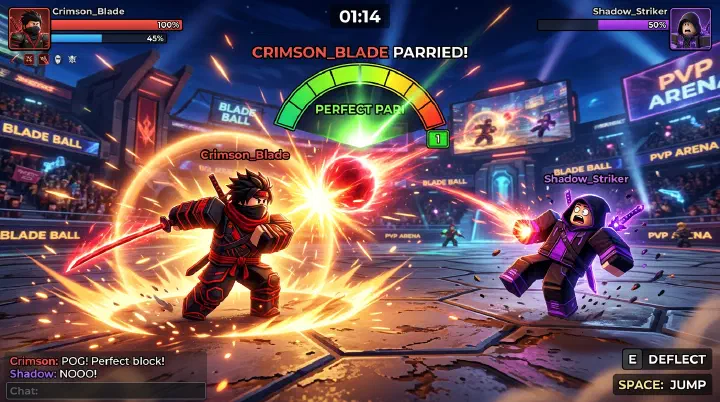
It’s the final 1v1. The lobby’s watching. The ball is screaming back at you at speed tier 7, your opponent just curved it inside-out, and you’ve got the deflect cooldown ready. You see the glow. Your finger hovers over F. The ball fills your screen. You press.
You’re dead.
The kill feed says you deflected 0.2 seconds late. Not because your finger was slow. Not because your monitor lagged. You pressed F when the ball looked like it was on you — and that’s exactly the problem. By the time it looked on you, the server had already registered the hit. You died on your client after you were already dead on the server. That half-second of disbelief? That’s the lag gap eating you alive.
Your opponent wasn’t faster. They didn’t have better gear. They just knew that in Blade Ball, you don’t deflect what you see. You deflect what’s about to happen. The difference between their press and yours wasn’t reflexes. It was calibration.
This guide is the frame data, the ping math, and the rhythm training that fixes that exact moment. If you’re stuck in the 30%-win-rate purgatory where you “know what you’re doing” but keep losing, your timing window is the only thing left to fix.
Failure Analysis: The Three Ways This Exact Death Happens
That 0.2-second death isn’t random. Every time it happens, it falls into one of three specific failure chains. Knowing which one killed you is the only way to fix it.
Failure Chain A: The Visual Lie (most common, ~60% of deaths) You react to the ball’s rendered position instead of its server position. At 80ms ping, the ball you see is almost a full frame behind reality. You press F “on contact,” but contact happened 160ms ago after round-trip. Your deflect animation starts just as the server registers the hit. You see yourself deflect; the server sees you die. This is the “I pressed it!” death, and it is purely a calibration error.
Failure Chain B: Model Confusion (~25% of deaths) You’re using visual reaction (Model 3) in a tier-7 fight that demands pure prediction (Model 1). You “feel” like you’re reacting, but the window closed before your brain even processed the image. These deaths feel unlucky because your timing looks right on replay. It isn’t. You brought a low-tier brain to a high-tier fight.
Failure Chain C: Input Lockout (~15% of deaths) You panic-spammed F during the ball’s flight, or you pressed F while still in a movement animation. The client queued your input, but the server ignored it because you were in recovery frames. These deaths feel like the game “didn’t register” your press. It registered it — it just arrived while you were technically unable to act.
Map every death to A, B, or C for ten fights. Most stuck players are dying from A and B in a 70/30 split. Fixing A requires ping calibration. Fixing B requires admitting you can’t react and switching to prediction.
Why Your Reactions Aren’t the Problem
Most players blame their reflexes. “I’m too slow.” “My reactions are bad.” This is almost never true.
Average human visual reaction time is about 250ms. Top esports pros sit around 180ms. Blade Ball’s deflect window is roughly 200-300ms depending on speed tier. So in theory, you have time. The problem isn’t your reaction — it’s that you’re reacting to information that’s already stale.
Here’s what actually happens when the ball comes back at you:
- The server sends ball position to your client
- Your client renders the ball, with delay equal to your ping
- You see the ball, brain processes it (~250ms)
- You press F, input travels to server (ping again)
- Server checks if you deflected during the active window
If your ping is 80ms, the ball you see is 80ms in the past, and your input arrives 80ms in the future. That’s 160ms of round-trip delay before reactions even start. Add 250ms reaction time and you’ve burned 410ms — but the deflect window is only 200-300ms.
Math says you can’t react. You have to predict.
This is the core mistake every stuck player makes: they practice reacting faster, when they should be practicing predicting earlier. Watching slow-motion clips, doing reaction-time browser tests, lowering graphics — none of this fixes the gap. You’re optimizing the wrong variable.
For the bigger picture of how speed scaling makes this worse, the speed and curve guide breaks down why a tier-6 ball gives you ~210ms windows while tier-9 drops to ~140ms. At high speed tiers, reaction is mathematically impossible. Only prediction works.
The Three Timing Models (Pick One Per Clash)
Every deflect attempt falls into one of three timing models. Mixing them up is what kills you.
1. Pure prediction (high ping or high speed tier) You press F before the ball is “on you” by a fixed offset. You’re not reacting — you’re firing on a clock. This is the only viable model when ping is over 100ms or the ball is past speed tier 7.
2. Audio-trigger reaction (medium ping, medium speed) The ball makes a distinct whoosh that’s tied to its proximity, not its visual position. Audio reaches your ears slightly before your eyes catch up to the visual frame, and audio reactions are ~140ms vs ~250ms visual. Mute your music. Crank ball SFX to max.
3. Visual reaction (low ping only, sub-tier 5) This is the only model where you can deflect what you actually see. Below speed tier 5 with sub-50ms ping, the window is wide enough that visual works. Almost no real fight stays in this zone for long.
The mistake: most players try to use model 3 in situations that demand model 1. They feel like they’re “reacting wrong” when they’re actually using the wrong model entirely.
Frame Data You Actually Need
Forget memorizing every ability. Memorize the clash windows. Here’s what matters when two players hit deflect at overlapping moments:
- Standard deflect active frames: ~12 frames (200ms at 60fps)
- Forcefield deflect active frames: ~18 frames, but 3-second cooldown
- Super deflect active frames: ~24 frames, 8-second cooldown
- Telekinesis active frames: ~15 frames, plus pull animation
- Ghost dash recovery: ~30 frames where you can’t deflect
The danger zone: when both players have similar deflect windows, whoever pressed earlier in their window wins the next clash because the ball returns slightly faster. Pressing on the first frame of your active window beats pressing on the last frame, even though both technically deflect.
This is why the ability combos and synergy guide emphasizes opening with utility before going to deflect — you want to force your opponent to burn their long-cooldown super deflect first, then clash with your standard deflect against their standard deflect, where your timing decides it.
The Ping Compensation Trick
Here’s the technique nobody teaches, because it sounds wrong: press F when the ball is one body-length away from you, not when it’s on your model.
The exact offset depends on your ping. Rough numbers:
- 30ms ping: deflect at ~0.3 body-lengths away
- 60ms ping: deflect at ~0.7 body-lengths away
- 100ms ping: deflect at ~1.2 body-lengths away
- 150ms+ ping: deflect at ~2 body-lengths away (almost feels too early)
The trick to calibrating this: go into a private server, get a ball at speed tier 5, and deliberately deflect “too early” until your character actually returns the ball. Note where the ball was when you pressed. That’s your offset. Reproduce it.
Most players never do this calibration. They assume Roblox’s lag compensation handles everything. It doesn’t — it gives you a window, but not a generous one. You have to find your personal pre-press distance.
The Counter-Intuitive Advice Everyone Gets Wrong
Standard Blade Ball advice says: “Watch the ball, react when it’s on you.” High-rank players do the opposite on almost every axis. Here are the three that matter most.
1. Don’t watch the ball. Watch your opponent. This sounds insane until you try it. The ball’s trajectory between deflects is determined by the deflecter’s character — their angle, their movement, their position when they pressed. If you’re staring at the ball, you only have ~200ms to read its arc. If you’re staring at your opponent’s character at the moment they deflect, you can predict the arc before the ball even moves.
Specifically:
- Their character’s facing angle = curve direction
- Their movement at deflect = curve magnitude
- Their ability cooldown bar = whether super deflect is up
- Their stamina bar = whether they can dash-cancel
You read all of this in the half-second before the deflect, not after. By the time the ball is moving toward you, you already know which direction it’s curving and where to position. The deflect press itself becomes the easy part.
This connects directly to the opponent reading guide, which goes deeper into character tells. The deflect is the output. The read is the real fight.
2. Stand still. Movement makes your window smaller. Every instinct says “keep moving so you’re harder to hit.” But dashing or walking toward the ball adds recovery frames before your deflect activates. Standing still gives you the full ~200ms active window. Dashing cuts it by 20-40ms. In a tier-7 clash, that’s the difference between a clean return and a death. Position before the deflect, not during it. Plant your feet, press F, then move.
3. Practice at tier 5, not tier 9. Harder practice feels like better practice. It isn’t. Tier 9’s ~110ms window is too fast for your nervous system to encode a reliable rhythm. You just panic and reinforce bad habits. Tier 5’s ~280ms window is wide enough to learn the pattern, but fast enough to matter. Master the rhythm at tier 5, and your subconscious will compress it naturally as speed scales in real fights. Deliberate practice beats desperate survival.
Decision Framework: Which Model, When
Every clash is a decision tree. Stop guessing and run the checklist.
Step 1: Read the speed tier
- Tier 1-5: Audio or visual reaction is viable.
- Tier 6-7: Switch to prediction or audio only.
- Tier 8+: Pure prediction or rhythm. No exceptions.
Step 2: Check your ping
- Sub-50ms: You can use visual reaction up to tier 5.
- 50-100ms: Audio reaction up to tier 6, prediction beyond.
- 100ms+: Pure prediction at every tier. Your visual data is too stale.
Step 3: Commit or disengage If the ball is coming at a bad angle and you’re unsure of the timing, do not deflect. Dash out. A missed deflect is a death. A burned dash is just cooldown. The decision framework only works if you apply it to clashes you choose to take.
Step 4: Post-clash reset After every deflect — successful or not — re-check your opponent’s ability bar and stamina. Did they burn super deflect? Did they dash? The next clash’s model depends on their cooldown state, not just the speed tier.
Run this mentally for one session and the guesswork disappears. You’ll stop “hoping” your timing is right and start knowing which model you’re in.
Rhythm Training Method (Replaces Reaction Drills)
Reaction-time websites are useless for Blade Ball because reaction isn’t the bottleneck. Instead, train rhythm.
The drill:
- Get into a 1v1 private server with a friend or alt account
- Set speed to scale to tier 5 only (not infinite)
- Have your partner serve the ball back at the same angle 20 times in a row
- Press deflect on the same beat each time — count “one-and-two-and-deflect” out loud
- After 20 reps, swap to a different angle, repeat
What this trains: your nervous system learns the temporal pattern of “ball leaves opponent → ball arrives at me.” Once that interval is encoded as rhythm rather than reaction, you stop needing visual confirmation. You press on the beat.
Pros do this without realizing it. They’re not reacting to ball-on-character. They’re feeling the beat of the rally and pressing on count. That’s why they look “robotic” — they literally are running on internal metronome.
Spend 30 minutes a day on this for a week. Your win rate will move more than any ability change.
What Speed Tier Does to Your Window
The deflect window doesn’t scale linearly with speed. It compresses on a curve:
- Tier 1-3: ~400ms window (anyone can deflect)
- Tier 4-5: ~280ms window (visual reaction works)
- Tier 6: ~210ms window (audio reaction needed)
- Tier 7: ~170ms window (prediction only)
- Tier 8: ~140ms window (rhythm only)
- Tier 9+: ~110ms window (pre-press required)
Most ranked fights end before tier 7. Most public-server clown fights extend past tier 8 because nobody finishes anyone. If you’re stuck at low ranks, your fights are probably ending earlier than you think — meaning you’re losing in tier 5-6 territory, where audio reaction should be enough. That’s a calibration problem, not a skill ceiling.
The ranked climbing decision guide has more on which speed tiers actually decide ranked games. Spoiler: it’s almost always tier 6.
Common Mistakes That Burn Your Window
A short audit list. If you’re doing any of these, fix them before grinding more:
- Holding F instead of tapping (reduces effective window by 30-40ms on some clients)
- Spamming F mid-ball-flight (locks you out of the actual active frame)
- Deflecting while moving toward the ball (your character has to stop first, eating frames)
- Deflecting mid-jump (recovery animation overlaps with active frames)
- Using deflect while another ability animation is playing (queues up but loses priority)
The hold-vs-tap thing trips up tons of players coming from other parry games. Blade Ball treats hold and tap differently in some patches. Always tap. Always single press.
For the underlying input timing system, the mechanics glossary covers active frames, recovery frames, and input buffering in detail.
The 30-to-80 Win Rate Path
Here’s the order of operations that actually moves your win rate:
- Calibrate your ping offset (one private server session, one hour)
- Mute music, max ball SFX (one settings menu trip)
- Train rhythm at tier 5 (30 minutes a day for one week)
- Switch focus from ball to opponent character (this takes two weeks to feel natural)
- Memorize the three timing models and pick one per clash (ongoing)
- Stop deflect-spamming (the hardest habit to break)
Most players skip 1, 4, and 6. Those three alone are worth ~25% win rate.
For new players still learning the basics, the beginner guide covers movement and ability fundamentals before timing. Don’t grind timing if your spacing is off — bad spacing means even perfect timing dies.
For mid-rank players ready for full optimization, the how to win guide ties timing into the broader fight game: positioning, ability cycle, mind games, and closing patterns.
The Honest Truth About Blade Ball
The skill ceiling isn’t your abilities, your gear, or even your reactions. It’s the gap between “what you see” and “what’s actually happening on the server.” Players who close that gap dominate. Players who don’t, plateau forever.
The good news: it’s a calibration problem, not a talent problem. Anyone with a working hand and 30 minutes a day can do it. The bad news: the calibration is invisible. You can’t watch a YouTube clip of someone deflecting and learn it. You have to feel the offset yourself.
Get into a private server today. Find your pre-press distance. Train rhythm at tier 5 for a week. Come back and watch your tier-6 clashes. The same ability load you have right now will start winning fights it used to lose, because you stopped dying 0.2 seconds before every clash.
That’s the whole game.