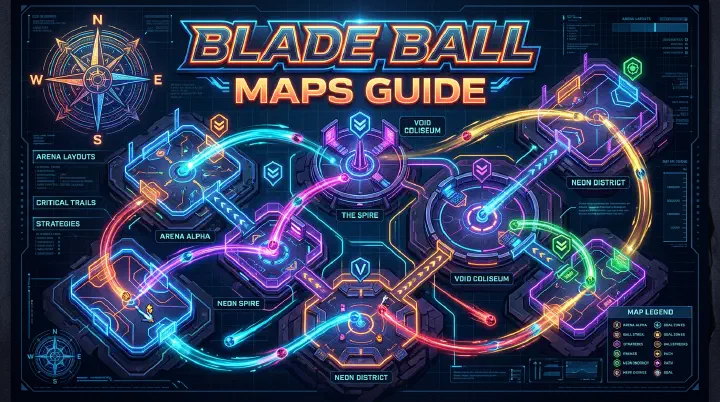
Last updated: June 21, 2026. Map-specific positioning framework, trail-ball interactions per arena, and a tier-based strategy that converts map disadvantage into match wins.
You’re on Factory. The Ball Just Did Something Weird
Round three. You’re on the Factory map. You’ve already lost twice this lobby to a teen who isn’t even that good — you can see them mis-clicking, panic-deflecting, eating their own dash. But somehow you keep dying first.
The ball locks onto you. You back-pedal toward the conveyor section, eye on the trajectory, finger ready. The ball hits the edge of a raised platform — not the wall, not the floor, the lip between them — and the bounce angle shifts maybe 15 degrees. Your deflect timer was calibrated for a clean wall bounce. You swing 80 milliseconds late. The blade clips through where the ball was, not where it is.
Dead.
You respawn into spectate mode and watch the teen finish the lobby on Sky Arena, a flat open map with no obstacles, no conveyor seams, no angle weirdness. They don’t get cornered. The ball just comes in clean, they deflect, the ball goes back. Easy.
That’s when it clicks. You’ve been losing about 60% of your Factory games for weeks. On Sky Arena, you’re around 55% wins. On Pirate Cove, you’re somewhere in the middle. You blamed your aim. You blamed lag. You bought a better sword skin. But the actual variable was the map all along — and you were treating it like background scenery.
This guide fixes that. Maps in Blade Ball aren’t wallpaper. They determine your deflect angles, your escape routes, which abilities save you and which ones get you killed. Your trail isn’t just cosmetic either — bright trails on dark maps make you a target priority for the ball’s AI homing logic in certain modes. Once you start playing the map instead of fighting it, the same skill level that lost on Factory starts winning on Factory.
Why Memorizing Maps Isn’t Enough
Here’s the trap most guides fall into: they hand you a map layout, label the safe zones, and act like that’s the job done. Memorization. Look at picture, remember picture, play better.
It doesn’t work. I’ve watched players who can draw every Blade Ball map from memory still get cornered on those exact maps in real matches. Knowing the layout is a prerequisite, not the skill itself. The actual skill is understanding how the map’s geometry interacts with three other systems running underneath the gameplay:
- Ball physics inheritance. The ball doesn’t bounce like a real-world ball. It inherits angle from the last surface it touched, then applies a homing correction toward the current target. On flat circular maps, that homing correction is small because the angle is predictable. On Factory or themed maps with raised seams, conveyor edges, or stepped platforms, the ball can bounce off geometry you didn’t even register as a surface — and the homing correction stacks on top of that, giving you a flight path that doesn’t match what you expected.
- Trail-arena contrast. Trails are visible to the ball’s targeting visual feedback. They don’t change hitboxes, but on a dark-themed map a bright Lightning Trail makes your position trivially trackable by other players spectating mid-deflect-chain. On a Sky Arena, that same trail blends into the bright backdrop and you become harder to track for human opponents trying to predict your dodge.
- Ability geometry dependence. Super Jump on a flat map is just a vertical hop with a slight delay. Super Jump on a map with elevation changes can put you on a platform the ball’s pathing didn’t account for, which is sometimes a free escape and sometimes a way to land in a corner you can’t dodge out of. Shadow Step’s teleport range is constant, but the useful destinations within that range vary wildly by map.
Memorizing the layout gives you a map of the building. Understanding these three interactions gives you a map of what your inputs actually do inside that building. The rest of this guide is the second map.
The Counter-Intuitive Thing Nobody Tells You About Map Positioning
Common advice says: “Stay in the center. The center has the best deflect angles, the most escape options, and the largest dodge space.”
That advice is wrong on at least three of the current map rotations.
The center is the best position only when the arena is symmetric, flat, and obstacle-free — the default 2026 map, basically. The moment you introduce geometry (Factory’s conveyors, Pirate Cove’s mast pillars, themed event arenas with elevation), the center becomes a liability. Here’s why: the ball’s homing correction is calibrated against the assumption that you’ll try to back away. When you sit in the center on a map with obstacles, every direction you can dodge has at least one piece of geometry the ball can use to take a weird bounce into you. You become a fixed point surrounded by deflectable angles, and the player chain dunking the ball into you has more options than you have escapes.
The counter-intuitive truth: on geometry-heavy maps, position yourself one-third to one-half of the way from center to edge, on the side opposite the densest geometry. You give up some dodge space, but you gain something more valuable — predictable bounce angles, because the side you’re facing has clean wall instead of a conveyor seam. Your reactions get faster because you stop having to compute weird geometry, which means your deflect window is calibrated correctly for the actual angles you’ll see.
Most players who finally break through 50% win rate on Factory do it by deliberately giving up the center. The center looked safe. It wasn’t.
The 2026 Default Map: Flat, Symmetric, and Where Center Actually Works
The current default arena is the simplest map in the rotation, and that simplicity is the entire reason it’s used as the standard tournament map.
What it looks like:
- Circular flat arena with no elevation changes.
- Slightly larger than the 2025 map, giving more reaction time.
- Transparent or lightly tinted boundary walls so you can see the ball through the wall geometry.
- No obstacles, no conveyors, no platforms, no decorative pillars.
- Clear edge markers — you know exactly when you’re at the perimeter.
What that means for your positioning:
- Dead center is genuinely the best spot. All directions are equivalent escape routes, so the ball’s homing correction has no geometry to bias the bounce. Your deflect window is calibrated against pure wall angles, and pure wall angles are what you get.
- The inner ring (25-40% from center) is the next-best zone. Slight tradeoff: you’re a less obvious target, but you give up some dodge options. Use this when you’re in a lobby with one player who’s clearly targeting you specifically.
- The mid-range (40-70% from center) is fine for casual but bad for ranked. Enough room to dodge, not enough room to recover from a misjudged deflect.
- The edge and corner zones are death traps. Limited dodge directions, the wall reduces your options on one side, and any deflect chain ending here will trap you. Use abilities to escape immediately — don’t try to deflect your way out.
The 2026 map is where you go to test your raw deflect skill. Strip out the map-specific weirdness and what’s left is just timing. If you can’t win on the 2026 map, you don’t have a map problem — you have a fundamentals problem, and that’s a different guide. (Start with the Blade Ball Beginner Guide if that’s you.)
Map Tier List by Geometry Complexity
Here’s where I’ll keep a comparison table, because comparing maps side-by-side is genuinely what reference tables are for:
| Map | Geometry | Center Viability | Best Position | Skill Floor |
|---|---|---|---|---|
| 2026 Default | None — flat circle | Excellent | Dead center | Pure fundamentals |
| Sky Arena | Minimal — slight raise on edges | Good | Center or inner ring | Low — forgiving |
| Pirate Cove | Moderate — mast pillars, plank seams | Medium | Inner ring opposite densest pillar | Medium |
| Factory | Heavy — conveyors, raised platforms, seams | Poor | One-third out, clean-wall side | High |
| Themed Event Arenas | Variable | Variable | Scout first match, then commit | Depends |
The pattern: as geometry complexity rises, the value of the center drops, and the value of knowing which side of the map is the clean-wall side rises. On Factory, the south wall is geometrically the cleanest — fewer raised seams, more consistent bounce angles. Position yourself between center and south wall, facing north, and most of the ball’s incoming trajectories will arrive on predictable angles.
Map-Specific Ability Choices
Your ability loadout should change with the map. Most players run the same loadout every match and wonder why some maps feel impossible.
On flat maps (2026 Default, Sky Arena):
- Infinity is at its best — pure deflect mode with no geometry interfering.
- Super Jump is wasted slot — no elevation to exploit.
- Shadow Step is great for repositioning to center if you get knocked out.
- Dash is reliable because there’s no platform edge to clip on.
On medium-geometry maps (Pirate Cove):
- Shadow Step jumps to the top of value — teleporting past a pillar is a free reset.
- Super Jump finally has a use, putting you above pillar-level for a brief escape window.
- Infinity is still solid but you’ll need to track ball-through-pillar angles.
- Force Field is useful for the moment you get cornered against a pillar.
On heavy-geometry maps (Factory):
- Platform becomes shockingly strong — you spawn a platform on top of a conveyor seam and the ball’s bounce angle off your platform is now clean.
- Death Slash is risky because the ball can bounce off a seam mid-slash.
- Super Jump is your panic button — most platforms on Factory have valid landing spots.
- Dash gets you in trouble — easy to dash straight into a raised platform edge.
For deeper ability analysis, see the Blade Ball Abilities Tier List. The tier list assumes the 2026 default map; on other maps the ranking shifts as described above.
Trails: What They Actually Do (and What They Don’t)
Trails are sold as pure cosmetics. That’s about 90% true. Here’s the 10% that matters:
- Trails don’t change hitboxes, cooldowns, or ball damage. Anyone who tells you a specific trail “deflects better” is wrong.
- Trails affect human opponent tracking. A bright Lightning or Fire trail on a dark-themed map (Factory, Halloween event variants) makes your sword’s swing arc visually trackable, which means deflect-chain opponents can read your swing timing slightly faster.
- Trails affect your own perception. A heavy, fast-moving trail like Phoenix or Void can mask your own swing arc in your peripheral vision. Some players actually deflect better with the default trail because the visual feedback is cleaner.
- Trails don’t affect the ball’s homing AI. This is a persistent myth. The ball homes on player position, not trail visibility.
Quick acquisition summary by tier:
- Free starting kit: Default Trail. Always equipped if you’ve equipped nothing else.
- Cheap upgrades (500-1,200 coins): Lightning Trail, Shadow Trail. Both reasonable first purchases.
- Mid-tier (1,500-2,500 coins): Rainbow Trail, Galaxy Trail. More visually distinctive without breaking the bank.
- Prestige (2,000-3,000 coins or event-locked): Golden Trail, Crystal Trail. These signal you’ve put serious time in.
- Legendary (event/tournament locked): Phoenix Trail, Void Trail. Phoenix returns sometimes; Void typically requires tournament placement.
- Code-redemption trails: Bubble Trail and similar. Check Blade Ball Codes Guide for whatever’s currently active.
If you’re picking a trail purely for performance, pick a dim trail on dark maps (so you’re harder to track) and accept a bright trail on light maps (you’re trackable anyway, might as well look good).
Sword Skins: Same Story, Mostly Cosmetic
Sword skins have the same caveats as trails — no hitbox or cooldown change. But two skin-specific notes worth knowing:
- Thin-blade skins (Phantom, Crystal Katana) are harder for opponents to visually parse mid-swing. Same hitbox, but the visual representation of your swing arc is thinner, so timing prediction by humans gets slightly harder. Not a huge edge, but it’s real.
- Bright/glowing skins (Neon, Lightning, Fire) make your swing arc easier to read. On a stream or competitive lobby, this is a small but actual disadvantage.
Quick acquisition tiers:
- Free / starting: Default Blade.
- Affordable purchase (1,000-1,800 coins): Golden Blade, Lightning Blade, Neon Blade. Good starter prestige.
- Mid-cost (1,500-2,200 coins): Fire Blade, Ice Blade, Shadow Blade, Phantom Blade. Phantom Blade is a sleeper pick for the visual-parsing reason above.
- High-cost (2,000-3,000 coins): Diamond Blade, Crystal Katana, Dragon Blade. Diamond Blade is the “I bought this with my own coins” prestige item.
- Code/event/tournament only: SPARKLERR Blade, Bubble Wand Sword, Serpent Katana, Void Blade. SPARKLERR and Bubble Wand are milestone-locked and unlikely to return.
If you’re trying to spend efficiently: Phantom Blade if you’re competitive, Golden Blade if you want visible prestige cheap, hold out for the next code redemption window for legendaries.
Event-Exclusive Cosmetics and the Calendar That Matters
Event cosmetics are the only items in Blade Ball that genuinely become unobtainable. Don’t sleep on these.
The recurring seasonal events:
- Summer Event (June-August) — Fire Trail, Fire Blade, Summer Title. Returns each year, so missing one year isn’t fatal.
- Halloween Event (October) — Shadow Trail variants and a Halloween-themed sword skin. Returns yearly.
- Winter Event (December-January) — Ice Trail, Ice Blade, Holiday Title. Returns yearly.
- Anniversary Event (variable) — Anniversary-exclusive trails and blades. Different rewards each year, so missing one means missing that specific cosmetic permanently.
The one-time milestone events:
- 4BVISITS milestone — Bubble Wand Sword via code. Code is likely dead now.
- 5BVISITS milestone — SPARKLERR Blade via code. Same status.
- SERPENT code — Serpent Katana. Periodically reactivated.
Tournament-locked items (Void Trail, Void Blade) come back whenever community tournaments cycle, so they’re rare but not gone forever.
Three practical rules for event cosmetic farming:
- Play within the first week of the event. Some rewards have completion-rate dependent unlock thresholds. Early-week players hit them faster.
- Check codes daily during events. Event codes often expire faster than seasonal codes.
- Save coins before the event starts. Event shops sometimes sell exclusive items for coins, and running out mid-event is a guaranteed regret.
Standout Cosmetic Combos by Budget
If you’ve made it this far and just want recommendations:
- Free legendary route: Whatever code is currently active (check Codes Guide) + Bubble Trail if still redeemable. Zero coins, maximum prestige if you catch the codes alive.
- Budget combo (~1,500 coins): Lightning Trail + Golden Blade. Cohesive electric/gold theme, affordable, looks intentional.
- Mid combo (~3,000 coins): Rainbow Trail + Diamond Blade. Colorful and clean, mid-range investment.
- Prestige combo (5,000+ coins): Golden Trail + Dragon Blade. Read clearly as “I’ve been playing forever.”
- Legendary endgame combo: Phoenix Trail + Dragon Blade (“Phoenix Rising”). Fire-themed and instantly recognizable in a lobby.
- Stealth/competitive combo: Default Trail + Phantom Blade. Hard for opponents to read your swing, almost invisible on Factory’s dark theme.
Frequently Asked Questions
Do trails or sword skins affect gameplay?
No direct effect — same hitboxes, same cooldowns, same mechanics. Indirect effect on human opponent tracking is real but small (bright trails/skins are slightly easier for opponents to read).
What’s the best map for new players?
The 2026 default map. No geometry, predictable bounces, pure fundamentals practice. If you’re struggling on themed maps, drop back to default-map lobbies to rebuild your timing.
Is the center always the best position?
No. On the 2026 default and Sky Arena, yes. On Factory and other geometry-heavy maps, position one-third to one-half out, opposite the densest geometry. The center becomes a target sink when there are bounce-angle surprises around you.
How do I get SPARKLERR Blade now?
You probably can’t. The 5BVISITS code is long expired. Check current codes anyway via Blade Ball Codes Guide in case of a reactivation.
Should I prioritize cosmetics or abilities with my coins?
Abilities first, every time. Cosmetics are pure flair. Strong ability loadouts win matches and earn more coins for cosmetics later. See Abilities Tier List for purchase order.
Will the maps change in 2027?
Based on the annual pattern (2024 → 2025 → 2026), probably yes. Expect a refined version of the current default — slightly larger, marginally cleaner visuals, same underlying physics. Themed event variants will continue to introduce geometry challenges.
How many trails and sword skins are there total?
Roughly 12+ trails and 15+ sword skins as of mid-2026, with new additions per event cycle. The full count keeps drifting upward.
Are event cosmetics ever coming back?
Seasonal ones (Fire, Ice, Halloween-themed) return yearly. Milestone-locked ones (SPARKLERR, Bubble Wand) are essentially gone. Tournament items return with tournaments.
How do I equip cosmetics?
Customization menu in the lobby. Select the trail or sword skin, confirm, it persists across matches until you change it.
Next Steps
- Blade Ball How to Win Guide — Advanced positioning, deflect-chain reads, and ability-timing combos.
- Blade Ball Game Modes Guide — Mode-specific strategy for Classic, 1v1, Team, and Event modes.
- Blade Ball Abilities Tier List — Every ability ranked, with notes on map-specific value.
- Blade Ball Beginner Guide — Fundamentals walkthrough if you’re losing on the default map.
- Blade Ball Codes Guide — Active codes for free cosmetics and coins.
Disclaimer: This guide reflects Blade Ball as of June 2026. Map rotations, cosmetic availability, trail and sword skin pricing, and event schedules can change with game updates. Event-exclusive cosmetics may or may not return. Always cross-check with the official Blade Ball Wiki and community Discord for current state.
Sources: