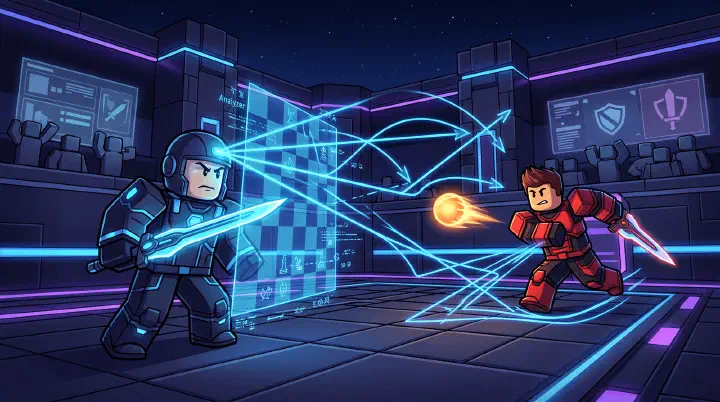
You queue into a 1v1. The countdown hits zero. Your opponent — default skin, basic sword, no aura — stands perfectly still on the other side of the arena. First deflection: they send the ball straight at you. You block, return it. Second deflection: same direction, same timing. Third deflection: you predict it before they swing. You’re already moving when the ball leaves their blade. It comes exactly where you expected. You slam it past them for the win.
That’s not luck. That’s reading.
But here’s the part that separates Diamond from the rest: most players don’t know they have patterns. The Aggressor thinks they’re being unpredictable. The Waiter thinks they’re being patient. Every action — every drift, every early swing, every ability panic — is a signal they’re broadcasting without realizing it. Your job isn’t to play better than them — it’s to decode those signals in real time and turn them into wins.
This guide breaks down exactly what to watch for in the first 10 seconds of any match, how to bait reactions on purpose, and what to do when your opponent is so fast that reading alone isn’t enough. By the end, you’ll never lose to a pattern you didn’t see again.
You’re Losing the Same Way Every Time
Here’s a test: after your next 1v1 loss, can you describe your opponent’s playstyle in one sentence? “They kept deflecting left.” “They always used their ability right after I used mine.” “They never pushed, just waited.”
If you can’t answer that question, you just lost to a pattern you didn’t see. Every player below Diamond has tells — habits they repeat without realizing. The players beating you consistently have learned to read. You haven’t yet.
This guide is about the skill that matters more than block timing: seeing what your opponent is going to do before they do it.
The Four Playstyles (And How to Spot Each in 10 Seconds)
After the first 10 seconds of a match — roughly 3-4 deflections — you should know which archetype you’re facing.
Type 1: The Aggressor
How to spot them: They stand close to the center. They deflect immediately — no waiting, no repositioning. They often move TOWARD the ball rather than holding position. They use their ability early (deflection 2-3) rather than saving it.
Their tell: Aggressors always deflect toward whoever is closest. It’s not strategic — it’s impulsive. They hit the ball at the nearest target because they want to end the round fast.
The counter: Stay 15-20 studs away from them. Let another player be the closest target — the Aggressor will focus that player instead of you. When it’s down to you and the Aggressor, bait their impulse: stand slightly closer than another player, they’ll deflect at you. You know it’s coming. Block and return to their weak side (the direction they’re not currently facing).
Type 2: The Defender
How to spot them: They stay near the arena edge or a wall. They wait to deflect — letting the ball travel almost to them before hitting it. Their movement is minimal. They almost always have Infinity or Force Field equipped.
Their tell: Defenders always deflect back toward the CENTER of the arena. They want the ball away from them, and center is the safest direction.
The counter: Position yourself between the Defender and the center. When they deflect toward center, the ball comes straight to you. You’re now dictating the exchange from the Defender’s weak angle — their back is to the wall and they have limited dodge space.
Type 3: The Trickster
How to spot them: They change direction frequently — left, right, pause, left again. Their movement is erratic, not smooth. They dash or teleport more than they walk. They often have Wind Cloak, Shadow Step, or Super Jump.
Their tell: Tricksters use their mobility ability exactly 0.5-1 second after you use yours. They’re reactive — they move in response to your movement, not proactively. They’re trying to mirror your pattern, not create their own.
The counter: Fake your ability. Start moving like you’re about to dash — drift sharply in one direction — then don’t. The Trickster will dash in response to your feint. Now their ability is on cooldown and they’re standing where you wanted them to be.
Type 4: The Waiter
How to spot them: They barely move. They deflect with perfect timing (parries, not weak hits). They save their ability until deflection 6+. In the first 10 seconds, they look like they’re doing nothing — but they’re watching.
Their tell: Waiters track the ball with their camera, not their character. Watch their head movement — if it follows the ball smoothly while their body stays still, you’re facing a Waiter. They’re the hardest to read because they actively suppress their tells.
The counter: Force them to move. Deflect the ball at their feet — a low shot forces them to jump or dash. Waiters hate being forced out of their observation stance. Once they move, their tells appear.
The 3 Most Common Tells (And How to Exploit Each)
Tell 1: The Directional Drift
What it looks like: You’re watching your opponent. The ball is 3 seconds away from reaching them. They start slowly strafing left.
What it means: They’re going to deflect left. Not maybe — almost certainly. Players position themselves where they want the ball to go, not where they are. The drift is unconscious.
How to exploit: Start moving left before the ball even reaches them. By the time they deflect, you’re already in position to receive their left-side return. You look psychic. You’re just reading the drift.
Tell 2: The Ability Arm
What it looks like: Your opponent’s character model raises their off-hand slightly (the hand not holding the blade). This animation plays 0.3 seconds before ability activation.
What it means: An ability is about to be used. Combined with the game situation, you can often guess which one: if they’re cornered → escape ability. If the ball is at deflection 6+ and heading toward them → defensive ability. If you’re low HP and the ball is heading toward you → they’re using an offensive ability to finish you.
How to exploit: If you see the arm raise and you’re the target, dash or move perpendicular to the ball’s path. If you’re not the target, wait 0.5 seconds for their ability to go on cooldown, then attack — they have nothing to respond with.
Tell 3: The Panic Deflect
What it looks like: The ball is at deflection 5+. It’s heading toward your opponent. They swing their blade a full 1-2 seconds before the ball arrives.
What it means: They’re scared of the ball speed. They’ve given up on timing and are hoping to get lucky. Their next deflect will also be early. Their next-next deflect will also be early. Panic is a loop.
How to exploit: Once you see a panic deflect, expect every subsequent deflect from this player to be early. Position yourself slightly further from them than normal — early deflections travel slower and shorter, so the ball won’t reach you at its expected speed. This buys you extra reaction time.
The First 30 Seconds: Your Scouting Protocol
Here’s exactly what to observe, in order:
0-5 seconds: Watch their starting position. Center = likely Aggressor. Edge = likely Defender. Can’t tell = keep watching.
5-10 seconds: Watch their first 2 deflects. Do they hit immediately (Aggressor) or wait (Waiter/Defender)? Which direction do they deflect?
10-15 seconds: Bait a tell. Move sharply in one direction. Do they mirror you (Trickster) or maintain their position (Waiter)? Did their hand twitch (ability arm)?
15-20 seconds: Test their block timing. Send the ball directly at them at deflection 3-4 speed. Was their block clean (Waiter) or a bit late (Aggressor/Defender)?
20-30 seconds: By now you should know their archetype and at least one tell. Execute the counter.
Decision Framework: Read or React?
Here’s the dilemma that decides most Blade Ball matches: you have 30 seconds of information on your opponent. You’ve identified their archetype. You’ve spotted two tells. But now the ball is coming at you at deflection 7 speed — you don’t have time to think. Do you commit to your read or trust your reflexes?
When to commit to your read: You’ve seen the same tell 3+ times without variation. The Aggressor has deflected left in every single exchange. The Defender has repositioned to the same wall after every return. In this case, gamble on the read. Pre-position yourself before the ball even reaches them. You’ll look like you’re cheating — because you are.
When to trust your reflexes: Your opponent has already adapted once. Maybe they deflected left twice, then deflected center on the third exchange. This indicates they’re self-aware enough to break their own patterns. Against adaptable players, stick to fundamentals: watch the ball, block cleanly, and return to unpredictable angles. Don’t overthink.
The decision rule: 3 repetitions of the same tell = commit. Any deviation = trust your reflexes and reset your read clock.
Failure Analysis: Why Your Reads Are Backfiring
Mistake 1: Reading Instead of Blocking
What players do wrong: They lock onto their opponent so hard that they stop tracking the ball. The ball reaches them and they take damage because they were busy analyzing where their opponent would deflect instead of watching the incoming hit.
Why it happens: Reading feels active. Blocking feels passive. Players want to feel smart, so they prioritize the mental game over the mechanical one.
The fix: Use the “80/20 split.” 80% of your visual attention stays on the ball. 20% tracks your opponent. You need ball position to time your block — opponent tells are secondary information. Train yourself to read opponent position from peripheral vision, not direct focus.
Mistake 2: Confirmation Bias
What players do wrong: You decide your opponent is an Aggressor in the first 5 seconds. For the rest of the match, you only notice actions that confirm this read. They deflect early — “see, Aggressor.” They stand close — “see, Aggressor.” You ignore the three times they waited or deflected defensively.
Why it happens: Human brains prefer consistency over accuracy. Once you label someone, it takes 3x contradictory evidence to change your mind.
The fix: Deliberately look for contradictory evidence. In the 10-15 second window, ask yourself: “What would disprove my current read?” If your read is Aggressor, look for a moment of patience. If you find one, update your label to “Aggressor with some patience” — not a pure archetype. Nuance beats labeling.
Mistake 3: Baiting Predictably
What players do wrong: You know you should bait tells, so you move the same way every time — sharp dash left, pause, watch. After 2-3 rounds, your opponent notices your scouting pattern and feeds you false tells. You think they’re an Aggressor, but they’re actually a Waiter pretending to be aggressive.
Why it happens: Scouting is still a pattern. If your scouting pattern is predictable, it becomes readable too.
The fix: Vary your scouting approach. Sometimes move left. Sometimes move right. Sometimes stay still. Sometimes send a fast ball at them. If your opponent reacts differently to each approach, you’re getting genuine data. If they react the same way every time, they might be baiting you.
Counter-Intuitive Insights That Win Matches
1. The Best Way to Read Your Opponent Is to Read Yourself
Here’s the counter-intuitive truth: you can’t spot someone else’s patterns until you understand your own. Record 3 of your own matches. Watch your own pre-movement. Do you drift left before deflecting? Do you always dash when the ball reaches deflection 5? Do you pull out your ability at the same HP threshold every time?
Most players discover they’re more predictable than the people they’re trying to read. Fix your own tells first — suddenly your opponent’s tells become obvious because you’re no longer distracted by your own noise.
2. Faster Opponents Are Easier to Read, Not Harder
Conventional wisdom says speed makes players unpredictable. The opposite is true. A fast player makes more decisions per second, which means their habits surface faster. The Aggressor who deflects instantly reveals their preferred direction in 2 exchanges. The Waiter who takes 8 seconds to act might only give you one data point per round.
The lesson: don’t fear fast players. Welcome them. They’ll show you everything you need to know in the first 10 seconds. It’s the players who deliberately slow down and pause who are truly dangerous.
3. Sometimes the Correct Move Is to Stop Reading
This is the most counter-intuitive insight in the guide: if you can’t identify a pattern after 20 seconds, stop trying. Some players are genuinely random — they have no consistent tells, no preferred deflect direction, no ability timing. Against these players, reading is a trap. You’ll waste mental energy looking for something that doesn’t exist.
Instead, switch to “constraint play”: position yourself to survive random outcomes. Stay in the center of the arena so you can reach any deflect. Keep your ability for defensive use only. Focus on perfect blocks rather than predictions. Random players beat thinkers — don’t be the thinker.