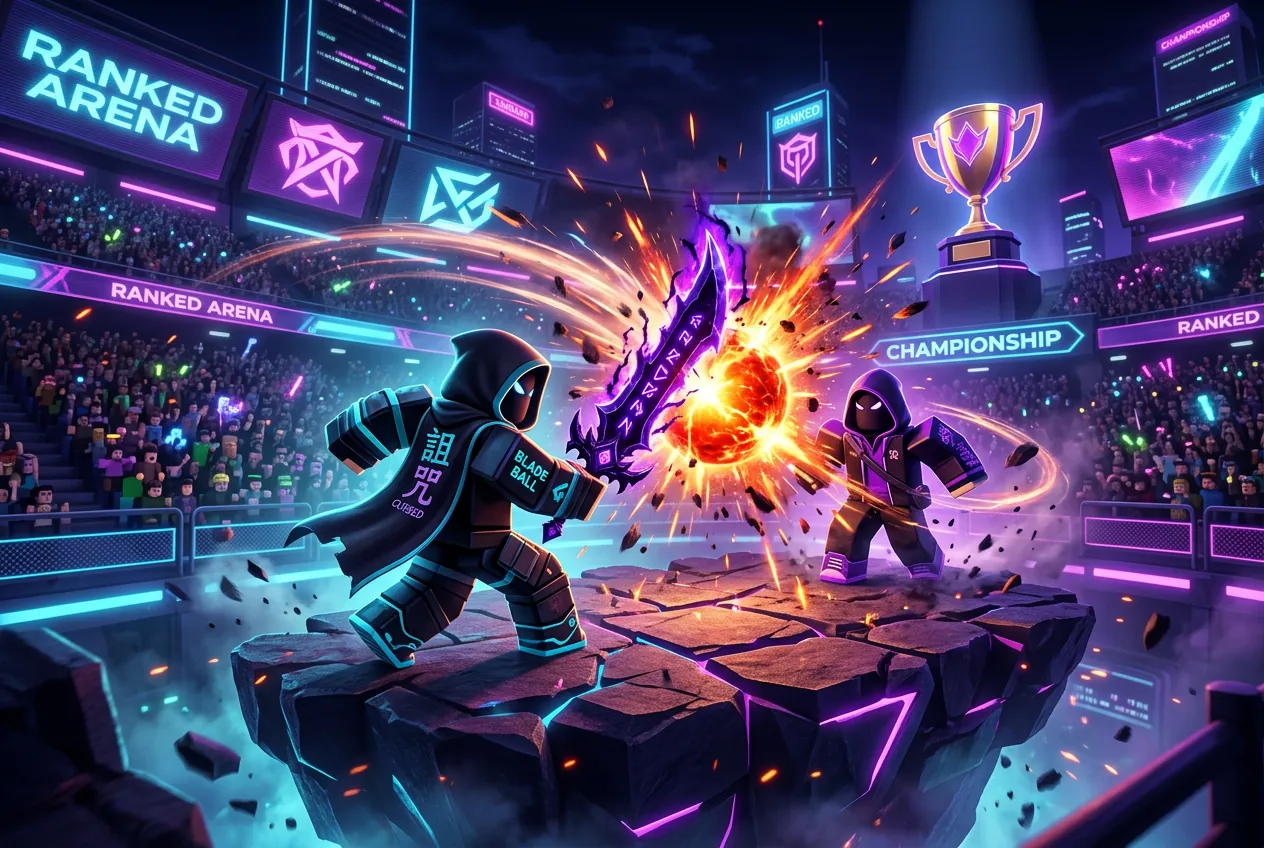
It’s the last week of Ranked Season 20. You’re sitting 20 points below Champion, staring at the queue button. Every win pulls you closer. Every loss dumps you back into Grandmaster, and the season timer doesn’t care how tired you are.
Across the lobby, you spot someone holding the Ranked Season 20 Champion sword. The blade catches the light. A small part of you wonders if that person is actually better than you, or just better at knowing when to stop queuing. That question — when to push and when to hold — is what this guide is actually about.
Blade Ball is a Roblox ball-battle game. You hold a sword, you deflect a speeding ball back at your opponents, and the last player standing wins the point. The ranked ladder is where that simple loop turns into a full competitive season, complete with exclusive rewards that vanish when the clock runs out. Season 20, running under the V15.0 patch that dropped on August 1, 2026, is one of those seasons. This guide breaks down what’s worth grinding for, how the ladder actually works, and how to climb without torching your sanity in the process.
Ranked Season 20: The Rewards Worth Grinding For
Here’s the scene. You finally hit Champion on a Tuesday night. The rank-up banner plays, your MMR locks in, and then the reward drops into your inventory. You don’t just get a “congratulations” screen. You get gear.
The centerpiece of Season 20 is the Ranked Season 20 Champion sword. It’s a Unique or Ranked-rarity item that works as both a sword and a back accessory, so you can swing it in matches or wear it as a flex between rounds. You earn it by reaching Champion rank. That’s it. No RNG, no Robux, no grinding a battle pass track — just the rank.
One tier below sits the Ranked Season 20 Top 200 reward. It’s not the same as the Champion sword. It’s a separate, lower-tier drop handed to the players who finish inside the top 200 on the season leaderboard. If you’re strong but can’t quite clear the Champion threshold, the Top 200 bracket is your realistic target — more on that decision later.
The package also comes with a special Deflect Sound 3 sound effect plus VFX, and an icon called Cursed Obsession. The icon name alone tells you the vibe they were going for: dark, obsessive, the kind of thing you either chase for weeks or learn to let go of.
Here’s the part that matters most. Every season’s Champion reward is different. The sword from Season 19 is not the sword from Season 20, and the sword from Season 21 will be different again. Once a season ends, its reward is gone permanently. You cannot buy it. You cannot trade for it. You cannot retroactively earn it. The item is a timestamp — proof that you climbed during that specific window.
| Reward | Rarity | How You Earn It | Comes Back? |
|---|---|---|---|
| Ranked Season 20 Champion sword | Unique/Ranked | Reach Champion rank | No, season-exclusive |
| Ranked Season 20 Top 200 reward | Lower tier | Finish inside the top 200 leaderboard | No, season-exclusive |
| Deflect Sound 3 + VFX | Seasonal | Bundled with the Champion reward | No |
| Cursed Obsession icon | Seasonal | Bundled with the Champion reward | No |
That table is the whole economy of ranked seasons in a nutshell. It’s not a store. It’s a leaderboard with a souvenir.
The Season 20 Ladder, From Bronze to Champion
Before you grind for a sword, you need to know the terrain you’re climbing. Ranked Season 20 uses a tier ladder that starts low and ends at Champion.
From the bottom up, it runs through Bronze, Silver, Gold, Platinum, Diamond, and Grandmaster — then Champion at the peak. Each of the middle tiers splits into divisions, which is where the slow grind lives. You don’t skip tiers. You climb one at a time, and the gap between each step gets wider as you go up.
Here’s the scene that trips people up. You’re in Diamond, winning matches, and it feels like the finish line is close. But the distance from Diamond to Grandmaster is bigger than everything you climbed to get to Diamond in the first place. Then Grandmaster to Champion is another wall entirely. A lot of players burn out right at the base of that second wall because they underestimated it. They treated Champion like “one more tier” when it’s really a separate project.
Champion is not just “Grandmaster but better.” It’s the rank where the reward lives, which means it’s where the grind concentrates. To reach it you need to clear the Grandmaster tier and then hold or push through whatever the final threshold asks of you. The exact MMR number moves between patches, so check the ranked lobby in-game for the current cutoff rather than trusting an old number from a guide.
Above the tiers sits the leaderboard. The Top 200 reward is a placement prize, not a rank. You could theoretically be a high Grandmaster and still make Top 200 if the bracket thins out. Conversely, you could be Champion and miss Top 200 if a pile of players finish above you. They’re two different games: the rank is a threshold you cross once, the leaderboard is a position you defend until the season clock stops.
If you want the full breakdown of how MMR and tiers work under the hood, read the Blade Ball ranking and competitive guide. It covers the number side. This guide is about the season side — the rewards and the decision-making.
The Climb: When to Push and When to Hold
Every ranked season is a two-sided decision. Push hard and you risk losing points. Play safe and you risk running out of time. Here’s how to think about it in Season 20.
Stability vs. Risk
The core tradeoff is simple. Aggressive play scores more points per hour but swings harder when it goes wrong. Conservative play protects your rank but climbs slowly. In a season with a hard deadline, both can kill you.
The scene that decides it: it’s a weekday evening, you’ve got two hours, and you’re mid-Grandmaster. Do you chase high-risk deflections to speed up your climb, or do you play patient and let the wins come slow? The answer depends on your gap. If you’re 100 points from Champion with three weeks left, play conservative — time is on your side, and a tilt spiral is the only thing that can stop you. If you’re 20 points out with two days left, conservative won’t cut it. You need points now, which means you accept the risk of a bad streak.
The mistake is using the same risk profile for the whole season. Players who push aggressively for the first three weeks burn out. Players who play safe for eight weeks and then sprint in the final days panic and throw. Match your aggression to your remaining runway, not your mood.
Season Start vs. Season End
Here’s a decision framework that trips up almost everyone. When should you actually grind?
Season start is chaotic. The ladder resets, placement matches shuffle everyone around, and the matchmaking pool is full of players who are mis-ranked. Smurfs are at the bottom. Rusty former Champions are mixed into the middle. You’ll play weird matches where you either stomp someone or get stomped, and neither teaches you much. But the leaderboard is wide open — the Top 200 slots aren’t locked in yet.
Season end is the opposite. The ranks have settled, so every match is against someone near your actual skill. The quality of practice is much higher. But the leaderboard has hardened, and every player near the cutoff is fighting for their life.
The counter-intuitive move: use the first week for placement and calibration, not for grinding. Lock in a stable rank, then do your real climbing in the middle weeks when the field is settled but the deadline hasn’t tightened. Save the final few days for defense, not offense — once you’re above the line you want, your job becomes holding it, not pushing further.
The Two-Way Fork: Champion vs. Top 200
This is the decision most players never make consciously. They just grind and take whatever they get. That’s how you end up with neither.
Picture it: you’re Grandmaster, climbing steadily, but you can feel yourself hitting a ceiling. Champion feels just out of reach. Meanwhile you’re sitting at rank 180 on the leaderboard. Two rewards are in play, but you can only realistically secure one.
- Push Champion if you’ve already touched the top tier before or you’re consistently beating other Grandmasters. It’s a rank goal with a clear finish line, and the sword is the bigger flex.
- Defend Top 200 if Champion keeps slipping away. The bottom of the Top 200 bracket is where competition thins out, and holding a placement often takes less raw skill than clearing a rank threshold — you just have to stay active enough to not get knocked out.
The trap is splitting your focus. A player who half-heartedly chases Champion while half-heartedly watching the leaderboard often loses the momentum to do either. Pick one, commit, and let the other go. This is the same choose-and-commit logic that runs through the ranked competitive strategy guide — you win by committing to a plan, not by hedging.
Where Season Grinders Go Wrong
Every season, the same three failures sink otherwise decent players. Here they are, with the reasons and the recovery.
Failure 1: The End-of-Season Panic Grind
The scene: three days left, you’re 40 points below your goal, and you decide to queue nonstop until you make it. Match one, loss. You queue again immediately, tilted. Match two, loss. You tell yourself the next one breaks the streak. Match three, you play recklessly, trying to force fast wins, and you throw a winnable round. By the end of the night you’ve lost more points than you had to gain in the first place.
Why it happens: fatigue plus urgency. You conflate “play more” with “play better,” and the pressure to make progress makes you take risks you’d never take with a clear head.
The recovery: hard-stop rules. Decide your maximum loss streak before you queue — say, two losses in a row means you stop for at least 30 minutes. If you’re already tilted from the day, don’t queue ranked at all. The points you lose to a panic grind are harder to recover than the points you’d gain by waiting until tomorrow with a clear head. A deadline is a reason to be disciplined, not a reason to abandon discipline.
Failure 2: Ranked Only, No Training
The scene: you’ve been grinding ranked every day for two weeks straight. You notice your deflect timing feels off, so you queue more ranked to “get it back.” But it doesn’t come back. The problem is that ranked matches only punish your mistakes; they don’t give you reps to fix them. You’re practicing your errors until they feel permanent.
Why it happens: ranked feels productive because your MMR moves. But MMR is not skill. When your timing or phase recognition slips, ranked is the worst place to rebuild it, because the pressure prevents you from slowing down and isolating the problem.
The recovery: pull yourself out of the queue and spend 15 minutes in a practice space or casual before your ranked session. Work the specific thing that’s breaking — flash-blocking, deflect angles, whatever it is. Think of ranked as the test and training as the study. You don’t prepare for a test by taking more tests. If the terminology in this section is new, the Blade Ball mechanics glossary defines every mechanic we’re talking about.
Failure 3: The Reward Eats the Game
The scene: you get the Champion sword. Or the Top 200 icon. Or you chase it so hard that by the final week you realize you haven’t enjoyed a single match in a month. Every game became a means to an item. The moment you log off with the reward in hand, you feel… nothing. Because the fun was the excuse, and the grind became the point.
Why it happens: the season structure is designed to make the reward feel like the goal. It’s not. The reward is a souvenir of the climb. When you invert that — when the item becomes the reason to play — you stop improving and start obsessing over a number.
The recovery: remember why you queued in the first place. You liked deflecting balls and winning points. If the grind has turned every session into an anxiety spiral, take a break from ranked for a couple days and play casual just to feel the game again. The sword only matters if you still want to play the game that earned it. A reward you resented your way into is worth less than a rank you’re proud of.
Counter-Intuitive Ways to Climb Season 20
Some of the best season advice sounds backward until you try it.
The Champion Sword Is Not Just Cosmetics
Here’s the counter-intuitive read most players miss. The Ranked Season 20 Champion sword looks like a cosmetic flex — a way to show off. But that undersells it. Because each season’s reward is permanent and unrepeatable, the sword is actually a provenance marker. It says: “I was good enough to reach Champion during the exact window Season 20 was live.”
That’s worth more than any battle pass item, because battle pass items come back. Abilities rotate through later passes. Limited shop stock gets re-released now and then. But a ranked Champion sword from a specific season can never be re-earned, by you or anyone else. A player holding it in the lobby six months from now is proving something no amount of Robux can buy. So if you’re debating whether the grind is “worth it for a skin,” you’re thinking about it the wrong way. It’s not a skin. It’s a dated proof-of-skill.
Top 200 Can Be Easier Than Champion
Most players assume Champion is the harder goal because it’s the higher rank. Not always. Champion is a fixed threshold — everyone above the line gets the sword, and the line doesn’t care how many people cross it. Top 200 is a fixed quantity — only 200 people get it, period.
The difference shows up in where the competition concentrates. The Champion threshold draws everyone who thinks they can clear it, and that crowd is thick right at the top. The Top 200 bracket, by contrast, thins out hard at the bottom edge. If you’re a high Grandmaster who can’t quite crack Champion, you might be fighting a handful of players for the last few Top 200 slots instead of a whole tier’s worth of players for the final rank. For some profiles, the lower reward is genuinely the easier grab. Don’t assume the bigger prize is always harder to win — the structure matters more than the title.
Playing Fewer Matches Climbs Faster
This sounds lazy, but it’s real. Volume is the enemy of a season climb, because fatigue degrades your decisions faster than you notice. A player who queues 20 tilted matches in a night ends up net-negative, while a player who plays 8 focused matches, reviews the losses, and stops wins the week.
The trick is to treat each session like a ladder with a budget. Pick a match count and a stop condition before you start. When you hit either, you’re done. This keeps your win rate high enough to actually climb, instead of grinding your MMR back down to where it started. A season is long enough that consistent small gains beat occasional big losses every time. For a deeper look at the when-to-push, when-to-hold logic, see the ranked climbing decision guide.
Deflect Sound 3 and the V15.0 Patch
The reward isn’t the only thing new in this window. V15.0 dropped on August 1, 2026, and it shipped Deflect Sound 3 — a new deflect sound option alongside the VFX that comes with it.
If you’ve played Blade Ball for any stretch, you know how much of the game’s feel lives in audio. The deflect sound is your timing cue. A clean block has a sound. A late block has a different sound. Your ears learn the difference before your eyes do, and a lot of high-level players react to the sound as much as the visual flash.
A new deflect sound matters because it changes that feedback. For the first few matches with Deflect Sound 3 equipped, your timing might feel slightly off — not because the mechanics changed, but because the cue you’ve been trained on sounds different. That’s a real, small adjustment window, and it’s worth being aware of before you take the new sound into a ranked match that actually matters.
So here’s the practical note: if you earned or equipped Deflect Sound 3 right before a ranked session, run a few casual matches first to retrain your ear. Don’t let a cosmetic audio change cost you points in a game where timing is everything. The sound is new, the VFX is new, and both are worth showing off — just not at the cost of a clean deflect during your Champion push.
The Bottom Line
Ranked Season 20 is a deadline, a leaderboard, and a souvenir all rolled into one. The Champion sword is the headline, the Top 200 reward is the underrated alternative, and Deflect Sound 3 plus the Cursed Obsession icon round out a package that will be gone the moment the season ends.
Climb with a plan, not a panic. Match your aggression to your remaining runway. Pick one goal — Champion or Top 200 — and commit to it. Train between ranked sessions instead of using ranked as training. And when the season clock hits zero, make sure you’re holding a rank you’re proud of, not just an item you resented your way into.
The sword is proof you climbed. How you climbed is the part you’ll actually remember.
Related Guides
- Blade Ball Ranking and Competitive Guide — MMR, tiers, placement matches, and how the numbers work
- Blade Ball Ranked Competitive Strategy Guide — Countering the four playstyles at every bracket
- Blade Ball Battle Pass and Events Guide — How seasonal rewards and battle passes compare to ranked rewards
- Blade Ball Mechanics Glossary — Every deflect, parry, and timing term defined