Last updated: June 29, 2026.
It’s the final round. Your hands are sweating. The ball is whipping across the arena at impossible speed, and you’re one mistake away from dropping back to Platinum I. Your opponent — some kid with a Grandmaster badge — just teleported behind you. You hear the deflection sound before you see the ball. Heart pounding. Blade up. This is what ranked Blade Ball feels like at the edge.
If you’ve never queued into competitive mode, that paragraph probably sounds dramatic. But ask anyone who’s sat at 2199 MMR, one win from Diamond, and they’ll tell you the stress is real. Ranked isn’t casual with numbers attached. The ball moves faster. Players track your cooldowns. One lazy positioning choice and you’re watching the defeat screen.
This guide breaks down how the ranking system actually works, why most players get stuck, and the counter-intuitive habits that separate climbers from hard-stucks.
The Ranking System Explained
Blade Ball uses a tier-based system with hidden MMR running underneath. Your visible rank is just the surface. The real game happens in the numbers you can’t see.
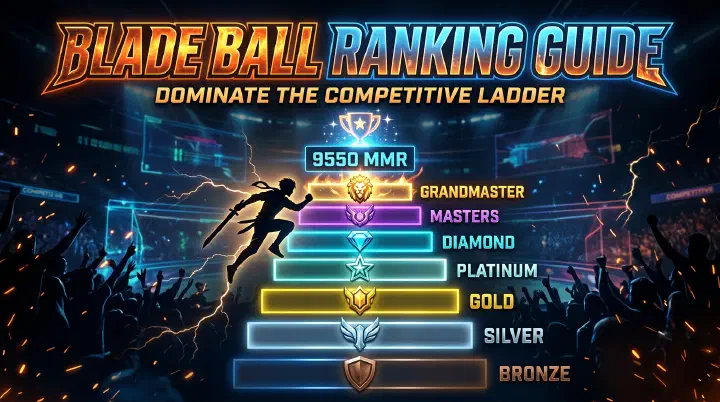
Here’s how the tiers break down:
- Bronze I through III — Roughly 0 to 599 MMR. About a quarter of the ranked population lives here. Matches are chaotic. Players whiff basic deflections. If you’re reading this guide, you’ll climb out fast.
- Silver I through III — 600 to 999 MMR. This is the biggest chunk of players at around 30%. You’ll see some ability usage, but positioning is usually terrible. People stand near edges for no reason.
- Gold I through III — 1000 to 1399 MMR. Welcome to the middle class. Players here have decent mechanics but panic under pressure. This is where ego starts to hurt more than skill.
- Platinum I through III — 1400 to 1799 MMR. Now you’re in the top 15% or so. Opponents fake their deflection angles. They bait your abilities. Every match feels like a chess game at 90 miles per hour.
- Diamond I through III — 1800 to 2199 MMR. Less than 10% of ranked players make it this far. The gap between Diamond III and Diamond I is bigger than the gap between Bronze and Gold combined.
- Grandmaster — 2200+ MMR. Single tier, no divisions. There’s an internal leaderboard for the top 100, and the absolute best players sit between 2500 and 5000+ MMR depending on the season.
Each tier below Grandmaster has three divisions. Division III is the floor, Division I is the ceiling. You need to cross the MMR threshold to promote. No best-of-three series. No promos. Just raw numbers.
Grandmaster works differently. Once you hit 2200, you’re in. But the real prestige is the global leaderboard. Top 100 gets end-of-season rewards that actually look cool, not just another recolored skin.
How MMR Actually Works
Your Matchmaking Rating is a single number that goes up or down after every match. Here’s what affects it:
When you win:
- Standard win against similar MMR opponents: +15 to +25
- Strong individual performance (3+ kills, clutch saves): +20 to +30
- Win streak bonus kicks in after 3 straight wins. Each additional win adds +5, stacking up. A 10-win streak adds +35 bonus MMR on top of your base gain.
- Beating higher-rated opponents: +25 to +40, scaled by how much higher they are.
When you lose:
- Standard loss: -15 to -25
- Loss but you top-fragged on your team: -10 to -15 (reduced penalty)
- Losing to much lower-rated opponents: -25 to -35 (this one stings)
- Leaving early: -40 to -50 and a potential temp ban. Don’t do this.
The win streak system is the fastest way to climb through lower tiers. Three wins in a row unlocks the bonus. After that, every consecutive win accelerates your MMR gain. It resets on any loss, so protecting a streak becomes a weird psychological game. Some players start playing safer at 2-0 in a session. Others get greedy and throw it on an aggressive play. Both approaches can work, but you need to know which one fits your mental state.
Placement Matches
Every season starts with 10 placement matches. Your provisional MMR begins at 1000 (Gold III) and swings hard based on results.
- A perfect 10-0 usually places you in Platinum I or Diamond III.
- 7-3 lands around Gold I or Platinum III.
- 5-5 typically drops you in Silver I or Gold III.
The system looks at more than wins. It tracks deflections, survival time, and the average MMR you faced. So going 6-4 against mostly Diamond players might place higher than 7-3 against Silvers.
Failure Analysis: Why Ranked Players Plateau
Most players don’t fail because their mechanics are bad. They fail because they repeat the same mistakes without realizing it. Here are the real reasons people get stuck:
They practice the wrong thing. Bronze and Silver players spend hours in training mode hitting static balls. That’s fine for muscle memory, but ranked isn’t static. The ball changes speed. Opponents use abilities. You need to practice under pressure, not in a quiet room.
They blame teammates in free-for-all. Blade Ball ranked is mostly FFA. There are no teammates. But players still find a way to externalize blame — “that guy got lucky,” “the map sucks,” “ability spam.” This mindset kills improvement because it removes your agency.
They play on autopilot. Gold and Platinum players are especially guilty of this. They’ve learned the basics, so they stop thinking. They deflect on instinct without considering where the opponent is standing. They use Freeze at the same moment every round. Autopilot gets you to Gold. It won’t get you past Platinum.
They ignore their losing streaks. Every ranked player has bad days. The difference is what you do with them. Hard-stuck players queue again immediately after a loss, tilted and impatient. Climbers review what happened — even mentally for 30 seconds — before hitting the next match.
They stick to one ability loadout. It’s comfortable. You know Freeze + Teleport inside out. But when the meta shifts or you face a counter-pick, you’re helpless. One-tricking works in casual. In ranked, it creates a hard ceiling.
They don’t warm up. Even Grandmaster players hop into casual or training for 5-10 minutes before ranked. Cold fingers and slow reaction times cost MMR. It’s not about being “good enough to skip it.” It’s about consistency.
Decision Framework: Safe vs Aggressive Plays
Every rank tier demands a different risk profile. What works in Silver will get you punished in Diamond. Here’s how to think about aggression at each level:
Bronze to Gold: Default to aggression. Players in these tiers panic under pressure. They don’t track your cooldowns. They whiff fast balls. You should play aggressively — chase the ball, force exchanges, use abilities on cooldown. The only time to play safe here is when you’re on a win streak and feeling shaky.
Gold to Platinum: Read before you commit. This is where players start faking and baiting. Don’t chase every ball. Ask yourself: where is the nearest opponent? Do they have ability advantage? If you’re not sure, default to center position and let them make the first mistake.
Platinum to Diamond: Aggression needs a reason. Diamond players punish blind aggression. Every aggressive play should have a purpose — you’re capitalizing on a known cooldown, you’re forcing a reposition, you’re ending the round before the safe zone shrinks. If you can’t name the reason, play safe.
Diamond to Grandmaster: Safe is the new aggressive. Sounds backwards, but at this level, patience wins more games than flashiness. Top players rarely overextend. They wait for you to make a mistake, then capitalize. Your “aggressive” plays should look like safe positioning that suddenly isn’t safe for the opponent.
The 10-Second Rule: Before any aggressive push, give yourself 10 seconds of observation. Where’s the ball? Where are the enemies? What’s on cooldown? If you can’t answer all three, you’re gambling, not playing.
Counter-Intuitive Advice That Actually Works
Some of the best ranked advice sounds wrong at first. Here are three that work:
Losing streaks can be productive if you analyze them. Most players dread a 3-loss streak. But those losses contain more data than your wins. After each loss, ask one specific question: “What was the last decision I made before I died?” Write it down mentally. Three losses in a row with the same answer means you’ve found your leak. Fix it, and the streak becomes the reason you break through your plateau.
Playing worse opponents makes you worse. The matchmaking system sometimes throws you a lobby full of lower-rated players. It’s tempting to relax and style on them. Don’t. Play every match like your MMR depends on it, because it does. Sloppy habits formed in easy lobbies show up when you face equal competition.
Sometimes you should let the ball go. In FFA, not every ball is yours to deflect. If two opponents are fighting over a ball and you’re at a bad angle, let them trade. Third-partying in Blade Ball is real. Wait for one to die, then clean up. Your KDA doesn’t matter. Your placement does.
Competitive Meta: Best Abilities for Ranked (2026)
Abilities shape the ranked meta more than any blade skin ever will. Here’s what actually works as of mid-2026:
S-Tier — Freeze Still the most versatile ability in ranked. Slows the ball by 60% for 2 seconds. The cooldown is 12 seconds, so it’s up for almost every exchange. Freeze is strongest against aggressive players who rely on speed and unpredictability. If you’re climbing through Gold or Platinum, learning Freeze timing is non-negotiable.
S-Tier — Invisibility Three seconds of transparency. At high MMR, players predict your deflection based on where you’re standing. Invisibility breaks that prediction. Opponents have to guess. Most guess wrong. The cooldown is long enough that you can’t spam it, but used at clutch moments, it wins rounds.
S-Tier — Teleport 15-stud instant reposition on a 10-second cooldown. Teleport is map-dependent but always strong. On Sky Fortress, it saves you from falling. On Dojo, it creates impossible angles. The skill ceiling is high — bad teleports put you in worse positions.
A-Tier — Raging Deflect 40% larger hitbox for 3 seconds, 14-second cooldown. This is the “training wheels” ability for players with shaky timing. It’s less tactical than Freeze or Teleport, but in Diamond+ lobbies where ball speed gets absurd, the extra hitbox margin matters.
A-Tier — Wind Cloak 30% movement speed for 4 seconds. Great for repositioning and chasing balls near edges. Pairs well with Teleport for maximum mobility. Less useful in 1v1 situations.
B-Tier — Pulse, Barrier, Magnet Pulse is a panic button. Experienced players expect it. Barrier blocks one hit but has an 18-second cooldown — too long for what it does. Magnet’s effect is so subtle most players don’t notice it. Avoid these in serious ranked play unless you’re experimenting in casual.
Recommended Loadouts
- All-Rounder: Freeze + Teleport. Control the ball, control your position. Works on every map.
- Aggressive: Raging Deflect + Wind Cloak. Chase kills, force exchanges, dominate through pressure.
- Tactical: Invisibility + Freeze. Break their reads, then slow the ball for an easy deflection.
Best Blades for Ranked Play
Blade stats are standardized in ranked, so this is about visual clarity and hitbox honesty.
Reaper — The hitbox matches the visual model better than any other blade. You won’t get phantom whiffs where you swear you hit the ball.
Phantom — Translucent blade that never blocks your view of the ball. Takes a few matches to adjust, but once you do, tracking becomes easier.
Infinity Edge — Slightly longer reach, about 5% more than standard. The margin is tiny but real. Good for players who prefer precision deflections.
Chrono Blade — Balanced, clean, no distractions. If you don’t have a preference, use this.
Avoid: Firebrand (particles hide the ball), Crystal Blade (reflective glare on bright maps), Slime Blade (hitbox doesn’t match the blob shape).
Map-Specific Strategies
Arena — The standard circle. No hazards, pure skill. Control the center 60%. If you get pushed to the edge, use Teleport or Wind Cloak to reclaim space. Watch for wall bounces — good players aim near walls to create weird return angles.
Sky Fortress — Elevated platforms with gaps. The ball speeds up downhill. Deflect downward when possible to give opponents less reaction time. Never stand on the edge of a platform. One good angle and you’re falling.
Dojo — Rectangular with columns. The ball bounces unpredictably off columns, creating blind spots. Use columns to hide your movement when the ball is far away. Learn the common bounce angles. What looks random to new players is predictable to veterans.
Lava Pit — Shrinking safe zone, lava damage. Don’t defend a position you’ll have to abandon in 10 seconds. Manage the zone proactively. Invisibility is strong here because you can hide your repositioning as the circle shrinks.
Seasonal Rewards and Resets
Seasons last 8-10 weeks. Rewards are based on your highest rank achieved, not where you end:
- Bronze: 50 coins, participation badge
- Silver: 150 coins, Silver weapon skin
- Gold: 300 coins, Gold weapon skin, title
- Platinum: 500 coins, Platinum weapon skin, animated title
- Diamond: 800 coins, Diamond weapon skin, animated title, aura effect
- Grandmaster: 1200 coins, Grandmaster weapon skin, exclusive aura, animated title, leaderboard badge
At season end, your MMR gets compressed toward 1000. It’s a soft reset — previous season performance factors into your placements. Diamond+ players usually place in Platinum after reset. Gold and below land close to where they were.
FAQ
How long does it take to climb from Silver to Diamond in Blade Ball? Most dedicated players hit Diamond within 4-6 weeks if they play 10-15 ranked matches per day with focused improvement. The jump from Platinum to Diamond usually takes the longest because opponents start tracking ability cooldowns and reading your patterns.
Should I solo queue or play with friends in ranked? Solo queue builds better long-term skills because you learn to adapt to random playstyles. Duo queue can help if your partner complements your ability loadout, but premade teams often face tougher MMR matching that slows climbing.
What is the best time of day to queue for ranked? Weekday evenings between 6 PM and 10 PM EST typically have the most active player pool and fairest matchmaking. Avoid late-night queues unless you want uneven matches against tired Grandmaster players or smurfs.
Related Guides
- Parry Chain Counter Guide — How to break and punish aggressive parry chains
- Ranked Climbing Decision Guide — Deeper breakdown of when to push and when to hold back
- Opponent Reading Guide — Learn to predict deflections and fake your own intent
- How to Win at Blade Ball — Match-winning strategies for every game mode
Good luck in the queue. See you in Grandmaster.