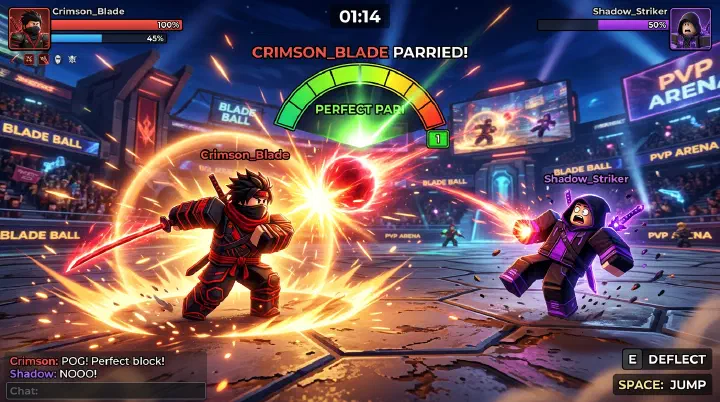
You load into Blade Ball for the first time. The countdown hits zero. A glowing ball spawns in the middle of the arena and flies straight at you. You spam the block button. It goes through. You die in 0.8 seconds. You think, “this game is impossible.”
Every Blade Ball player has been there. The learning curve feels vertical because the game doesn’t teach you its most important mechanic — flash-blocking — anywhere in the tutorial.
But here’s the truth: Blade Ball isn’t about fast reflexes. Not really. It’s about knowing what to look at and when to press. Once you understand the flash, the parry window, and the speed curve, you go from dying in deflection 2 to surviving deflection 10 in a single practice session.
This hub is everything you need to get good at Blade Ball, organized in the order you should learn it. Start with the basics if you’re new, jump to the ability tier list if you’re building a loadout, or dive into the ranked guide if you’re climbing.
What Is Blade Ball, Exactly?
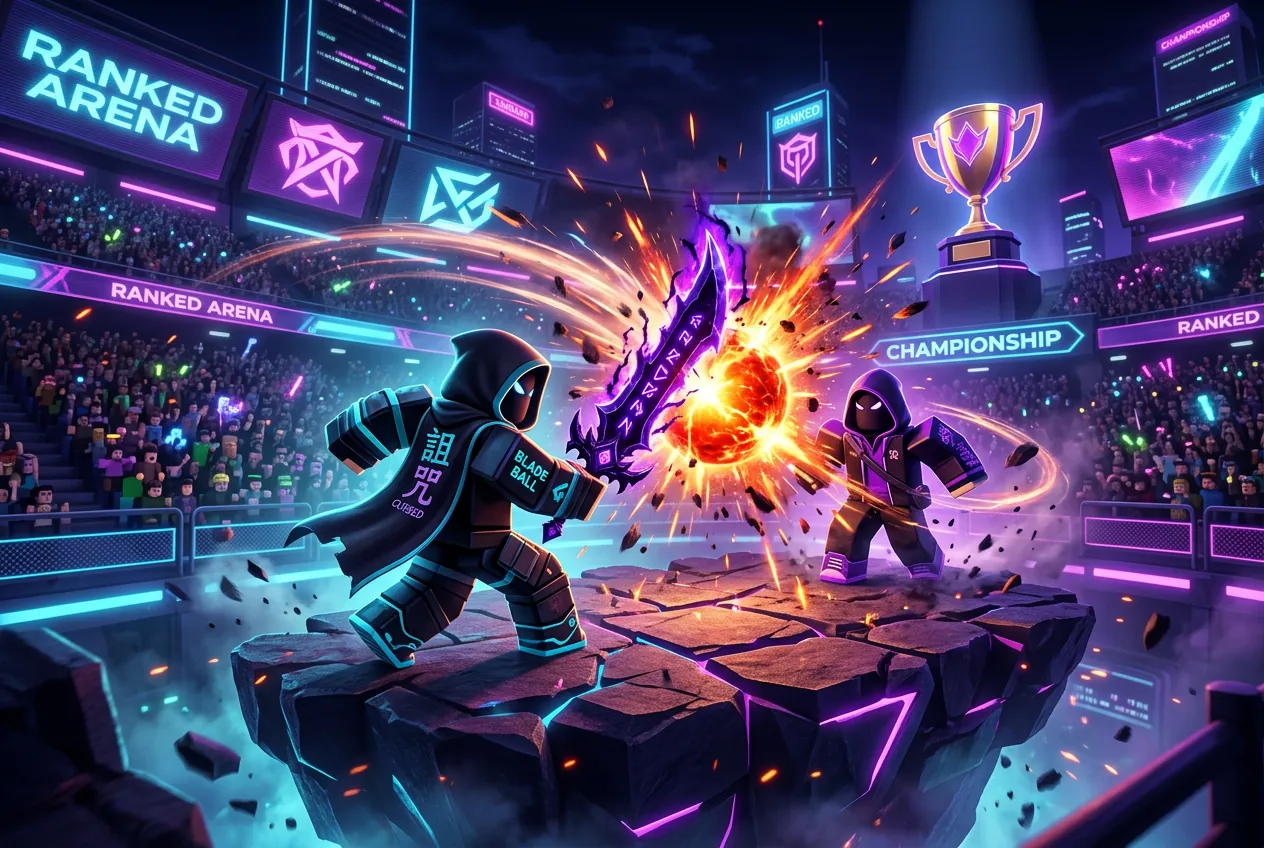
Blade Ball is a Roblox PvP game where players deflect a homing energy ball using swords and special abilities. The ball speeds up with every deflection. Last player standing wins.
It sounds simple. It isn’t.
The game has a layered skill ceiling that keeps players coming back:
- Beginner layer: timing blocks, understanding the ball speed curve, learning which abilities do what
- Intermediate layer: curve shots, ability combos, opponent reading, phase recognition
- Advanced layer: parry chain control, mind games, tournament-level matchup knowledge
Most players stall at the intermediate level because they never learn the fundamentals properly — they just play a lot and hope they get better. This hub fixes that.
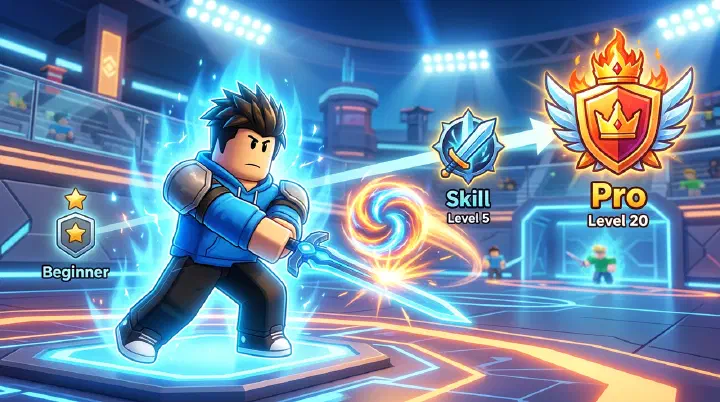
The Blade Ball Learning Path (What to Learn, in Order)
Don’t try to learn everything at once. Follow this progression and you’ll climb faster than 90% of players.
Step 1: Master Flash-Blocking (Bronze → Gold)
Flash-blocking is the #1 skill in Blade Ball. It’s also the one nobody teaches.
Around deflection 4-5, the ball becomes too fast to track visually. Your eyes can’t keep up. But your character emits a white flash ring when the ball enters parry range — and that flash triggers your reflexes faster than your visual cortex can process a moving object.
Train the flash first. Everything else — abilities, positioning, curve shots — is useless if you can’t stay alive long enough to use it.
Step 2: Build Your First Loadout (Gold → Platinum)
Once you can survive to deflection 8 consistently, you’re ready for abilities. Don’t buy the flashiest one. Buy Infinity first — it’s a safety net that doubles your survival rate while you learn everything else.
- Abilities Tier List — every ability ranked →
- Ability Combo Guide — best pairings for every playstyle →
Step 3: Learn to Win Instead of Survive (Platinum → Diamond)
Surviving is easy. Winning is harder. You need to stop just deflecting and start eliminating people. This is where curve shots, opponent reading, and ability timing enter the picture.
- How to Win More — the decision framework →
- Parry Chain & Counter — how to win high-speed exchanges →
- Opponent Reading — patterns, tells, and rhythm →
Step 4: Climb the Ranks (Diamond → Master)
Ranked play changes everything. Matchups matter more. Rotations matter. The meta shifts every patch.
- 1v1 Ranked Climbing Guide — Bronze to Diamond →
- Battle Pass & Seasonal Events →
- Tournament Performance — why you choke and how top players don’t →
The Core Mechanics (Quick Reference)
The Parry Window
A parry happens when you block the ball at the right timing. If you block early or late, you miss and take damage. The parry window gets tighter as the ball speeds up — at high deflection counts, the window is less than 100ms.
Good players don’t make the window bigger. They make their timing more consistent.
AP (Ability Power)
AP is the stat that makes your abilities stronger. Higher AP = faster ball from Raging Deflect, longer Freeze duration, further Thunder Dash. You increase AP by equipping better blades — each tier (Common → Rare → Epic → Legendary) adds +5-15 AP.
Quick rule of thumb: blade tier matters more than blade cosmetics. A Legendary blade with a bad look will always beat an Epic blade that looks cool.
Curve Shots
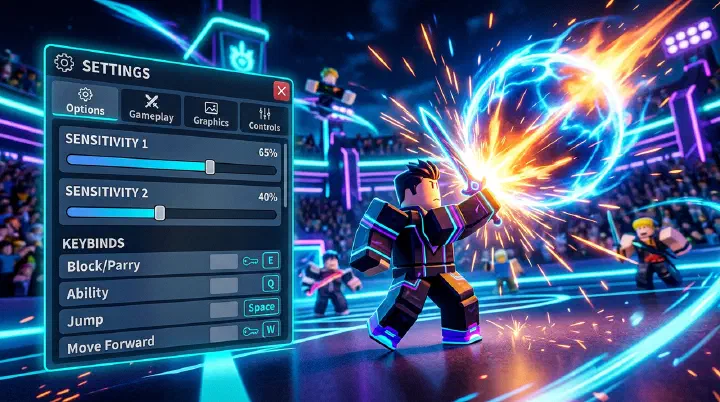
When you parry, you can curve the ball by moving your mouse or right stick during the deflect animation. Curve is how you beat players who just hold block in a predictable spot.
Beginners curve too much. Good players curve just enough — a slight bend is harder to read than a dramatic arc.
Clashes
A clash happens when two players parry the ball at exactly the same time. Both get knocked back, the ball resets to the center, and both players get a small speed boost. Clashes are neutral — nobody wins, nobody loses.
If you see yourself clashing a lot, you’re parrying on the same rhythm as your opponent. Change your timing.
The Speed Curve
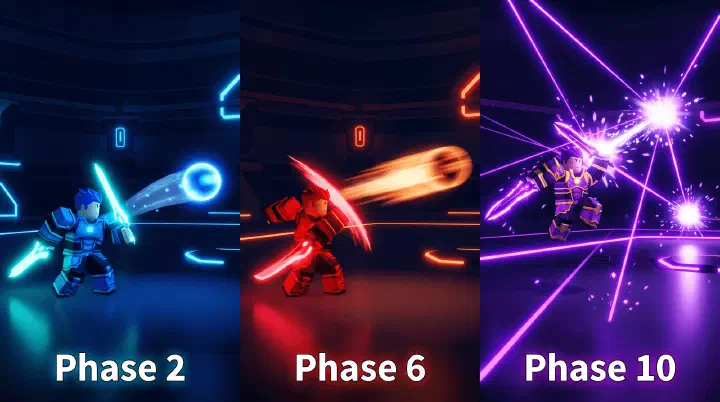
The ball gets faster with every deflection. The curve isn’t linear — it accelerates more between deflections 4-6 than it does between 8-10. That’s because the game crosses from “you can see it” to “you can’t see it” in that range, and the speed increase slows down after deflection 8 because you’re already at the limit of human reaction.
Game Modes
Blade Ball has several modes. Most players stick to one or two, but each teaches a different skill:
1v1 Ranked — pure skill, no team variance. Best for climbing RP and improving your fundamentals.
Free For All — chaos, positioning, and target selection. Best for practicing against multiple playstyles at once.
Team Mode — coordination with a partner. Best if you have a friend to queue with.
Limited-Time Modes — Strike Tournament, Overdrive, Item Duels, Squad Royale. Rotate in and out during events.
Quick Answers
The key facts from every DungeonPath guide on this game, condensed into one place. Tap a topic below for the full detail that lives in the individual guides.
Best Ability Combos & Synergies in Blade Ball — Win More With These Pairings (2026)
What’s the best ability combo in Blade Ball?
Raging Deflect + Wind Cloak is the best overall combo right now. Raging Deflect gives you a damage-boosted parry that returns the ball at 1.4x speed, and Wind Cloak’s speed boost lets you position for the next deflect before the opponent can react. Together they create an aggressive, high-tempo playstyle that overwhelms most opponents. At high ranks, Freeze + Rapture is the most consistent for defensive counter-play.
Can you change abilities mid-match in Blade Ball?
No, abilities are locked once the match starts. You choose your two abilities during the pre-match lobby. This is why synergy matters — you can’t adjust if you realize your abilities don’t work together mid-game. Always test new combos in casual mode before bringing them to ranked.
Should I use two offensive abilities or one offensive and one defensive?
One offensive + one defensive or utility ability wins more consistently than double offensive. Two offensive abilities create downtime where both are on cooldown and you’re vulnerable. A defensive ability (Freeze, Forcefield, Wind Cloak) covers your off-windows. The only exception is Raging Deflect + Thunder Dash, which has overlapping aggro timings that justify the double-offensive approach.
How to Play Blade Ball — From First Match to First Win (2026)
Why can’t I block the ball in time?
Because you’re watching the ball, not the flash. The ball speeds up with each deflection — by deflection 5, it’s too fast to react to visually. The game gives you a white flash around your character when the ball enters your parry window. Train yourself to press block when you see the flash, not when you see the ball. This one mental shift — reacting to the flash instead of the ball — is the difference between Bronze and Gold.
What ability should I buy first?
Buy Infinity first (about 2,000 coins, ~20-30 matches of saving). It’s an automatic shield that blocks one ball hit — essentially a free life. Most new players buy a mobility ability first (Shadow Step, Super Jump) because they want to dodge. But beginners don’t have the timing to dodge consistently — they need a safety net. Infinity is that safety net. Once you have it, your survival rate in the first 5 deflections doubles.
Blade Ball Codes Guide: All Active Codes for May 2026 (+ How to Redeem)
Active codes (last verified when the original guide was written — codes expire fast, check in-game):
| Code | Reward | Notes |
|---|---|---|
| 5BVISITS | SPARKLERR Sword Skin | Milestone code for 5 billion visits |
| 4BVISITS | Bubble Wand Sword Skin | Milestone code for 4 billion visits |
| 2BTHANKS | Free Wheel Spin | Thank you milestone reward |
| RAMADAN | Free Wheel Spin | Seasonal event code |
| SPOOKYSEASON | Free Wheel Spin | Halloween event code |
| SUMMERWHEEL | Free Wheel Spin | Summer event code |
| SUMMERSTARTSHERE | Free Wheel Spin | Summer kickoff code |
| ENERGYSWORDS | Free Wheel Spin | Event promotion code |
| GIVEMELUCK | Free Wheel Spin | Lucky wheel promotion |
Expired Codes
These codes have expired and no longer work:
| Code | Previous Reward |
|---|---|
BLADEBALL | Coins |
SORRY50K | Coins + items |
SERPENT | 3x Serpent Katanas (giveaway entry) |
LAUNCH | Free wheel spin |
1M | Coins |
Note: Codes expire without warning. Redeem them as soon as you find them. New codes are typically released during updates, milestones, holidays, and special events.
How often are new Blade Ball codes released?
New codes typically release during major updates, seasonal events, and milestone celebrations. Check back every 1-2 weeks or join the official Discord for real-time announcements.
Do Blade Ball codes expire?
Yes, most codes expire within 1-4 weeks of release. Codes tied to specific events (Halloween, Christmas) expire when the event ends. Redeem codes as soon as you find them.
Blade Ball Battle Pass & Events Guide: All Seasons, Limited Items & LTMs (2026)
How much does the Blade Ball battle pass cost?
The Blade Ball premium battle pass costs between 480-639 Robux depending on the season. The pass gives you access to the premium reward track, extra weekly challenges, increased season currency earnings, and +10 free levels at purchase. Since February 2026 (Galactic Battle Pass), passes now feature infinite tiers where the top player each season earns an exclusive reward.
Do Blade Ball battle pass items come back?
Most battle pass items and abilities are exclusive to their season and do not return. However, some abilities rotate back into later passes (Titan Blade, Death Slash, and Slash of Duality have reappeared in multiple seasons). Limited shop items with fixed stock (like Skeleton Bride, Fallen Angel) are one-time releases and typically do not get re-released.
What are the best Blade Ball limited-time modes?
The most popular LTMs are Strike Tournament (competitive 1v1/2v2, rewards exclusive swords for top finishers), Overdrive/Juggernaut (one overpowered player vs all), and Item Duels (wager items against other players). Squad Royale (March 2026) introduced team battle royale mechanics.
Blade Ball Gale’s Edge v7.0 Guide: Best New Abilities & Meta Strategies (2026)
How do you use Gale’s Edge effectively in Blade Ball?
Use Gale’s Edge to scoop up the ball mid-flight and redirect it toward a specific opponent. Press Q to stop the wind gust and release the ball. Best used when the ball is traveling toward you — redirect it 90 degrees to catch opponents off guard.
What does Quantum Arena do in Blade Ball v7.0?
Quantum Arena creates a void zone where ALL players’ abilities are disabled — including your own. While inside, you can use a burst version of Thunder Dash that freezes opponents you dash through. Use it to neutralize ability-heavy opponents and force pure deflection fights.
Which is better: Gale’s Edge or Quantum Arena?
Both are S-tier but serve different roles. Gale’s Edge is an offensive playmaking tool for redirecting the ball to eliminate specific targets. Quantum Arena is a control tool that shuts down ability spam and forces fair fights. Top players run both and switch based on matchup.
Blade Ball Game Modes — Which Mode to Play, Best Loadouts & Mode-Specific Strategy (2026)
What’s the best game mode for climbing ranked in Blade Ball?
1v1 is best for pure RP climbing — you control everything and there’s no teammate variance. FFA gives less RP per win but more per minute because matches are shorter. Team mode gives the most RP per win but requires coordination with a partner. Recommendation: climb with 1v1 if you’re confident in your mechanics, FFA if you want volume practice, Team only with a dedicated partner you’ve practiced with.
How to Win More Blade Ball Matches — The Decision Framework That Wins Games (2026)
I can survive to the final 3 but I never win. What am I missing?
In the final 3, the game changes from survival to elimination. The remaining players are the best in the lobby — you can’t outlast them. You need to pick a target and eliminate them. The most common mistake: spreading damage across both opponents. Both survive with low HP. They both target you because you’re the threat. Focus fire on ONE opponent until they’re eliminated, THEN engage the last player. A 1v1 against an opponent at 60% HP is winnable. A 1v2 against two opponents at 30% HP each is not.
What’s the single most impactful thing I can do to win more?
Stop dying in Phase 2 (deflections 5-8). The majority of players in casual lobbies die between deflections 5 and 7 because they never learned flash-blocking. If you can consistently survive to deflection 8, you’ll automatically reach the final 3 in most casual matches without doing anything special. Master flash-blocking before worrying about ability combos, positioning tricks, or opponent reading.
Blade Ball Terms & Mechanics Explained — AP, Parry, Clash, Curve & More (2026)
What does AP mean in Blade Ball?
AP stands for Ability Power. It’s a stat that scales the damage and effect strength of your abilities. Higher AP means your Raging Deflect sends the ball back faster, your Freeze lasts longer, and your Thunder Dash travels further. AP is increased by equipping higher-tier blades and certain ability upgrades. The base AP is 100, and each blade tier (Common → Rare → Epic → Legendary) adds +5-15 AP.
What’s the difference between a parry and a clash in Blade Ball?
A parry happens when you deflect the ball with correct timing — the ball returns to the sender at increased speed based on your AP and timing precision. A clash happens when two players parry the same ball simultaneously — both are pushed back, the ball resets to the center, and both players gain a small speed boost. Clashes are neutral; they don’t score points for either side.
How does ball curve work in Blade Ball?
Ball curve is applied during a parry by moving your mouse or right stick in a direction during the deflect animation. The ball will curve toward that direction after being hit. Curve is essential for getting the ball past defenders who are holding predictable angles. The amount of curve is affected by your blade’s Curve stat — Legendary blades add 20-30% more curve than Common blades.
Blade Ball 1v1 Climbing Guide — Decision-by-Decision Through Every Rank, Bronze to Diamond (2026)
Why am I stuck in Gold in Blade Ball?
Because Gold is where good aim stops being enough. In Bronze and Silver, the player with better aim wins. In Gold, everyone has decent aim. The differentiator becomes phase recognition — knowing when the ball crosses from reactable (deflections 1-4) to flash-only (deflections 5-8) and switching your visual focus from the ball to the flash. Gold players die at deflection 5-6 because they’re still tracking the ball visually when it’s moving faster than their eyes can process. The players who escape Gold are the ones who learn to block the flash, not the ball.
The Blade Ball Speed Curve — Why Everything Changes After Deflection 5 (2026)
Why can I block the first 4 deflections but always die on the 5th?
Because between deflections 4 and 5, the ball crosses the human visual reaction threshold. The average human takes 0.25 seconds to see something, process it, and act. At deflection 4, the ball travels from player to player in about 0.25 seconds — right at the edge. At deflection 5, it drops to 0.17 seconds — faster than your brain’s visual pipeline. Your eyes physically cannot register the ball’s position, send that information to your brain, and command your hand to press block, all within 0.17 seconds. You need a faster cue: the white flash. Your character emits a bright white ring when the ball enters parry range. That flash triggers your reflexive response (0.1-0.15 seconds), which IS fast enough. The fix isn’t ‘get better at seeing the ball.’ The fix is ‘stop watching the ball and start watching the flash.’
How do I practice blocking at high deflection speeds?
The flash drill. Enter a 1v1 with a friend. Have them deflect the ball directly at you over and over without abilities. By deflection 5, stop looking at the ball entirely. Stare at your character model. Press block the INSTANT you see the white flash. You’ll miss the first 5-10 attempts because your brain fights you — it wants to look at the ball. After 20-30 attempts, flash-blocking becomes reflexive. This drill takes 15 minutes and permanently changes how you play past deflection 4.
Why You Choke in Blade Ball Tournaments (And How Top Players Don’t)
How do I stop panicking when the ball speeds up in tournament finals?
Panic comes from untrained reactions, not cowardice. Set up a private server and practice 10 minutes of high-speed deflects at 1.5x normal velocity every day for three days before the event. This desensitizes your reflexes so the tournament pace feels normal, not terrifying.
Should I use my best ability in round one or save it for later?
Use your best ability in round one. Tournament brackets often seed stronger players in later rounds, so surviving early rounds is harder than it looks. If you barely scrape through round one with a weak ability, you enter round two with low confidence and damaged focus.
What is the fastest way to recover after losing a tournament match?
Immediately write down three things: what killed you, what you were thinking five seconds before it happened, and one mechanical adjustment for next time. Do not queue into another match for at least 10 minutes. Emotional replay loops destroy more players than actual skill gaps.
Frequently Asked Questions
Is Blade Ball free to play?
Yes, Blade Ball is free to play on Roblox. You can earn coins through gameplay to buy most abilities. The battle pass and some cosmetic skins cost Robux, but the core game is fully playable without spending money.
What is the best ability for beginners in Blade Ball?
Infinity is the best first ability for new players. It’s an automatic shield that blocks one hit — essentially a free life every time it’s off cooldown. Most beginners want a mobility ability first, but they can’t use mobility consistently yet. Infinity gives you the safety net you need while you learn the basics.
How do I get better at Blade Ball fast?
Master flash-blocking first. That single skill will take you from Bronze to Gold in a week. After that, pick one ability and learn it completely before trying others. Most players hop between 5 abilities and never master any of them. One well-practiced ability beats five mediocre ones.
What is the current meta in Blade Ball?
As of September 2026, the meta is defined by the Gale’s Edge v7.0 update. Gale’s Edge and Quantum Arena are S-tier offensive and control abilities respectively. Infinity is still the best defensive ability. The most consistent 1v1 loadouts pair one offensive ability with one defensive or utility ability.
Can I play Blade Ball on mobile?
Yes, Blade Ball has full mobile support with touch controls. The gameplay is the same, but the learning curve for parry timing is slightly different on touch. Many top players compete on mobile — the skill ceiling is just as high.
How often does Blade Ball update?
Major updates drop roughly every 4-6 weeks, usually with a new season or battle pass. Small patches and balance changes happen more frequently. The most impactful recent update was v7.0 Gale’s Edge in May 2026, which added two new S-tier abilities that reshaped the meta.
Start Here
If you’re new, follow this order:
- Deflect & Parry Timing Guide — Learn flash-blocking, the #1 foundational skill
- Beginner Walkthrough — First match, first ability, first win
- Abilities Tier List — Pick your loadout
For everyone else:
- Codes & Free Rewards
- Ability Combos & Synergies
- Parry Chain & Counter — Advanced Mechanics
- Gale’s Edge v7.0 — Latest Meta
- 1v1 Ranked Climbing Guide
Explore More
- Best Roblox Games of 2026 — See where Blade Ball ranks among 16 Roblox games
- All game guides → — Browse every guide on DungeonPath
Updated September 2026. Game updates may change meta and balance.