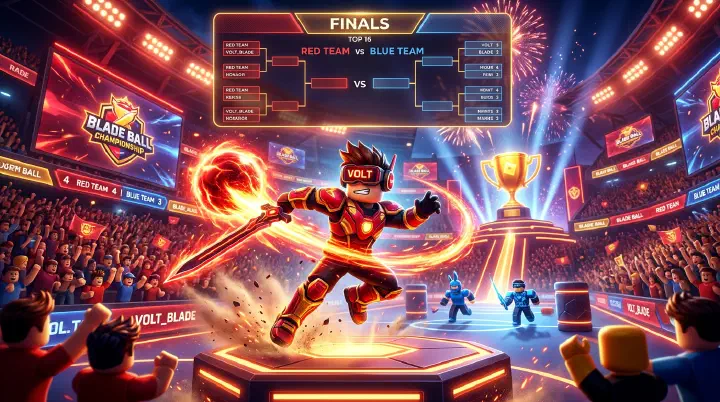
You are three hits away from winning the semi-final. The ball is glowing red, the lobby is quiet, and your palms are sweating through the keyboard. You have practiced this deflect angle a hundred times in free-for-all. But now, with eight spectators watching and a tournament title on the line, you mis-time by half a second. The ball clips your shoulder. Your screen goes gray. Some random player with half your ranked hours just advanced to the final, and you are staring at a respawn screen wondering why your hands betrayed you.
This is the tournament experience for 90% of Blade Ball players. They enter brackets with solid mechanics and leave with nothing because they prepared for the wrong game. Tournament Blade Ball is not ranked queue with a trophy attached. It is a different beast with its own rhythm, pressure curve, and decision traps.
What Tournament Play Actually Looks Like
Blade Ball tournaments run on a single-elimination bracket system. Lose once and you are out. Most community-hosted events use 16-player brackets, while official or sponsored tournaments scale to 32 or 64. Each round is typically a standard free-for-all or small-team elimination match, with the top two or three players advancing depending on bracket size.
The format sounds simple, but the pressure is not evenly distributed. Round one feels like a warm-up lobby until you realize half the entrants are not random kids. They are ranked grinders who smell easy prey. The ball speed starts normal but accelerates faster than public lobbies because tournament players deflect more consistently. What feels like a comfortable pace in ranked suddenly becomes a blur after 45 seconds.
Here is a scene you will face: round two, six players left, ball speed at 85% of max. Two players are hugging the center, spamming short deflects to bait mistakes. You are on the edge, waiting for an opening. In ranked, you would rush the center and force a trade. In a tournament, one mistake ends your entire run. The correct play is to let them fight, stay on the perimeter, and clean up whoever survives. Tournament rewards patience in ways ranked queue punishes.
Failure Analysis: Where Bracket Dreams Die
Most tournament losses fall into three categories, and almost none of them are “my opponent was better.”
Nervous over-aiming. In practice, you trust your muscle memory. Under pressure, you start micro-adjusting your cursor, second-guessing angles that should be automatic. The result is a deflect that arrives 0.1 seconds late. That is all it takes. The fix is pre-round ritualization. Do the exact same mouse flick, the exact same deep breath, before every single round. Familiar physical cues trick your brain into treating tournament rounds like practice.
Ability panic-picking. Players enter tournaments with one comfort ability and no backup plan. If that ability gets countered by the map or an opponent’s build, they freeze. One player I watched brought only Teleport into a bracket. He faced a lobby full of Raging Deflect users on a small map. He lost round one without using his ability once because he had never practiced an alternative. You need at least two tournament-ready abilities with different defensive profiles. Check our Blade Ball Abilities Tier List and Ability Combos and Synergy Guide to build a flexible loadout.
** stamina miscalculation.** Tournament brackets can last 30 to 60 minutes. Most casual players are mentally drained after 20 minutes of high-focus deflecting. By the semi-final, their reaction time drops 15-20% without them noticing. The winners are not always the most mechanical players. They are the ones who conserved mental energy in early rounds by playing simple, low-risk angles instead of flashy plays.
The Pre-Tournament Prep Routine
Winning starts before the bracket loads. Here is a prep framework that actually works, broken into time blocks.
24 hours before: Lock your loadout. Do not experiment with new abilities or sensitivity settings. Play three ranked matches with your exact tournament build. The goal is confidence, not improvement. If you want to test something new, do it the week before, not the day of.
2 hours before: Warm up with 10 minutes of focused deflect practice in a private server. Do not grind. Hit 20 clean deflects at medium speed, then stop. Over-warming creates fatigue. Eat a light snack and hydrate. Tournament lobbies run on server time, and delays happen. You do not want to be hungry or jittery from an energy drink crash mid-bracket.
15 minutes before: Join the tournament server early. Test your ping. Walk the map boundaries. Identify tight corners where the ball ricochets unpredictably. In tournaments, map knowledge separates survivors from casualties because you cannot afford a single surprise bounce.
Between rounds: If you win, write one sentence about what worked. If you lose, write one sentence about what killed you. Do not watch other matches while waiting. Spectating builds anxiety by showing you how “good” the remaining players are. Look away, stretch your hands, and reset.
Decision Framework: When to Push and When to Hide
Tournament lobbies force constant risk-reward calculations. Use this framework during matches.
- Early round, full lobby: Play the edge. Let aggressive players trade kills in the center. Your goal is survival, not kill count. One kill in round one is meaningless if you die trying for three.
- Mid-bracket, six players left: Start controlling space. Move toward the center slowly and claim a quadrant. If two players are fighting near you, back off immediately. Third-partying works in ranked. In tournaments, the survivor of a duel is often weak and easy to clean up anyway. Wait for the free shot.
- Final four, high speed: This is where ranked habits kill you. In ranked, you might trade hits to secure a kill. In a tournament final, trading health is suicide because the other two players are fresh. Play deflection angles that force opponents to over-extend. Let the ball do the work.
- 1v1 final: Forget everything except breathing. The player who controls their heartbeat wins. Stick to your strongest deflect angles. Do not show off. One clean parry chain beats ten flashy plays. If you need a refresher on parry timing under pressure, our Deflect and Parry Timing Guide breaks down the exact windows.
Counter-Intuitive Advice: Play Worse to Win More
Here is the advice that sounds wrong until you try it: intentionally underperform in early rounds.
In ranked, you want to dominate every lobby. In tournaments, early-round dominance paints a target on your back. Other players watch who looks scary. If you are deflecting at 100% mechanical speed in round one, the survivors in round two will team up on you, bait your ability, and force you into bad positions before the ball even speeds up.
The best tournament players often look mediocre in round one. They play safe, deflect cleanly, and let someone else be the “threat.” Then round three hits, and they suddenly have perfect positioning while the “scary” player got focused out two rounds ago.
This does not mean throwing early rounds. It means choosing survival over highlight reels. Let someone else take the risky center kills. Edge-play conservatively. Preserve your mental energy and your ability cooldown. The bracket remembers who won, not who looked cool in round one.
What Separates Tournament Winners from Ranked Grinders
Ranked climbing rewards volume. Play enough hours, and you will trend upward. Tournament success rewards compression: delivering your absolute best in a tiny window of time.
Winners have three traits that grinders often skip:
Bracket awareness. They know how many players advance each round and adjust aggression accordingly. If three players advance from an eight-player lobby, there is no reason to be the first person fighting. Let four players eliminate each other, then secure your spot quietly.
Adaptive loadouts. They switch abilities or sword skins between rounds based on map and opponent behavior. A wide-open map favors mobility abilities. A tight corridor favors deflect abilities that control bounce angles. If you are using the same setup every round, you are leaving advantage on the table. Our Maps and Trails Guide covers map-specific positioning in detail.
Post-loss recovery speed. Grinders rage-queue. Winners analyze once, then move on. In a double-elimination bracket, losing once is a data point, not a death sentence. Even in single-elimination, fast recovery protects your mental state for the next tournament.
Prize Structure and Why It Matters Less Than You Think
Most Blade Ball tournaments offer Robux, exclusive skins, or Discord roles as prizes. Community tournaments usually pay 1,000 to 5,000 Robux for first place. Sponsored events or content creator brackets can hit 50,000 Robux or more. The prize is nice, but fixating on it hurts performance.
Top players treat prizes as a side effect, not a goal. They focus on execution metrics: “Did I maintain my pre-round ritual?” “Did I pick the right ability for this map?” “Did I back off when I should have?” Prize-focused players get tight in semi-finals. Process-focused players play the same in round one and the final.
If you are entering tournaments for profit, reconsider. The hourly rate is terrible compared to ranked rewards or trading. Enter tournaments to test your nerve, not your bank account.
Final Checklist Before Your Next Bracket
Run through this before entering your next tournament:
- Two abilities practiced and ready, not one
- Sensitivity and settings locked 24 hours prior
- Map corners tested in a private server
- Pre-round ritual defined and rehearsed
- Goal set to “execute my process” instead of “win Robux”
- Plan for between-round recovery time, not spectating
Tournament play in Blade Ball is less about being the best player in the room and more about being the most consistent player under pressure. The bracket does not care about your ranked ELO. It cares whether you can hit one clean deflect when your hands are shaking and the lobby is silent.
Related Guides
- Blade Ball Abilities Tier List
- Blade Ball Ability Combos and Synergy Guide
- Blade Ball Deflect and Parry Timing Guide
- Blade Ball How to Win Guide
- Blade Ball Opponent Reading Guide
- Blade Ball Ranked Climbing Decision Guide
- Blade Ball Settings and Controls Guide
- Blade Ball Maps and Trails Guide
- Blade Ball Parry Chain and Counter Guide
- Blade Ball Speed Curve Guide