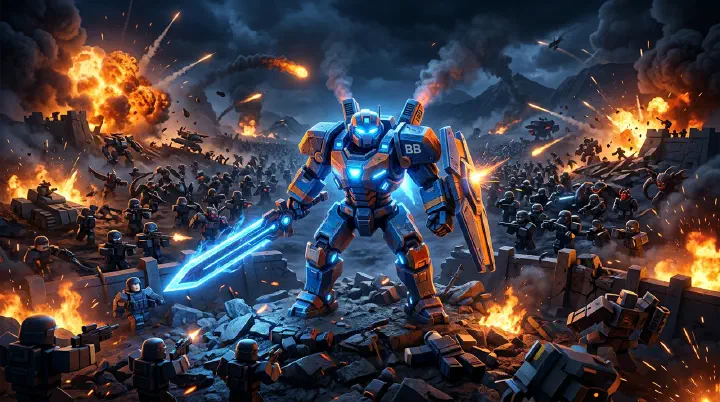
Wave 35. The “Incoming swarm” warning flashes red across your screen and the bass drop hits your headphones. You check the minimap expecting to see coverage on both lanes. Instead, your stomach drops. Your team has placed three Cameramen in the same lane — two base units and one upgraded — all beaming the same chokepoint while the other lane sits completely empty, a wide-open highway straight to your base. Your Upgraded Speakerman is fighting adds alone on the far side because nobody else bothered to cover it. One teammate is spam-pinging a spot behind your front line while their own Titans are bleeding out to a mob they ignored. Another is standing still at the Cen shop, presumably reading upgrade descriptions in the middle of combat. You are sprinting between both lanes, lungs burning, trying to collect enough Cen to place a fourth unit, knowing in your gut you will not make it in time. You pause for half a second to ping the empty lane one more time. Nobody moves. The swarm hits. The empty lane leaks within 8 seconds. The boss walks through your undefended flank. The base explodes. You lose. Not because you played badly. Because you trusted four strangers to do their job — and they did what strangers always do.
This is the solo queue experience in Blockade Battlefront. It is not a skill issue. It is a trust issue — specifically, the mistake of trusting four strangers to understand lane coverage, economic pacing, and boss positioning. The good news is that solo queue is not unwinnable. It is a different game with different rules, and once you stop playing team-mode strategies in a lobby full of individuals, your win rate climbs fast. Here is how to treat public lobbies like the survival challenge they actually are.
Why Solo Queue Feels Impossible
Most solo queue losses look like team failures, but they are actually decision failures. The player who understands solo queue mechanics can carry a lobby of beginners to wave 50. The player who treats public lobbies like coordinated runs dies at wave 30 blaming everyone else. Here are the five mistakes that make solo queue feel rigged.
Mistake 1: Trying to coordinate with uncooperative teammates. You type “cover left” in chat. Nobody responds. You ping the empty lane. Three players stay right. You spend the next 20 seconds pinging, typing, and getting frustrated — while missing Cen drops, forgetting to reposition your own Titans, and building false confidence that someone will eventually listen. They will not. Solo queue coordination has a time cost and a mental cost, and after wave 5 the return on investment is negative. One ping per wave. If they do not move, assume they are bots and play accordingly.
Mistake 2: Building a team-dependent loadout. Titan Cineman is an S-tier unit in coordinated play. Its 15% vulnerability debuff multiplies the entire team’s damage. In solo queue, you place Cineman, activate the spotlight, and watch your three Cameramen teammates ignore the debuffed target to shoot a 50-HP add. That 15% amplification is wasted on players who do not understand focus fire. Solo queue loadouts must produce 100% of their value from the unit itself — not from team coordination.
Mistake 3: Filling gaps instead of creating pressure. When your team abandons a lane, the instinct is to plug the hole. You sell a unit, rush to the empty lane, and place a stopgap Titan. Now you have split your economy, diluted your coverage, and positioned yourself reactively for the rest of the run. The enemy does not care which lane leaks. They care about total pressure. Plugging gaps is a losing strategy because you are always one step behind.
Mistake 4: Not having a backup plan for leavers. A teammate disconnects at wave 28. You panic because your entire strategy assumed four players of Cen income. You have no solo-clear unit. You have no plan for 100% lane coverage. The remaining three players limp to wave 35 and die to the first swarm because nobody prepared for the possibility of playing with a smaller team. Leavers are not emergencies. They are standard events. Plan for them in your first 10 waves.
Mistake 5: Copying premade squad strategies. Every YouTube guide assumes a coordinated team with assigned roles — one player handles Cen economy, one handles boss DPS, one handles swarm clear, one handles flank coverage. In solo queue, every player thinks they are the boss DPS. Nobody is the flank coverage. The strategies that work in Discord voice calls fail in public lobbies because they rely on trust you do not have. Solo queue is its own game mode with its own meta.
The Solo Carry Loadout
If you cannot trust your team, you must trust your units. The solo carry loadout prioritizes self-sufficiency, map independence, and forgiveness over raw peak damage. Here is the decision framework for building it.
If you are the only one watching flanks → use Upgraded Titan Speakerman. Its rapid fire covers both lane entrances without perfect positioning. The 8-second stun passive buys time when adds slip past your front line. Unlike Upgraded Cameraman, which requires a front line to survive long enough to beam, Speakerman handles its own leaks. It is lower DPS on paper, but dead DPS is zero DPS — and in solo queue, your Cameraman will die.
If you need to boss-kill alone → use Upgraded Titan Cameraman, but only with an escape plan. Cameraman has the highest single-target damage in the game. It also has paper defenses and a habit of dying in 8 seconds when nobody tanks. The solo queue rule: place Cameraman at maximum range, behind a disposable meat shield like Large Cameraman or Brown Cameraman. If the meat shield dies, sell and reposition before the boss reaches the beam. Never place Cameraman at the front line in a public lobby. Your teammates will not save it.
If your team has zero AoE → use Upgraded Titan TV Man. Swarm waves in solo queue are where runs die, because three players are shooting individual targets while 40 adds pour through. TV Man’s screen-wide AoE does not care about your team’s target discipline. It clears the swarm while your teammates finish stragglers. TV Man is expensive at 6,500 Cen, but it is the only unit that compensates for a team’s lack of awareness.
If a teammate leaves mid-run → sell Titan Cineman immediately. Cineman’s value is multiplicative. With a full team, it is mandatory. With a partial team, it is a waste of a deployment slot. Replace it with a second self-sufficient clear unit — Large Speakerman, Jetpack Plunger Cameraman, or another TV Man if you can afford it. Your new goal is coverage, not optimization.
If you do not know what your team is doing → default to balanced survivability. One Upgraded Speakerman, one Large Cameraman, one Titan TV Man if affordable. This trio covers swarm clear, stun lock, and a front line that does not require micro. It will not speedrun wave 90, but it will get you to wave 50 consistently — which is more than most solo queue lobbies manage.
When to Ignore Your Team and Do Your Own Thing
There is a moment in every solo queue run where you have to choose between being a good teammate and being a winning player. Here is how to know which side to pick.
Ignore your team when they cluster. If three players are stacked in one lane at wave 20+, do not join them. Do not ping them back. Let them fight over Cen drops and beam the same target. Your job is the other lane. The clustered lane will clear its enemies — three players can handle one lane. The empty lane will leak without you. Coverage beats coordination every time.
Ignore your team during boss waves. Boss waves require focus fire and ability timing. Solo queue teams do neither. They use abilities on wave 49 stragglers. They shoot adds during the boss fight. They cluster into cleave lines. Do not try to fix this. Save your own abilities. Position your own Titans for maximum personal output. If the team wipes, you want to be the last one standing with a chance to clutch — not the one who died trying to get them to spread out.
Ignore your team when they argue. Chat fights in BBF are performance art. Nobody changes their mind. Everyone misses Cen drops while typing. If two teammates are flaming each other, mute them mentally and play harder. A player engaged in a chat argument is functionally AFK. You are now covering their lane too. Accept it and move on.
Do not ignore your team when they accidentally do something right. If a random teammate places Titan TV Man dead center at wave 30, that is a player who understands the game. Support them. Cover their weak lane. Ping their good placement with a thumbs-up. Solo queue carries are not solo — they are just players who recognize the one competent person in the lobby and build around them.
Counter-Intuitive Solo Queue Rules
The advice that works in premade squads will kill you in public lobbies. Here are the rules that sound wrong until you try them.
Sometimes the best teammate is the one who left. A departure at wave 25 sounds catastrophic, but it consolidates Cen income onto fewer players. In a 4-player lobby, you get roughly 25% of total map Cen. In a 3-player lobby, you get 33%. That 8% increase compounds every wave and often lets you afford Upgraded TV Man or a second Upgraded Speakerman earlier than you could in a full lobby. The leaver also removes a body that was probably stealing kills, clustering lanes, and using abilities at the wrong time. Treat a departure as an economic buff, not a disaster.
Don’t fill the gap your team left — create a new gap the enemy can’t handle. When your team abandons a lane, the instinct is to plug it with a single Titan and play defense. The better play is to overcommit your strongest lane. Stack three Titans on one side, clear it in 10 seconds, then rotate everything to the other lane. The enemy AI does not split forces based on your coverage — it sends waves on a timer. If you clear one lane fast enough, you have 15-20 seconds to reposition before the next wave hits the other side. Offense is faster than defense.
The worst place to be is where your team already is. Cen drops, enemy density, and Titan effectiveness all suffer from overcrowding. Three players in one lane means stolen kills, missed drops, and Titans blocking each other’s line of sight. The value of a second player in a lane is high. The value of a third player is near zero. The value of a fourth player is negative. If your minimap shows two dots in your lane, leave. Go anywhere else. Your presence is more valuable where nobody else is.
Let bad Titans die. If a teammate places a base Cameraman at the front line during wave 40, it will die. Do not save it. Do not heal it. Do not reposition your own Titan to cover it. A bad player’s dead Titan frees up their deployment limit, which they will hopefully use more wisely next wave. If you save it, you reward the bad placement, waste your own positioning, and teach them nothing. Solo queue is Darwinian. Let natural selection work.
Saving Cen is often better than spending it. In coordinated play, unspent Cen is dead Cen — you want full deployment at all times. In solo queue, holding 2,000 Cen for an emergency Upgraded Speakerman is smarter than spending it on a Large Cameraman that will die because nobody covers it. Liquidity is power when your team is unpredictable. The player with Cen in the bank can react to a leaver, a lane leak, or a surprise boss. The player with a full board can only watch things burn.
Adapting Your Loadout to a Bad Team
Your ideal loadout changes based on what your team is doing wrong. Here is the diagnostic checklist at wave 15.
| What Your Team Is Doing | What You Should Build | Why |
|---|---|---|
| Clustering in one lane | Upgraded Speakerman + mobile filler | Covers the empty lane without requiring team rotation |
| No AoE, struggling with swarms | Rush Upgraded TV Man | Only unit that compensates for missing crowd control |
| Wasting abilities on trash waves | Self-sustaining units, save your own abilities | You cannot fix their timing, so be the only player with cooldowns ready |
| Buying expensive Titans too early | Cheap coverage units, bank Cen | They will die before paying off; you need liquidity when the team collapses |
| Leaving mid-run | Sell Cineman, double down on solo clear | Multiplicative buffs are wasted with fewer players |
| Arguing in chat instead of playing | Balanced survivability loadout | They are functionally AFK; you need units that cover multiple lanes alone |
Use this table as a decision tree, not a rigid build order. Solo queue rewards adaptation. The player who copies a premade build order dies at wave 35 when the team deviates from the script. The player who diagnoses the lobby in the first 15 waves and adjusts their economy accordingly is the one who carries.
Solo queue in Blockade Battlefront is not a test of mechanical skill. It is a test of emotional discipline and strategic self-reliance. The players who climb in public lobbies are not the ones with the fastest ability rotations or the most upgraded Titans. They are the ones who stopped expecting teamwork from strangers and started building loadouts that win despite it. Trust your units. Cover the empty lane. Let bad plays die. And when your team finally does something right — even by accident — be ready to capitalize on it. That is how you survive solo queue. That is how you carry.
Related Guides: