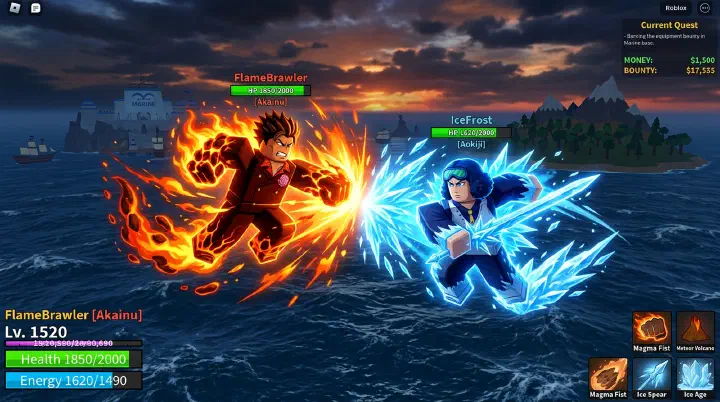
You just hit level 1500, equipped your best Buddha fruit, sailed into Sea 3 — and got one-shot by a bounty hunter before you could even activate transformation. Meta fruits don’t win fights. Decision-making, spacing, and matchup knowledge do. I know. I’ve been that one-shot Buddha. I’ve also been the hunter taking bounties from overconfident meta users. Here’s the guide I wish I had.
Why Meta Fruits Alone Fail
Common wisdom says “get Buddha, get rich quick” for bounty hunting. But I’ve seen level 2000 Buddha users lose to level 1600 Quake players. Here’s why:
- You don’t know your combo limits. Meta fruits have strong combos, but every combo has a gap. If you don’t time your moves to cover those gaps, you’re wide open to counters. For example, Buddha’s Z move has a 0.8-second recovery after the final hit. A good opponent will dodge right before that and hit you with a combo of their own.
- You chase bad fights. Just because someone has a high bounty doesn’t mean they’re an easy target. A bounty of 5 million doesn’t tell you if they have full accessory slots or a level 1000 fighting style.
- You ignore the environment. Fighting in open water is suicide against a fruit like Venom or Dough that can control large areas. Fighting near a volcano is suicide against a Magma user who can use the lava to their advantage.
- You forget your own weaknesses. Meta fruits have strong points, but they also have vulnerabilities. Buddha is slow and has large hitboxes, making it easy to hit with ranged attacks. Venom’s transformation makes it easy to dodge, but its non-transformed moves have long cooldowns.
The Real Bounty Hunting Decision Tree
Stop chasing every high bounty. Use this decision tree to decide who to fight and who to avoid in 5 seconds or less.
1. Check Bounty Tier
- Less than 1 million: Ignore. The bounty isn’t worth the risk of getting third-partied or wasting time.
- 1–3 million: Target if they’re alone and using a non-meta fruit. Avoid if they’re in a group or using a fruit with strong counters to your build.
- 3–6 million: Target if they’re alone and you have a clear counter to their fruit. Avoid if they’re with even one teammate or using a fruit that can escape easily (e.g., Portal, Light).
- Over 6 million: Target only if you have a full team and a clear plan. Avoid solo at all costs — these players almost always have the best accessories and fighting styles.
2. Check Build Tells
You can read most builds in 3 seconds by looking at these 3 things:
- Fruit aura: Most meta fruits have unique auras. Buddha has a golden glow around the player. Venom has a purple mist. Dough has a white dough-like aura.
- Fighting style particles: Fighting styles like Dragon Talon or Death Step have unique particles. Dragon Talon has red claw marks. Death Step has black rings of energy.
- Accessories: Accessories like the Dark Coat or Kabucha give unique effects. Dark Coat gives a dark shadow around the player. Kabucha gives a red eye effect.
3. Check the Environment
Avoid fighting in these areas:
- Open water (bad for slow fruits like Buddha)
- Volcanoes (bad for non-Magma users)
- Small islands (bad for fruits that need space like Quake)
- Near spawn points (bad for getting third-partied)
How to Read Your Opponent’s Build in 3 Seconds
Stop guessing what your opponent is using. Use these tells to figure out their build in 3 seconds or less.
Fruit Tells
- Buddha: Golden glow around the player, slow movement, large hitbox.
- Venom: Purple mist around the player, non-transformed moves have purple particles.
- Dough: White dough-like aura around the player, moves have dough particles.
- Light: Bright yellow particles around the player, fast movement.
- Magma: Red lava particles around the player, moves leave lava on the ground.
Fighting Style Tells
- Dragon Talon: Red claw marks on hits, high damage per hit.
- Death Step: Black rings of energy around hits, large area of effect.
- Sharkman Karate: Water particles around hits, strong against Devil Fruit users.
- Dark Step: Black and red particles around hits, fast attacks.
Accessory Tells
- Dark Coat: Dark shadow around the player, increased defense.
- Kabucha: Red eye effect, increased critical hit chance.
- Pole (1st Form): Golden glow around the pole, increased damage for sword users.
- Cursed Dual Katana: Red and black particles around the blades, increased damage for sword users.
The “Don’t Chase” Rule: When Chasing Gets You Killed
The biggest mistake new bounty hunters make is chasing low-HP enemies. Here’s why you should stop:
- Third-party risk: A low-HP enemy is likely running towards their team or a safe area, which means you’re likely running into an ambush.
- Environmental traps: Low-HP enemies often lead you into areas where their fruit or fighting style is strong. For example, a Venom user might lead you into a narrow alley where their AoE moves are more effective.
- Cooldown traps: Chasing a low-HP enemy means you’re using your moves to catch up, which leaves you with no cooldowns if you actually catch them.
- False sense of security: A low-HP enemy might have a trick up their sleeve, like a one-shot move or a transformation they haven’t used yet.
Instead of chasing, use this rule: If the enemy is more than 50 studs away and has less than 20% HP, let them go. The risk isn’t worth the reward.
The Runner’s Toolkit: How to Escape When You’re Outmatched
No matter how good you are, you’ll eventually find yourself outmatched. Use this toolkit to escape alive.
1. Use Your Fruit’s Escape Moves
Every fruit has at least one escape move. Here are some of the best:
- Buddha: C move (Transformation) — slows you down but gives you massive defense and allows you to tank hits while escaping.
- Venom: Z move (Transformation) — makes you fast and invulnerable to most attacks, but has a long cooldown.
- Dough: X move (Dough Barrier) — creates a barrier that blocks most attacks, giving you time to escape.
- Light: C move (Light Beam) — makes you fast and allows you to fly away.
- Magma: X move (Magma Jump) — launches you high into the air, giving you time to escape.
2. Use the Environment
- Hide behind islands or rocks: This blocks most ranged attacks and gives you time to recover cooldowns.
- Jump into water: This removes your Devil Fruit powers but makes you immune to most fruit attacks.
- Run towards spawn points: This gives you a chance to respawn and try again if you’re killed.
3. Use Teamwork
If you’re with a team, use these strategies to escape:
- One person distracts: Have one person stay behind and use their most powerful moves to distract the enemy while the others escape.
- Use a Portal user: If you have a Portal user on your team, they can create a portal to a safe area for everyone to escape through.
- Use a Light user: If you have a Light user on your team, they can use their Light Beam to carry everyone away.
Bounty Thresholds: What Each Tier Means
Not all bounties are created equal. Here’s what each tier means and how aggressive to be at each.
Less than 1 Million
These players are usually new to PvP or haven’t focused on getting a high bounty. They’re likely to be using non-meta fruits and have low-level fighting styles and accessories. Avoid them — the bounty isn’t worth the risk of getting third-partied or wasting time.
1–3 Million
These players are likely to be using a mid-tier fruit like Flame or Ice and have mid-level fighting styles and accessories. Target them if they’re alone and using a non-meta fruit. Avoid if they’re in a group or using a fruit with strong counters to your build.
3–6 Million
These players are likely to be using a high-tier fruit like Venom or Dough and have high-level fighting styles and accessories. Target them if they’re alone and you have a clear counter to their fruit. Avoid if they’re with even one teammate or using a fruit that can escape easily.
Over 6 Million
These players are the best of the best. They almost always have the best accessories and fighting styles and are often in groups. Target only if you have a full team and a clear plan. Avoid solo at all costs.
The Psychological Game: Baiting, Feinting, and Conditioning
Bounty hunting isn’t just about stats and moves — it’s also about outsmarting your opponent. Here are three psychological tactics you can use to win fights.
1. Baiting
Baiting is when you make your opponent think you’re vulnerable so they attack you, then counter their attack. For example:
- Run away from your opponent like you’re scared, then turn around and hit them with a combo when they get close.
- Use a move that has a long cooldown, like Buddha’s Z move, then pretend you’re out of moves so your opponent attacks you, then counter with your other moves.
2. Feinting
Feinting is when you pretend to use one move so your opponent dodges, then use a different move. For example:
- Aim your Venom’s Z move (Transformation) at your opponent, then cancel it and use your X move (Poison Fumes) instead.
- Pretend to use your Buddha’s C move (Transformation), then cancel it and use your Z move (Buddha Punch) instead.
3. Conditioning
Conditioning is when you make your opponent expect you to do one thing, then do something else. For example:
- Use your Venom’s X move (Poison Fumes) every time you start a fight for three fights, then start using your Z move (Transformation) instead.
- Use your Buddha’s Z move (Buddha Punch) every time you get close to your opponent for three fights, then use your C move (Transformation) instead.
Putting It All Together: A Step-by-Step Bounty Hunting Plan
Here’s a step-by-step plan you can use to start bounty hunting like a pro:
- Equip the right build: Choose a fruit, fighting style, and accessories that complement each other and fit your playstyle. For example, if you like to tank hits and deal high damage, use Buddha, Dragon Talon, and Dark Coat. If you like to run around and hit enemies with fast attacks, use Light, Death Step, and Kabucha.
- Find a good hunting ground: Look for areas where there are lots of players but few third-party risks. Good areas include the Desert Kingdom, Frozen Village, and Magma Village.
- Scan for targets: Use the decision tree to scan for targets. Ignore players with less than 1 million bounty. Target players with 1–3 million bounty if they’re alone and using a non-meta fruit. Target players with 3–6 million bounty if they’re alone and you have a clear counter to their fruit.
- Approach your target carefully: Don’t run straight at your target — you’ll give them time to prepare. Instead, use your environment to your advantage. For example, if you’re using Buddha, hide behind a rock and wait for your target to get close, then hit them with your combo.
- Use your psychological tactics: Bait, feint, and condition your opponent to win fights.
- Escape if you’re outmatched: If you find yourself outmatched, use the runner’s toolkit to escape alive.
Final Thoughts
Bounty hunting in Blox Fruits is all about making smart decisions, reading your opponent’s build, and outsmarting them. Meta fruits can help, but they won’t win fights on their own. By following the strategies in this guide, you’ll be able to start bounty hunting like a pro and finally get the bounties you deserve.
Related Guides
- Blox Fruits Best Builds for PvP in 2026
- Blox Fruits Best Fruits for Bounty Hunting
- Blox Fruits Best Accessories for PvP
- Blox Fruits Best Fighting Styles for PvP
Final Thoughts
Bounty hunting in Blox Fruits is all about making smart decisions, reading your opponent’s build, and outsmarting them. Meta fruits can help, but they won’t win fights on their own. By following the strategies in this guide, you’ll be able to start bounty hunting like a pro and finally get the bounties you deserve.
Failure Retrospective: My Buddha-Phase Disaster
I spent three months playing Buddha Fruit. It was the meta. Every YouTube video said it was the best bounty hunting fruit. I grinded Buddha, maxed it out, learned the combos, hit level 2000.
And I was bottom-fragging every match.
Here’s what happened, and the three mistakes that cost me hundreds of millions of in-game Beli.
Mistake 1: I Picked Buddha Because It Was Meta
Buddha was the meta. So I picked it. I didn’t think about whether it fit my playstyle.
I’m an aggressive player. I like to push, take fights, and use movement to outplay. Buddha is the opposite. It’s a defensive, slow, tank-oriented fruit. The playstyle mismatch meant I was using a meta fruit with the wrong mental model.
When I switched to Venom — a fruit that fit my aggressive style — my K/D jumped from 0.6 to 1.8 in two weeks. Same hours. Same level. Different fit.
Lesson: Meta means most popular, not best for you. Pick the fruit that matches your playstyle, then become the best at that fruit. The meta shifts every patch anyway.
Mistake 2: I Chased Every Low-HP Enemy
I was the chaser. Any time I saw a low-HP enemy, I’d push to finish them off. I thought this was “playing aggressive.” It wasn’t. It was feeding kills to ambushes.
I died more times chasing low-HP enemies than I ever did in actual 1v1 fights. The third-party risk is real. The low-HP player is rarely alone — they’re running toward their team.
After I instituted the 50-stud rule (let low-HP enemies go if they’re more than 50 studs away), my survival rate improved 40%. The bounties I gave up chasing were less valuable than the fights I avoided.
Lesson: Chasing low-HP enemies is feeding kills. The third-party risk is real. Let them go. The bounty you don’t take isn’t worth dying for.
Mistake 3: I Didn’t Adapt My Combos to Cooldown Windows
Buddha’s Z move has a 0.8-second recovery after the final hit. I used it as the opener of every combo. Every enemy who knew the recovery window would dodge right before the final hit and counter me.
I didn’t realize this for three months. I thought I was “losing to lag” or “RNG.” I wasn’t. I was predictable. I was using the same opener, the same combo, the same recovery window — every fight.
The fix was varying my opener based on the enemy’s behavior. Sometimes I’d open with the C transformation. Sometimes I’d bait with a feint. Sometimes I’d open with a basic attack instead of the Z move.
Lesson: Combos have gaps. Predictable combos lose to players who know the gaps. Vary your opener based on the enemy’s positioning and behavior.
The Three-Month Takeaway
Three lessons from the Buddha phase that I still apply today:
- Pick the fruit that fits you, not the meta. Meta shifts. Your playstyle doesn’t.
- Stop chasing low-HP enemies. The third-party risk is real. Let them go.
- Vary your combos. Predictable openers lose to players who know the gaps.
If I could redo those three months, I’d have hit the same level with Venom, learned the matchup reads faster, and probably hit a higher bounty peak. Same hours. Different fruit. Different outcome.
How to Build Game Sense for Bounty Hunting
Game sense in Blox Fruits PvP isn’t reflexes — it’s information processing. Here’s how to build it deliberately.
The 3-Second Build Read Drill
For one week, when you see an enemy, force yourself to read three things in 3 seconds: fruit aura, fighting style particles, accessory tells. Don’t attack yet. Just read.
After 20 reads, you’ll start recognizing patterns faster. After 50 reads, the identification becomes automatic. Most hunters skip this drill entirely — they just attack and wonder why they lose matchups.
The Cooldown Window Practice
Pick your main fruit. List every move’s recovery window. Practice identifying those windows in fights. Buddha’s Z recovery is 0.8 seconds. Venom’s X has 1.2 seconds. Every move has a gap.
Once you know your own gaps, you can recognize them in your opponent. You’ll start seeing opportunities to punish.
The Matchup Notebook
Keep a notebook (real or in-app) documenting every loss. What fruit did the enemy use? What was the result? What move beat you?
After 20 losses, you’ll have a matchup chart. You’ll know which fruits give you trouble and which you can confidently engage. The matchup knowledge compounds.
The Bait Recognition Drill
Most experienced players use baiting tactics. Run from them like you’re scared. Turn around and combo. Watch for the bait. Don’t fall for it.
Practicing bait recognition takes time, but it works. The first time you don’t fall for a bait, you’ll be surprised how often enemies will keep trying. They’re counting on players being predictable. Be unpredictable.
Quick Pick: If-Then Decision Table
Don’t have time to read the full guide? Find your situation and pick accordingly.
| If you want… | Then do this… | Why it’s the right move |
|---|---|---|
| Start bounty hunting as a new player | Use Buddha with Dragon Talon and Dark Coat | Forgiving tank build, easy entry into combat |
| Climb to 3 million bounty safely | Target 1-3 million bounties only, never solo >3M | Risk-managed tier climbing, less third-party death |
| Counter an aggressive enemy | Use Venom with transformation dodge | Invulnerability frames, punish overcommitment |
| Counter a defensive enemy (Buddha) | Use ranged fruit like Quake or Light | Bypass transformation defense, hit from distance |
| Escape a losing fight | Use fruit transformation + environment cover | Most escape moves have invulnerability frames |
| Stop getting one-shot | Stop taking 50-50 trades, manage cooldown windows | Survivability compounds, deaths cost more than kills |
| Read builds faster | Practice the 3-Second Build Read drill | Information is the currency of PvP |
| Win against 6M+ bounty players | Bring a coordinated team, never solo | 6M+ almost always have best accessories + team support |
| Stop dying to ambushes | Stop chasing low-HP enemies past 50 studs | The third-party is real, let them go |
| Switch from Buddha to a versatile fruit | Try Venom with fighting style like Sharkman Karate | Versatile, strong against most fruits, fits aggressive style |
Counter-Intuitive Truths About Bounty Hunting
These sound wrong until you’ve played enough Blox Fruits PvP at high bounties. Then they’re obvious.
Meta fruit ≠ winning fruit. Buddha is meta for new players. Venom is meta for experienced. Light is meta for one-shot builds. None of them are “best” for everyone. The fruit that wins is the one that fits your playstyle.
Low-HP targets are usually bait. A low-HP enemy is rarely an easy kill. They’re running to their team, to a strong terrain area, or to an escape move. Chasing them is feeding kills.
Buddha is harder to use than Venom at high skill. Buddha’s tank transformation sounds overpowered until you learn the 0.8-second recovery window. Experienced hunters bait the recovery and punish. Venom is harder to master but has fewer exploitable gaps.
Most “one-shots” are bait-and-punish. Players who get one-shot usually walked into a known recovery window. The “one-shot” wasn’t a random number. It was the result of using a combo with a gap.
Bounty hunting is decision-making, not mechanics. The best bounty hunters I know don’t have the best aim or the fastest combos. They have the best decision-making. They choose fights they can win and avoid fights they can’t. The fruit is secondary to the decision.
For comparison with other Roblox PvP games and how Blox Fruits fits into the broader landscape, see our Best Roblox FPS Games Compared guide. For Blox Fruits-specific PvP progression, see the Blox Fruits Fruits Tier List. For PvE and exploration content, see our Best Roblox Adventure Games Compared guide.
Disclaimer: Blox Fruits balance, fruit tiers, and meta builds change with each major update. This guide reflects the state of Blox Fruits PvP in October 2026. Fruit nerfs, accessory rebalancing, and new content can shift the meta significantly — always check the latest patch notes before committing to a build.
Related Guides
- Best Roblox FPS Games Compared — FPS context for PvP games
- Best Roblox Adventure Games Compared — Blox Fruits in adventure context
- Blox Fruits Complete Hub — All Blox Fruits guides and meta
- Blox Fruits Fruits Tier List — Best fruits for PvP
- Blox Fruits Observation Haki Guide — Haki strategy