The Arena Match That Changed Everything
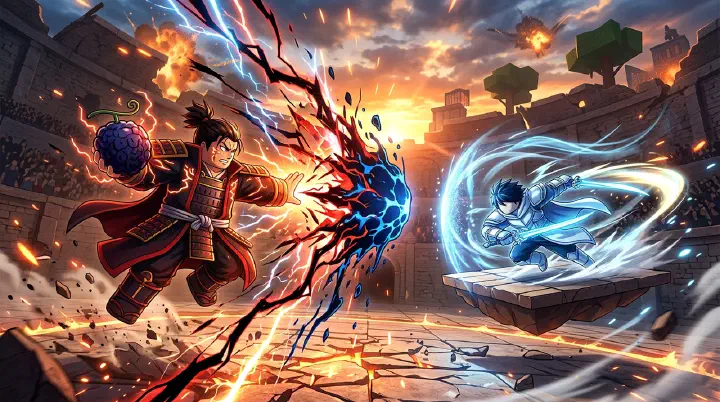
The Port Town arena on Sea 3. Your opponent loads in — level 1500, a plain Magma fruit. Not awakened. Not mythical. Just the base red-text Magma you can buy for 650,000 Beli from the Blox Fruit Dealer.
You’re level 2200. You’ve got a Dough fruit you spent 12 hours rolling for. A Dark Coat you farmed 40 Sea Beasts to afford. A V4-awakened Shark race with full gear. On paper, this fight is over before it starts.
You open with Dough Wall (C). He doesn’t dodge — he flash-steps through the wall while it’s still forming. You panic, follow with Dough Punch (X). He sidesteps it like you telegraphed the move from orbit. You switch to your sword — Cursed Dual Katana Z — and he Instinct-dodges on the exact frame it would’ve connected.
Then he hits you. Magma Z into X into C. Three moves. No wasted inputs. No hesitation. You watch your health bar go from full to zero in under two seconds. The kill screen shows 800 damage total.
You had every advantage on paper: higher level, better fruit, better gear, better race. None of it mattered. Not because Magma is secretly broken. Because that player understood the combat system at a depth you didn’t know existed.
That’s the moment the game changes. Blox Fruits PvP isn’t a stat check. It’s a combat system with layers: neutral footsies, hitstun decay math, frame traps, kaitun (Instinct-dodge) baiting, and matchup-specific counter-play. Most players never learn past “press Z, X, C in the right order.” The ones who do win 80% of their fights regardless of what fruit they’re holding.
This guide covers everything those guides don’t.
The Combat Loop: Neutral, Pressure, and Punish
Every single Blox Fruits PvP exchange follows a three-phase loop. Understanding this loop is the difference between reacting to fights and controlling them.
Neutral — Both players are on the ground, moving, neither has an advantage. This phase is about spacing, baiting, and finding the opening. Most players treat neutral as “the time before the fight starts.” It’s not. Neutral IS the fight. Every exchange begins and ends here. The player who wins neutral more often wins the match.
Pressure — One player lands a hit and starts their combo. This is the phase where most fights are won or lost. But here’s what most guides won’t tell you: pressure isn’t just about executing your combo. It’s about reading whether your opponent has an escape option ready and adjusting mid-combo. If you see them twitch during your third move, cut the combo short and reposition. A 40% combo that lands is worth more than a 100% combo that gets dodged.
Punish — The combo ends (or drops) and the other player retaliates. This is where the fight resets or ends. Great players don’t just punish with damage — they punish with information. Every punish phase tells you something about your opponent’s habits. Do they always dodge left after a knockdown? Do they panic and burn their V4? Do they freeze up for half a second? File that away. You’ll use it in the next exchange.
Most players only practice the Pressure phase — they grind combo strings in training mode but never learn how to enter or exit them cleanly. Here’s the decision framework that separates good players from great ones.
The Three-Variable Decision Framework
You have one Instinct dodge available. Your opponent is 20 studs away. The question: do you dash forward and try to land your opener, or do you wait and bait them into coming to you?
The answer depends on three variables. Run through this checklist before every engagement:
| Variable | Dash Forward If | Wait If | Why |
|---|---|---|---|
| Your fruit range | Your fruit’s longest-range move reaches beyond 25 studs (e.g., Magma Z, Venom C) | Your fruit requires close range (e.g., Buddha Z, Ice C) | You want to force the engagement where you have the advantage. Dashing in with a short-range fruit puts you in their optimal range too. |
| Their remaining dodges | They used their dodge in the last 3 seconds (you saw the flash) | They haven’t dodged recently | A player with dodge available will Instinct out of your opener 90% of the time. Wait for them to waste it or bait it out. |
| Your Instinct status | You have a dodge available and your energy bar is above 60% | Your energy is low or your dodge is on cooldown | Engaging without a dodge means one mistake = you eat their full combo. Only go in if you can afford to lose the first exchange. |
Here’s how this plays out in two real matchups:
Buddha vs. Venom: If you’re the Buddha, wait. Buddha’s C (Transformation) has a 1.5-second windup — you can’t afford to start that in neutral where Venom can land Z (Poison Beam) and interrupt you. Wait for the Venom user to miss their Z, then dash in during the 2-second cooldown window. If you’re the Venom user, you want to dash forward — your Z outranges Buddha’s entire kit, and you can poke safely from outside their transformation range.
Portal vs. Dough: If you’re the Portal user, dash forward immediately. Portal’s V (Portal Escape) beats Dough Wall every single time because it teleports you behind the wall before it finishes forming. Dough users rely on the wall to control space — you’ve just deleted their primary tool. If you’re the Dough, wait. Portal users want you to commit first so they can V out of your setup. Bait the V by feinting a C (start the wall animation, cancel it), then engage when their escape is on cooldown.
Why Your Combos Keep Dropping: The Three Failure Modes
You practiced your combo in the Training Area. It worked 10 out of 10 times against the NPC dummy. In PvP, it drops 70% of the time. Here’s why — and here’s how to fix each failure mode.
Failure 1: Hitstun Decay
Every consecutive hit in Blox Fruits reduces the enemy’s stun duration by roughly 30%. After 3 hits, the stun window is so short that even a 0.1-second delay between inputs gives them a chance to Instinct-dodge out.
The Training Area dummy doesn’t dodge. It doesn’t have ping. It doesn’t have Instinct. It’s a terrible practice partner and it’s teaching you bad habits.
The fix: Practice your combo inputs with a metronome. Record a friend’s POV while you combo them and count the frames between hits. If there’s more than a 6-frame gap (0.1 seconds at 60fps) between any two moves, the combo is unsafe in real PvP. Cut moves until the timing is tight, or swap to moves with natural hitstun extension — fighting style moves with long animation locks like God Human’s X or Sharkman Karate’s Z.
Real example: The popular Dough combo is Wall > Punch > Beam > Sword. Four moves. The gap between Beam and the sword swing is roughly 0.3 seconds on a good connection — that’s enough for anyone with 80+ ms ping to dodge out. The solution: skip the sword follow-up. Use Dough C (stun) after the combo lands instead. This trades 200 damage for a 100% confirm rate. For a full breakdown of how each Fighting Style affects combo extension and confirm rates, check the dedicated style guide.
Failure 2: Desync on High Ping
If your ping is above 100 ms, your combo timing looks different on your screen vs. the server’s reality. The move you see landing may have already whiffed on the server. You’re comboing a ghost.
The fix: Deliberately input your moves 50-100ms later than you think you should. This sounds backward — you want to be faster, right? But on high ping, the server is behind your inputs. Inputting earlier means the server sees your second move before the first one’s hitstun is registered. Delaying slightly ensures the server registers both hits in the correct order.
Test this rhythm in Arena by asking a friend with similar ping to tell you when your combos actually feel tight from their perspective. What feels “right” on your screen at 150ms is wrong on the server. You need to retrain your muscle memory for the server’s timeline, not yours. Our Observation Haki guide goes deeper into how dodge timing interacts with latency.
Failure 3: Wall Collision Interruption
If your combo pushes the enemy into a wall, the collision can reset their hitstun state or give them a free dodge window. This is especially common in arenas near the edges of the map — exactly where knockback-heavy combos naturally push enemies.
The physics engine treats wall contact as a “state reset” in some edge cases. Your opponent’s character model briefly clips the wall geometry, and the game decides they’re no longer in hitstun. One frame later, they’ve Instinct-dodged out of your “guaranteed” combo.
The fix: Position yourself 2-3 dashes away from any wall before starting your combo. If you can’t avoid wall proximity, use a combo that ends in a knock-up (Sharkman Karate C, Dragon Talon Z) instead of a knock-back. Knock-ups don’t trigger wall collision issues because the enemy’s trajectory is vertical, not horizontal.
Matchup Knowledge: Countering Every Fruit Archetype
Forget tier lists. Matchup knowledge matters more than fruit tier. A skilled player who knows the archetype they’re facing will beat someone who only knows their own combo strings, every time. Here’s the framework for countering every fruit archetype in Blox Fruits.
One-Shot Burst (Magma, Leopard, Dragon Z-combo)
How they play: Burst fruits rely on a single high-damage rotation. They’re looking for one clean opening to land their full sequence. After that rotation, their cooldowns are all active — they can’t contest you until at least two moves come back up.
How to counter: Bait their burst first. Intentionally take a bad position near a wall — they’ll burn their combo trying to trap you. After it whiffs, you have 4-6 seconds to engage freely. Don’t trade with them during their burst window. Don’t try to out-damage a Dragon Z combo. Just survive it, then punish.
Key tell: Burst players get visibly impatient when you won’t commit. They’ll start throwing out single moves fishing for a confirm. That’s your signal — they’re desperate to start their rotation. Make them wait longer.
Zone Control (Dough, Venom, Ice, Flame)
How they play: Zone controllers want to lock down an area and force you to engage through their AoE. Dough Wall, Venom puddles, Ice freeze fields — these are all tools designed to limit your movement options until you’re forced into a predictable path.
How to counter: Stay mobile. Never stand still for more than 1 second. Run laps around the arena perimeter and only dash in when one of their zone moves is on cooldown. Zone controls have strong area denial but weak close-range kits. If you close the gap inside their zone (inside Dough Wall, past Ice’s freeze range), they have no tools to stop your combo.
Key tell: Zone controllers panic when you’re inside their zone. They’ll burn their escape move (Portal V, Light C) immediately. Track that cooldown — it’s longer than you think.
Hit-and-Run (Light, Portal, Phoenix)
How they play: Hit-and-run fruits ALWAYS have an escape plan. They land a quick combo, then disappear before you can retaliate. They win by accumulating small damage advantages over time, not by securing kills in one rotation.
How to counter: Anticipate their exit route, not their entrance. Instead of chasing them after they hit you, position yourself between them and their escape vector (usually open water or the arena center). If you cut off their escape, they’re forced to fight in neutral where they’re weakest. Portal users especially panic when they can’t V-teleport to safety because you’re standing on their landing spot.
Key tell: Hit-and-run players always look toward their escape destination before they commit to an attack. Watch their character’s facing direction — it tells you where they’re going before they go there.
Grappler/Tank (Buddha, Buddha-Sword hybrids)
How they play: Grapplers win in sustained contact because they have higher base Melee damage and passive defense. They want you in their face, trading M1s, where their stat advantage guarantees they’ll out-damage you.
How to counter: Don’t trade M1s with them. Ever. Use a “poke and retreat” pattern: land a ranged move, back off, wait for cooldowns, repeat. Buddha and tank builds are designed to win the damage race in close quarters. By refusing to stay in that range, you force them to use their slow, telegraphed moves to close distance — moves you can Instinct-dodge.
Key tell: Buddha players get frustrated when you won’t engage. They’ll start transforming early or burning their gap-closers predictably. That’s when you punish.
Transformer (Venom full trans, Dragon full trans, Phoenix full trans)
How they play: Transformed fruits are statistically the strongest in the game for their duration. They have to come to you — transformations are melee-range or short-range by design. Every transformation has a duration limit, usually 30-45 seconds.
How to counter: Run out their transformation timer. Spend that time dodging, not fighting. Use fruits with good mobility (Light, Portal, Phoenix) or fighting styles with long-range pokes (Dragon Talon C, Sharkman Karate Z). A transformed Venom with no enemies in range for 20 seconds has wasted half their timer. You don’t need to beat them in their transformed state — you just need to survive it.
Key tell: Transformers get aggressive the moment they transform. They know the clock is ticking. Use that desperation against them — they’ll overextend, and overextended transformers are punishable.
The Real “Tier List” Is Situational
A Magma fruit is F-tier against a player who stays airborne and pokes from range. It’s S-tier against a Buddha who tries to tank hits standing still. Your fruit’s tier changes with every single matchup. Learn the archetype of what you’re facing and adjust your playstyle — don’t expect a static tier list to win fights for you. The players who obsess over tier lists are the ones who lose to “low-tier” fruits and can’t explain why.
5 Counter-Intuitive PvP Rules That Will Double Your Win Rate
Rule 1: Fight Without Your Fruit to Improve With It
If you want to get good at your fruit, spend your first 10 arena matches using only your fighting style and sword. No fruit abilities at all. This forces you to learn positioning, spacing, and timing from the ground up. When you add your fruit back, you’ll instinctively know when to use it instead of relying on it as a crutch.
Every top arena player I’ve met has done this drill at some point. The ones who skipped it are the ones who fall apart the moment their fruit combo gets countered — because they never learned the fundamentals underneath.
Rule 2: The Best Move to Use Is the One You Don’t Use
In a close fight, players panic and cycle through all their moves as fast as possible. The winner is almost always the one who holds one move in reserve. Having a move available that your opponent doesn’t know about changes the dynamic of the fight — they have to play around the possibility, which gives you control over their movement.
Save your C move. Using it late wins fights. Using it on cooldown gets you predicted. Your opponent is counting your cooldowns whether you realize it or not. When they think you’ve got nothing left, that’s when you use it.
Rule 3: Lower Your Graphics Settings to Improve Instinct Timing
This sounds ridiculous but it’s mathematically correct. Instinct dodge has a visual tell — a brief white flash around the enemy’s character model. On high graphics settings, particle effects, bloom, and map lighting obscure this flash. On minimum graphics, the flash is the only bright thing on screen. Top competitive players run minimum graphics specifically for this reason.
The same applies for audio cues: turn down music and keep SFX high so you hear ability windup sounds before you see them. Buddha’s Z has a distinct audio cue that starts 0.4 seconds before the visual — that’s 0.4 extra seconds to react. On high settings with music blaring, you miss it every time.
Rule 4: Losing the First Exchange Can Win You the Fight
If your opponent lands their opening combo — don’t panic-mode Instinct dodge away. Take the combo. Watch which moves they use and in what order. Now you know their rotation.
When they inevitably use the same sequence 10 seconds later (because muscle memory is hard to break), Instinct the key confirm move and punish with your own combo. Players who always dodge the first combo learn nothing about the opponent. Players who take it and learn win the second exchange — and the second exchange is usually the last one.
Rule 5: Stop Moving for One Second
There’s an invisible skill filter in Blox Fruits PvP: players who can stand still for one second without panic-dashing or spamming moves, and players who can’t.
Standing still forces the opponent to commit to an approach — they have to be the one to enter your range on your terms. It’s psychologically disorienting because most players expect constant movement. Try it: in your next arena match, start by standing completely still for one full second. Watch how many opponents sail right past you because they committed to a dash and overshot. Punish them. One second of stillness wins more neutral exchanges than five seconds of frantic dashing.
Arena Strategy: Playing the Map, Not Just the Opponent
Most PvP advice focuses on what moves to press. Here’s what the arena map itself tells you — and how to use it.
The Center vs. Edge Dynamic
The arena center gives you space to dodge in any direction — it’s the strongest neutral position on the map. The arena edge gives your opponent predictable escape routes (toward center or toward water) — it’s the strongest pressure position in the game.
When you’re center: Don’t leave it unless you have to. Let the opponent approach you. If you chase them to the edge, you give up your positional advantage for nothing. The center is yours. Make them take it from you.
When you’re on the edge: Your top priority is resetting to center, not landing a combo. Use an escape move (Portal V, Light C, even a well-timed Instinct dash) to reposition before engaging. Fighting from the edge puts you at risk of wall collision drops and environmental knockbacks. One bad edge fight costs more than three good center fights.
Water Hazards
Fruits with knock-back moves (Magma X, Flame C, Ice X) become S-tier near water edges. A single knock-back into water is a 10-second removal from the fight — effectively a win in team modes. If you’re fighting near water without a water-safe fruit (only Magma, Ice, or abilities that let you fly), your first priority is repositioning away from the edge. Don’t try to outplay near water. Just leave. The risk-reward is never in your favor.
Timer Awareness
In arena, the timer creates different win conditions depending on the clock:
- 90-60 seconds remaining: Play normal neutral. The timer isn’t a factor. Focus on clean execution and gathering information about your opponent’s habits.
- 60-30 seconds remaining: Start tracking the health advantage. If you’re behind, take calculated risks — you need to make something happen. If you’re ahead, play defensive and force them to come to you through your zone.
- 30-0 seconds remaining: Aggression if you’re losing, evasion if you’re winning. At 30 seconds, the player with more health wins by default. If you’re ahead, don’t let the opponent force you into a bad engagement — stall. If you’re behind, you have nothing to lose. Go all-in.
FAQ
Can I win PvP with a non-meta fruit?
Yes. A skilled player with Flame or Ice will beat an average player with Dragon or Dough 8 times out of 10. The fruit matters less than your ability to execute the combat loop — winning neutral, landing your confirms, and punishing their mistakes. Focus on the system, not the fruit. The players who blame their losses on “not having a meta fruit” are the ones who haven’t learned the system yet.
How do I counter Instinct dodging?
Instinct dodging has a cooldown window. After your opponent uses Instinct, you have roughly 2 seconds to land hits before they can dodge again. Bait the dodge by starting a slow move (like Buddha Z or Magma Z), cancel it, then immediately use a fast move (like a sword M1 or fighting style X). The opponent’s Instinct will trigger on the slow move’s windup, leaving them vulnerable to the fast follow-up. This is called a “feint confirm” and it’s the single most reliable way to open against good players.
Should I use melee, sword, or fruit builds for PvP?
Hybrid builds (2 stats invested + 1 tertiary) almost always outperform pure builds at high-level play. Pure fruit builds get shut down by Instinct. Pure sword builds lack AoE pressure. Pure melee builds get outranged. The current meta is Fruit + Melee with a secondary stat in Sword for the utility moves (Cursed Dual Katana Z for combo extension, Soul Cane for mobility). Focus your stat allocation on one primary damage source and one secondary utility source. The Races Awakening Guide covers which race passives pair best with which build type.
What’s the single most important PvP skill to learn first?
Neutral game — specifically, the ability to land your opener without your opponent dodging it. Practice in Arena by forcing yourself to land exactly one opener per engagement and then resetting. Don’t chase the kill. After 100 reps of clean openers, you’ll see your win rate jump dramatically because you’re not wasting your advantage state. Most players grind combos for hours and never practice the 2 seconds of neutral that determine whether they get to use those combos at all.
How do I handle third-parties in bounty hunting?
Third-parties are the biggest killer of high bounty players. The rule: never fight two enemies at once if you can avoid it. If a third-party arrives, reset to neutral immediately — use an escape move (Portal V, Light C, Phoenix transformation) and reposition. Let the two other players fight each other first, then clean up the winner. The player who engages first against two opponents loses 90% of the time in Blox Fruits. Patience wins. Greed gets you sent back to the spawn point.
What race is best for PvP?
Shark (tank + water immunity), Draco (burst damage + combo starter), and Cyborg (Instinct break) are the top three. But your race matters less than having V4 unlocked for ANY race — the V4 ability itself is a fight reset, and the stat bonuses matter more than the passive differences between races. If you have V4 on any race, you’re competitive. If you don’t, prioritize grinding it. The V4 activation frames alone are worth more than any racial passive.