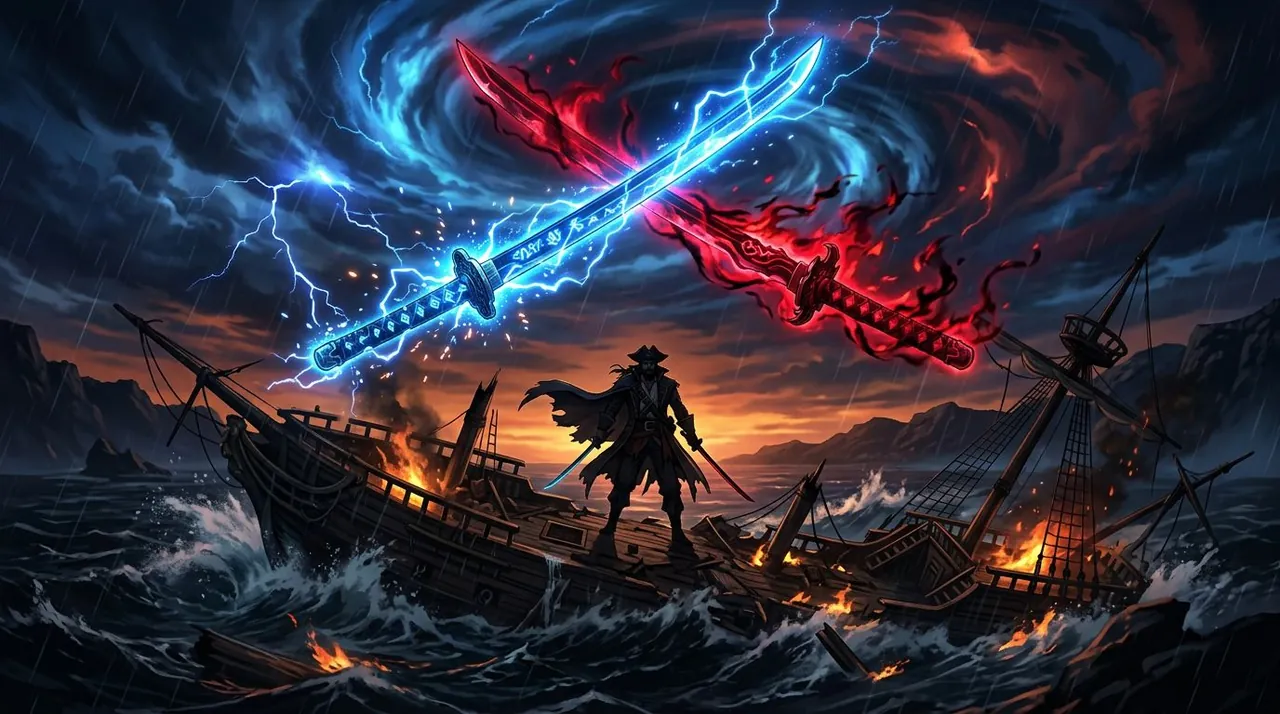
You’re at the Cursed Castle With 400 Mastery and Nothing to Show for It
You spent the last two evenings on the Floating Turtle, waiting out the clock, chasing the same small bird in circles until it finally dropped Yama. You did the grind. You pushed Yama to 400 mastery because every forum post said that’s the number. Now you’re standing inside the Cursed Castle in the Third Sea, sword in hand, and… nothing. No prompt, no glowing sword, no quest marker. You walk the halls, check every room, climb the towers. Still nothing.
That’s the Tushita wall, and it catches almost everyone the first time. The sword isn’t a boss drop and it isn’t handed to you. You have to know exactly where to look and exactly what condition the game wants before it shows up. Get one detail wrong and you’ll stand in that castle for an hour convincing yourself the game is bugged.
This guide walks the whole chain — Yama, then Tushita, then the Cursed Dual Katana fusion — in order, and it ends with whether CDK is even worth the grind for your build. If you haven’t reached the Third Sea yet, start with the Third Sea guide and come back. If you’re still below level 1500 or so, the leveling guide will get you there faster than chasing a sword.
Why CDK Still Matters in 2026
Let’s be blunt about why you’d sink days into this.
The Cursed Dual Katana has been a top-tier sword since it landed, and it has held that spot through every meta shakeup since. New swords drop every update — some are trade-bait, some are niche, a few are genuinely strong — but CDK keeps showing up near the top of sword lists years later. There are two reasons.
First, damage. CDK hits hard, and its skills chain into clean combos that punish the moment someone’s Instinct drops. In a game where trades get decided by who confirms first, CDK’s damage floor is higher than most blades.
Second, and the real reason it endures: CDK is two swords in one. It’s one of the very few blades with a moveset toggle — one key swaps you between a kick-based set and a slash-based set. That covers both a fast, low poke pattern and a wide, heavy slash pattern, patching almost every matchup hole a single-style sword has. Most swords force you into one rhythm. CDK lets you switch mid-fight.
That’s why it survives power creep. The swords and weapons guide ranks the full field, and the swords and styles meta guide tracks CDK against the newest releases. Short version: new swords get flashy, but CDK is still the benchmark they’re measured against.
Step 1: Yama — the Bird That Flees at Dusk
Yama comes from the Floating Turtle island in the Third Sea. Specifically, from one enemy: the Ghoul Vulture, a small flying bird. It only appears during Dusk — one of the game’s day-night phases — and when you hit it, it doesn’t fight back. It flees.
That fleeing is the whole mechanic, and it’s the part that trips people. The Ghoul Vulture spawns, you hit it, and it takes off across the island. You have to chase it down and keep hitting it until it dies. Kill it, and Yama drops.
Three things go wrong here, in order of how often:
First, timing. Dusk is a short window. Show up during Day or Night and there’s no bird, no matter how long you circle. Players who don’t know the game runs on a visible day-night clock will farm the island for an hour and see nothing.
Second, the chase. The bird doesn’t tank hits in place. You land one or two, it zooms off, and if you stop to check your inventory or answer a chat message, it’s gone. Then you’re waiting for the next Dusk window.
Third, the drop. It’s not guaranteed every kill, so plan to kill the Ghoul Vulture more than once.
The failure most people hit, retold. You read “Yama drops from a bird at Floating Turtle,” fly there at Night, kill a few random enemies, and leave empty-handed, convinced the guide was wrong.
- The error: You went at Night and killed whatever spawned, or you tagged the bird once and let it fly off while you checked your phone.
- The cause: The summary you read said “bird,” not “Ghoul Vulture, during Dusk, and you have to chase it down.” The Dusk condition and the flee mechanic are the two facts that get dropped in summaries.
- The recovery: Open the in-game clock, wait for Dusk, and the moment the Ghoul Vulture spawns, commit. Don’t stop. Chase it across the island, keep it tagged, and finish it before the window closes. If it escapes, don’t chase shadows — wait for the next Dusk and try again.
The island itself, and the spots the vulture tends to fly through, are mapped in the islands and locations guide if you keep losing track of it mid-chase.
Step 2: Tushita — the Sword Hidden at the Cursed Castle
Yama in hand, now you need Tushita. It’s a legendary sword tied to the Cursed Castle in the Third Sea, and it is not a boss drop. It’s a hidden pickup gated behind your Yama mastery.
The gate: your Yama has to be at a high mastery before Tushita will even appear. The number people cite is around 400 to 500 — I’d treat that as approximate, because the exact gate has shifted across updates. What’s certain: if your Yama mastery is low, the castle won’t show you anything, and no amount of standing in the right spot changes that.
Once your Yama mastery is high enough, you go to the Cursed Castle and find the sword in its hidden spot — a specific location that only becomes interactable under the right condition. That condition is where most players stall. The reliable version: bring a high-mastery Yama, go to the castle, and check the specific hidden spot the community points to. If the condition is met, the sword is there to claim.
The takeaway for planning: don’t show up to the Cursed Castle with a fresh Yama. Mastery first, castle second. The mastery grind is the real time cost of this step, not the search.
Step 3: Fusing the Cursed Dual Katana
Two swords, both pushed to high mastery — Yama and Tushita, each around the 400 mark — and then the fusion. Depending on the update, you either talk to an NPC to combine them or the game fuses them once both conditions are met. The result is the Cursed Dual Katana.
This is where the grind doubles. Most players think Yama mastery was the hard part, then realize Tushita also has to be leveled up before the fusion opens. It’s not a “get both, done” step — it’s “get both, then grind both.”
From zero, the full chain is a Third Sea trip, a Dusk chase (maybe more than once), two separate mastery grinds, and the fusion. That’s a multi-day project, not an evening — so know what you’re buying before you start.
The Two Movesets, and How to Actually Fight With CDK
Here’s the part that makes CDK worth the grind, and also the part that separates people who own CDK from people who are good with it.
CDK has two movesets, and you toggle between them. One set is a kick-based basic-attack pattern — fast, low, good for poking and catching someone on the move. The other is a slash-based set — wider arcs, bigger damage per swing, better for trading in close and for confirming kills. Most swords give you one rhythm. CDK gives you both, and you switch mid-combo.
Why that matters in a real fight: the kick set covers the matchup a slash-only sword loses — fast targets, Observation Haki users who dodge wide telegraphed swings. The slash set covers what a kick-only style loses — tanky brawlers you want to out-trade with raw damage. Owning CDK means you pick the rhythm that beats the player in front of you, instead of living at the mercy of the matchup.
How people actually fight with it:
- Open with the slash set to break their Instinct and chunk them.
- Swap to the kick set to chase the follow-up when they try to run.
- Swap back to slash for the finisher once they’re stuck.
Good CDK users flick between sets multiple times in a single rotation. If you’re new, start with “slashes to trade, kicks to chase” and add more switching as it becomes muscle memory.
The combo side pairs beautifully with anything that locks someone down — a stun, a freeze, a grab. When you have the Observation Haki timing to read dodges, and a basic PvP combo flow down, CDK converts every confirmed opening into real damage. That’s why it has stayed relevant: it’s not just strong, it’s flexible.
Is CDK Worth It for You?
Here’s the decision, in a frame instead of a hot take.
| If you… | Then | Because |
|---|---|---|
| Main sword builds and want a top-tier blade that never leaves the meta | Grind it out | CDK’s damage plus the moveset toggle keeps it competitive against almost everything |
| Main a fruit and only swing a sword as a utility button | Skip it for now | The whole chain is a mastery grind, and the payoff lives in sword combat you won’t lean on |
| Are still below roughly level 1500, not in the Third Sea | Level first | You literally can’t start until you’re in the Third Sea; spend the time leveling |
| Want one flexible sword for both PvP and grinding | Strong pick | The two movesets cover both fast chases and heavy trades |
| Hate mastery grinds | Skip it | Two separate 400-plus mastery grinds is the actual cost, not the fights |
The clean rule: CDK is a sword-main’s weapon. If you build sword, it’s one of the safest top-tier investments in the game. If you build fruit, the grind is enormous and the reward mostly sits in a playstyle you don’t use.
The Counterintuitive Bit
Here’s the thing that feels wrong and is true: the kick-based set is the underrated half, not the slash set.
Everyone grinds CDK for the big slash damage and treats the kick set as a gimmick you flex with. But the kick set is why CDK beats fast, dodge-happy players that a pure damage sword can’t touch. Slashes telegraph. Kicks come out low and quick, and they’re harder to Instinct-dodge at close range. Players who only use the slash set are paying for half a sword.
Second: grind the two swords’ mastery together, not one at a time. It feels slower in the moment, but you hit the fusion gate with both done instead of finishing Yama, then starting Tushita from zero while the first sits idle. The efficient version is to level both side by side.
FAQ
Is the Cursed Dual Katana still top-tier in 2026?
Yes, and for a reason that outlasts raw numbers: the moveset toggle. New swords put up bigger single stats, but CDK’s two-in-one kick and slash sets patch matchup holes no single-style sword can. Damage-wise it’s still among the strongest, and the durability comes from flexibility. If you build sword, it’s still a safe top-tier investment.
What mastery do I need for Yama and Tushita?
The commonly cited gate is around 400 to 500 mastery on each sword — Yama before Tushita will even appear, and both before the fusion opens. Treat the exact number as approximate; it has shifted across updates. The safe play is to push both comfortably past the cited number before you go looking.
Do I need the Third Sea for this whole chain?
Yes. Yama is on the Floating Turtle and Tushita is at the Cursed Castle, both Third Sea locations. That means roughly level 1500-plus before any of it is reachable. If you’re not there yet, level first — none of the chain starts before the Third Sea.
What’s the deal with the Ghoul Vulture and Dusk?
The Ghoul Vulture only spawns at the Floating Turtle during Dusk, one of the game’s day-night phases. It doesn’t fight — it flees, and you have to chase it across the island and kill it before it escapes or the window ends. Miss the Dusk window and there’s nothing to farm.
Is CDK worth it if I’m a fruit main?
Probably not. The entire chain is a mastery grind — two swords to 400-plus — and the payoff lives in sword combat. If you only swing a blade as a utility button, you’d be grinding for a playstyle you barely use. Fruit mains should look at the fruits tier list and put the time there instead.