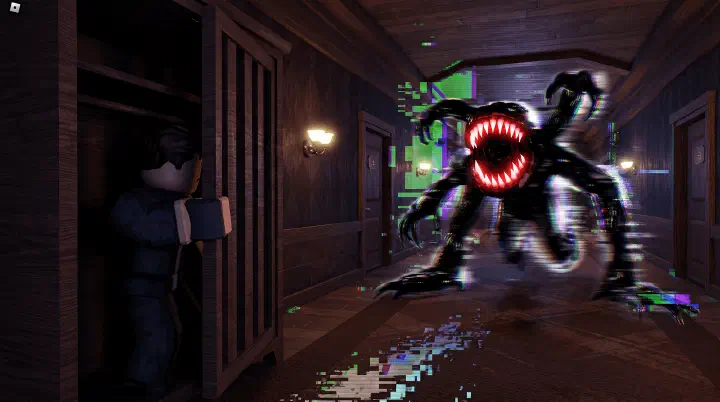
You have survived Rush a dozen times. The screech, the closet, the exit — automatic. Then a run comes where the screech sounds wrong. Distorted. Glitchy. You hesitate, then enter a closet. The screech passes. You wait one second. You step out. The screech comes again, but you are no longer in the closet. Ambush kills you.
This is how roughly 90 percent of players experience their first Ambush death. Not because they failed to react. Not because they could not find a closet. Because they confused Ambush for Rush and exited between passes. Rush passes once. Ambush passes 2 to 6 times with 2 to 5 second gaps. The fundamental rule: if the screech sounds distorted, stay in the closet until you have counted to 3 after the last pass. Extra waiting never killed anyone. Exiting between passes kills thousands.
The audio difference is teachable in 30 seconds. Rush rises in pitch — a clean smooth crescendo over 3.5 seconds. It sounds like a warning siren. Ambush wavers in pitch — a distorted glitchy fluctuation. It sounds like Rush played through broken speakers. The lights also differ: Rush flickers once. Ambush flickers repeatedly between passes. If lights are still flickering after pass 1, stay in the closet.
The count-to-3 rule: after each pass, count silently. One-Mississippi, two, three. If another screech comes within 3 seconds, restart the count. If 3 seconds pass with silence, the sequence is done. Do not count passes — count silence. The rule is not “Ambush does 3 passes.” The rule is “3 seconds of silence equals safe.”
The complacency trap: your tenth Ambush encounter is more dangerous than your first. By the tenth time, you are comfortable. You know the rhythm. You exit after pass 2 because “it is probably done.” On the eleventh encounter, pass 3 catches you in the open. Treat every Ambush as your first. Count to 3 after every pass. Never assume. Always count.
A player tracked 50 Ambush encounters. Encounters 1-10: died 6 times, survived 4. Every death was exiting between passes. Encounters 11-30: died 3 times. Encounters 31-50: died zero times. The Ambush death rate dropped from 60 percent to 0 percent with one behavioral change. Count to 3. Every time.