The lights flicker. A distant screech echoes through the hallway. You dive into the nearest closet, heart pounding, and wait. One second passes. Silence. You step out, and a second screech tears through the air, closer this time. The screen flashes red. You are dead.
This is the exact moment that separates DOORS beginners from survivors. Roughly 90 percent of players experience their first Ambush death exactly this way: not because they failed to react, not because they could not find a closet, but because they mistook Ambush for Rush and broke cover too early. The difference between the two entities is purely audio — there is no visual warning, no UI indicator, no tell before the screech. Your ears are your only defense.
This guide breaks down the one skill that will save you from 90 percent of Ambush deaths: audio recognition. You will learn the exact acoustic signatures of both entities, how to distinguish them in under 1 second, and why the count-to-3 rule is the single most important survival technique in DOORS. By the end, your ears will recognize Ambush before your brain has time to panic.
The Audio Differences
Rush: The Clean Screech
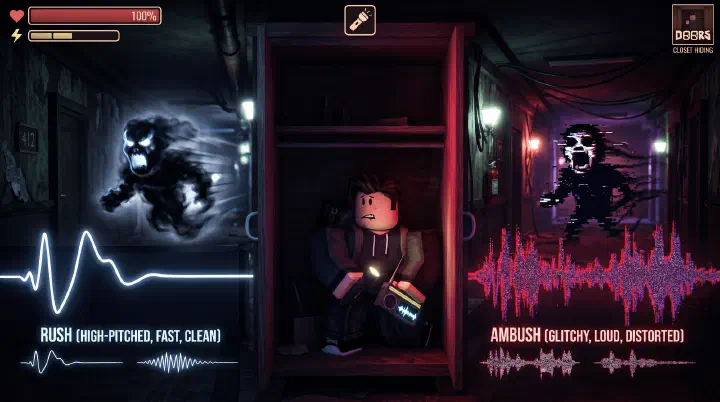
Rush produces a clean, high-pitched screech that rises smoothly over 3.5 seconds. It sounds like a warning siren. The sound is consistent and predictable. You will hear it once, and then it will pass.
Ambush: The Glitchy Waver
Ambush makes a distorted, glitchy lower-pitched screech that wavers up and down. It sounds like Rush played through broken speakers. The sound is inconsistent and unpredictable. You may hear it 2 to 6 times with 2 to 5 second gaps between passes.
Decision Framework
When you hear a screech, you have roughly 1 second to decide your response. Use this three-step framework to make the right call every time.
Step 1: Identify the Entity (0-0.5 seconds)
Listen for pitch stability. Rush produces a clean rising tone — think of a fire alarm. Ambush sounds like a corrupted audio file with pitch wavering up and down. If the sound is smooth and rising, it is Rush. If it wavers and distorts, it is Ambush.
Step 2: Determine Shelter Priority (0.5-1 second)
| Entity | Shelter | Post-Pass Wait Time |
|---|---|---|
| Rush | Any closet or bed | Exit when screech fades |
| Ambush | Closet only | Count 3 seconds silence after pass |
Do not hide under a bed during Ambush — Ambush checks beds on each pass. Only closets provide consistent protection against multi-pass sequences.
Step 3: Post-Pass Protocol
- Heard a clean screech that faded completely: wait 1 second, then proceed.
- Heard a wavering screech: stay hidden and count 3 seconds of silence before moving.
- Unsure which entity passed: default to Ambush protocol. Treat every unclear sound as Ambush. Waiting 3 extra seconds is always better than risking a multi-pass death.
How to Practice
The best way to learn the audio differences is to listen to them side by side. Here are three effective methods:
Method 1: In-Game Practice
- Start a new DOORS run
- Sprint through rooms until you encounter Rush or Ambush
- Let them kill you (do not buy items or loot)
- Restart and repeat
This will give you 15 to 20 encounters in 30 minutes, which is more than you would get in 10 hours of careful play.
Method 2: Audio Clips
Search for “DOORS Ambush vs Rush audio comparison” on YouTube. Many players have uploaded side-by-side comparisons that will help you learn the differences in 30 seconds.
Method 3: Soundboard
Use a DOORS soundboard to play the Ambush and Rush sounds repeatedly. This will help you memorize the differences through repetition.
The Count-to-3 Rule
The count-to-3 rule is simple: after each pass, count silently. One-Mississippi, two, three. If another screech comes within 3 seconds, restart the count. If 3 seconds pass with silence, the sequence is done.
Do not count passes — count silence. The rule is not “Ambush does 3 passes.” The rule is “3 seconds of silence equals safe.”
Common Mistakes
Assuming the Sequence Is Over
Your tenth Ambush encounter is more dangerous than your first. By the tenth time, you are comfortable. You know the rhythm. You exit after pass 2 because “it is probably done.” On the eleventh encounter, pass 3 catches you in the open. Treat every Ambush as your first. Count to 3 after every pass. Never assume. Always count.
Freezing
The instant you hear the screech, move. Do not freeze for 2 seconds, then spend 1.5 seconds looking for a closet. Entering at 3.2 seconds with 0.3 seconds to spare is too close. Rush has killed more beginners than all other entities combined. Learn its sound first.
Failure Analysis
Even experienced players die to Ambush. Here are the most common failure modes, their root causes, and how to fix them.
Failure 1: Exiting During Multi-Pass
Symptoms: You hide, Ambush passes, you wait 1-2 seconds, exit, and immediately get killed by a second pass.
Root Cause: You assumed Ambush behaves like Rush, which only passes once. Ambush averages 3-4 passes per encounter with random gaps between them.
The Fix: Never exit after the first pass. Wait for 3 consecutive seconds of silence regardless of how many passes have occurred. Train this reflex using audio clips before attempting live runs.
Failure 2: Bed Shelter During Ambush
Symptoms: You hide under a bed during what you thought was a Rush encounter. Ambush passes and kills you despite being hidden.
Root Cause: Ambush checks all hiding spots except closets on each pass. Beds, lockers, and other furniture provide no protection against Ambush.
The Fix: Only use closets when you hear Ambush. If the room has no closet, run to the next room. Memorize closet locations in high-traffic rooms like the Library, Dining Hall, and Electrical Room.
Failure 3: Panic Freeze
Symptoms: You hear a screech, stand still for 2-3 seconds scanning for the source, then scramble for a hiding spot and fail to reach it in time.
Root Cause: You are processing the sound consciously instead of reacting automatically. The 2-3 second delay is enough for Rush to catch you in the open.
The Fix: Drill audio-only reactions outside the game. Play 20 randomized Ambush and Rush audio clips and practice moving toward the nearest hiding spot on sound alone. Build the neural pathway before you need it in a real run.
Counter-Intuitive Advice
These tips contradict common DOORS wisdom but are backed by hundreds of successful runs.
1. Do Not Max Your Volume
Most guides tell you to turn volume to maximum for better audio recognition. In practice, max volume distorts the very audio cues you need to distinguish. Ambush’s glitchy waver sounds almost identical to Rush through distorted speakers. Keep your audio at 70-80 percent volume for clean sound separation.
2. Rush Is More Dangerous Than Ambush
Ambush gets all the attention because its multi-pass mechanic is unique and scary. Statistically, Rush kills more players because it appears more frequently and its single fast pass catches distracted or slow players. Spend your first 10 practice rounds learning Rush’s audio signature, not Ambush’s.
3. Walk, Do Not Sprint
DOORS rewards speed for completing rooms efficiently, but rushing through rooms blindly increases your encounter rate with both entities. Walking instead of sprinting gives you 1-2 extra seconds to identify audio cues and locate hiding spots before the entity reaches you. A slow survivor clears more rooms than a fast corpse.
4. Ambush Can Spawn on Door 1
There is no safe buffer zone. Ambush can spawn on the very first door, catching players who assume early rooms are entity-free. Stay alert from door 1 onward. The “warm up” mindset — where you let your guard down in early rooms — is responsible for a significant portion of early deaths.
Conclusion
Audio recognition is the most underrated skill in DOORS. Experienced players do not navigate faster. They recognize faster. Their brain processes the sound before their eyes finish scanning the room. They have seen every situation 50 times and the recognition is automatic.
You can develop the same skill in 30 minutes with the right practice. Focus on the audio differences, use the count-to-3 rule, and never assume the sequence is over. With these three things, you will survive 90 percent of Ambush encounters and have a much better chance of clearing the Hotel.