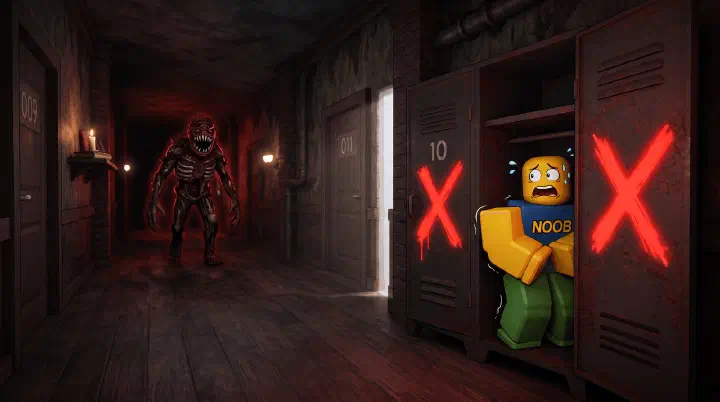
Door 14. You’ve survived long enough to feel confident. You open the door, step into a standard hotel room — two beds, a dresser, a closet on the far wall. You walk toward the dresser to check for gold. The lights flicker. You freeze. Is that Rush? Ambush? You waste one second deciding. In that second, Rush is already halfway through the map. You turn toward the closet, but you’re too far. Rush screams through the room and you’re dead before your hand touches the handle.
This death happens thousands of times every day in DOORS. Not because the player is bad. Not because the game is unfair. Because they made one of 12 specific, fixable mistakes that every beginner makes. This guide is going to walk through each one — what it looks like, why it happens, what it costs you, and exactly how to stop doing it.
Mistake #1: Freezing When You Hear the Screech
You hear Rush’s screech. Your brain goes: Is that Rush or Ambush? Where’s the nearest closet? Should I grab this coin first? By the time you decide, you’re dead.
Rush travels the entire map in 3 to 4 seconds from the first light flicker. The flicker is your one and only warning. You don’t get a second one. You don’t get a “hey, seriously, hide now” follow-up. The lights dim. Then Rush arrives. That’s the whole sequence.
The fix is training a reflex, not making a decision. When you enter a new room, the very first thing you do — before looting, before opening the next door, before anything else — is locate the nearest closet or bed. Freeze-frame it in your mind. When the lights flicker, you don’t think. You don’t decide. You are already sprinting toward the closet you pre-selected 10 seconds ago.
The second piece: learn the Rush audio cue cold. Not “I kind of know what it sounds like.” Cold. Spend 10 minutes on YouTube with Rush and Ambush audio side by side. Rush is a clean, rising, high-pitched screech with no distortion. By the time you’ve heard it three times in real runs, your body should be moving toward a closet before your brain registers what’s happening.
Death audit check: If Rush killed you in more than 3 of your last 10 runs, your audio reflex isn’t automatic yet. Do the 10-minute training drill.
Mistake #2: Treating Ambush Like Rush
You hear a screech. You jump in a closet. The entity passes. You step out. You die. What just happened?
You confused Ambush for Rush. Ambush looks and sounds similar on the first pass, but it doesn’t stop after one sweep. It passes through the room 2 to 6 times with a distorted, glitchy screech and a green-tinted screen. The gap between passes is 3 to 5 seconds. Beginners hear the silence after the second pass and think it’s over. They step out. Ambush is mid-return and kills them instantly.
Here is the distinction that saves your run: if the screech sound has any digital distortion, any glitchiness, any lower-pitched graininess — it’s Ambush. Rush’s screech is clean. Ambush’s screech sounds like a corrupted audio file. If you hear even a hint of distortion, you stay in that closet and you do not move.
Count to 3 after every pass. If you hear nothing for 3 full seconds — not 2, not 2.5, three — and the green tint is gone, you can exit. If you hear another screech or the green returns, reset your count. Stay put. Ambush has killed more impatient players than any other entity in the game.
For a deeper breakdown of every entity’s audio signature and the full counter-strategy for multi-entity rooms, see our entity defense and counter guide.
Mistake #3: Spinning Wildly When Screech Appears
The room goes dark. You hear a wet, clicking sound. Then a whisper: psst. You panic. You spin your camera in every direction, snapping left and right, trying to find the source. Five seconds later, Screech bites you and you’re dead.
Screech spawns in dark rooms and announces itself with a psst whisper. It sits somewhere on your screen — on the floor, on the ceiling, tucked in a corner — and stares at you with glowing white eyes. If you don’t look directly at it within about 4 seconds, it damages you. If you ignore it or can’t find it, it kills you.
The beginner error is spinning so fast you overshoot Screech’s position. You whip past it three times without your camera ever stopping on it. Screech despawns and respawns if you miss it, but the damage window keeps ticking.
The fix: when you hear psst, stop moving. Stand still. Rotate your camera smoothly — not fast, not jerky — in a full 360-degree sweep. Start at eye level, then tilt up, then tilt down. Look for two glowing white dots. When you find them, center your crosshair on them and hold still for half a second. Screech will screech and vanish. Then you can continue.
The locker trap: Here is a counter-intuitive danger. If you’re in a closet when Screech spawns — which happens often, because beginners hide in closets the moment a room goes dark — you cannot look at Screech. Your camera is locked inside the closet. Screech will attack you through the closet door and you cannot counter it. If you hear psst while in a closet, exit immediately, find Screech, look at it, then re-hide if needed. The closet that protects you from Rush makes you helpless against Screech.
Mistake #4: Looking Around When the Screen Turns Purple
The screen tints purple. Your peripheral vision blurs. Something is wrong, so you look around to figure out what it is. Your HP starts draining. Five seconds later, you’re at 20 HP and you still don’t know what happened.
This is Eyes. Eyes spawns as a cluster of glowing purple orbs that drift toward you. Looking directly at it causes rapid health drain. The more you look, the faster you die. The purple tint is your warning: Eyes is somewhere in the room, and looking at it is killing you.
The fix is a hard-coded reflex: the moment you see purple tint, snap your camera to the floor. Do not look around. Do not try to find Eyes. Do not satisfy your curiosity about where it is. Floor. Now.
Navigate by looking at walls — Eyes doesn’t trigger through walls, so you can use wall surfaces as visual guides while keeping your camera low. Most Eyes rooms share similar layouts across runs. After 5 to 10 encounters, you’ll recognize them and navigate on muscle memory alone. Until then: floor, walls, exit.
Mistake #5: Sprinting Through Seek’s Chase
Seek’s chase begins. The hallway stretches ahead. You hold sprint and run as fast as the game lets you. You trip on furniture, get caught on doorframes, bounce off walls, and Seek’s slime catches you three turns before the exit.
Seek doesn’t kill you because you’re slow. It kills you because you’re uncontrolled. Seek’s speed scales to stay just behind you — sprinting harder doesn’t outrun it, it just increases the odds you’ll collide with an obstacle and lose momentum. The chase is a pathing test, not a speed test.
The fix: run at about 80% of your max speed. Keep your camera pointed forward, not at Seek behind you. Scan for furniture and debris — chairs, tables, fallen shelves — and route around them before you reach them. When the path forks, Guiding Light’s blue sparkles point to the correct direction. Follow them instantly. Don’t second-guess. Don’t turn around to check if Seek is still there — it is.
The final stretch is where most players die. They see the exit door, relax, stop sprinting, and Seek catches them in the last two seconds. Do not stop running until the screen cuts to black and the cutscene triggers. The chase isn’t over at the exit door. It’s over when the game says it’s over.
For a complete breakdown of every Seek chase variant, room pattern, and speed threshold, read our Seek chase complete guide.
Mistake #6: Sprinting During the Library Encounter
You enter Room 50. Figure is patrolling. You know it’s blind and tracks by sound. You crouch. You’re being careful. Then Figure turns, walks directly toward you, and snaps your neck. You have no idea what you did wrong.
You sprinted. Even a half-second sprint tap produces the loudest sound in the game. Figure doesn’t need to see you — it hears your footsteps from across the entire library. Sprinting is a homing beacon. Crouch-walking is loud enough that Figure can detect you at medium range. The only truly safe movement during Figure’s listening phase is no movement at all.
Figure operates on a cycle: it walks for about 8 to 9 seconds, then stops and listens for about 2 to 3 seconds. During the walk phase, its own footsteps partially mask yours — you can crouch-walk safely. During the listen phase, any movement whatsoever is detected instantly. The beginner mistake is moving during the listen phase because they didn’t know phases existed.
The fix: watch Figure. When it’s walking, you can crouch-walk. When it stops, you stop. No exceptions. If you keep accidentally pressing sprint, unbind the sprint key for the Library encounter. Many experienced players do this for Room 50 and Room 100. Silence beats speed every time.
For the full 11-second patrol cycle and the exact rhythm that beats Figure, read our Figure survival protocol.
Mistake #7: Opening Doors Without Reading the Number
You see a numbered door. You open it. It’s Dupe. You’re dead.
Dupe looks identical to the real exit door except for one tell: the room number on the door is wrong. A real exit door’s number follows the sequence of the floor you’re on (e.g., Door 23, Door 24, Door 25). A Dupe door has a scrambled or misaligned number — sometimes off by several digits, sometimes displayed backward, sometimes with an extra character. Under pressure, beginners don’t check.
The fix: before opening any door, glance at the number. Confirm it follows the sequence. If the number looks wrong in any way — wrong digit, wrong font, wrong spacing — do not open it. Walk away. Find the real door. The real door always has the correct, cleanly displayed number.
This gets harder in dark rooms, where you need a light source to read the number. It gets harder when Rush is approaching and you’re desperate to find the exit. But opening a Dupe door is instant death with no counterplay once the animation starts. It is the one mistake in DOORS you cannot recover from. Check the number. Always.
Mistake #8: Wasting Gold and Items in the Pre-Run Shop
You load into the lobby with 100 gold from your last failed run. You buy a flashlight because it feels safer than a lighter. You buy a bandage you’ll never use. You don’t buy vitamins because they cost 100 gold and that seems expensive. You enter the Hotel with a flashlight that will run out of batteries by Door 30 and zero speed items for Seek’s chase.
The pre-run shop has a strict priority order that experienced players follow every single run. Here is the tier list:
| Priority | Item | Cost | Why |
|---|---|---|---|
| 1 | Vitamins | 100g | Speed saves you from Seek, Figure repositions, and bad door timings. Non-negotiable first buy. |
| 2 | Lighter | 50g | Reliable light source, no batteries needed, lasts the entire run. |
| 3 | Lockpick | 50g | Accesses locked side rooms with extra gold and items. Adds up over a full run. |
| 4 | Crucifix | 250g | Entity insurance. Only buy if you’ve saved gold from previous runs. Never buy before Vitamins + Lighter. |
| 5 | Flashlight | 150g | Luxury upgrade over Lighter. Better range, but battery-dependent and not worth the gold as a first buy. |
Beginners buy the flashlight and bandage first. Experienced players buy vitamins and a lighter every single run. The difference is survival rate.
The crucifix trap: The crucifix looks like the best item in the game. It banishes an entity. For beginners, it is a gold trap. A crucifix costs 250 gold — that’s vitamins plus a lighter plus a lockpick. It requires precise placement timing (1.5-second wind-up animation before activation). It does not work on Figure, Seek, Dupe, Eyes, or environmental hazards. Most beginners buy it, carry it for 40 doors, then die to something it can’t counter. Buy it only when you have gold to spare and you’ve already covered speed, light, and utility. For the full crucifix strategy — entity list, timing, save-or-spend framework — see our crucifix usage guide.
Mistake #9: Backtracking for Dropped Items
You dropped a lockpick two rooms ago to pick up a bandage. You need that lockpick now. You turn around and go back. Rush spawns in the hallway between rooms. You have no closet. You die.
DOORS punishes backtracking more harshly than almost any other decision. Rush and Ambush can spawn at any time. The hallway between rooms has no hiding spots. If an entity spawns while you’re in transit between rooms, your run is over unless you are close enough to sprint to cover.
The fix: never backtrack more than one room. If you drop an item, it’s gone. A bandage, a battery, a lockpick — none of them are worth a full run. The exception: if you dropped a crucifix or vitamins and you are still in the same room or the immediately adjacent room, and the lights have not flickered in the last 3 doors, you can retrieve it. Otherwise, keep moving forward.
This is also why item management matters. Don’t pick up a bandage if it means dropping your lockpick. Don’t swap your lighter for a flashlight you don’t need. Once you drop something, assume you will not get it back.
Mistake #10: Playing Without Headphones (or With Music On)
You’re playing on laptop speakers. Or you have Spotify running in the background. Or your game volume is at 40% because you’re also in a Discord call. You don’t hear Rush’s screech until it’s 1 second away. You don’t hear Screech’s psst at all. You open doors without listening for growling behind them. You die to things you never knew were coming.
DOORS is an audio-first game. Every entity has an audio cue. Rush has its screech. Ambush has the distorted version. Screech whispers psst. Figure has distinct footsteps that tell you exactly where it is in the room. Seek has a heartbeat that intensifies as the chase begins. Guiding Light whispers directions during chases. Halt has a distorted radio transmissions. Eyes has a low, pulsing hum. Without headphones, you are missing 60% to 70% of the game’s warning systems.
The fix: wear headphones. Close-ear or over-ear, so you can hear directional audio — which side Screech’s whisper comes from, which direction Rush’s screech is approaching from. Turn off all background audio. Set SFX volume to 80% or higher. If you must be in voice chat, use push-to-talk so your teammates aren’t talking over entity audio cues.
This one change — headphones, no music, high SFX volume — will improve your survival rate more than any strategy guide ever will.
The Decision Framework: When to Hold vs. When to Act
Here is the decision framework that separates consistent survivors from one-time lucky runs. It works for the three most common split-second dilemmas in the Hotel.
Dilemma 1: Hide in the closet or sprint to the next room?
You hear Rush. The nearest closet is behind you, 5 studs away. The exit door is ahead of you, 10 studs away, open. You think: maybe I can make it.
Wrong answer. Rush covers 10 studs faster than you do. The closet at 5 studs is always the correct choice, even if the exit is visible. The only exception is if you are already in a narrow corridor bridge with no closets at all — in that case, sprint forward and pray.
Dilemma 2: Use your last lockpick or save it?
You see a locked side room. You have one lockpick left. You know side rooms often have gold, items, and sometimes a crucifix. But there might be a locked exit door later that requires a lockpick to progress.
Use it. Locked exit doors that block progression are rare in the Hotel. The vast majority of exit doors are unlocked. A locked side room has guaranteed loot that compounds over the rest of your run. The gold you earn from that room might buy you a crucifix at the next Jeff Shop. The risk of hitting a locked progression door later is low enough that the expected value favors using the lockpick now.
Dilemma 3: Revive a downed teammate or save yourself?
A teammate goes down in the open. Rush is incoming. You have 3 seconds to hide.
Do not revive them. Hide. Rush kills both of you if you’re caught in the open. Revive them after Rush passes. If they bleed out before the entity passes, that’s unfortunate — but one dead teammate is better than two. The only exception: if you are already in a closet and Rush is not yet in the room, and the downed teammate is within arm’s reach of another closet. But in practice, this scenario almost never happens.
The Big One: You’re Focusing on the Wrong Skill
New players obsess over speed. They think the key to DOORS is fast reactions, quick closet entries, and rapid item swaps. They practice sprint-jumping through rooms. They try to optimize their loot route. They watch speedrun videos and wonder why they can’t replicate the pace.
Here is the counter-intuitive truth: DOORS is not a speed game. It is a listening game. The players who consistently clear the Hotel are not the fastest players. They are the players who hear Rush 2 seconds before anyone else. They hear the distortion in Ambush’s screech on the first pass and stay in the closet while their teammates die stepping out. They hear Screech spawn the moment the room goes dark and are already looking for it while their teammates are still figuring out which way the exit is.
If you change one thing about how you play, change this: stop trying to be faster and start trying to hear more. Turn up the volume. Wear headphones. Learn the audio cues until they are as familiar as your own name. Every other skill — closet timing, pathing, item management — builds on top of audio awareness. Without it, you’re playing half the game.
Mistakes in DOORS are not failures. They are data. Every death tells you exactly which system you haven’t mastered yet. Run the death audit from the how-to section above. Fix the top two causes. Then fix the next two. Within 20 runs, you’ll be clearing Room 50 consistently. Within 50, you’ll be clearing the Hotel.
The game isn’t unfair. It just doesn’t explain itself. These 12 mistakes cover every system that kills new players. Fix them, and the Hotel goes from a death trap to a puzzle you know how to solve.