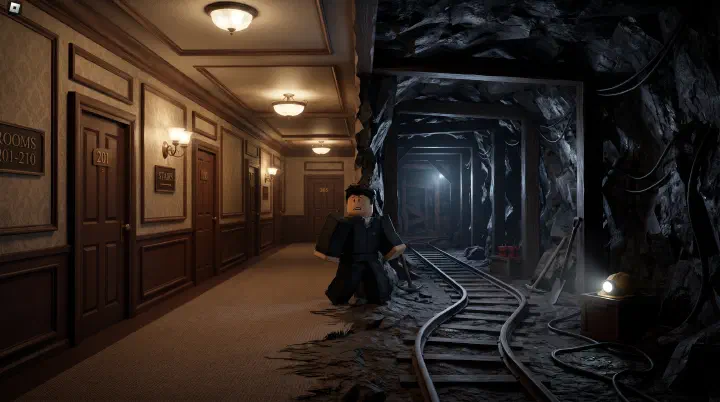
You’re back in the DOORS lobby for the third time this week. The elevator to The Hotel is on your left, lit and familiar. The shaft down to The Mines is on your right, dark and humming. You’ve cleared the Hotel twice now — Rush doesn’t scare you anymore, you can out-sneak Figure, and you’re starting to feel like maybe, finally, you’re good at this game.
That feeling is exactly what The Mines is built to punish.
And there’s a third door coming. The Archives update lands August 28, 2026, and it’s about to rewrite the part of DOORS most players have only heard whispers about. So the real question isn’t just “Hotel or Mines” anymore. It’s “which of these three should I actually care about right now?”
Here’s the honest answer, floor by floor — including the mistakes that get players killed and how to claw a run back after you make them.
The Three Regions at a Glance
DOORS currently has two main floors — The Hotel (Floor 1) and The Mines (Floor 2) — plus a hidden subfloor called The Rooms that most players never reach. The Archives update replaces that third piece. Before we dig into the details, here’s the shape of the comparison.
| The Hotel (Floor 1) | The Mines (Floor 2) | The Archives (upcoming) | |
|---|---|---|---|
| Doors / Length | 1-100 | 101-200 | Reworks The Rooms subfloor |
| Boss encounters | Seek (x2), Figure | Seek (x2), Figure, Queen Grumble, Dam finale | Not yet confirmed |
| New entities | Rush, Ambush, Screech, Eyes, Figure, Seek, and more | Hotel roster + Giggle, Grumble, Gloombats, Dread | 7 new entities announced |
| Avg first clear | 15-40 attempts | 30-60 attempts (after Hotel) | Unknown — not live yet |
| Checkpoints | None | None | Unknown |
| Status | Live, stable | Live, stable | Releases Aug 28, 2026 |
That last column matters more than it looks. The Archives isn’t a third “main” floor in the Hotel-and-Mines sense — it’s a rework of The Rooms, DOORS’ secret subfloor, and it’s coming in hot. More on that below. First, the fight most players are actually trying to win: Hotel versus Mines.
“I Beat the Hotel, So the Mines Can’t Be That Bad”
This is the single most common last thought before a Mines death, and it’s the first failure we need to talk about.
What goes wrong: You walk into Room 101 with your Hotel instincts running on autopilot. In the Hotel, the floor tells you when danger is coming — lights flicker before Rush, the room layout usually gives you a closet within sprinting distance. So you stop looking up, you keep your flashlight on whenever a room feels dark, and you assume a closet is always nearby.
The Mines has no respect for any of that. Your first Giggle drops from the ceiling behind you while you’re checking a locker, and you never even saw the silhouette. A few rooms later you flick on your flashlight in a dark cave and Gloombats swarm out of the shadows to punish the exact habit that kept you alive for a hundred Hotel rooms. You die before Door 120 and you don’t understand why.
Why it happens: The Mines doesn’t add difficulty on top of the Hotel — it inverts several core survival habits. Looking up was optional in the Hotel; it’s mandatory in the Mines. Keeping your light on was the safe default; in the Mines it’s a bait that summons enemies. Trusting the layout to provide a hiding spot was reasonable; the Mines hands you open caves with no closet in sight.
How to recover: Treat your first three to five Mines runs as scouting, not attempts. Don’t try to survive deep — die on purpose and take notes on where each new entity comes from and what you did right before it killed you. If Giggle got you, you were under a ceiling opening you never checked. If Gloombats got you, you had your light on when you should have listened. Every early death is data. The full adaptation map is in our Mines survival guide, but the short version is: look up, listen first, and assume the Mines is hostile to your light.
Hotel vs Mines: What Actually Changes
The gap between the two floors isn’t just “Mines is harder.” It’s a different design philosophy. The Hotel teaches you one entity at a time. The Mines throws everything at you and expects you to already know the rules.
Entity density: one threat at a time vs. everything at once
The Hotel introduces entities gradually. Rooms 1-30 teach Rush and basic hiding. Rooms 30-50 add Screech, Eyes, and the first Seek chase. Rooms 50-100 add Ambush, Halt, and Figure. You rarely face more than one or two threats at a time, and by Room 100 you’ve been tested on everything — but never truly overwhelmed.
The Mines assumes you know the Hotel’s full roster and layers on top of it. Giggle hides on ceilings and drops when you pass under. Gloombats swarm when you use light or step on eggs. Queen Grumble patrols The Nest as a stealth-and-timing check, not a hiding check. Dread shows up if you linger too long in one room, adding time pressure to puzzles. And none of the Hotel entities go away — rooms 190-198 throw Rush, Ambush, Eyes, Gloombats, Giggle, and Screech at you all at once, often in the dark. That gauntlet ends more runs than any boss.
Bosses: knowledge check vs. execution check
The Hotel’s bosses are mostly learnable. Seek is a sprint-and-turn routine that stops being scary by your tenth run. Figure at Door 100 is the real filter, but it’s a puzzle you can internalize: solve the breaker while it patrols, then survive the burning corridor.
The Mines’ bosses are execution checks. Seek now has dripstones to time and minecart sections to crouch through. The Nest (Door 150) is a dark maze with no hiding spots where Queen Grumble’s patrol routes are the only safe path. The Dam finale at Door 200 is a multi-phase platforming fight against the Seek Worm — valves, goop, tight jumps. You can watch every guide on the planet and still die because your hands weren’t fast enough. If you want the full pattern breakdown before you go in, our boss attack patterns guide walks through each one.
The mental game
Hotel runs are 30-45 minutes. A death hurts, but the run is short enough that “one more try” doesn’t feel punishing — you can fit three or four attempts into a session.
Mines runs are 45-90 minutes. Dying on Door 198 after 80 minutes is a different kind of pain. The emotional arc is predictable: Doors 101-130 feel fine, Door 150 humbles you, Doors 151-189 build false confidence, and then Doors 190-198 kill you in a dark room with three entities screaming at once. Most players can only stomach one or two Mines attempts per session. That’s not a skill problem — it’s endurance.
“It’s Just a Harder Hotel” — The Misread That Ends Runs
The second failure pattern is subtler, and it’s a mindset mistake rather than a reflex mistake.
What goes wrong: You’ve accepted that the Mines is hard, so you approach it like a harder Hotel. In the Hotel, the counterplay to almost every entity is some version of “find the closet and hide.” Rush, Ambush, Halt — hide. So you arrive at The Nest assuming the same rule applies. You look for a closet. There isn’t one. Queen Grumble walks through you, and you die confused.
Why it happens: The Mines changes what “surviving” even means. Several of its hardest sections have no hiding mechanic at all. The Nest is stealth and timing — you read Grumble’s patrol route and move through gaps in it. The Dam is pure platforming. If you treat every threat as a hiding puzzle, you’ll spend the whole run looking for closets that don’t exist while the actual mechanic walks past you.
How to recover: For each new Mines section, ask one question before you move: “Is this a hiding check, a timing check, or a movement check?” If it’s hiding, find the closet. If it’s timing, watch the patrol. If it’s movement, stop looking for cover and focus on your jumps. The entity counterplay reference in our defense guide is built around exactly this split. Once you stop forcing Hotel solutions onto Mines problems, the deaths get a lot more informative.
The Third Region Nobody’s Talking About: The Archives
Up to this point, the conversation has been two floors. That’s about to change, and if you’ve already cleared the Hotel and you’re grinding the Mines, this is the piece you should be watching.
What The Archives actually is: The Archives is a rework — not a bolt-on — of The Rooms, DOORS’ secret subfloor that you access through a hidden passage in the Hotel. The update lands August 28, 2026, and it rebuilds The Rooms with better art, a real story, and gameplay that ties it into the game’s canon. It’s also described by the developers as lore-heavy, setting up the story for Floor 3. So this isn’t a side attraction; it’s the connective tissue for where DOORS goes next.
What’s confirmed so far: The update adds 7 new entities. Two of them are named and discussed publicly: Honcho, a cardboard-and-paper employee-type entity that appears to run or oversee the Archives, and Ransom, a rework of A-90 (The Rooms’ infamous punishment entity) redesigned as a distorted, monochromatic, glitchy face. The other five are mostly unnamed in official material — teasers have shown black humanoid shapes with sticky notes, a blue flower-like eye entity that blocks doorways, a wheel-legged figure with a TV screen for a face, and paper-sheet creatures. Alongside the entities come 10+ new items (pizza, gween soda, a mug, a waiting ticket, a throwable paper plane), a new Journal, and door labels with letter sections like C-048 and F-027.
The part that actually matters for free-to-play players: Once The Archives releases, all subfloors become permanently free to access — as long as you’ve discovered them. That’s a real change from The Rooms, which has been gated and confusing to reach for a lot of players. If you’ve bounced off The Rooms before, this is the update that removes the friction.
Honest caveat: None of this is live yet as of this writing, and specifics will shift between teasers and release. The named entities and the “7 new entities” count are confirmed, but behaviors, exact spawn locations, and difficulty are not — and even confirmed details can change in a post-release patch. Treat the broad strokes as real and the fine print as tentative. When the update drops, our full Archives update guide will have the exact mechanics, entity behaviors, and walkthrough.
For the purposes of this comparison: The Archives looks like it’ll sit somewhere between the Hotel and the Mines in raw difficulty — less of the Mines’ endurance gauntlet, but with The Rooms’ DNA of sudden, punishing insta-kill entities that don’t give you a closet to hide in. If you found The Rooms frustrating, the rework is aimed at you. If you’ve never reached The Rooms, this is your easier entry point.
Which Floor Should You Grind? A Decision Framework
The right answer depends entirely on what you want, and most “which floor is harder” threads ignore that. Here’s the framework.
You’re a first-time clearer. Grind The Hotel. Not because it’s easier, but because it’s the tutorial The Mines and The Archives both assume you’ve internalized. Every entity in the harder floors builds on a Hotel mechanic — Rush teaches you audio cues, Ambush teaches you to stay put, Figure teaches you to move silently. Skip this and the Mines isn’t harder, it’s unreadable. Our Hotel walkthrough covers the full route room by room.
You’re an achievement hunter. Your floor choice is dictated by the achievement list, not by difficulty. A lot of the hardest achievements live in the Hotel (Hotel Hell — clear it with every modifier on), but the Mines and The Rooms each carry their own completionist bait, and The Archives will almost certainly add more. Pull up the achievements and secrets guide, find which achievements you’re missing, and grind that floor specifically.
You’re preparing for new content. Don’t grind the current Rooms. This is the counterintuitive one: The Rooms is about to be replaced by The Archives, so every hour you pour into the old subfloor’s exact layouts and A-entity timings is time spent memorizing content that’s being rewritten. Instead, keep your Hotel and Mines fundamentals sharp — those aren’t changing — and wait for The Archives to drop so you learn the new subfloor once, correctly, instead of twice. The exception: if you’ve never been to The Rooms at all, a quick visit now is fine just to understand the subfloor’s general rhythm, which the Archives will likely preserve.
The counterintuitive tip that actually saves runs: In the Mines, the dark is often safer than your light. The Hotel trained you to keep a flashlight on whenever a room feels dark. The Mines punishes that instinct — Gloombats swarm toward light, and a glowing beam is a neon sign advertising where you are. In the Mines, learn to navigate dark rooms by sound and memory first, and reach for the light only when you’ve confirmed the room is clear of light-sensitive threats. It feels wrong for the first ten rooms, then it starts saving you a run every session.
“I’ll Farm The Rooms While I Wait” — Why That’s a Trap
The third failure pattern is about where you spend your time, not how you play.
What goes wrong: You’ve cleared the Hotel, you’re partway through the Mines, and you hear The Archives is coming. So you decide to “get ahead” by farming The Rooms now — learning every A-entity timing, every dark-room layout, every shortcut. You figure you’ll walk into The Archives already warmed up.
Why it’s a trap: The Archives replaces The Rooms. It’s not an expansion or a rebalance — it’s a full rework, with new art, a new story, and a redesigned entity roster (including Ransom replacing A-90 entirely). The specific timings and layouts you memorize now have a strong chance of being gone in eleven days. You’d be building muscle memory for a version of the subfloor that’s about to stop existing.
How to recover: Reframe the goal. Instead of memorizing The Rooms, spend that time on fundamentals that transfer anywhere — audio-cue discipline, dark-room navigation, resource management. Those skills carry into The Archives regardless of how the subfloor changes. Then, when the update drops, treat it like a fresh Mines run: scout first, die on purpose, and learn the new rules before you try to survive deep.
The Bottom Line
The Hotel breaks your fear. The Mines breaks your ego. The Archives is about to break your assumption that you’ve seen everything DOORS has to offer.
For a new or mid-level player, the order hasn’t changed: Hotel first, then Mines, then — in eleven days — The Archives. The gap between Hotel and Mines is real and wider than most players expect, but it’s a knowable gap once you stop forcing Hotel instincts onto Mines problems. And the smartest thing you can do with The Rooms right now is leave it alone and let the rework arrive on its own terms.
Whatever floor you pick, the pattern that separates consistent clearers from one-time lucky runs is the same: die to learn, not to survive, and treat every death as a note for the next attempt.