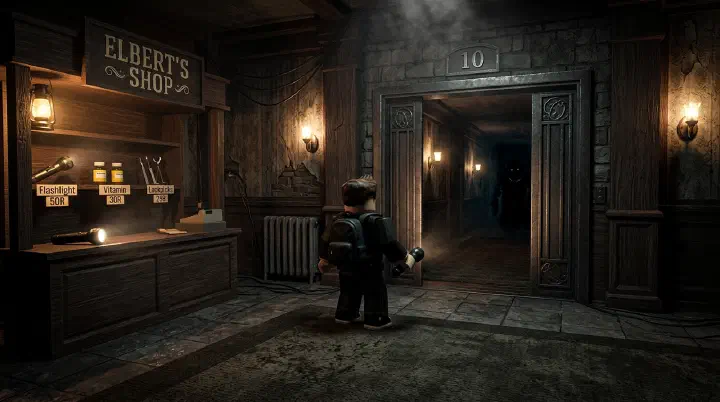
You are crouched behind a bookshelf in the Library. Door 47. The Figure is patrolling two aisles over, and you can hear the heavy, uneven footsteps dragging across the carpet. The door to Room 48 is twenty feet away, exposed across an open stretch of floorboards that creak if you walk. You need speed. You reach for your inventory, fingers searching for the Vitamins that would give you the burst of movement to dash past while Figure’s back is turned. Your inventory is empty. You forgot to buy them.
In the lobby five minutes ago, you stood in front of the shop for thirty seconds debating whether the Flashlight was worth the extra gold. You impulse-bought a Glowstick because it looked useful, then grabbed a Lighter because everyone says you need light. You spent 200 gold on items that now sit in your backpack doing nothing, while the one item that could have saved this run stayed on the shop shelf. Figure turns the corner. You die with 150 unspent gold in your pocket. Gold you could have spent on survival.
The lobby is not a waiting room. It is your only chance to prepare before the elevator seals and the hotel starts hunting you. Every run that ends before Door 10 does not end because the player got unlucky. It ends because they walked into the elevator winging it.
Why Players Die Before Door 10
Most players treat the first ten doors as a tutorial they can sleepwalk through. The hotel disagrees. Here are the five specific preparation failures that end runs early.
Skipping the Lobby Shop Entirely New players treat the lobby as a social space. They stand around, emote, and walk into the elevator empty-handed. By Door 5 they are fumbling in absolute darkness. By Door 8, Rush spawns and they have no light source to identify which closet is closest. They die not because Rush is unfair, but because they entered the hotel blind.
Buying the Wrong Items First The Flashlight looks like the obvious choice. Better range, brighter beam, professional feel. But it costs three times what a Lighter costs, drains batteries that cannot be refilled mid-run, and does not solve the actual threats in the hotel. Darkness slows you down. Entities kill you. Spending half your budget on a slightly better light while skipping speed and safety items is like buying a better umbrella for a house fire.
No Team Role Assignments Everyone buys a Lighter. Nobody buys Vitamins or a Crucifix. When Ambush arrives, four players try to wedge into the same closet while carrying redundant light sources. Meanwhile, the door to Room 15 stays locked because no one brought a Lockpick, forcing the team to backtrack through rooms they already cleared while Rush is active.
Entering Without a Light Source Some players buy a Candle and assume they are covered. A Candle warns of approaching entities by turning blue, but it does not illuminate closets, door numbers, or drawer locations in dark rooms. You cannot hide from what you cannot see. A Candle is a supplement, not a replacement.
Ignoring the Pre-Run Checklist Players treat each run as a fresh reset with no carryover responsibility. They do not check the team’s combined loadout, do not agree on who opens doors, and do not verify whether the host accidentally left a challenge modifier active. The elevator becomes a trap disguised as a doorway.
The Item Priority Tier List
Survival in Doors is about layering answers to different threats. Light answers darkness. Speed answers entities. Utility answers obstacles. The tier list below is not about preference. It is about survival return on gold invested.
S-Tier: Must Buy Every Run
Vitamins are the single most powerful item in the lobby shop. A temporary speed boost sounds simple, but it is the universal answer to every entity in the game. Seek’s chase sequence becomes survivable instead of a death sentence. Rush’s spawn timing becomes forgiving because you can cover the distance to a closet faster. Figure’s patrol pattern becomes something you can actively navigate around instead of cowering from. Ambush’s rebounds give you more margin for error when entering and exiting your hiding spot. If you have gold for nothing else, buy Vitamins. No exceptions.
A-Tier: Buy Based on Role
The Lighter is your budget light source. The range is poor, the flame flickers, and it reveals less than a Flashlight. It is also cheap, reliable, and infinite. It will show you door numbers in dark rooms, reveal closet locations, and help you spot Screech before he jumps. One player on the team needs a Lighter. Only one.
The Lockpick opens locked doors and locked drawers without requiring a key. This saves massive amounts of time, and time is safety. Every second you spend searching drawers for a key is a second Rush could spawn. The Lockpick also opens high-value drawers that contain extra gold and items, funding better loadouts for future runs. The Locksmith should carry this.
The Crucifix is expensive insurance. You hope you never activate it. When a rare entity spawns around a blind corner, or when Figure clips through geometry and catches you, the Crucifix banishes the threat and saves the run. You are not buying an item. You are buying a second chance. The Anchor carries this.
B-Tier: Situational
The Flashlight is better than the Lighter in exactly one way: range. In every other way it is worse. It costs more, requires batteries that drain permanently, and tempts players into thinking they need two light sources. Buy a Flashlight only if your team has a massive gold surplus and every other priority is already covered.
The Candle is excellent for veteran teams who communicate over voice. It gives early warning of entity spawns by turning blue before Rush or Ambush arrives, letting the team pre-position. But it does not replace a Lighter. A Candle without a Lighter is just a pretty stick that tells you when you are about to die in the dark.
Never Buy: Trap Items
The Glowstick provides light for approximately ten seconds, then becomes dead weight. It does not banish entities. It does not open doors. It does not speed you up. It is a light source with an expiration date, and in a game where runs last thirty to sixty minutes, expiration dates kill.
Gold Budgeting by Team Size
Your team size determines how much utility you can layer before entering. These budgets assume standard survival runs without modifier bonuses.
| Team Size | Minimum Gold | Core Purchases | Ideal Additions |
|---|---|---|---|
| Solo | 150 | Vitamins + Lighter | Lockpick |
| Duo | 250 | Vitamins (both) + Lighter + Lockpick | Crucifix |
| Trio | 350 | Vitamins (all) + Lighter + Lockpick + Crucifix | Second Lighter |
| Quad | 450 | Vitamins (all) + Two Lighters + Lockpick + Crucifix | Candle for Scout |
Solo players should never enter without Vitamins and a Lighter. If you cannot afford both, run a short farming run to Door 20 first. It is better to spend five minutes farming than to spend thirty minutes dying because you entered unprepared.
Team Role Assignments
Before the elevator opens, assign roles. Do not discuss it in Room 1 while Rush is spawning. Do it in the lobby where it is safe.
The Scout carries the Lighter and leads the group. They are responsible for checking corners, identifying dark rooms, and calling out drawer locations. The Scout opens doors only after confirming the team is ready. They never open a door alone while the rest of the team is looting drawers three rooms back.
The Medic carries Vitamins and stays in the middle of the pack. Their job is to watch player positions and be ready to use items if someone gets hit or needs to speed through a dangerous crossing. In solo play, you are the Medic by default.
The Locksmith carries the Lockpick. They open locked doors immediately so the team never has to backtrack. They also prioritize opening locked drawers in safe rooms. The Locksmith does not waste the Lockpick on a single drawer unless the team is desperate for gold or items.
The Anchor carries the Crucifix and a backup light source. They stay at the back. They are responsible for covering retreats, being the last into closets, and watching for rear spawns. If someone gets caught by a rare entity or Figure breaks pattern, the Anchor uses the Crucifix. This is the most expensive role and should go to the most experienced player.
If you are running with fewer than four players, combine roles. In a duo, one player is Scout-Locksmith and the other is Medic-Anchor. In a trio, drop the dedicated Medic and have everyone carry their own Vitamins.
Modifier Configuration
Modifiers change the rules of the hotel. For a standard survival run aiming to reach Door 100, the host must verify the configuration before anyone boards the elevator.
Enable These:
- More Gold modifiers if the team is farming for better loadouts. These increase the gold economy without increasing danger.
- Extra Item Spawn modifiers that add world spawns without increasing entity aggression. Free items are free survival.
Disable These:
- Increased Entity Spawn Rate modifiers like “Rush Hour.” These turn manageable threat spacing into endless spawn chains that exhaust your item supply.
- No Closets variants unless the entire team has completed challenge runs before. Closets are your primary survival mechanic. Removing them is a self-imposed hard mode.
- Darkness modifiers that remove ambient light or reduce Lighter range. You need light to identify threats and navigate. Darkness modifiers punish players who have not memorized every room layout.
- Inventory Restriction modifiers that limit how many items each player can carry. These prevent proper role distribution and force everyone into generalist builds that fail against specialized threats.
Always confirm modifiers in the lobby. One misclick by the host turns a standard run into a death march, and by the time the team realizes, the elevator has already sealed.
The Pre-Run Checklist
Use this checklist in the lobby before every run. Do not skip steps because you are in a hurry. The thirty seconds you spend here saves the thirty minutes you would lose by dying early.
Light Check. Confirm at least one player has a Lighter or Flashlight. Candles and Glowsticks do not count. If the team has no reliable light source, do not enter.
Speed Check. Confirm every player has Vitamins. No exceptions. Even the Anchor, who stays in the back, needs speed for Figure crossings and emergency repositioning.
Utility Check. Confirm someone has a Lockpick. Confirm someone has a Crucifix if the team budget allows. If running solo, you carry both.
Role Check. Everyone states their role and position. Scout leads. Medic stays middle. Locksmith handles locks. Anchor covers the rear. If anyone does not know their job, explain it now.
Modifier Check. The host states the active modifiers out loud. The team confirms they are set to standard survival. If any challenge modifiers are active by accident, reset the lobby.
Voice Check. Confirm team communication is active. If a player is muted or cannot use voice, assign them Anchor so they can follow the group without needing to call shots. Text chat during an active Rush is a death sentence.
Gold Check. Confirm no player is sitting on unspent gold that could have bought survival items. Convert every piece of gold into utility before the elevator closes. Gold does not carry over if you die.
Counter-Intuitive Advice That Saves Runs
Do not buy a Flashlight. The Flashlight is the most expensive noob trap in the lobby. Its improved range feels powerful in the shop, but during an actual run it does not help you survive Rush, Ambush, or Seek any better than a Lighter. The batteries drain, leaving you with a dead metal tube in the dark. Buy a Lighter. Spend the difference on Vitamins or a Crucifix.
The best item is the one you hope you never use. The Crucifix sits in your inventory taking up space for ninety-nine doors. That is exactly what you want. If you are using the Crucifix, something has already gone wrong. Its value is not in active use. It is in the psychological security that lets you take necessary risks. Players without a Crucifix play too scared, make timing mistakes, and die to hesitation.
Entering without a plan is better than a bad plan. A bad plan creates false confidence. If your team assigns roles but does not understand them, you will stack up in doorways arguing about who goes first while Rush spawns. If you do not have time to coordinate, default to Scout leads, everyone follows at three-second intervals, first closet on the right is the call. Simple and executable beats complex and forgotten.
Buy Vitamins even if you are bad at timing. New players skip Vitamins because they believe they will just hide better. Hiding does not work in Seek’s chase sequence. Hiding does not work when Ambush rebounds. Hiding does not work when Figure hears your footsteps. Speed is the only universal answer to every entity in the game. Timing can be learned. Speed can be bought.
Spending all your gold is better than saving it. Gold has no value inside a run. The 200 gold you save for next time does not resurrect you when Figure catches you at Door 47. Treat the lobby shop like a burn pile. Convert every piece of gold into survival before the elevator closes. Future runs only matter if you survive the current one.
Conclusion
The elevator doors are the point of no return. Everything after that is execution, but execution depends entirely on what you did in the lobby. The players who reach Door 100 are not necessarily faster, smarter, or braver than the players who die at Door 8. They are simply the ones who bought Vitamins, assigned a Scout, verified the modifiers, and refused to enter with gold in their pocket.
Use the checklist. Follow the tier list. Stop treating the lobby like a waiting room. The hotel is already preparing for you. Prepare back.