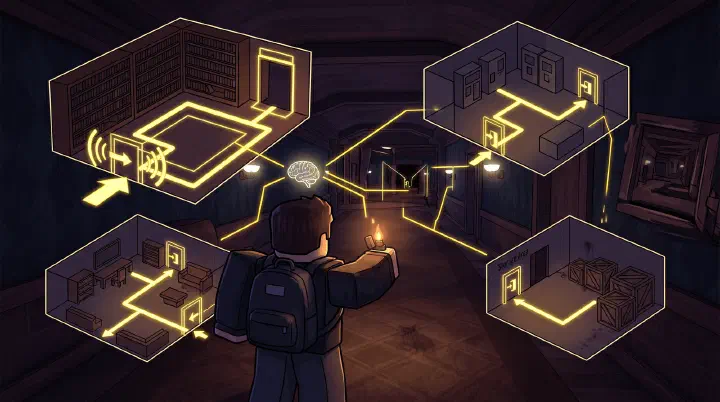
You open a door. The room ahead is dark. You step inside, squinting at the shapes — a table, some shelves, a door on the far wall. You take two steps forward. The lights flicker. You spin around looking for a closet. There isn’t one. Rush screams through the room and you’re dead before you reach the exit.
You didn’t die because you were slow. You died because you entered a room you couldn’t read. If you had recognized the room type in the first half-second — spotted the furniture layout, noted the absence of closets, clocked the distance to the exit — you would have known to back out before Rush even spawned.
That’s what room recognition is. Not memorizing a spreadsheet of room layouts. It’s building a reflex: you see a room, your brain categorizes it, and you act on the category before you consciously think about it. This guide builds that reflex.
The 2-Second Door Check: What to Read Before You Step In
Most players treat doors as transitions. You open, you walk through. But the doorway itself gives you a free preview of the room — if you know what to look for.
The Door Gap Color
Before you open a door, look at the gap under it. The color of light bleeding through tells you the room’s lighting state:
- Warm yellow glow: Normal lit room. Standard behavior. Closets will be present in most layouts.
- Faint blue-white flicker: The room’s lights are on but unstable. This is the most dangerous signal — it means Rush or Ambush has already spawned and is en route. Do not enter. Wait 5 seconds, then open.
- No light at all: Dark room. The light source is off or missing. If you don’t have a light item, you’re entering blind. If you do, pull it out before you step through.
- Reddish glow: Rare. Indicates a special room — usually a boss arena or event room. You’ll know these from context (Seek’s eyes appearing, Figure’s breathing).
This takes half a second and costs you nothing. But I’ve watched dozens of death clips where the player opens a door with a blue-white flicker under it, walks in, and is dead to Rush in 3 seconds. The warning was there. They just didn’t look.
The Door Opening Sound
Doors in DOORS don’t all sound the same. The next room’s door — the exit door — makes a distinct sound when it exists nearby. If you hear a door creak or click as you open your entry door, the exit is close. If you hear nothing but ambient hum, the room is large and the exit is far away.
This is subtle. You won’t notice it on your first run. But after 10-15 runs, your brain will start registering “no exit sound = big room = stay near the entrance.”
The Room Shape From the Doorway
Stand in the doorway. Don’t step in. Look left, right, and forward. In one second, you can answer three questions:
- Is the exit door visible? If yes, you know the room type immediately (straight shot, L-shape with visible exit, or corridor). If no, you’re in a room with a hidden exit — higher risk, move slower.
- Are there closets on the walls? If yes, note the nearest one. That’s your panic destination. If no, this room is a no-hiding zone — treat it as a high-risk room and minimize time spent in it.
- Is the room small or large? Small rooms (under 20 studs across) are fast to cross but often have no closets. Large rooms (30+ studs) take longer to cross but usually have multiple hiding spots. The trade-off determines your pathing.
Here’s the counter-intuitive part: don’t look for the exit first. Look for the hiding spot first. The exit will always be there. The hiding spot is what saves you if the lights flicker 2 seconds after you enter. Train yourself to scan closets before you scan doors. It feels wrong — you want to know where you’re going. But in DOORS, where you hide is more urgent than where you go.
The Hotel Room Types: What You See and What It Means
The Hotel has roughly a dozen recurring room layouts. They’re not exactly identical — furniture placement shifts, lighting varies, container positions randomize — but the underlying geometry is consistent. Learn the geometry, and you’ll recognize the room type in the first second of entry.
Standard Hallway (Straight Shot)
What you see: A rectangular room, longer than wide. Exit door directly ahead on the far wall. Furniture along the sides — paintings, occasional chairs, small tables. 1-2 closets on the left or right wall.
The scene: You’re on floor 12. You open the door, see a clear path to the exit 30 studs ahead, two closets on the left wall. You walk straight through, grab a coin from a table on the way, and reach the exit in 4 seconds. This is the most common room type — about 30% of Hotel rooms.
The danger: These rooms are so safe that they breed complacency. You stop checking for closets because “they’re always there.” Then you hit a straight-shot room on floor 40 with zero closets and the lights flicker. You panic, run for the exit, and Rush catches you 3 studs short.
What to do: Walk straight. Check the left and right walls for closets as you move — don’t assume. If you see one, mentally note it. If you don’t see one, your survival plan for this room is “sprint to the exit.” You have about 3.5 seconds from light flicker to Rush arrival. A straight-shot room takes 3-4 seconds to cross at walking speed. That’s cutting it close. Speed up if you’re in a no-closet variant.
L-Shape Corridor
What you see: You enter. The wall ahead is blank — no door. The room opens to the left or right. The exit is on the perpendicular wall around the bend.
The scene: Floor 23. You open the door, see a wall directly ahead. The room opens to the right. You walk forward, turn right, and the exit is 15 studs away on the right wall. You’re through in 3 seconds.
The danger: The exit in L-shape rooms is always on the side wall after the bend — never on the far wall. New players walk all the way to the far wall looking for a door that isn’t there, waste 5-6 seconds, and get caught if Rush spawns. I’ve seen players run in circles in L-shape rooms because they refused to believe the exit was on the side wall.
The variant: Some L-shape rooms have a closet tucked in the corner of the bend. If you see one, it’s the best hiding spot in the room — Rush rarely checks the bend corner on its first pass. If the lights flicker in an L-shape room, sprint to the bend corner closet, not the exit. The exit is farther and Rush will intercept you.
Large Open Room (Lounge / Dining Area)
What you see: A wide room, 25-40 studs across. Multiple furniture clusters — couches, dining tables, armchairs. 3-5 closets spread across the walls. The exit is on the far wall, but you might not see it immediately because furniture blocks the view.
The scene: Floor 8. You enter a room with a long dining table in the center, chairs around it, a chandelier overhead. Two closets on the left wall, one on the right. The exit is on the far wall behind a half-wall partition. You walk around the table, grab a gold pile from a chair, and exit in 7 seconds.
The danger: These rooms feel safe because they’re spacious and well-lit. But the distance from entrance to exit is longer than any other room type — 7-10 seconds of walking. If Rush spawns while you’re in the middle of the room, you have to cover 15+ studs to reach either a closet or the exit. That’s a long sprint.
The better habit: In large open rooms, hug ONE wall. Pick the left or right wall and walk along it, closet to closet. You’ll reach the exit in the same amount of time, but you’ll always be within 3 studs of a hiding spot. Walking through the center of the room is faster by maybe 1 second — and it leaves you 10 studs from the nearest closet. Not worth it.
Storage Room
What you see: Metal shelving units, 2-3 rows of them. Crates and boxes on the floor. The exit is usually on the left or right wall, partially hidden behind shelving. 1-2 closets, often tucked in a corner.
The scene: Floor 17. You enter, see shelves loaded with nothing, a crate in the corner. You scan the far wall — no exit. You check the right wall — there it is, behind a shelf. You walk around the shelf, grab a coin from the crate on the way, and exit.
The danger: Storage rooms force you to navigate around obstacles. The exit is never directly ahead — it’s always behind a shelf or on a side wall. If you sprint into a storage room without checking corners, you’ll crash into a shelf, waste time reorienting, and miss the exit entirely.
The loot decision: Storage rooms have 2-3 containers. The question is whether to loot them. Here’s the rule: if the room has a visible closet, you can loot one container safely. If it doesn’t, skip looting. The extra 3-4 seconds of looting in a no-closet room is how people die to Rush on floor 17. A coin or a bandage isn’t worth a run.
Mini-Library (Pre-Room 50)
What you see: Bookshelves — 3 to 6 of them, arranged in rows or along the walls. Dim, warm lighting. The exit is usually on the far wall, but bookshelves can block the direct path. No Figure (that’s only Room 50).
The scene: Floor 35. You enter a room with bookshelves on both sides, a narrow path between them. The exit is visible on the far wall, but you have to walk a winding path between the shelves. There’s one closet on the left wall, partially hidden behind a bookshelf.
The danger: Mini-libraries have narrow paths. If Rush spawns, you can’t sprint in a straight line — you have to navigate the shelves. That extra navigation time is fatal. The closet position is also harder to see because the shelves block your view.
What to do: Before you enter a mini-library, look at the shelf arrangement. Identify the path to the exit AND the path to the nearest closet. They might not be the same path. If the closet is behind a shelf on the left and the exit is straight ahead, you need to know which direction to break for if the lights flicker. The answer is always the closet, not the exit. The exit is farther and the shelves will slow you down.
Garden / Courtyard Room
What you see: Windows on one or more walls showing an outdoor scene (grass, trees, sky). Plants, benches, or garden furniture inside. The exit is on the far wall, usually framed by windows. Lighting is natural — bright during the day cycle, dim at night.
The scene: Floor 28. You enter a room with large windows on the left wall showing a moonlit courtyard. A bench in the center, potted plants in the corners. The exit is on the far wall, clearly visible. One closet on the right wall.
The danger: Garden rooms are visually busy. The windows, the outdoor scene, the plants — your eyes are drawn to the scenery instead of the exits. I’ve watched players walk into garden rooms, stop to look out the window, and get killed by Rush because they were sightseeing. The room is not a museum. It’s a death trap with nice wallpaper.
The hidden value: Garden rooms almost always have a closet on the wall opposite the windows. If the windows are on the left, the closet is on the right. This is consistent enough to be a rule. Use it: glance at the window wall, then look directly opposite for the closet. Don’t scan the whole room.
Dark Room (No Lights)
What you see: Nothing. The room is pitch black. You can make out faint shapes — furniture silhouettes, maybe a door outline — but no details. If you have a light source, you’ll see furniture, containers, and possibly closets.
The scene: Floor 42. You open the door. Complete darkness. You pull out a lighter, flick it on. The small flame reveals a table, two chairs, and — crucially — a closet on the left wall, 8 studs away. The exit is on the far wall, 20 studs ahead. You walk toward the exit, keeping the closet in your peripheral vision. If the lights flicker, you sprint left, not forward.
The danger: Dark rooms are the deadliest room type in the Hotel. Not because they have special mechanics — because you can’t see the threats. You don’t know if there’s a closet. You don’t know where Screech is. You don’t know if Dupe is waiting at the exit door. And your movement speed naturally drops because you’re cautious.
The protocol for dark rooms:
- Pull out your light source before entering — lighter, flashlight, glowstick, anything. If you have none, step into the doorway and listen for 3 seconds. No sounds? Enter slowly. Any sounds? Back out.
- Scan the nearest wall for a closet. That’s priority one. If you find one, proceed. If you don’t find one within 3 seconds, this room has no accessible closet — treat it as a sprint-through zone.
- Hug the wall with the closet as you move toward the exit. Don’t walk through the center of the room. You want to stay within sprinting distance of your hiding spot.
- If you hear Screech’s “psst” sound, stop moving immediately. Look at the floor. Screech spawns more aggressively in dark rooms because the game knows you can’t see it coming.
Key-Locked Room
What you see: A standard room layout, but the exit door has a lock icon. You need a key to open it. The key is somewhere in the room — in a drawer, on a table, behind a container.
The scene: Floor 15. You enter, see the locked exit. You scan the room — there’s a key on the desk to your left. You grab it, unlock the exit, and leave. Took 4 seconds.
The danger: Key-locked rooms force you to stay in the room longer than you want to. Every second you spend searching for the key is a second Rush can spawn. The key’s location is randomized within the room, but it’s always on a surface — never inside a container you have to open. Scan tables, desks, shelves, and the floor near furniture. Look for the glowing outline.
The bad habit: Players search key-locked rooms by walking in circles, checking every surface. This is slow. Instead, stand in the center of the room and rotate 360 degrees. The key’s glow is visible from across the room. You’ll spot it in 2 seconds instead of 10. Then walk directly to it, grab it, and exit. Don’t loot anything else. The locked exit is a neon sign that says “Rush is coming.” Don’t ignore it.
Exit Room (Door 50, Door 100)
What you see: A sealed door with a number on it. The room is larger than normal, typically with a unique layout that signals a boss encounter or safe room. The atmosphere changes — music shifts, lighting changes, furniture disappears.
The scene: You reach door 50. The room is massive — the Library. Bookshelves everywhere. Figure’s footsteps echo. You know what’s coming because you’ve read the room type before you even saw Figure.
The danger: Exit rooms are the only rooms where the exit is NOT your immediate goal. You can’t leave until you complete the room’s objective. New players see the big door with the number, run toward it, and get killed by the boss because they didn’t realize the room has a mechanic.
What to do: When you enter a room and see a numbered door, stop moving. Identify the room type — Library, Courtyard, Electrical, etc. Recall the mechanic. Then proceed. The room recognition here isn’t about finding the exit — it’s about recognizing what kind of fight you’re in.
For more on specific exit rooms, check out the Room 50 Library Walkthrough and the Hotel Full Walkthrough.
Danger Signals: What Room Features Predict Entity Spawns
Rooms don’t just have layouts. They have tells — environmental cues that warn you an entity is about to appear. The best players read these tells before the entity even announces itself.
The Light Flicker (Rush and Ambush)
This is the most well-known signal, but most players don’t use it optimally. The lights flicker roughly 3.5 seconds before Rush arrives. In those 3.5 seconds, you need to:
- Identify the nearest closet (0.5 seconds)
- Sprint to it (1-2 seconds)
- Enter and close the door (0.5 seconds)
That leaves you about 1 second of margin. If you don’t know where the closet is before the lights flicker, you’re already behind. This is why the “closet first” scan matters. You’re not looking for the closet because you’re about to hide. You’re looking for it so you already know where it is when the lights flicker.
The specific scenario that kills people: You’re in a room with two closets. The lights flicker. You sprint to the closer closet. It’s occupied — another player is already inside. You sprint to the second closet. It’s too far. Rush kills you.
The fix: If you’re in a room with multiple closets and the lights flicker, sprint to the FARTHEST closet first. Everyone else will sprint to the nearest one. The farthest one is almost always empty. You’ll reach it with time to spare because Rush takes 3.5 seconds and a sprint across a room takes 1.5-2 seconds.
Footsteps Without a Player (Ambush)
Ambush sometimes announces itself with footsteps — heavy, rhythmic thuds that sound like another player walking but don’t match anyone’s actual position. If you hear footsteps that don’t correspond to a visible player, Ambush is active. Find a closet and wait. Don’t try to outrun it. The Entities Bestiary covers Ambush’s full behavior pattern.
The Silent Room (Screech)
You enter a room. It’s quiet. Too quiet. No ambient hum, no distant sounds, no door creaks. This is a Screech room. Screech spawns in rooms with low ambient noise — the game uses silence as a cue that you should be listening for the “psst” sound.
What to do: In a silent room, keep your camera moving. Look up, down, left, right every 2-3 seconds. Screech appears in your peripheral vision and attacks if you look at it too long or ignore it entirely. The sweet spot is a quick glance: see it, look away, it despawns. Don’t stare. Don’t ignore.
The Empty Closet Room (Rush Trap)
Some rooms are designed to look safe — well-lit, closets on the walls, clear exit — but the closets are fake. They’re decorative, not functional. You can’t enter them. If Rush spawns, you’re trapped.
How to spot fake closets: Real closets have a slight gap between the doors and a visible handle. Fake closets are flat textures with no depth. It’s subtle, but once you see the difference, you’ll never miss it. Check one closet per room by walking close to it — if the interaction prompt appears, it’s real. If not, exit the room immediately. A room with fake closets isn’t worth the risk.
The Two-Way Decision: When the Closet Is Full
You’re in a large open room. The lights flicker. You sprint to the nearest closet. Another player is already inside. You have 1.5 seconds before Rush arrives. What do you do?
This is the most common panic-death in DOORS. Here’s the decision framework:
Option A: Sprint to Another Closet
When to do it: You can SEE another closet within 15 studs. Sprint time: 1-1.5 seconds. You’ll make it.
When NOT to do it: The next closet is farther than 15 studs, or you can’t see it immediately. Sprinting blindly to a closet you can’t see is gambling — you might run the wrong direction, miss the closet, and die in the open.
Option B: Hide Under a Bed
When to do it: There’s a bed within 5 studs. Beds provide partial protection — Rush passes over them, but Ambush checks under beds. If the lights flickered cleanly (no distortion), it’s Rush, and the bed will save you. If the sound was distorted or wavering, it’s Ambush — the bed won’t help.
The problem: You can’t always tell Rush from Ambush in 1.5 seconds. Default assumption: if the flicker was clean and the screech is rising smoothly, it’s Rush — bed is safe. If anything sounds off, assume Ambush — bed is death.
Option C: Hug the Entry Door Frame
When to do it: You’re near the door you entered through. Press yourself against the wall next to the door frame, on the side closest to the door. Rush’s pathing occasionally clips through door frames, missing players pressed against the wall immediately adjacent to the frame.
The caveat: This works maybe 40% of the time. It’s not reliable. It’s a desperation move when no closet or bed is available. If you’re going to die anyway, it’s worth trying. But don’t plan around it.
Option D: Sprint to the Exit
When to do it: The exit is closer than any closet. This is rare — closets are usually placed nearer to the entrance than the exit. But in some layouts (particularly L-shape rooms), the exit is on the near wall and a closet is on the far wall. In that case, sprint to the exit. You’ll reach the next room before Rush catches you.
The risk: You’re betting that the next room has a closet. If it doesn’t, you’re in the same situation with less time. But it’s better than dying in the current room.
The Pre-Decision: Know Before You Need To
The real solution to the full-closet problem isn’t a decision in the moment — it’s a decision before the moment. As you enter each room, identify your primary closet AND your backup closet. If the primary is full, you already know where the backup is. You don’t waste 1 second scanning. You just sprint.
This is the difference between players who survive Ambush on floor 80 and players who die on floor 20. The survivor already knew the backup closet was behind the third shelf on the left. The victim is still looking for it when Ambush makes its second pass.
Death Replays: The 3 Most Common Room Recognition Deaths
Death 1: Entering a Dark Room Without a Closet Check
What happened: Floor 37. You open a door. The room is dark. You step in, pull out your lighter, and start walking toward the exit. The lights flicker 3 seconds later. You spin around looking for a closet. You can’t see one. You sprint toward the exit. Rush catches you 5 studs short.
Why it happened: You entered a room without confirming a hiding spot. The dark hid the fact that this room had no closets. You committed to the room before you had the information you needed.
The fix: Never commit to a dark room. Step into the doorway, light source out, scan for a closet. If you don’t see one in 2 seconds, back out. Wait. Enter when you’re ready to sprint through without stopping. A dark room without closets is a sprint-through zone — you don’t walk, you don’t loot, you don’t pause. You cross it in 3 seconds or you die.
Death 2: The Open Exit Door Trap
What happened: Floor 19. You open a door. The exit door on the far wall is already open. You think “nice, someone cleared this room” and sprint through. The lights flicker. You’re in the middle of the room with no closet nearby. Rush kills you.
Why it happened: An open exit door doesn’t mean the room is safe. It means someone else already passed through — possibly triggering Rush on their way out. The entity spawn isn’t tied to you opening the door. It’s tied to time spent on the floor. If the previous player triggered Rush and sprinted out, Rush is still coming, and you’re walking into it.
The fix: Treat an open exit door as a warning, not an invitation. If you see an open door ahead, slow down. Check the room for closets. If the lights flicker, you’re already in position to hide. The open door is convenient — you don’t need to interact with it — but it doesn’t make the room safe.
Death 3: The L-Shape Disorientation
What happened: Floor 26. You enter an L-shape room. The wall ahead is blank. You walk forward, turn the corner, and see two doors — one on the left wall, one on the right wall. You pause. Which one is the exit? You pick the wrong one — it’s Dupe. You die.
Why it happened: L-shape rooms occasionally spawn with Dupe — a fake door that looks identical to the real exit. You paused because you saw two doors and couldn’t distinguish them. The pause gave Dupe time to activate.
The fix: Dupe doors have a tell: the door number is wrong. If you’re on floor 26, the real exit says “27.” Dupe says a random number — usually “13” or “66.” Glance at the number before you approach. If it’s wrong, it’s Dupe. Walk to the other door. If both numbers are wrong, back out of the room entirely — there’s a bug or a rare double-Dupe spawn.
How to Train Your Room Recognition
You can’t learn room recognition from a guide. You have to see the rooms. But you can accelerate the learning process:
The Speedrun Drill
Start a new run. Ignore loot. Ignore coins. Ignore everything except rooms. Sprint from door to door, spending no more than 3 seconds in each room. The goal is to see as many rooms as possible in the shortest time. You’ll die to Rush constantly — that’s fine. Each death is 10-15 rooms of recognition practice. In 30 minutes of speedrun drills, you’ll see more rooms than you would in 5 hours of careful play.
As you enter each room, say the room type out loud: “straight shot,” “L-shape,” “storage,” “dark.” Saying it out loud forces your brain to categorize instead of just reacting. After 50-60 rooms, you’ll stop needing to say it — the categorization becomes automatic.
The Closet Count Game
In your next run, count the closets in every room. Not because you need the number — because it trains your eyes to scan for closets first. After 10 floors, closet scanning becomes a reflex. You’ll start noticing closet positions without consciously looking for them.
The Death Vod Review
If you’re recording your runs (OBS is free, use it), watch your deaths. Pause the video the moment you enter the room where you died. Ask yourself: what room type was it? Where was the nearest closet? Did I check for one before I entered? The answer is almost always “no.” That’s the gap. Close it.