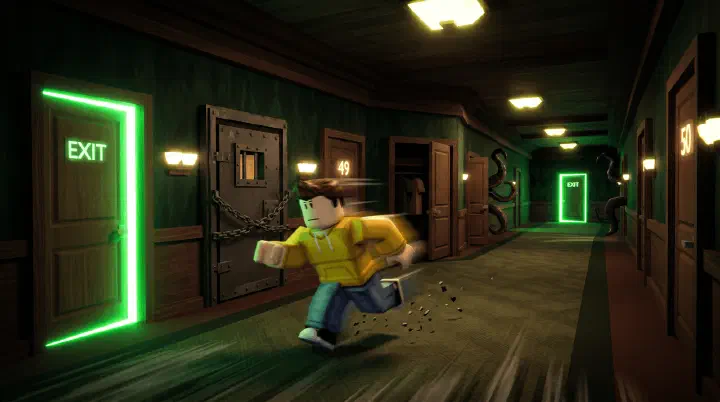
Go back and watch a recording of your last DOORS run. Every time you enter a new room, pause the video. Count how many seconds pass between the door opening and you moving toward the exit. If the number is higher than 2, that is time Rush can catch you. Over a 50-floor Hotel run, shaving 1 second per room saves nearly a full minute. That minute is the difference between a clean clear and a death on floor 48.
Room recognition is the most underrated skill in DOORS. Experienced players do not navigate faster. They recognize faster. Their brain processes the exit position before their eyes finish scanning the room. They have seen every layout 50 times and the recognition is automatic. You can develop the same skill in 30 minutes with the right drill.
The twelve Hotel room types. Type 1: the straight shot, roughly 30 percent of all rooms. You enter from one end. The exit is on the far wall directly ahead. Walk straight forward. The room is rectangular, longer than wide. Containers line the sides but do not block the center path. Type 2: the L-shape, roughly 20 percent. The room bends 90 degrees left or right. The exit is on the perpendicular wall after the bend. Enter, glance at both side walls. The side with more open space is the bend direction. Walk toward it. Type 3: the central obstacle, roughly 15 percent. A large piece of furniture blocks the straight path. Go left around it — the left side has wider walkways in roughly 80 percent of these rooms. The exit is on the far wall. Type 4: the corridor bridge, roughly 10 percent. A thin room, 5 to 8 studs wide, connecting two larger areas. Run straight through. Do not stop. No hiding spots in corridor bridges. Type 5: the closet gallery, roughly 8 percent. Three to six closets lining the walls. The exit is on the far wall, usually between two closets. Mentally note the nearest closet position but do not stop to check them. Type 6: the container room, roughly 7 percent. Three to five loot containers scattered around. The exit is on a side wall roughly 70 percent of the time — check left wall first, then right. Type 7: the dead-end loot room, roughly 5 percent. Small room, half the size of standard. Containers everywhere. ONE entrance. No exit door. Grab one container if it is on your path and leave through the same door. Never explore a dead end.
The 3-second room entry protocol: second 1 — scan the far wall, then left wall, then right wall. Your brain should identify the exit position by the end of second 1. If no exit is visible on any wall, you are in a dead end or special room. Second 2 — note the nearest hiding spot. Do not walk to it. Just know where it is. Second 3 — begin walking toward the exit. By the end of second 3, you should be moving. If you are still standing at the entrance scanning, you have not learned the types yet.
The 30-minute recognition drill: start a run. Do not buy items. Do not loot. Sprint from room to room. At each room, identify the exit in under 1 second, then sprint to it. Do not stop for entities. Let Rush kill you. Restart. Repeat for 30 minutes. You will enter roughly 150 to 200 rooms in that time — more rooms than 10 hours of careful play. By the end of the drill, you will see the exit before you consciously know what room type you are in. Recognition becomes automatic. The drill compresses weeks of casual learning into half an hour.