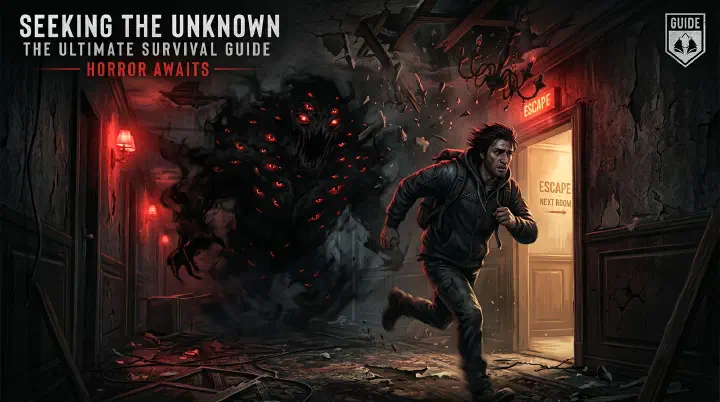
Door 142. The hallway stretches ahead like a throat, dark and narrow. You hear it before you see it — a wet, rhythmic thud that isn’t your footsteps. Then the lights flicker red. The screen shakes. Your controller rumbles, and that heartbeat pounds through your speakers like it’s coming from inside your own chest.
Seek is coming.
You’ve died here nine times. Maybe ten. You lost count after the third chandelier dropped on your head in the maze section. Every run ends the same way: a black screen, a jump scare, and that smug “You Died” text while your squad watches from the lobby. Not today. Not after this guide.
This isn’t another “run fast and don’t look back” post. Those don’t work past door 80. This guide breaks down exactly how the Seek chase works under the hood — the speed scaling, the room generation patterns, the debris physics, and the split-second decisions that separate survivors from spectators. By the end, you’ll have a mental model for every phase of every chase, from the first hallway to the final sprint.
How the Seek Chase Actually Works
Most players think Seek chases are random. They’re not. The game engine builds each chase from a fixed pool of room segments, then scales Seek’s speed based on your current door count and how far you are into the chase sequence.
When the chase triggers, the game enters a special “chase state.” The lights shift to that ugly red pulse. Your camera gets a permanent shake that intensifies as Seek gets closer. The heartbeat sound isn’t just atmosphere — it’s positional audio. When it speeds up, Seek is gaining. When it slows, you’ve created distance.
Seek doesn’t have a fixed speed. The entity uses adaptive scaling. It moves fast enough to stay threatening but not so fast that you can’t outplay it. The key word is outplay, not outrun. You can’t just hold W and hope.
Here’s what actually determines whether you live or die:
- Camera orientation: Looking backward slows your movement. The game applies a hidden movement penalty when your camera faces more than 90 degrees behind your running direction. That’s why players who panic and stare at Seek always get caught.
- Debris collision: The chase rooms spawn physics objects — books, chairs, broken wood. Sprinting into them doesn’t just slow you down. It can stagger you for a full second. Seek covers a lot of ground in one second.
- Pathing RNG: The maze section has three possible layouts. Two of them have a “dead-end trap” where the correct path looks wrong. Most deaths in the maze happen because players trust their eyes instead of their memory.
- Chandelier timing: Falling chandeliers aren’t random. They’re triggered by proximity. Run under one at the wrong moment, and it drops. The trick is learning which chandeliers are on timers and which are proximity-based.
Speed Thresholds by Door Range
Seek doesn’t get faster in a straight line. The difficulty ramps in chunks tied to your progress through the hotel.
- Doors 30-60 (First chase): Seek is slow. You can afford a mistake or two. The hallway is short, and the maze only has one layer. This is your training ground. Don’t waste it.
- Doors 60-90 (Second chase): The speed jump is noticeable. The hallway doubles in length, and the maze adds a second layer with looping paths. Debris density increases, so tripping becomes a real threat.
- Doors 90-120 (Third chase): This is where most players hit a wall. Seek’s speed scales to match a sprinting player, meaning walking is sometimes safer. The final sprint section adds falling chandeliers and collapsing floor sections.
- Doors 120+ (Subsequent chases): Every chase past 120 uses the maximum speed scaling. Rooms are longer, darker, and loaded with more debris. There’s no margin for error. One trip, one wrong turn, one hesitation — you’re dead.
The big takeaway here: your strategy has to evolve. What worked at door 45 will get you killed at door 105. You need to tighten your movement, trust your pathing, and stop treating the chase like a sprint race.
The Three Phases of Every Seek Chase
Every chase, no matter the door, breaks down into three phases. Treat each one as its own mini-game.
Phase 1: The First Hallway
This is the warm-up. The hallway is straight or has gentle curves. The goal here isn’t speed — it’s rhythm. You want to build a clean line through the debris without sprinting yourself into a stagger.
Look ahead, not at Seek. The hallway is wide enough that you don’t need to hug walls. Stay center-left or center-right so you have room to dodge physics objects. If a chair is in your path, strafe around it. Don’t jump. Jumping in Doors has a landing animation that locks your movement for a split second. That split second matters.
The first hallway is also where you set your mental tempo. If you’re panicking here, the maze will destroy you.
Phase 2: The Maze
This is where most runs end. The maze section drops you into a series of connected rooms with multiple exits. Only one exit is correct. The others loop back or dead-end.
The maze has three patterns that rotate randomly:
- The Spiral: Rooms connect in a clockwise or counter-clockwise spiral. The correct path always moves inward. If you find yourself back in a room you’ve seen, you’ve gone the wrong way.
- The Fork: Two doors, one correct. The wrong door usually has subtle visual cues — slightly darker lighting, a dead-end visible through the frame, or fewer debris objects. The right door looks harder. That’s intentional.
- The Loop Trap: Three rooms that connect in a triangle. The correct exit is the one that feels like backtracking. Players naturally avoid the door they just came from, but that’s often the way forward.
In the maze, slow is smooth and smooth is fast. If you sprint blindly, you’ll hit debris, bounce off walls, and lose your bearings. Walk through doorways, sprint in the open rooms. That’s the rhythm.
Phase 3: The Final Sprint
This is the finish line. The game spawns a long, straight corridor with a single exit door at the end. Chandeliers fall. Floorboards collapse. The screen shakes so hard you can barely see.
The final sprint tests everything you’ve practiced. You need to read the corridor ahead while managing your stamina. Here’s the pattern that works: sprint in bursts. Hold shift for three seconds, release for one. This keeps your stamina above the trip threshold while maintaining near-maximum speed.
Watch the ceiling, not the floor. Chandeliers have a two-second wind-up before they drop. If you see one shaking, don’t go under it. The floor collapse sections have cracked textures. Learn to spot them at a glance. They’re always in the same positions for each corridor variant.
When you reach the exit door, don’t stop. Push through it. The chase doesn’t end until the screen cuts to black. I’ve seen players die with their hand on the doorknob because they slowed down to celebrate.
Failure Analysis
Let’s get specific. These are the mistakes I see in every failed run, including my own early ones.
Looking backward too long. The camera penalty is brutal. Every second you spend checking how close Seek is costs you distance. You don’t need to see Seek. You need to hear it. Use the heartbeat audio as your distance tracker. If it’s loud, you’re too close. If it’s fading, you’re fine. Your eyes belong on the path ahead.
Wrong path in the maze section. The maze punishes guesswork. Players see two doors and panic-pick the one that “feels” right. The game designers know what feels right. They built the wrong path to feel intuitive. Stop guessing and start recognizing patterns. The spiral, the fork, the loop trap — they all have tells once you know what to look for.
Standing up at the wrong time. Crouching slows you down, but it also shrinks your hitbox and lets you slide under low debris. Some players refuse to crouch during chases because it feels slower. That’s wrong. There are sections where crouching under a falling chandelier saves two seconds of detour. Two seconds is the difference between living and the lobby screen.
Sprinting into debris. The stagger animation is a death sentence at high doors. At door 140, Seek is close enough that a single stagger means you get caught. Treat debris like landmines. Go around them, even if it means breaking your sprint rhythm.
Panicking at the exit door. Players see the exit and relax. Their hands come off the sprint key. Their movement gets sloppy. Seek doesn’t care that you’re almost safe. The chase ends when the cutscene triggers, not when you see the door.
Decision Framework
You don’t need perfect reflexes. You need a framework. Here’s the one I use for every chase, regardless of door count.
Preparation (Before the chase triggers): Keep your stamina above 50%. Don’t sprint into the room that triggers the chase. Listen for audio cues — the ambient music drops out about two seconds before the lights turn red. That’s your warning. Use those two seconds to center your camera and find the forward path.
First hallway decision tree:
- Is the path clear ahead? Sprint.
- Is there debris in the next three seconds of movement? Walk through it, then sprint.
- Did I just hear the heartbeat spike? Don’t look back. It means Seek entered the hallway. Keep moving.
Maze decision tree:
- Have I seen this room before? Backtrack immediately. You’re in a loop.
- Are there two doors? Check the lighting. The correct door is usually slightly brighter. The wrong door wants you to pick it.
- Is there debris blocking a door? That’s often the correct path. The game hides the right way behind clutter.
Final sprint decision tree:
- Can I see the exit? Sprint in bursts. Don’t burn all your stamina.
- Is a chandelier shaking above me? Stop sprinting, walk around the drop zone, then resume.
- Is the screen shaking violently? That means Seek is close. Don’t turn. Don’t panic. Your character moves faster than you think. Trust the inputs.
This framework isn’t flashy. It’s boring. But boring decisions keep you alive when the game is doing everything it can to make you panic.
Counter-Intuitive Advice
Here are five things that sound wrong until you try them.
Sometimes walking is faster than sprinting. In high-density debris sections, sprinting causes staggers. Two staggers cost more time than walking cleanly through the same section. If a hallway is cluttered with chairs and broken wood, let off the sprint key. You’ll be surprised how much ground you keep.
Crouch under chandeliers instead of going around. The detour around a falling chandelier is often longer than the crouch animation. At door 120+, that extra half-second of distance matters. Crouching also keeps your hitbox low if the chandelier drops early.
The wrong-looking door is usually right. In the fork maze pattern, the correct path is almost always the one that looks worse. Darker lighting, more debris, a tighter squeeze — the game rewards players who push through discomfort. The easy door is a trap.
Hug the center line, not the walls. In the final sprint, debris and chandelier drop zones bias toward the edges. Most players panic and stick to walls because it feels safer. The center corridor is usually the cleanest line. Trust the middle.
Turn your flashlight off. The red chase lighting creates high-contrast shadows that make debris and cracked floorboards easy to read. A flashlight beam washes out those shadows and blinds you to collapse warnings. Counter-intuitive, but the dark is your friend here.
FAQ
How often does Seek appear in Doors?
Seek chases occur roughly every 30-50 doors. The first chase is around door 30-40, with subsequent chases becoming progressively harder and at higher door counts.
Can you outrun Seek by sprinting?
Not exactly. Seek’s speed scales to stay just behind you. Sprinting helps you reach turns faster, but reckless sprinting causes you to trip on debris. Controlled movement beats raw speed.
What items help during a Seek chase?
Vitamins give a temporary speed boost, and a flashlight helps see debris in dark sections. However, most items are less useful than good pathing — don’t rely on items to carry you.
Why do I keep dying right at the exit door?
The chase doesn’t end until the cutscene triggers. Many players see the exit door and relax, letting go of sprint or moving sloppily. Seek can still catch you during those final steps. Keep sprinting until the screen cuts to black.
Does playing in multiplayer make Seek chases harder?
Seek’s speed scaling is identical in solo and multiplayer. However, other players can block your path, create visual clutter, and trigger debris collisions that slow you down. In coordinated teams, spread out horizontally so you don’t bump each other.