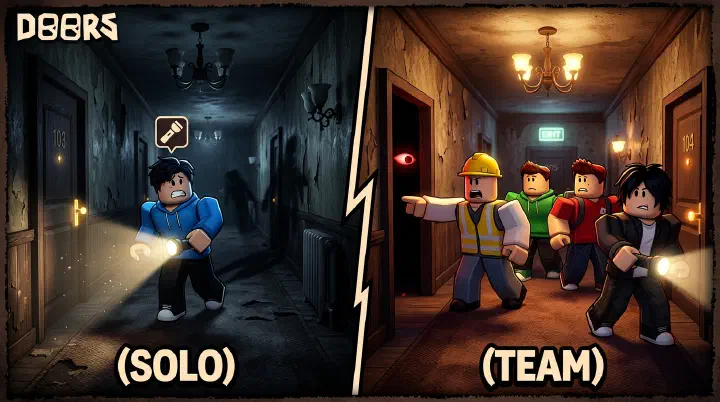
Door 47. You’re solo. The hallway’s dark. You’ve got your flashlight aimed down the corridor because you heard Rush two rooms back and you’re not taking chances. Then you hear it. That wet popping sound. Screech spawns on your shoulder.
You flick your camera right, stare it down, it dies. You snap back to the hallway. Too late. Rush is already halfway through the room. The static from Screech drowned out the audio cue. You didn’t see the lights flicker.
In a team, your friend would’ve screamed “RUSH” over voice chat the second the bulbs dimmed. Solo? You’re dead, and you didn’t even see it coming.
That’s the moment every solo DOORS player knows. It’s not a skill issue. It’s a game-mode issue. DOORS isn’t just harder alone. It plays completely differently. The entities behave the same, but the information economy flips upside down. Most players die because they switch from team to solo without rewiring their brain. They play like someone’s watching their back.
Nobody is.
The Mental Model Shift Nobody Talks About
When you play in a team, your brain offloads work. You stop listening for every audio cue because someone else will call it. You stop checking every dark corner because three other flashlights already swept it. You develop a dependency that feels like teamwork but is actually cognitive outsourcing.
Solo strips all of that away. You are the callouts. You are the lookout. You are the scout, the medic, and the bait. That sounds like it just means “more work,” but it’s deeper than that. In a team, attention splits. In solo, attention concentrates. You see more because you’re not dividing your focus across four player models, four flashlights, and four voices in Discord.
But concentration has a cost: tunnel vision. That Screech killed you not because you’re bad, but because your brain was locked onto one threat and had zero bandwidth left for the second. The players who fail at solo aren’t incompetent. They’re still running team software on solo hardware. You have to uninstall the assumption that someone else is handling the thing you’re ignoring.
Here’s the fix. In solo, you don’t just watch the hallway. You watch the hallway while keeping one ear free for audio layers. You don’t clear Screech in the middle of a wide-open room. You hug a wall, handle it fast, and immediately sweep for the next threat before your brain relaxes. Teams can afford to relax between encounters. Solo players can’t.
How Entities Actually Change (Even Though They Don’t)
The AI doesn’t change. Rush doesn’t move faster because you’re alone. Ambush doesn’t bounce extra times for groups. Figure doesn’t grow more ears. But the effective difficulty? That shifts hard depending on your player count.
Rush and Ambush are team-favored. Full stop. These two rely on audio cues and visual tells that are brutal to miss when you’re already managing another threat. In a group, even if you’re in a closet fighting Screech or reading a Dupe door label, someone else is free to watch the lights. Solo, you have to finish your current micro-task and then process the cue. The timing window doesn’t care that you were busy.
Ambush is worse. Its audio signature is subtle, and its backtrack mechanic means you can’t just hide once and check your phone. In a team, one player can call “Ambush returning” while the rest of you hug the closet. Solo, you’re guessing based on audio fade, and if you’re wrong, you open the closet door directly into its face.
Screech flips the script. This thing is genuinely easier solo. In a team, Screech can spawn on multiple players simultaneously. I’ve had runs where all four of us got Screech within five seconds of each other. Suddenly everyone is looking at their own shoulder monster, nobody’s watching the hallway, and Rush waltzes through the room like it’s closing time. Solo, you get one Screech. You handle it. Done. No coordination required.
Figure is the big counter-intuitive win for solo. Everyone assumes Figure is easier with friends because “more eyes.” Wrong. Figure is blind. It hunts by sound. In a team, four players mean four times the chance someone panics and sprints. One runner kills the whole lobby. I’ve watched full teams wipe in the Library because one guy got jump-scared and dashed for the exit.
Solo, you control the only noise source in the room. You can time your crouch-walking perfectly because you don’t have to account for someone else’s footsteps. Figure becomes a rhythm game instead of a herd-management simulator. The heartbeats are predictable when it’s just you.
Eyes is another solo winner. Keeping line of sight off Eyes is trivial when you’re the only camera the game has to track. In a team, there’s always that one player who doesn’t know where Eyes spawned and backs straight into it while you’re trying to navigate the room. Eyes scales with player count in the worst way – more eyes looking around means more chances to accidentally meet its gaze.
Dupe is roughly even, but I give the edge to teams. Four people reading door numbers means faster verification and less time standing in the doorway like a target. Solo, you check every single door yourself. That costs time, and time is exposure.
Halt benefits from teams because one player can intentionally trigger it to map the safe path while others hang back. Solo, you eat the damage yourself or burn a revive. The Mines made this worse with tight corridors where Halt combined with Grumble pressure turns into a nightmare without someone watching your back.
Seek is mostly neutral, but the chase sequence favors teams slightly. Having multiple sets of eyes to spot the correct path in the obstacle course helps. That said, solo players tend to memorize the chase layout faster because they run it more often. Teams sometimes cruise through on one player’s callouts without learning the route themselves.
Loot Economics: Sharing Sucks
In solo, every item is yours. The Crucifix goes in your pocket. The Vitamins are yours. The Lockpick is yours. You make the call on what to carry and when to use it. Sounds great until you hit door 80 with a full inventory and realize you had to leave the Skeleton Key behind because you grabbed two Vitamins “just in case.”
Teams complicate this. Who gets the one Crucifix? Who burns the vitamins during the Seek chase? Randoms will yoink every item they see and then die with it in door 52. Organized teams can specialize – one player carries defensive items, another carries keys, a third hoards light sources. But with randoms? There’s no specialization. There’s just loot goblins.
And here’s the math nobody does: more players means more item spawns, but not proportionally more. Two players don’t get double the loot. They get slightly more, which means per-player resource density drops. Solo has fewer total items, but you get one hundred percent of them. In hard mode or modifier runs, that per-capita density matters more than total loot.
The Lighter versus Flashlight debate also changes. Solo, you can run Lighter and accept the limited range because you’re only lighting your own path. In a team, someone needs a Flashlight for the group. Guess who gets stuck with that job? Usually the most experienced player, burning their inventory slot for the team’s benefit.
The Revive Trap
Teams have revives. That’s the main argument for co-op, right? If you get knocked down, someone picks you up. Except they don’t. Not in random matchmaking.
Random players will ignore your downed body because they’re afraid of the entity. They’ll try to revive you in the middle of a hallway during Rush. They’ll burn both your revives in the first ten doors because they don’t understand knockdown mechanics. Or worse – they’ll disconnect, and now you’re playing solo anyway but with scaled enemy spawns.
I’ve tracked my clear rates across about two hundred runs. Solo, I clear The Hotel roughly thirty-five percent of the time. With a pre-made team of friends on voice chat, that jumps to about sixty percent. With randoms? It drops to twenty percent. Random teammates are actively harmful. They multiply entity spawns, split resources, and provide false confidence. You play sloppier because “someone will revive me,” and then nobody does.
The revive mechanic is a safety net made of dental floss. Trust it at your peril.
When Solo Is Actually Better
There are specific situations where solo isn’t just viable – it’s objectively optimal.
Learning entity patterns. You need to die to Rush ten times to learn its audio cue timing. In a team, you might never see Rush because your teammates are better at spotting closets and you just hide when they say so. Solo forces direct confrontation. You learn faster because you have to.
Stealth sections. The Library with Figure, the Mines with Grumble nests, any section where noise matters. Solo eliminates the human variable. You know exactly how loud you’re being because you’re the only one moving.
No-death or speedrun attempts. Coordinating four people is harder than coordinating one. Unless you’re a practiced world-record team, solo gives you tighter execution and zero communication delay.
Low-floor grinding. If you’re farming knobs, doing runs to door 50, or hunting specific achievements, solo is faster. No waiting for players to load. No arguing about routing. No one wandering into a side room and triggering a spawn.
Modifier runs with scarce resources. Some modifiers reduce item spawns or disable closets. These are actually easier solo because you don’t have to share the three items that still exist on the entire floor.
Decision Framework: What to Pick and When
| Situation | Solo | Pre-made Team | Randoms |
|---|---|---|---|
| Learning new entities | Best | Good (can observe) | Bad (pure chaos) |
| Rush / Ambush-heavy floors | Harder | Best | Okay if callouts exist |
| Figure / Screech rooms | Easier | Harder | Nightmare |
| Resource-scarce modifiers | Best | Good | Terrible |
| Revive-based achievements | Impossible | Best | Unreliable |
| Speedrunning | Best | Good (only if practiced) | Avoid completely |
| The Mines tight corridors | Easier | Harder (body blocking) | Disaster |
| Grinding knobs / low floors | Best | Slow | Painfully slow |
Use that table as a rule of thumb, but trust your gut. If your random lobby has three players under level ten, just leave and queue solo. You’ll live longer.
The Hard Truth About Randoms
Here’s the counter-intuitive punchline: random teammates are worse than no teammates. The game scales spawn intensity with player count. More players means more Screeches, more pressure, more opportunities for simultaneous overlapping threats. You don’t get four times the brainpower. You get four times the noise, four times the item competition, and about zero-point-three times the reliable callouts.
If you don’t have a pre-made squad on voice comms, solo is the objectively better choice for serious runs. Randoms are for messing around, teaching a friend, or when you want to feel like a hero dragging three dead weights to door 100. They are not a strategic advantage. They are a difficulty modifier that the game doesn’t warn you about.
The worst part? Randoms teach bad habits. You start relying on revives that won’t come. You stop checking corners because “someone else probably did.” You get sloppy. Then when you go back to solo, you die in door 15 wondering what happened. What happened is you forgot how to play.
Closing the Gap
If you’re a team player trying to go solo, here’s your homework. Stop relying on callouts. Wear good headphones and memorize every audio cue. Learn to identify the exact moment Rush’s audio begins, because that’s your only warning when Screech is chewing your ear off. Practice the Figure chase in solo until you can do it blindfolded – literally, the entity is blind, not you.
Never handle Screech in the open. Hug walls. Handle it fast. Then immediately check for the next threat before your brain releases adrenaline. In teams, you can afford a two-second breather. Solo, that breather gets you killed.
If you’re a solo player joining a team, communicate or die. Call every flicker, every hum, every weird door. Your value isn’t your skill; it’s your information. The best DOORS player in a team isn’t the one who survives longest. It’s the one who makes sure everyone else survives too.
DOORS doesn’t care if you’re brave. It cares if you’re aware. Solo or team, the real game is information management. Choose the mode that gives you more of it, and stop pretending that four random players in a lobby count as a team.
Sometimes the best teammate is no teammate at all.