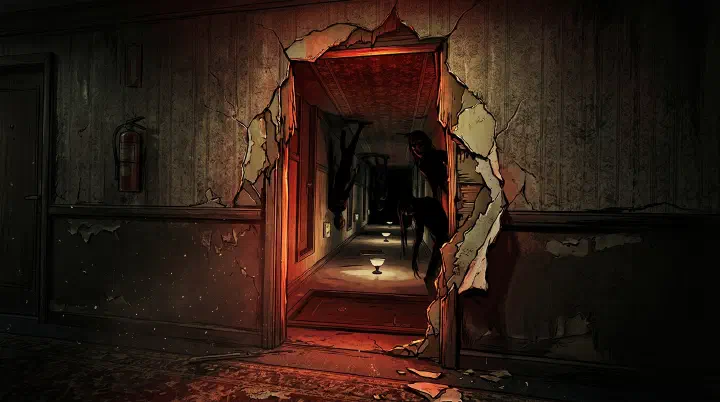
Room 99. The Guiding Light is still with you — the faint blue glow that has pointed at every key and every closet since door 1. Then you cross into room 100 and the Light itself flickers. Not the ceiling lights. The Light. The quiet helper that has been your co-pilot for ninety-nine doors goes dark, and it does not come back on.
You are alone now. That is the first thing The Backdoor takes from you.
The second thing is the hum. You hear it before you see anything — a low, rising drone, like a train building speed in a tunnel. Then the wall at the far end of the hall tears open and a red grin rushes past at sprinting speed. That is A-60. It does not knock. It does not wait for you to find a closet. It just goes.
If you were not already inside a locker when the hum started, you are dead.
That is the whole pitch of The Backdoor. It strips away the hand-holding, then sends things at you that are faster and louder than anything the Hotel throws. Here’s what the area is, how to get in, and how to stay alive once the Light goes out.
What The Backdoor Actually Is
The Backdoor is not Floor 2. That is The Mines, a real level with a start and an end. The Backdoor is a side door off the Hotel that leads into a separate, effectively endless sequence of rooms.
The rooms reuse Hotel assets — the same wallpaper, the same doors, the same lockers. But the logic is different. There is no consistent room numbering you can lean on. There is no friendly voice telling you where to hide. And the entities are not Rush and Ambush from the main bestiary. They are a different cast with letter-number names: A-60, A-120, and company.
The core idea is endurance. You do not “clear” The Backdoor. You see how far you get before it kills you. Depth is your score, not a door number. That changes what “winning” even means.
How You Get In
Access is deliberately hidden. There is no menu button and no glowing waypoint. You reach the end of the Hotel — door 100 — and then you look for something that does not belong: a cracked wall section, a door frame sitting slightly crooked, a dark gap where a wall should be.
In some versions the entry is behind the Lobby or tucked into a mid-run room. In others you trigger it with a lever or a switch. The community has not settled on one method — the trigger has shifted across updates. The one constant is that the game never tells you it is there. You either stumble onto it or you already know where to look.
If you do not see the crack on your first clear, do not assume it is bugged. The Backdoor is built to feel like a secret you discovered, not a level you unlocked.
The Backdoor Entity Roster
These are the things that will kill you. Two are confirmed by nearly everyone who has been inside. The rest are murkier, so I flag them below.
A-60
A-60 is the signature threat of the whole area. Picture a wide red grin attached to a face that fills the hallway, rushing at you far faster than Rush and a lot louder. Its warning is a rising hum or rumble that builds as it approaches. In most versions there is no helpful light flicker to pair with it. The hum is the warning. If you are standing in the open when A-60 reaches you, you die.
Hide in a locker. Any locker in the current or previous room. Do not wait to see the grin — by the time you can see it, you have already lost.
A-120
A-120 is the faster sibling. Same attack shape, same one-hit kill, but the window between “I hear it” and “I need to be inside a locker” is much shorter. Players describe it as A-60 with the training weights taken off. If you can comfortably survive A-60, A-120 is the entity that punishes you for getting comfortable.
A-90 and the rest (approximate)
Beyond A-60 and A-120, reports get less consistent. A-90 is frequently mentioned — an entity that punishes movement, appearing on your screen and damaging you if you keep walking while it is visible. Freeze the moment you see it. Other A-series names, A-200 and beyond, come from the crossover game the area borrows from, and it is not clear which of them appear in every build of DOORS.
Treat the two confirmed entities as your real training set. Treat everything else as a bonus threat you’ll learn the hard way.
| Entity | Warning | What kills you | Correct response |
|---|---|---|---|
| A-60 | Rising hum or rumble | Being in the open when it passes | Locker before it arrives |
| A-120 | Same hum, tighter timing | Being in the open when it passes | Locker immediately on first sound |
| A-90 (reported) | Appears on your screen | Moving while it is visible | Freeze completely |
How Survival Changes vs The Main Hotel
The Hotel teaches you three habits. The Backdoor breaks all three.
First, the Guiding Light fails. Around room 100 — the community figure, not a hard number — the blue glow goes dark and the voice stops pointing at closets. From then on, you find hiding spots yourself. Lean on that prompt for ninety-nine doors and this is where the run falls apart.
Second, audio becomes everything. With no reliable light-flicker warning, the hum is your only cue. This is the same skill as telling Rush from Ambush, just under more pressure. If you can’t read an approaching sound in under a second, train that before you go deep.
Third, lockers are your only real cover. In the Hotel you can sometimes hide under beds or behind furniture. In The Backdoor, the safe answer is a locker — in the current room or the one behind you. There’s no third option and no door you can close in its face.
On top of all that, rooms run longer and darker, and there is no end. You are not racing to door 100 — you are managing how long you survive. If you’re still shaky on hiding and timing basics, start with the beginner guide first.
A Step-by-Step Survival Routine
Here is the loop that keeps runs alive once you are inside.
- Check your inventory at the door. Flashlight with battery, one mobility item like Vitamins, and a defensive item if you have one. Do not walk in empty-handed.
- Scan every room for lockers before anything happens. Note the nearest locker and the fallback locker in the previous room. Do this every single room, even when the Light is still alive.
- Move between rooms at a walk. Sprint only when a hum starts and you need to close the last few steps to a locker.
- The moment the hum rises, go. Nearest locker, no second-guessing.
- Stay in the locker through the pass. Then count three seconds of silence before you step out.
- Move to the next door as soon as you exit. Do not loot in the open after a pass.
- When the Guiding Light dies, keep the same routine. The scan habit you built in steps 2 and 3 is now your only radar.
The whole loop is designed so that when the Light fails, nothing changes. You were already playing without it.
Failure Retrospective: Where Runs Actually Die
Every Backdoor death I have seen falls into one of three patterns. Each one is fixable.
The Light-Fail Panic
Error: the Guiding Light goes quiet around room 100, and the player freezes in the open, trying to figure out why the prompt is gone.
Cause: they had outsourced their awareness to the Light. When the helper died, so did their picture of the room.
Recovery: never rely on the prompt in the first place. Scan every room manually from door 1. If the habit is already automatic when the Light dies, the transition is a non-event instead of a death.
The Wrong-Locker Death
Error: the hum starts, the player picks the “better” locker — the one closer to the exit — and gets caught mid-sprint.
Cause: they optimized for the next room instead of the next second.
Recovery: take the locker you can reach in one second, not the one you want. A-60 does not negotiate. Reachability beats position, every time.
The Overconfident Exit
Error: A-60 passes, the player steps out after one second, and something kills them — a second pass, or A-120 right behind it.
Cause: they treated Backdoor entities like single-pass Rush.
Recovery: count three seconds of silence after every pass. If the hum never fully resolves, you are still in danger. Stay in.
If-Then Decision Table
When in doubt, run the table.
| If this happens | Then do this |
|---|---|
| You hear the rising hum | Enter the nearest locker in under a second. Do not wait to see the face |
| The hum keeps building after a pass | Stay in. A second pass or a second entity is active |
| Three full seconds of silence after a pass | Exit and move to the next room at a walk |
| The Guiding Light goes dark | Keep scanning for lockers yourself. Never stop to check what happened |
| A room has no visible locker | Retreat to the previous room’s locker before the hum starts |
| You are at low health with no flashlight battery | Stop pushing for depth. Hold near known lockers and survive the next pass |
Counterintuitive Tips
The Backdoor rewards the opposite of what feels right.
Slow is fast. Sprinting between rooms does not make you safer. It raises how many rooms you cross per minute, which raises your encounter rate, and it eats the time you need to spot a locker. Walk between rooms. Sprint only into a locker. A slow survivor clears more rooms than a fast corpse.
The dark room can be your friend. Bright rooms breed false confidence — you stop scanning because you can see. Dark rooms force you to scan, and the A-60 hum stands out more clearly against the silence. If you have battery, do not fear the dark. Fear the rooms that look too safe.
Do not trust the Light even while it is alive. It fails around room 100. Treat every prompt as a bonus, never as a dependency. The longest survivors are the ones who were already playing blind.
Keep your volume at about 70 to 80 percent. Max volume distorts the hum, and a distorted A-60 rumble reads as silence until it is on top of you. Clean sound, clean reaction. The same audio discipline that separates Rush survivors from Ambush victims applies here, harder.
Frequently Asked Questions
How do I access The Backdoor in Doors?
After reaching door 100, look for a cracked wall section, a crooked door frame, or a hidden lever near the end of the Hotel. The exact trigger has varied across updates, and the game never points you to it. If you do not see it on your first clear, check again on a later run.
Is The Backdoor harder than the main Hotel?
Yes, and not just a little. The Guiding Light stops helping you, rooms run longer and darker, and the A-series entities are faster and louder than Rush or Ambush. You should be able to reach door 100 comfortably before you bother going inside.
What are A-60 and A-120?
They are the area’s signature entities. A-60 is a fast, loud face with a wide red grin that rushes the hallway; its warning is a rising hum, and being in the open when it passes is instant death. A-120 is a faster variant with a tighter reaction window. Both are locker checks.
Does the Guiding Light really stop working in The Backdoor?
Yes. Around room 100 the blue glow goes dark and the voice stops pointing at hiding spots. From that point on you find lockers yourself, which is why scanning every room from the start matters.
Are there exclusive rewards in The Backdoor?
Yes. The area has exclusive badges and, in some versions, limited cosmetics and achievements tied to depth or completion. Completionists have a real reason to run it, even though it is built to kill you.