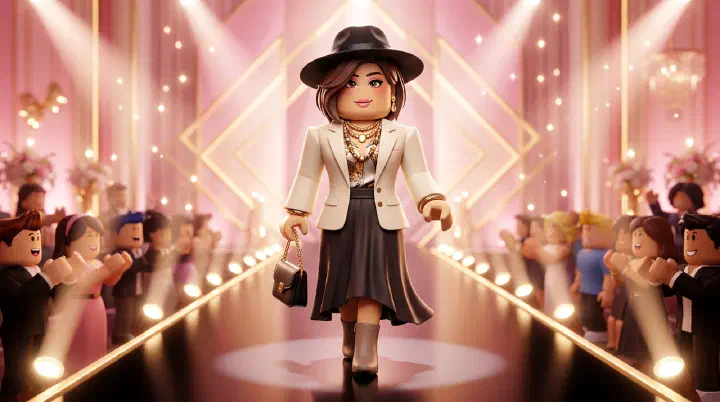
You have exactly ninety seconds left on the clock. The theme is “Vintage Hollywood,” and you are determined to nail the glamour. You grab the pearl strand necklace, layer a choker underneath it for depth, slap on oversized sunglasses, add a wide-brim fedora, and finish with a clutch and dangly earrings. You spin the camera to admire your work. Everything looks perfect from the front.
The runway starts. Your model walks out, and suddenly the choker is buried inside the pearl necklace, creating a chunky glitch at the neckline. The fedora hovers a half-inch above the hairline because the victory rolls hairstyle pushes upward. The sunglasses clip through the hat brim at certain angles. You still feel confident until the results pop up: fifth place, two stars. The winner? A player in a simple red dress, one pearl necklace, and a cigarette holder. No hat. No sunglasses. No layering chaos.
That moment stings because you invested time and creativity. But Dress to Impress does not reward effort the way players assume it does. The accessory system looks forgiving, yet the scoring engine and voter behavior punish specific mistakes hard. This guide breaks down why your layered outfits keep losing, how to build accessory combinations that actually work, and the advanced tricks that separate podium finishes from middle-of-the-pack heartbreak.
Your Outfit Scored a 1 — What Went Wrong
You followed every rule you know. The theme was “Gothic Glamour,” you picked a black lace dress, layered a dark veil over a choker, added silver rings on every finger, and topped it with a wide-brim witch hat. The look was cohesive. The color palette was monochrome. You even matched the silver jewelry to the dress’s embroidery. Then the votes came in: one star, dead last.
Here is the autopsy. The veil and the choker occupy the same neck zone. At voting distance, they read as a single garbled black blob, not two distinct pieces. The ten silver rings are invisible in the thumbnail because the model’s hands rest at her sides during the runway walk. The wide-brim hat casts a shadow over the face, hiding the makeup you spent thirty seconds perfecting. Three accessories that should have worked together canceled each other out because of where they sat on the model, not what they looked like in the inventory.
The fix takes ten seconds: keep the dress, keep the choker, drop the veil, drop eight of the ten rings, and swap the witch hat for a smaller fascinator that leaves the face visible. Same theme, same player, same core items — but the result jumps from a one to a probable four or five. The difference is not in what you wore. It is in what you chose not to wear.
This pattern repeats across every theme. A failed outfit is rarely a bad outfit. It is an outfit where accessories fought each other for space, attention, or both. The fix is almost always subtraction, never addition. Our voting psychology guide explains why voters punish clutter even when they cannot articulate the problem — the brain processes simple outfits faster, and speed equals stars.
Why Your Layered Outfits Keep Losing
Most players treat accessories like a shopping spree — more items feel like more value. The game and its voters penalize five specific mistakes.
Clipping Destroys Polished Looks
Clipping is the silent killer of high scores. When two 3D meshes intersect, the result looks broken. A necklace that clips through a turtleneck does not read as layered. It reads as buggy. Voters notice subconsciously even if they cannot name the problem. The outfit feels “off,” and they scroll past.
Common clipping disasters: chokers paired with high necklines, wide hats combined with puffy hairstyles, large shoulder bags worn over capes, and glasses that intersect with hair bangs. If two items share the same body region, assume they will fight until proven otherwise. Test every combination from the side and back angles before the runway — the front view lies.
Over-Accessorizing Drowns the Theme
Every accessory should earn its place. When you pile on necklaces, bracelets, rings, bags, hats, and glasses, the theme gets buried under noise. A “Punk Rock” theme does not need five chains, two belts, spiked wristbands, and a mohawk hat simultaneously. Three strong punk elements read clearer than seven weak ones. Voters process thumbnails in under two seconds. If their eye does not land on a cohesive story immediately, they move on.
Ignoring Theme Relevance
That diamond tiara looks gorgeous, but it does not belong in a “Streetwear” round. Players often default to their favorite accessories regardless of the prompt. Favorite items create blind spots. The voting audience expects thematic consistency. A single off-theme luxury piece can make the entire outfit feel confused, like the player ran out of ideas or never read the prompt.
Color Mismatch Between Accessories
Even thematically appropriate accessories fail when their colors clash. A gold chain with a silver belt buckle splits the outfit into two palettes. Warm-toned bags paired with cool-toned jewelry create visual dissonance. In Dress to Impress, dye options exist for a reason. Matching metals, leathers, and gem tones across accessories signals intention. Mismatched colors signal randomness. Our color theory guide covers the full palette system, but the accessory rule is simple: all metals should match, and all accent colors should pull from the same temperature family.
Using Items That Conflict With Each Other
Some accessories carry inherent visual conflict. A futuristic visor and a medieval circlet do not coexist in the same universe. A sporty baseball cap and elegant opera gloves create cognitive dissonance. Players layer these items hoping for “unique,” but voters perceive “inconsistent.” Each accessory carries a style tag in the viewer’s mind, and contradictory tags cancel each other out.
The Accessory Priority Framework
Stop guessing and start building outfits with a clear hierarchy. This framework gives you a repeatable process for every round.
Step one: anchor with one statement piece. Identify the single accessory that best communicates the theme. For “Bohemian,” that might be a flower crown. For “Business Chic,” it is a leather tote bag. For “Gothic,” it is a choker or dark veil. This piece stays no matter what.
Step two: add functional support. Choose one or two accessories that complement the anchor without competing for attention. If your anchor is a bold necklace, add small earrings and perhaps a bracelet. If your anchor is a dramatic hat, keep the ears and neck clean. The support pieces should echo the anchor’s color or material.
Step three: evaluate before adding more. Ask three questions. Does this new item share a body region with something already equipped? Does it match the color temperature of existing pieces? Does it add new information about the theme, or just more noise? If you cannot answer yes to all three, stop.
Never layer these combinations:
- Multiple neck items with high collars
- Wide hats with voluminous or tall hairstyles
- Large bags with long coats or capes
- Glasses with face-obscuring masks or veils
- Belts over dresses that already have strong waist detail
Which Layering Approach Fits Your Theme
The three-step framework works for every round, but the specific accessories you reach for depend on the theme category. Here is a decision table that maps your goal to the right approach.
| If you want to… | And your theme is… | Then do this… |
|---|---|---|
| Win with the fewest items | Any theme | Anchor with 1 statement piece + 2 support pieces. Stop there. |
| Layer multiple neck items | Streetwear, Boho, Casual | Use items at different drop lengths. Choker at the throat, long pendant at the chest. Never high collars. |
| Wear a bold hat and still score | Fantasy, Royal, Gothic | Skip necklaces entirely. Keep earrings tiny. Avoid big hairstyles that push the hat upward. |
| Use a bag with a coat | Business, Winter, Travel | Small crossbody or clutch only. Large totes clip through coat meshes. |
| Add back items (wings, cape) | Fantasy, Dramatic, Angel | Strip all neck and shoulder accessories. Back items claim the silhouette — neck items fight for attention from the same viewing angle. |
The table covers the five most common layering traps. If your theme falls outside these categories, apply the priority framework instead: one statement, two support, evaluate before adding.
For themes with heavy pattern work — like “Decora” or “Harajuku” — the accessory rules shift. Patterns already create visual density. Pairing dense patterns with dense accessories creates a wall of noise. In those rounds, accessories should be the calm counterpoint to the pattern chaos. A single clean necklace or a pair of solid-color earrings reads as intentional restraint. Our pattern layering guide covers the full pattern-accessory balance.
Counter-Intuitive Advice That Wins Rounds
Some of the highest-scoring accessory strategies contradict what feels intuitively correct. Internalize these principles and watch your average placement climb.
Three accessories score higher than eight. This is the hardest lesson for enthusiastic dressers. The game rewards clarity, and voters punish clutter. A player with a well-chosen hat, necklace, and bag outranks a player wearing every accessory they own. Empty space is breathing room for your theme to land. In a lobby of eight, the three with the cleanest looks almost always take the podium.
Matching accessories to the background hurts your score. When the runway shifts to a blue underwater backdrop and you wear turquoise jewelry, you become camouflaged. Voters see thumbnails first, not full runway detail. Accessories that contrast with the stage environment pop visually. A bright red belt on a snowy white stage commands attention. A white belt disappears entirely. The rule: your accessories should stand out from the stage, not blend into it.
The ugliest accessory can win you a round. Some items look odd in the inventory but read as perfect thematic shorthand. The rubber chicken bag, the toilet paper scarf, the giant cheese hat — these communicate instantly. In a “Funny” or “Weird” theme, a deliberately absurd accessory outperforms a beautiful but generic one. Ugly items bypass the voter’s “pretty filter” and land directly in the “memorable” category.
Removing an accessory mid-round is sometimes the power move. If you are down to the final ten seconds and you spot clipping you cannot fix, unequip the problem item. A simpler outfit beats a broken one. Players hesitate to undo their work. Champions cut ruthlessly. The runway is not the place to hope glitches go unnoticed — they never do.
Your most expensive accessory is not always your best. VIP items dazzle, but voters do not see price tags. A free event item that perfectly nails the theme outperforms a hundred-robux luxury piece that only vaguely fits. Theme relevance always beats rarity or cost. The VIP guide details which premium items are worth the investment, but the core principle is this: if a free item fits better, wear the free item.
Advanced Layering Tricks for Experienced Players
Once you have mastered the basics, these techniques push your outfits into top-three territory.
Use Hair to Hide Minor Clipping
Not all clipping is fatal. If a necklace sits slightly inside a turtleneck but the hair falls forward over the chest, the glitch disappears from the voter’s main angle. Long, straight hairstyles mask chest-level clipping. Side-swept bangs hide minor glasses-frame issues. Think of hair as a soft eraser — for mistakes the voter cannot see from the standard runway camera angle.
Exploit Vertical Space
Voters see your model from the front at a slight angle. Accessories in different vertical zones read as layered without physically overlapping. A headpiece, shoulder detail, waist belt, and ankle bracelet coexist because they never touch in 3D space. Stack vertically, not horizontally. The neck and chest are the most contested zones. Spread accessories up and down the body instead of crowding one spot.
Match Accessory Scale to Outfit Scale
A tiny stud earring disappears on a ballgown with huge sleeves. An oversized tote bag overwhelms a sleek cocktail dress. Large silhouettes demand bold accessories. Minimalist outfits demand delicate ones. Scale harmony makes layering feel intentional. The gut check: squint at your outfit. If one accessory dominates the frame, it is too big. If one vanishes, it is too small.
Pre-Build Accessory Sets for Common Themes
Speed matters. In timed rounds, you cannot build from scratch. Create mental or physical loadouts for recurring themes. Your “Fantasy” set might include the star circlet, crystal pendant, and ethereal wings. Your “Streetwear” set might include the crossbody bag, snapback, and chain necklace. Pre-built sets eliminate decision fatigue and ensure your combos are already clip-tested. Our outfit planning guide covers the full pre-round preparation system.
How Accessories Interact With Theme Scoring
Understanding the full scoring picture helps you invest your accessory choices wisely. The dressing and scoring guide covers the complete algorithm, but here is the accessory-specific breakdown.
Voters judge outfits holistically. Accessories contribute to the overall impression, but they do not add bonus points directly. A player wearing ten accessories does not get a “quantity multiplier.” Instead, accessories modify how voters perceive the core outfit. Well-chosen accessories elevate a simple dress. Poorly chosen accessories downgrade an elaborate gown.
Color coordination across accessories and clothing counts more than most players realize. If your dress is pastel pink and your bag is neon green, voters register the clash even if both items are individually cute. Think of accessories as color punctuation. They should complete the sentence, not rewrite it in a different language.
Movement matters too. Bags swing, capes flow, and necklaces shift during runway walks. Static screenshots do not capture this, but voters do. Avoid accessories that glitch or spasm during animation. Test your outfit by walking in place in the dressing room. If something flickers or floats, fix it or remove it.
Accessory Tier List by Reliability
While individual taste varies, certain accessory categories offer more consistent scoring value across themes.
- Necklaces: High value, medium risk. The fastest way to add elegance or edge. Risk clipping with collars. Test from side angle.
- Earrings: High value, low risk. Almost never clip. Always visible. Small but carry disproportionate visual weight in close-up thumbnails.
- Bags: Medium value, medium risk. Great for themes like “Shopping Spree” or “Business.” Risk clipping with coats and long skirts.
- Hats: High value when theme-appropriate, high risk. Transformative but notoriously glitchy with hair. Always test with your chosen hairstyle.
- Glasses: Medium value, low risk. Excellent for “Nerd,” “Boss,” or “Celebrity” themes. Avoid layering with face jewelry or masks.
- Bracelets and Rings: Low individual value, low risk. Safe fillers that add polish without stealing focus. Nearly invisible in thumbnails, so treat them as bonus polish, not scoring weapons.
- Back Items (wings, capes, bows): Situational value, low risk. Game-changers in fantasy or dramatic themes. Invisible from the front in thumbnails, so pair them with a strong front-facing accessory.
What’s Unconfirmed
A few things about the accessory system remain unclear because the developers have not published the full scoring formula. Treat these as working theories.
The exact weight of accessories versus clothing in the theme-matching algorithm is unknown. Community testing suggests accessories carry less weight than the core outfit (dress, top, bottom), but the ratio is not documented. VIP accessories may receive a slight visibility bonus in certain lighting conditions, but this has not been confirmed. The game engine’s mesh collision threshold — how close two items can get before the game considers them “clipped” — is also unpublished. Players report that hair accessories seem to have a more forgiving collision radius than neck items, but this is anecdotal.
If you have data from controlled testing, share it. The community figures out more about the scoring engine every month.
Bringing It All Together
The next time you queue into a “Royal Ball” theme, resist the urge to equip every shiny item in your inventory. Choose one statement piece: a tiara, a jeweled choker, or an ornate fan. Add small earrings that match the metal tone. Consider a delicate bracelet if the sleeves are short. Stop there. Preview from the front, side, and back. Check for floating, clipping, or color clashes. Walk in place to catch animation glitches.
Submit with confidence. Your outfit will read as polished, intentional, and thematic. Voters reward that clarity. And if you find yourself in fifth place again, audit your accessories first. The fix is rarely adding more. It is almost always subtracting smarter.
For more Dress to Impress strategy, check our guides on theme-winning frameworks, color theory and palette building, and beginner fundamentals. If accessories are your bottleneck, the pattern layering guide and voting psychology breakdown will help you close the gap. Master the layers, and the podium will follow.