The theme lands: “Cottagecore.” Your heart skips. You scroll through your wardrobe — nothing but corsets, miniskirts, and a single floral top you never use. Sixty seconds left, and you’re piecing together an outfit that looks like a confused garden ornament. The walk begins. You place dead last.
That’s not bad luck. That’s not having a system.
Most DTI players approach themes like a pop quiz — you either know the word or you don’t. The best players treat themes like a multiple-choice test: every theme belongs to one of five categories, and each category carries a universal formula. Learn the formula, and you never panic again.
There are 80+ themes in DTI’s rotation, but every single one collapses into exactly five buckets: Fashion Style, Era/Time, Environment, Character/Profession, and Mood/Concept. The category tells you the target silhouette, the winning color palette, and the one accessory that seals the deal. This guide maps them all.
Here is every DTI theme organized by its category and the formula that wins:
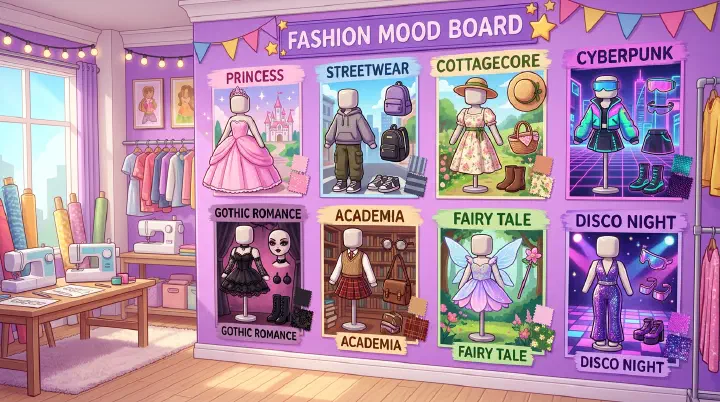
Fashion Style — Gothic, Y2K, Streetwear, Boho, Emo, Preppy, Kawaii, Grunge, Minimalist, Punk, Hip-Hop, Vintage, Chic, Edgy, Sporty, Coquette. Each demands a recognizable silhouette from that style’s era, a monochrome or two-tone color scheme, and one era-specific accessory. Gothic equals all black with dramatic shapes and a choker. Y2K equals metallic plus pastels with a crop top and butterfly clips. Streetwear equals black with one neon accent, oversized fit, and a chain belt. Learn the signatures, not the individual names.
Era/Time — 1980s, Victorian, Medieval, 1920s, 1950s, 1970s, Renaissance, Ancient Egypt, Disco, Retro. Silhouette comes first. Big hair and neon for the 80s. Corset and long dark skirt for Victorian. Flapper dress and pearls for the 1920s. The shape communicates the period before any detail registers.
Environment — Beach, Winter, Forest, Desert, Jungle, Ocean, Garden, Arctic, Tropical, Space. Color-driven and beginner-friendly. Sand and blue for Beach with sunglasses. White and ice blue for Winter with a scarf. Green and brown for Forest. Voters register color before anything else.
Character/Profession — Princess, Doctor, Rockstar, Chef, Athlete, Superhero, Artist, Detective, Royalty, Pilot, Firefighter, Nurse, Astronaut. Won or lost on a single identifying piece. The crown for Princess. The stethoscope for Doctor. The guitar for Rockstar. One piece carries the theme; the rest supports it.
Mood/Concept — Elegant, Spooky, Romantic, Powerful, Mysterious, Cute, Scary, Glamorous, Dark, Angelic, Demonic, Whimsical. Color is mood. Elegant equals black, gold, champagne with long gloves. Romantic equals pink, red, white with a flower. Spooky equals black, purple, dark red with a dark veil.
Some themes carry higher win rates because voters universally agree on the visual signature. Gothic, Beach, Y2K, Formal, Princess, and 1980s have the highest win rates, consistently producing 4+ star placements because their formulas are locked — every voter knows exactly what each should look like. Cottagecore, Fantasy, Vintage, Streetwear, and Kawaii sit in the middle, where playing the extreme stereotype beats nuance every time. A Cottagecore entry with an exaggerated straw hat and apron beats a subtle cottage vibe by two full stars. Avant-Garde, Editorial, Futuristic, Minimalist, and Abstract have the lowest rates — voters freeze because there is no clear template, so boldness is the only safe play. Commit fully to a single wild direction rather than hedging with something safe.
How to Decide What to Wear in 30 Seconds
When the theme appears, run this decision tree:
Step 1: Identify the category (3 seconds). Is it a fashion style, an era, an environment, a character, or a mood? This single classification determines everything that follows.
Step 2: Lock the color palette (5 seconds). Each category has a default palette. Environment themes use nature colors. Mood themes use emotional colors. Fashion styles use the subculture’s signature colors. Pick three colors max.
Step 3: Choose the silhouette (10 seconds). Era themes are silhouette-first — the shape communicates the period. Character themes need one identifying piece on a neutral base. Fashion styles need the era-specific cut — A-line for the 50s, oversized for the 90s, crop tops for Y2K.
Step 4: Add exactly one identifying accessory (7 seconds). One piece that anchors the theme. If you have more than one, remove all but the strongest.
Step 5: Fill remaining time with fit and polish (5 seconds). Clean layering, good color blocking, no clipping. These won’t save a wrong interpretation, but they elevate a correct one from 3 stars to 4+.
This framework gets you from theme reveal to a wearable outfit in 30 seconds. That leaves 30 seconds for hair, makeup, and final tweaks.
Why Most Players Lose on Themes
Three mistakes kill scores more consistently than any wardrobe gap:
Mistake 1: Interpreting literally instead of visually. When the theme is “Detective,” players put on a trench coat and call it done. But voters vote on silhouette and color first, not props. A beige trench coat in an all-beige outfit reads as boring, not detective. The correct move is a smart, structured silhouette in muted browns and blues with one identifying piece — the magnifying glass or badge. The theme communicates a vibe, not a costume.
Mistake 2: Over-accessorizing to “prove” the theme. The more items you add to show you understand the theme, the more visual noise you create. Princess plus crown plus wand plus gown plus tiara plus necklace reads as clutter. Princess plus structured gown plus crown reads as royalty. One strong identifying piece beats five weak ones.
Mistake 3: Playing your creative interpretation instead of the stereotype. You think “Avant-Garde” means asymmetrical neon shapes. The voter thinks “Avant-Garde” means dramatic black-and-white editorial. You lose because you were original and they were predictable. Voters reward the stereotype. Always play the version that 8 out of 10 voters would pick for that theme.
Counter-Intuitive Advice That Wins Rounds
1. Less is more — except when more is more
The “one strong piece” rule applies to Character themes. But Mood themes and Fashion Style themes reward layering. Elegant wants multiple textured layers — velvet gloves, a pearl necklace, a structured gown. Streetwear benefits from layered accessories. Knowing which category demands minimalism and which rewards maximalism is the difference between a 2-star and a 5-star outfit.
2. Color beats detail every time
Voters spend 2-3 seconds per outfit. In that window, silhouette and color block register; individual items don’t. A perfect outfit in wrong colors loses to a simple outfit in the right palette. Color is the highest-leverage decision you make.
3. The “ugliest” outfit wins on difficult themes
On themes like Avant-Garde or Abstract, don’t try to make something “pretty.” The voter has no reference for what “good” looks like, so they vote for what’s memorable. An intentionally bold, polarizing, even “ugly” outfit scores higher than a safe, forgettable one. Break symmetry. Use clashing colors. Make them feel something — even if that something is confusion.
4. Voting against your theme is a valid strategy
In themes where the category is unclear (Cottagecore, Fantasy), players split on interpretation. If you recognize the split, pick a lane and go extreme. Extreme Cottagecore — full floral, straw hat, basket — beats mild Cottagecore every time, even though half the voters wanted something else. Polarizing beats middling.