The theme is Gothic Glamour.
You queue in, heart racing. Black dress — easy. You watched three tutorials this week. You know the meta. Dark lace gloves fly onto your avatar. Choker clicks into place. A dramatic black veil. Tall black heels. A tiny dark bag because it’s cute and you still have slots. At the last second you throw on dramatic sleeves because leaving an accessory slot empty feels like leaving votes on the table.
You hit the walk button feeling confident. Your look is obviously Gothic. Dark fabrics. Coordinated accessories. Every slot filled. You’ve got more items than anyone else in the lobby.
Walk time. You strut. You pose. You smile.
Then the votes land. Two stars. Maybe three if someone was generous.
The winner stands beside you with hardly anything on. A deep purple gown. Blood-red gloves. Black hair. Silver earrings. Three colors total. That’s the entire outfit. Simple silhouette. Clean lines. Easy to digest in two seconds.
That’s the part that stings. You had more Gothic items. Your outfit was objectively more detailed. You spent more time. You used more slots. But DTI voters don’t count accessories. They scan color first, making a snap judgment before anyone registers your lace trim or your carefully layered sleeves.
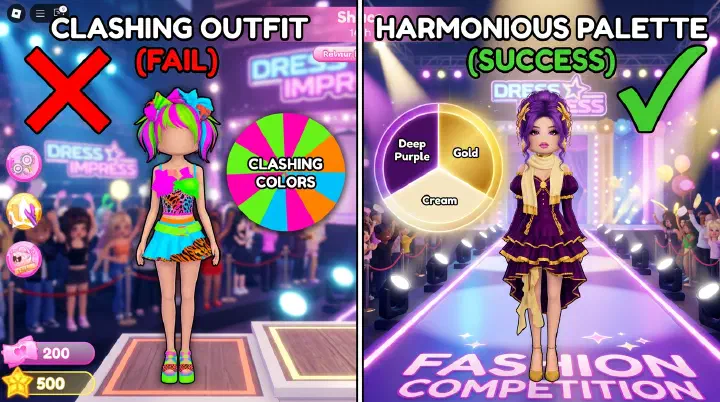
When your outfit has black, white, red, purple, silver, and gold all competing for attention, no single color wins. The brain registers “busy” before it registers “Gothic.” The winner’s three-color palette signaled elegance instantly. Yours signaled “a lot of stuff.”
Color isn’t one part of the outfit. Color is the message.
If your palette clashes, your look reads as messy even when every item individually fits the theme. If your palette is clean, even simple outfits look intentional — and intentional outfits get votes. Every single time.
Why More Items Don’t Win
The beginner mistake is treating DTI like a checklist.
For Gothic, you add black, lace, gloves, a veil, dark makeup, boots, red eyes, purple eyeshadow, silver jewelry, and maybe one white accessory. Every item individually fits. Together they create a visual mess.
That hurts you for three reasons.
First, voters read color before detail. The human brain processes color in roughly 13 milliseconds. It takes 200-300 milliseconds to identify shapes and objects. By the time a voter notices your lace gloves, they’ve already judged your palette. A clean palette makes the theme obvious before anyone spots a single accessory.
Second, too many colors make expensive items look cheap. A VIP dress draped in four clashing colors looks worse than a free dress committed to one strong palette. The eye doesn’t know the dress cost Robux. It only knows what it sees.
Third, accessories compete with each other. A red bow, silver necklace, purple gloves, and white stockings all ask for attention simultaneously. None of them wins. The voter’s eye jumps between them without landing anywhere.
Good outfits aren’t empty. They’re edited.
A winning outfit has:
- One base color covering most of the body (60-70%)
- One support color for theme and depth (20-30%)
- One accent color for the focal point (5-10%)
- Hair and makeup that repeat the same palette, not introduce new ones
- Accessories that support the outfit instead of starting new color stories
If you already use the DTI Theme Winning Framework, color is the second decision. Category tells the story. Palette tells voters what emotion to feel.
The 3-Color Framework
Pick three color roles, not three random colors.
Base color: the biggest color. Dress, skirt, pants, jacket, or main outfit piece. It covers about 60-70% of your look. The base is what voters see first — it should scream the theme category before they notice anything else.
Support color: the mood color. It appears on gloves, shoes, secondary clothing, hair streaks, or makeup. It covers about 20-30%. The support color creates depth and prevents the base from reading as flat.
Accent color: the tiny color that makes the outfit memorable. Jewelry, bag, lips, belt, bow, or one small accessory. It covers about 5-10%. The accent is the detail voters remember when they’re deciding between you and someone else.
For Gothic Glamour:
- Base: black
- Support: deep purple or burgundy
- Accent: silver
For Fairy:
- Base: pale green
- Support: soft pink or lavender
- Accent: gold or white
For Royal:
- Base: navy, emerald, or ivory
- Support: gold
- Accent: ruby, pearl, or silver
Most bad outfits fail because the accent becomes another support color. Red lips are fine. Red lips, red gloves, red shoes, red bag, and red hair are not. Now red is fighting the base for dominance.
If a color appears in more than three places, it’s probably not an accent.
Failure Analysis: Three Common Palette Mistakes in DTI
Knowing the 3-color framework is half the battle. Knowing what losing looks like helps you spot problems before the runway.
Mistake 1: Accidental Rainbow
You pick a black base. Then add silver shoes. White gloves. Red lipstick. Blue eyeshadow. Gold jewelry. Every piece individually fits Gothic, but together they create six competing colors.
Here’s what happens in the voter’s brain: the eye lands on white gloves, then jumps to silver shoes, then red lips, then blue eyeshadow, then gold jewelry. No single color dominates. The brain can’t settle on a theme signal. It registers “chaotic” before it registers anything else.
The consequence: voters can’t find the theme. They see a spray of unrelated hues, not a curated look. Your score drops 2-3 stars because the brain labels the outfit as “messy” before it even processes individual items.
The fix: before the walk, count your colors. If you have more than three distinct hues, pick the weakest one and recolor it to match your base or support. That single change often moves you from 2 stars to 3-4. I’ve seen it happen in real lobbies — a player recolors one accessory and suddenly the outfit reads as intentional.
Mistake 2: Theme Match Without Color Strategy
You see the theme Barbie. You equip a pink dress, pink shoes, pink bag, pink hair, pink makeup, and pink wings. Everything is pink. The outfit is recognizable — nobody will mistake it for anything else — but it’s flat. No contrast. No visual landing point. No depth.
The consequence: voters scan past it because every all-pink Barbie look reads the same after the first few. Your outfit doesn’t look like a specific styling choice. It looks like the default Barbie assumption. You lose votes to players who used the same theme but added one contrasting color for structure.
The fix: keep pink as your base but introduce a white support for shape and a silver or gold accent to create a focal point. Same theme, stronger readability. The contrast creates edges that the eye can follow.
Mistake 3: The One-Off Color That Hijacks Attention
Your outfit is cream, sage green, and brown — perfect cottagecore. But your wings are bright blue because they were the only wings you owned and you forgot to recolor them.
The consequence: that single blue item becomes the loudest signal in the entire outfit. It’s the only blue thing on screen. The eye gravitates to it immediately. Voters remember “blue wings” not “cottagecore.” You were one recolor away from a winning score.
The fix: recolor or remove any item whose color appears exactly once in your outfit and doesn’t serve as the planned accent. The eye always gravitates to the unique color. Make sure that unique color is your accent, not a forgotten misfit. Run a five-second audit before the walk: does every item’s color belong to my base, support, or accent? If not, recolor or drop it.
Color Wheel Rules That Actually Matter
You don’t need an art class. You need four practical rules that work inside DTI’s 45-second timer.
Monochrome wins when the theme is already clear. Use one color family with different shades: black, charcoal, grey; pink, blush, rose. This works for Gothic, Angel, School, Elegant, Baddie, Ice Queen, and Celebrity themes. The key is shade variation — black, charcoal, and grey together create depth. All-black with no shade variation reads as a silhouette with no features.
Analogous colors feel natural. These are colors near each other on the wheel: green and blue, pink and purple, orange and yellow. Use them for Fairy, Mermaid, Cottagecore, Spring, and Romantic themes. Analogous palettes feel harmonious because they exist together in nature — nobody questions a green-and-blue mermaid.
Complementary colors need restraint. Red and green. Blue and orange. Purple and yellow. They pop hard, but they can look like a costume if both are loud. Make one the base and the other a small accent. A green dress with tiny red earrings reads as intentional. A green dress with red shoes, red bag, and red hair reads as Christmas.
Neutrals save risky palettes. Black, white, cream, grey, brown, and denim calm strong colors. Hot pink works better with black or white. Gold looks richer with navy, ivory, emerald, or burgundy. When in doubt, ground your loudest color with a neutral partner.
Theme-to-Palette Mapping
Don’t choose colors from your favorite items. Choose from the theme category. Here’s what works for every major category.
Dark Themes
Gothic, Horror, Vampire, Villain, Dark Academia, Haunted, Emo, Witch, and Mysterious need low light and controlled drama.
Best palettes:
- Black + burgundy + silver
- Black + deep purple + gunmetal
- Charcoal + blood red + black
Avoid bright white as a large base unless you’re doing ghost, doll, or vampire aristocrat. For item and silhouette ideas, use the Gothic, Dark & Horror Theme Guide. The color lesson is simple: black alone can look flat. Black plus one dark support color looks styled.
Nature and Outdoor Themes
Forest, Jungle, Safari, Beach, Winter, Spring, Cottagecore, Camping, Farm, and Garden need colors that feel like the setting.
Best palettes:
- Sage green + cream + brown
- Olive + tan + gold
- Sky blue + white + sand
- Ice blue + white + silver
Nature themes punish artificial colors. Neon green doesn’t read as forest. It reads as slime. Ask: would this color exist in the actual environment? If not, make it a tiny accent or drop it. A neon pink flower in a forest outfit might work as an accent. A neon pink dress in a forest outfit does not.
Royal and Luxury Themes
Princess, Queen, Royal Ball, Gala, Red Carpet, Rich, Celebrity, Elegant, and Masquerade need contrast, shine, and polish.
Best palettes:
- Navy + gold + white
- Emerald + gold + cream
- Burgundy + black + gold
- Ivory + pearl + champagne
Gold signals wealth fast, but full gold often just looks yellow. Use it on trim, jewelry, crown, belt, or shoes. Let navy, emerald, burgundy, black, or ivory carry the body.
Counter-intuitive: a princess outfit doesn’t need to be pink. Navy with gold often looks more royal than a pink dress with every sparkly accessory attached. Most voters have seen fifty pink princesses. A navy-and-gold royal stands out.
Cute, Soft, and Romantic Themes
Kawaii, Romantic, Valentine’s, Coquette, Soft Girl, Doll, Fairy, and Pastel need low contrast.
Best palettes:
- Blush pink + cream + pearl
- Lavender + white + silver
- Baby blue + white + pale yellow
- Mint + pink + gold
The mistake is using every pastel at once. Pink, blue, lavender, mint, yellow, and white together look like spilled candy. Pick one pastel as the base, one nearby pastel as support, and one light neutral. Restraint is the difference between “soft” and “messy.”
Hair and makeup matter here. A soft pink outfit with black lipstick feels disconnected. Use the DTI Hair Combos & Makeup Pairings guide when the clothes work but the face feels wrong.
Streetwear, Y2K, and Modern Themes
Streetwear, Y2K, Baddie, Trendy, Pop Star, Influencer, Sporty, and Model can handle brighter color.
Best palettes:
- Black + denim + silver
- White + hot pink + chrome
- Brown + cream + gold
- Grey + red + black
Modern themes allow loud accents. They don’t allow every loud accent. For streetwear, black and denim are safe bases. Add one strong color: red, green, pink, or electric blue. One. That color becomes the outfit’s logo. Two strong colors start a fight.
Fantasy and Supernatural Themes
Fairy, Mermaid, Angel, Devil, Alien, Magical Girl, Witch, and Goddess can use unusual colors because the theme is unreal.
Best palettes:
- Teal + purple + pearl for mermaid
- White + gold + pale blue for angel
- Red + black + gold for devil
- Emerald + black + bronze for witch
What fails is mixing fantasy signals. Mermaid teal, devil red, angel gold, and fairy pink in one outfit creates no clear creature. Pick one fantasy world and stay in it. The voter needs to know what you are in two seconds.
Decision Framework: Base-First vs. Accent-First
You have 45 seconds and five outfit slots. The theme is Royal. Two competing approaches enter your head.
Option A: Base-First Approach
Pick the biggest color block first. For Royal themes, that’s usually navy, emerald, or ivory. Build the dress or main piece in that color. Then layer support (gold or cream) and accent (ruby or silver) through accessories.
Best for: themes where the mood and silhouette drive the vote — Gala, Red Carpet, Rich, Elegant. The dress color does the heavy lifting, so this works when you want instant theme recognition. A navy gown reads as “royal” before any accessory touches it.
Option B: Accent-First Approach
Start with the small piece you really want to feature — a crown, a signature bag, a rare item with a unique color. Build the entire outfit around its color. If the crown is gold with red gems, your base needs to be a dark color that makes gold pop — navy, black, or burgundy.
Best for: themes where a signature item creates identity — Masquerade, Queen, Celebrity. The standout piece proves you understood the brief, and the rest of the outfit exists to support it. Nobody questions a masquerade look with a striking mask, even if the dress is simple.
How to choose with limited time:
If the theme is generic (Elegant, Fancy), go base-first — the dress color signals the mood instantly. If the theme is specific (Met Gala, Royal Wedding, Vampire Queen), go accent-first — the defining piece proves you understood the theme’s nuance.
The trap: starting base-first when you have a great accent piece, or accent-first when you don’t have any standout item. A beautiful navy dress with no accent reads as “blue outfit.” A navy dress with a deliberate gold crown and ruby ring reads as “royal.” The decision framework keeps you honest about which approach fits the theme, not your inventory.
Counter-Intuitive: Four Times Your Gut Leads You Wrong
DTI color theory has several moments where the obvious choice backfires. Here are four situations where your first instinct is wrong.
1. Coordinated outfits often look flatter than intentionally mismatched ones.
Your instinct says: everything should match. Same color dress, shoes, bag, gloves, and hair.
Reality: if every item is the exact same shade — all black, all pink, all white — the silhouette disappears. Voters see one color blob with no depth. They skip it because they can’t read the shape. The outfit looks like a single flat object, not a composed look.
The fix: add a different color specifically to create contrast. Black dress + burgundy gloves + silver jewelry reads as intentional styling. All-black + all-black + all-black reads as “I stopped thinking.”
2. Expensive items look cheaper in a messy palette than free items in a clean one.
Your instinct says: rare VIP dress = automatic votes.
Reality: a rare gown covered in black, white, red, gold, and green clashing accessories looks worse than a free basic dress in one thoughtful color. Voters judge palette before rarity. They don’t know your dress was hard to unlock — they just see visual noise. The game doesn’t flash a “this item cost 4000 Robux” sign above your head.
The fix: treat rare items the same as basic ones. Apply the 3-color framework before you equip anything, regardless of rarity score. The item’s value is invisible to voters. Only the color harmony matters.
3. Your favorite accessory is usually the piece dragging your score down.
Your instinct says: this item is cute, so it helps the outfit.
Reality: if an accessory introduces a color that appears nowhere else in your look and doesn’t serve as the planned accent, it becomes the loudest signal. A pair of purple fairy wings will hijack a red-black-gold devil outfit entirely. The outfit would score higher without them. The item you love most is often the one that breaks your palette.
The fix: before the runway, do a five-second audit. What is your base, support, and accent? If you find a fourth color in any item, recolor it to match something already in your palette or remove it. Style is what you leave out.
4. Darker colors win more votes even on bright, cheerful themes.
Your instinct says: bright theme, bright colors.
Reality: darker shades create contrast and make details visible. A royal blue dress reads more clearly on the runway than a pale sky blue one, even for a spring theme. The runway lighting washes out pale colors. Darker tones hold their shape under the bright runway spotlights while pastels and whites tend to blow out into featureless blobs.
The fix: even on bright themes, choose a base color with enough saturation to hold its own under runway lighting. Pale pink works, but a slightly deeper rose pink reads better. Mint works, but forest green is more visible. The subtle difference between “soft” and “invisible” depends entirely on the runway’s lighting engine.
5. “Neutral” and “safe” are not the same thing — and safe loses.
Your instinct says: when you don’t know the theme, go neutral.
Reality: beige, grey, and cream are safe — they clash with nothing. But they also excite nobody. A safe neutral outfit gets 2-3 stars from voters who don’t hate it but don’t love it either. A bolder, riskier palette with clear intent gets 4-5 stars from voters who respect the commitment.
The fix: neutral bases are fine — black, navy, cream, white. But pair them with a support color that shows you understood the theme’s mood. A cream outfit with brown accessories reads as “boring.” A cream outfit with emerald green accessories reads as “elegant with a point of view.” The support color proves you made a choice, not a default.
Build a Palette in 20 Seconds
When the theme appears, don’t open your wardrobe first. Decide the palette first.
Use this order:
- Name the category: dark, nature, royal, cute, modern, fantasy.
- Pick the emotion: scary, soft, rich, cold, warm, magical.
- Choose a base color.
- Choose a support color.
- Choose one accent color.
- Then pick clothing.
Example: Ice Queen. White base, ice blue support, silver accent. Build: white gown, blue cape, silver crown, pale blue eyeshadow, white hair.
Example: Safari. Tan base, olive support, brown accent. Build: tan outfit, olive jacket, brown boots, natural makeup.
Example: Pop Star. Black base, hot pink support, silver accent. Build: black outfit, pink jacket, silver jewelry, glossy makeup.
Hair, Makeup, and Poses Must Support the Palette
Hair is a huge color block. Warm brown hair makes a white-blue-silver outfit less icy. Bright blonde can weaken black-burgundy Gothic unless the contrast is intentional.
Hair should repeat the base, repeat the support, or stay neutral. Makeup should not add a new color story. If your palette is navy, gold, and white, your eyeshadow shouldn’t suddenly be purple.
Poses matter too. If your outfit has one strong accent, show it. Silver crown? Use upright poses that frame the head. Red gloves? Use hand-forward poses that put them center stage. Dramatic skirt? Avoid poses that hide the silhouette behind crossed arms.
For pose choices, use the DTI Pose Meta Guide. The short version: pose to show your focal color, not just to look funny.
Fast Fixes Before Runway
You have ten seconds left. The outfit feels wrong. Don’t rebuild. Fix the palette.
- If the outfit looks messy, remove the brightest accessory.
- If it looks flat, add one small metallic accent.
- If the theme isn’t obvious, strengthen the base color.
- If hair clashes, switch to black, brown, white, or a color already in the outfit.
- If makeup feels random, match lip or eyeshadow to the support color.
- If shoes stand out too much, recolor them to the base color.
- If the outfit has four or five colors, cut it to three.
The best emergency fix is usually recoloring what you already have. It’s faster than swapping items and preserves the silhouette you’ve built.
When to Break the Rules
You can break the 3-color rule when the theme demands it.
Rainbow, Decora, Clown, Carnival, Crazy Day, Harajuku, and some Y2K looks can use more colors. But even then, you need structure.
Use rainbow order. Use a warm palette. Use a cool palette. Use one neutral base with many bright accents. Don’t scatter random colors everywhere.
More colors are fine when the theme is maximalist. Random colors are not.
This is also voting psychology. If every player goes chaotic for a chaotic theme, the cleanest chaotic outfit wins. The DTI Voting Psychology Guide explains why readable outfits beat technically detailed ones.
The Final Rule: Make the Theme Read From Far Away
Before you walk, zoom out mentally.
Can someone understand the theme from the color palette alone?
Black, burgundy, silver: dark glamour. White, blue, silver: ice queen. Sage, cream, brown: cottagecore. Navy, gold, ivory: royal. Pink, cream, pearl: romantic.
If yes, your items only need to support the palette. You don’t need every accessory, the rarest dress, or an exact tutorial copy.
That’s why the player with three colors beat your fully stacked Gothic outfit. Their palette made one clear promise. Yours made six small promises at once.
Next time Gothic Glamour appears, don’t start with the lace gloves. Start with the palette: black base, burgundy or purple support, silver accent. Then build only what supports that choice.
Fewer colors. Stronger signal. More votes.
Related Guides
- DTI Theme Winning Framework — The 3-Question Decision Tree for Every Theme Category
- How to Win Every Gothic, Dark & Horror Theme in DTI
- DTI Hair Combos & Makeup Pairings
- DTI Pose Meta Guide
- DTI Voting Psychology — Why Good Outfits Lose
- DTI Beginner Guide — How to Play, Themes & Voting
- All Dress to Impress Themes List