Last updated: June 26, 2026. All scoring mechanics, voting strategies, and theme tips reflect the current 2026 version of Dress To Impress.
Maya spent three minutes and forty-seven seconds on her “Royal Ball” outfit. She’d read every guide online. She layered a velvet gown over a corset, added pearl drop earrings, chose the most elaborate updo in the catalog, and even matched her lipstick to a shade she’d seen in a period drama. She walked the runway like she owned the castle.
Two stars. Not last place. Not close to winning either.
She checked the winner: a player in a plain red dress with a plastic crown from the default accessories. Maya was furious. “That isn’t even accurate,” she muttered. But here’s the thing Maya missed — and what most scoring guides won’t tell you. The winner didn’t dress for historical accuracy. She dressed for the three seconds a voter spends deciding whether to tap three stars or five.
Maya’s outfit was good. It just wasn’t readable.
This guide isn’t about making pretty outfits. It’s about making outfits that score. Those are two completely different games.
What Players Get Wrong About DTI Scoring
Most players lose before they open the wardrobe. They carry three false beliefs into every round, and each one costs them stars.
False belief #1: A “good” outfit is a high-scoring outfit.
It isn’t. You can build a gorgeous, cohesive, on-theme look and still land in the bottom half. Why? Because voters aren’t judging your outfit in a vacuum. They’re scrolling through ten looks in thirty seconds. Your outfit isn’t competing against perfection. It’s competing against nine other outfits for attention. A “good” outfit that blends in loses to a loud, obvious outfit every time.
False belief #2: Theme accuracy equals high scores.
Getting the theme “right” only gets you to the starting line. If your interpretation is subtle, clever, or historically perfect, most voters won’t notice. They see you for three seconds. If they can’t name the theme from silhouette and color alone, they won’t give you five stars. Cleverness is a bonus, not a foundation.
False belief #3: You should dress for yourself.
Dress To Impress is a multiplayer game. The score comes from other humans, not a rubric. That means you aren’t dressing for your taste. You’re dressing for a distracted stranger who is also trying to vote before the timer runs out. The sooner you treat voting as a user-experience problem, not a fashion problem, the sooner your scores jump.
How Scoring Works in Dress To Impress
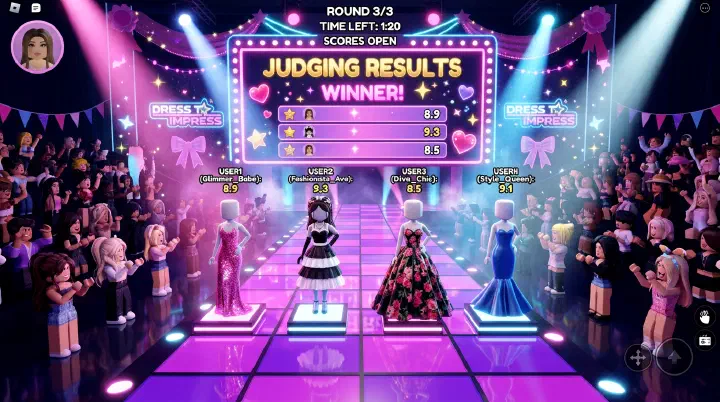
Dress To Impress uses a 1-to-5 star rating system. After the runway, every player rates every other player’s outfit. The highest total score wins the round.
Your goal is simple: maximize your average star rating across all voters. But simple doesn’t mean easy. Every voter has their own bias. Some vote strictly on theme. Others vote on color. A few vote on effort. And yes, some vote for their friends.
If you’re new to the game, start with our Beginner Guide for the basics. For details on the runway presentation phase, see our Runway & Voting Guide.
The 3-Second First Impression Rule
Here’s a framework you can use in the dressing room. Ask yourself: if a voter sees my outfit for exactly three seconds, what do they register?
Voters decide fast. Most don’t zoom in. They don’t read your accessory choices. They see shape, color, and vibe. That’s it.
Use this checklist before you lock in:
Silhouette Read: Can someone guess the theme from fifty feet away? If the theme is “Mermaid,” your bottom half needs to read as tail or flowy. If it’s “Business,” you need structure. Voters judge shape before detail.
Color Pop: Does your outfit have one dominant color that grabs the eye? Monochrome and two-tone outfits score higher than busy palettes because they’re easier to process in three seconds.
The Hook: What’s the one thing that makes a voter look twice? One bold accessory. One unexpected color choice. One dramatic hair style. Not five. One.
No Friction: Are there any visual contradictions that create confusion? A princess gown with sneakers. A goth outfit in neon yellow. These create mental “friction” that drops your score even if they’re creative.
If you pass all four checks, your outfit is optimized for human voters. If you fail one, fix it before you walk.
The Counter-Intuitive Truth: More Detail Can Hurt You
Here’s the part that breaks Maya’s heart. The more time you spend on tiny details — matching your bracelet to your eyeshadow, finding the perfect period-appropriate petticoat — the worse you sometimes score.
Why? Because detail doesn’t scale in a voting lobby. Voters see you from a distance. They see you while looking at nine other avatars. They see you while a chat message pops up and a sound effect plays. Detail is invisible. Clarity is king.
Players who spend ninety seconds on their silhouette and color palette consistently outscore players who spend three minutes on accessories. It feels wrong. It feels like cheating. But it’s how human attention works.
The best DTI players aren’t always the best dressed. They’re the best communicated.
The Three Pillars of a High-Scoring Outfit
Every winning outfit needs three things. Think of them as layers, not a checklist. You need all three, but the balance shifts based on the lobby.
Theme Relevance is your foundation. Without it, you’re drawing dead. This doesn’t mean perfect accuracy. It means instant recognition. When voters see you, they should think “oh, that’s [theme]” without squinting.
Visual Cohesion is what separates a mess from a look. Limit yourself to two or three main colors. Match your formality levels — don’t put a ballgown top over cargo pants unless the theme is literally “chaos.” Keep your era consistent. If one piece looks like it wandered in from a different game, voters notice.
Creativity is your tiebreaker. In a lobby where three players nailed the theme and look cohesive, creativity decides who wins. But — and this is crucial — creativity only works when the first two pillars are solid. A clever concept with poor execution gets two stars. A basic concept with flawless execution gets four.
Theme Relevance in Practice
Themes fall into six categories. Here’s what voters actually look for in each:
Color themes (“Red,” “Monochrome”): Make the theme color sixty to seventy percent of your outfit. Not half. Not a red belt on a black dress. Dominant.
Style themes (“Goth,” “Preppy,” “Y2K”): Nail the signature pieces. Goth needs black and edge. Preppy needs clean lines. Y2K needs low-rise or metallics. Miss the signature, and voters won’t register the style.
Era themes (“1980s,” “Victorian”): Use era-specific silhouettes. Big shoulders for the ’80s. Corseted waists for Victorian. The shape matters more than the fabric.
Character themes (“Villain,” “Princess”): Props and iconic pieces. A crown reads as princess faster than a fancy dress does. A cape reads as villain faster than a dark color palette.
Activity themes (“Beach Day,” “Prom”): Show function plus fashion. Swimwear for beach. Formalwear for prom. Voters need to see where you’re going.
Abstract themes (“Dreamy,” “Chaos”): Use color psychology. Pastels and soft textures read dreamy. Clashing patterns and asymmetry read chaos. Mood is visual.
Visual Cohesion
Cohesion means every item agrees with every other item.
Keep your palette tight. Two or three primary colors max. Complementary colors work. Analogous colors work. “Everything I liked in the catalog” does not work.
Match your formality. A tuxedo top with ripped jeans reads as accidental, not creative. Unless the theme invites contrast, keep everything in the same register.
Balance your accessories. Two to four pieces. Not zero — zero looks unfinished. Not six — six looks cluttered. If you’re unsure, remove one.
Match hair and makeup to the outfit, not against it. Bold outfit, bold makeup. Understated outfit, soft makeup. Hair should complete the look, not start a new conversation.
Creativity Levels
There’s a spectrum of interpretation. Most players stay on the safe end. Winners live in the middle.
| Level | Description | Example |
|---|---|---|
| Literal | Direct interpretation. Safe but boring. | Theme: “Fire” — a red dress |
| Clever | Smart connection that makes voters think. | Theme: “Fire” — phoenix-inspired with gold and orange |
| Subversive | Unexpected angle that still fits the theme. | Theme: “Fire” — an ice queen representing what fire destroys |
| Abstract | Emotional or conceptual interpretation. | Theme: “Fire” — passion and transformation through red-to-black gradient |
For most lobbies, aim for clever. It’s the sweet spot of readable and memorable. Literal gets you threes. Clever gets you fours and fives. Subversive and abstract can win big or bomb hard — only use them if your execution is flawless everywhere else.
Pro tip: Clever interpretations consistently win over literal ones. Voters reward outfits that make them say “Oh, I get it!” rather than “That’s just a red dress.”
Dressing Phase Strategy: Minute-by-Minute
The dressing phase typically lasts two to three minutes depending on the server. Here’s how to use that time effectively.
First minute: concept and base.
Read the theme in the first ten seconds. Pick a concept immediately. Don’t second-guess yourself. Spend the next twenty seconds choosing your main piece — dress, suit, or top-plus-bottom combo. This anchors everything. In the final thirty seconds of minute one, add shoes and one major accessory.
Second minute: refinement.
Add one or two secondary accessories. Pick hair and makeup. Then stop and look at the whole outfit. If it feels cluttered, remove one item. One removal in minute two usually improves your score more than one addition.
Third minute: differentiation.
Walk around. See what everyone else is building. If your outfit looks like a clone, make one distinctive change. Swap the color. Change the hair. Add one unexpected accessory. Differentiation is often the difference between third place and first. Also, practice your runway walk. Your pose and pace matter more than most players think.
Voting Phase: How to Get Higher Votes
Your runway performance directly influences the votes you receive. Here’s how to maximize your presentation.
Runway walk tips.
Walk confidently. Stand tall. Use the pose feature.
Pacing matters. Moderate speed gives voters time to process your look. Sprinting looks nervous. Crawling looks unsure.
Strike one or two poses. Highlight your best feature. Don’t pose so much that the outfit becomes background noise.
Face the camera. Engage with the “audience.” Looking at the ground reads as insecurity, and voters unconsciously penalize it.
The psychology of voting.
Understanding how other players vote helps you optimize your outfit for maximum stars.
| Voter Behavior | How to Appeal to It |
|---|---|
| Theme-first voters (~60% of players) | Make your theme interpretation immediately obvious |
| Color voters (~20% of players) | Use bold, cohesive color palettes that pop on screen |
| Effort voters (~15% of players) | Show that you put thought into every detail |
| Friend voters (~5% of players) | Unpredictable, but being friendly in chat helps |
What makes players give 5 stars.
Outfits that consistently receive top marks share five traits:
- Instant theme recognition — Voters understand the theme connection within two seconds.
- No obvious mistakes — No clashing colors, no mismatched styles, no missing pieces.
- One standout element — A unique accessory, a bold color choice, or a clever detail that makes the outfit memorable.
- Complete look — Hair, makeup, outfit, shoes, and accessories all work together.
- Confident presentation — The runway walk and pose sell the outfit.
What makes players give 1-2 stars.
Avoid these common mistakes:
- Theme miss — The outfit has no clear connection to the theme.
- Incomplete outfit — Missing shoes, no accessories, default hair.
- Color chaos — Too many colors that clash with each other.
- Default clothing — Using the starting outfit with no changes.
- Mismatched era — Victorian dress with modern sneakers.
Theme Interpretation Strategies by Category
Seasonal themes.
Christmas: Don’t just do red and green. Try a winter forest spirit with icy blue and pine accessories. It’s fresher than the fiftieth Santa hat.
Halloween: Skip the basic witch. Go for gothic elegance with skull jewelry and deep purple. It stands out in a sea of orange.
Summer: Instead of a beach dress, try a sunset gradient with coral and gold. It reads “summer” without reading “basic.”
Spring: Floral is fine. Cherry blossom layers in pale pink and white are better. They show effort beyond the first dress in the catalog.
Style themes.
Goth: Romantic goth with deep red and lace beats all-black every time.
Preppy: Tennis-core with pleated skirts and headbands reads preppy faster than generic polos.
Y2K: Cyber Y2K with metallics beats low-rise jeans alone.
Cottagecore: Mushroom forager with earth tones beats the floral midi everyone picks.
Character/archetype themes.
Villain: Elegant antagonist with poison-green accents beats black-and-red cape.
Princess: Modern royal with structured blazer and crown jewelry beats ballgown-and-tiara.
Detective: Noir monochrome with vintage accessories beats trench-coat-and-hat.
Fairy: Dark fairy in deep green and black beats pastel wings.
For a complete list of all themes that can appear in the game, check our All Themes List.
Item Categories and How to Use Them
Clothing items.
Dresses work best for formal, elegant, and character themes. Pick distinctive silhouettes that stand out on the runway.
Tops and bottoms shine for casual, activity, and style themes. Mixing separates lets you build combinations no one else has.
Suits dominate professional, villain, and era themes. Tailored fits score higher than oversized ones.
Outerwear works for seasonal themes. Use it as a statement piece, but remove it if it hides your main outfit during the runway.
Accessories.
Jewelry adds color accents and reinforces theme. Low to medium impact. Don’t pile it on.
Bags and purses complete a look. Medium impact. Match the era.
Hats are high impact when they fit. A perfect hat defines the outfit. A wrong hat destroys it.
Wings and special items are very high impact. Use them for fantasy themes only. A pair of angel wings on “Business Casual” looks like a mistake, not a choice.
Hair and makeup.
Match hair style to era and formality. Updos for formal. Loose waves for casual.
Hair color should fit the theme. Natural for realistic. Bold for fantasy.
Makeup should complement, not compete. Bold makeup for bold outfits. Soft makeup for understated looks.
Lipstick is your final accent. Match or contrast with your palette.
Advanced Scoring Mechanics
The recency effect.
The last player to walk often receives slightly higher votes because they’re freshest in voters’ minds. If you’re not last on the runway, compensate with a more memorable silhouette or color.
Group dynamics.
If you’re the only player with a strong outfit, you’ll win. Don’t overthink it.
If two strong outfits compete, theme clarity breaks the tie. The look that communicates faster wins.
If multiple players have similar outfits, stand out by adding one distinctive element that others skipped.
If everyone has weak outfits, completeness beats creativity. Just finish your look and walk tall.
VIP Items and Their Impact
If you have VIP access, you get additional clothing options that non-VIP players can’t use. These items can give you an edge.
VIP-exclusive dresses offer unique designs no one else has. Use them for any theme where the dress fits. The uniqueness alone draws votes.
VIP accessories like crowns and special wings are standout pieces. Use one as your distinctive element. Don’t over-accessorize with VIP items.
VIP hair options include colors and styles not available to free players. Match your VIP hair to your outfit’s color palette for a complete look.
Important: VIP items are an advantage, not a guarantee. A well-thought-out free outfit beats a lazy VIP outfit every time. That reads as “I paid to win,” and some voters dock stars for it. For more VIP details, see our VIP Guide.
Common Mistakes and How to Fix Them
Mistake 1: Ignoring the theme.
If you wear the same favorite outfit regardless of theme, you’re throwing away stars. Spend ten seconds reading the theme and planning. Don’t default to your “best” look.
Mistake 2: Over-accessorizing.
Five accessories don’t score higher than two. They just look messy. Limit yourself to two to four accessories. If you’re unsure, remove one.
Mistake 3: Color clashing.
Four colors that don’t work together hurt more than they help. Use a maximum of three colors. Pick one dominant color, one accent color, and one neutral. Done.
Mistake 4: Incomplete outfits.
Default hair and missing shoes signal “I didn’t try.” Always customize every slot. Even simple choices are better than defaults.
Mistake 5: Copying other players.
If three people already have your look, you’re fighting for the same votes. Change one thing. Color, hair, accessory. Differentiation wins.
Seasonal and Event Strategies
Dress To Impress frequently runs seasonal events with special themes and items:
Valentine’s Day: Focus on romantic and elegant themes. Red, pink, and white palettes dominate. Heart accessories and rose decorations help.
Summer Event: Beach and vacation themes. Bright colors, light fabrics. Sunglasses and beach accessories complete the look.
Halloween Event: Dark, spooky, and costume themes. Black, orange, and purple palettes. Witch hats and pumpkin accessories are popular for a reason.
Winter Event: Cozy and festive themes. Deep reds, greens, and whites. Snowflake accessories and winter coats.
For details on seasonal events and their exclusive items, see our Seasonal Events Guide.
Frequently Asked Questions
Q: How is the winner determined? A: After all players complete the runway walk, each player rates every other player’s outfit from 1 to 5 stars. The player with the highest total score wins the round.
Q: Does the number of players in the server affect scoring? A: Yes. More players means more votes, but also more competition. In smaller servers, every vote matters more. In larger servers, you need to appeal to a wider range of tastes.
Q: Can I change my outfit after the dressing phase ends? A: No. Once the runway phase begins, your outfit is locked. Use your dressing time wisely.
Q: How important is the runway walk? A: Very important. A confident, well-paced walk with good poses can boost your average rating by 0.5-1 star compared to a rushed or awkward walk.
Q: Should I focus on VIP items or free items? A: Focus on creating the best outfit possible with what you have. A creative free outfit beats a lazy VIP outfit every time. VIP items are a bonus, not a requirement.
Q: How do I improve my scoring over time? A: Watch what winning outfits look like. After each round, note what the winning player did differently. Over time, you’ll develop an instinct for what voters reward.
Q: Why does my historically accurate outfit keep losing to simple ones? A: Because voters don’t judge accuracy. They judge immediate recognition. A simple outfit that reads the theme in one second beats a complex outfit that needs explanation. Check the 3-Second First Impression Rule above.
Q: Is it better to be clever or safe? A: Safe gets you to the middle. Clever gets you to the top — but only if your execution is flawless. Start safe, then add one clever twist.
Related Guides
- Runway & Voting Guide — Master the runway walk and understand voting mechanics
- All Themes List — Complete list of every theme that can appear in the game
- Advanced Tips — Pro-level strategies for consistent wins
- VIP Guide — VIP-exclusive items, benefits, and whether it is worth purchasing
- Pattern Layering Combo Guide — Mix prints without creating visual chaos
- Color Theory Palette Guide — Build cohesive color schemes that pop on the runway
- Voting Psychology Guide — Understand what really happens in voters’ heads during the 30-second window