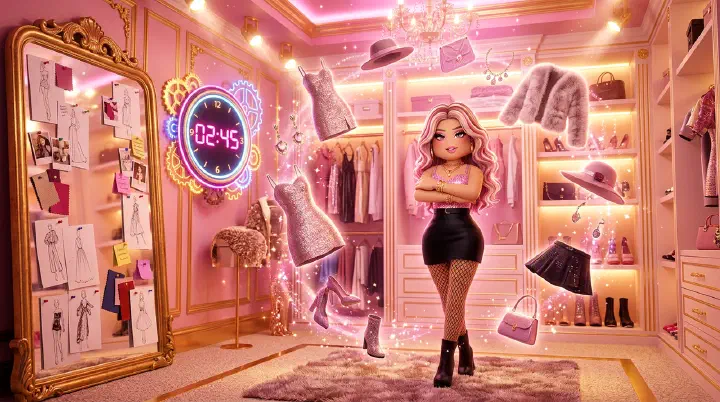
The theme flashes: “Royal Ball.” Five minutes on the clock. You feel a flicker of confidence — you know this one. You open your wardrobe and stare. Should you go with the blue gown or the red one? Does “Royal Ball” mean crowns and velvet, or could it mean elegant minimalism? You scroll through dresses. You scroll through accessories. Two minutes evaporate while you debate with yourself. You finally pick a dress, then spend another two minutes hunting for a necklace you swear you bought last week. You find it with forty-five seconds left. No time for shoes. No time for a crown. You submit a dress, a necklace, and default hair. Two stars. The winner walked out with a full ensemble — gown, tiara, gloves, sash, and heels — because the moment “Royal Ball” appeared, they already knew the exact seven items they were grabbing. They did not waste a single second deciding. They spent all five minutes executing.
That gap between deciding and executing is where most DTI rounds are won or lost. It is not your wardrobe size. It is not your taste. It is the absence of a plan. This guide covers the mental framework that turns theme analysis into an instant reflex, the go-to outfit library that eliminates decision fatigue, and the preparation habits that buy you back precious minutes when the timer starts.
Why You Run Out of Time Before the Runway
Most players blame the timer. The real problem is what they do with the first two minutes. Here are the five specific mistakes that drain your clock before you ever hit the runway.
No Theme-to-Outfit Mental Library
You treat every theme like a creative prompt. It is not. It is a retrieval task. Your brain should hear “Forest Fairy” and instantly pull up: green base, nature accessory, flowing silhouette. Instead, you hear “Forest Fairy” and start brainstorming. Brainstorming is slow. Retrieval is fast. Without a mental library, you are reinventing the wheel every round.
Wasting Time on the Wrong Items
You spend ninety seconds layering a perfect top and skirt combo, then realize the theme calls for a full gown. You spend two minutes on edgy accessories, then notice the theme was “Elegant Evening,” not “Punk Rocker.” This happens because players select items before they lock the theme category. They build while they think. The correct order is: categorize, plan, then build. Reversing this order burns your entire round.
No Backup Plan for Contested Items
You walk up to the accessory rack and three players are already swarming it. Your entire plan depends on that one tiara. So you wait. And wait. And wait some more. Meanwhile, the smart player already moved to Plan B — a different hair accessory that communicates the same royalty vibe. If your plan has zero flexibility, any contested item becomes a round-ender.
Treating Every Round Like a Blank Canvas
Blank canvas thinking feels creative. In DTI, it is a liability. The best players do not start from zero. They start from a template. A template is not cheating — it is a pre-validated foundation that you customize for the theme. Starting from zero every round forces you to solve the same problems repeatedly. Templates solve them once.
Perfectionism Paralysis
You find a good outfit at the three-minute mark. But it is not perfect. So you keep tweaking. You swap the shoes. You change the lipstick shade. You add a bracelet, decide it is too much, remove it, then add it back. The timer hits zero and your outfit is no better than it was at minute three. Perfectionism under time pressure does not improve outcomes. It just consumes the time you needed to walk confidently.
The Theme-to-Outfit Decision Framework
When the theme drops, you have thirty seconds to answer three questions. Not sixty. Not “whenever you feel ready.” Thirty seconds. Here is the exact framework.
Question 1: What category is this? Fantasy, Historical, Modern, Royal/Formal, Dark/Edgy, Casual, or Colorful/Playful. Every theme maps to one of these. “Space Princess” maps to Fantasy. “1920s Flapper” maps to Historical. “Red Carpet” maps to Royal/Formal.
Question 2: What is the signature silhouette? Gowns for Royal/Formal. Cropped or oversized for Modern. Corsets and long skirts for Historical. Wings and robes for Fantasy. All-black fitted for Dark/Edgy. Simple and understated for Casual.
Question 3: What is my one statement piece? One item that communicates the theme instantly. A crown for Royal. A guitar for Rockstar. A wand for Fantasy. A stethoscope for Doctor. The rest of the outfit just needs to not contradict that piece.
Once you answer these three questions, your plan is done. Everything else is execution.
Category Execution Rules
If the theme is Fantasy — prioritize wings, robes, or unnaturally colored hair. Voters process fantasy through impossible silhouettes. A regular gown in pink does not read as fantasy. A regular gown with wings does. Your color palette should be vibrant: purples, golds, soft blues, or pastels. One magical accessory is non-negotiable.
If the theme is Modern / Streetwear / Casual — prioritize clean silhouettes and minimal layering. Over-accessorizing reads as “did not understand the theme.” One bag, one necklace, or one hat. Pick one. Jeans, simple tops, and sneakers are not just acceptable — they are correct. The trap is trying to “elevate” a casual theme into something fancier.
If the theme is Historical / Era — silhouette beats accuracy. A corset and long skirt reads as Victorian even if the details are not historically perfect. Flapper dress silhouette reads as 1920s even with modern color choices. Focus on the overall shape first. Add era-appropriate hair and one signature accessory second.
If the theme is Royal / Formal / Elegant — go long or go home. Floor-length gowns dominate this category. Colors should be rich: deep red, navy, emerald, black, or champagne. One statement jewelry piece carries the outfit. A plain gown with a dramatic necklace beats a detailed gown with no jewelry.
If the theme is Dark / Gothic / Horror — all-black base is the foundation. Not mostly black. All black. One edgy accent: spikes, chains, dark veil, or dramatic makeup. The contrast between the all-black base and the single accent creates the visual punch voters remember.
If the theme is Colorful / Playful / Cute — maximum color saturation wins. Pastels or neons, but never muted. Three bright colors that harmonize. One playful accessory: bunny ears, oversized bow, or colorful wings. Muted colors in this category read as “ignored the theme.”
Building Your Go-To Outfit Library
A go-to outfit library is not a spreadsheet of eighty themes. It is a small collection of pre-validated bases that you adapt on the fly. You need six bases maximum. Here is how to build them.
Pick your strongest item in each category. Your best gown. Your best fantasy wings. Your best all-black top. Your best casual set. Your best historical silhouette piece. Your brightest colorful dress. These six items are your anchors.
For each anchor, define a three-color palette that works with it. Write it down. Not “something gold-ish.” Write: cream, champagne gold, soft brown. Navy, teal, pearl white. Black, dark purple, silver. Specific colors. When the theme hits, you do not open the color wheel and browse. You apply the pre-memorized palette instantly.
For each anchor, assign one statement accessory. A necklace for the gown. A wand for the wings. A chain belt for the black top. A bag for the casual set. A period-appropriate hat for the historical piece. A bow for the colorful dress.
Now you have six complete outfit formulas. When “Celestial Ball” drops, you reach for your gown base, apply the cream-gold-brown palette, and add your statement necklace. Thirty seconds. The rest of the round is fine-tuning and walking.
Test each base in an actual round. Do not just admire it in the dressing room. Walk it on the runway. See how it scores. A base that scores 3+ stars reliably is worth more than a base that looks incredible in your inventory but voters ignore.
Preparation Habits That Save Seconds
The best DTI players do not just plan outfits. They prepare their minds and their workflows before the first theme ever drops. These habits separate consistent winners from occasional lucky breaks.
Inventory Mapping
Know where your top twenty items live. Not approximately. Exactly. Which category, how many swipes down, which row. Your favorite gown is four swipes into Dresses, left side. Your go-to boots are second row in Shoes. This sounds obsessive until you realize that every second you spend scrolling is a second you are not accessorizing. Map your items during slow moments. Update the map when you buy something new.
Palette Pre-Memorization
Never open the color menu without a plan. Memorize four palettes that cover 90 percent of themes. Elegant Gold: cream, champagne, soft brown. Midnight Edge: black, dark purple, silver. Soft Pastel: baby pink, mint, pale yellow. Ocean Cool: navy, teal, pearl. When the theme hits, you pick the closest palette in two seconds. No browsing. No second-guessing.
The Daily 30-Second Wardrobe Audit
Before your first round of the day, spend thirty seconds scrolling through recently acquired items. Refresh your memory. New items are exciting, and excitement makes you reach for them in rounds. If you do not remember what you bought yesterday, you will default to old favorites and waste the potential of your new pieces.
Backup Item Tagging
For every statement piece in your library, identify one backup that communicates the same theme. If your fantasy wings are taken, your backup is a halo. If your crown is contested, your backup is a jeweled hairpin. Know these backups before the round starts. Do not invent them under pressure.
Post-Round Review
After every round, spend ten seconds asking: what took the longest? The color choice? Finding the shoes? Deciding on the theme category? The answer tells you exactly what to practice. If color choice slows you down, drill your palettes. If item finding slows you down, remap your inventory. Most players never review, so they repeat the same time-wasting mistakes forever.
Counter-Intuitive Advice That Wins Rounds
Some of the best DTI strategies feel wrong the first time you hear them. They work because they account for the psychology of voting and the reality of time pressure.
The Best Outfit Plan Is the One You Can Execute in Three Minutes, Not the Perfect One
You do not get extra stars for the idea in your head. You get stars for the outfit on the runway. A plan that requires six minutes to execute perfectly is a bad plan. A plan that produces a solid 4-star outfit in three minutes is a great plan. Optimize for execution speed, not theoretical perfection. The runway only sees what you submitted.
Skip the Most Popular Items — They Are the Most Contested
That legendary gown everyone talks about? Five other players are running for it too. The slightly less popular alternative that still fits the theme? Nobody is touching it. Voters do not compare your outfit to some theoretical “best item.” They compare it to the other nine players on the runway. A very good item that you actually obtained beats the “best” item that you never got because four players swarmed it.
Your First Instinct Is Usually Right
Your brain processes theme categories faster than you think. That first silhouette or color that popped into your head when you saw “Space Queen”? It is probably correct. The time you spend second-guessing yourself rarely improves the outcome. It just burns clock. Trust your first read, commit, and execute. The player who hesitates for thirty seconds to find a “better” idea usually ends up with the same outfit anyway, just with less time to finish it.
Preparation Beats Wardrobe Size
A player with fifty well-understood items will outscore a player with two hundred items they barely know. It is not about how much you own. It is about how fast you can retrieve and combine what you own. A small library with six solid base plans is more competitive than a massive wardrobe with zero planning. Stop buying items to solve your scoring problem. Start planning with the items you already have.
A “Boring” Plan You Can Execute Beats a Brilliant Plan You Cannot
There is a seductive temptation to craft unique, unexpected outfits. In a no-pressure environment, that is fun. In a timed round, it is dangerous. A predictable but complete royal gown with crown and gloves scores higher than a half-finished “creative twist” that ran out of time. Reliability is a competitive advantage. Save the experimental builds for practice lobbies.
Related Guides
- DTI Theme Winning Framework — The 3-Question Decision Tree for Every Theme Category
- DTI Speed Round Strategies: Win Every Timed Theme
- DTI Color Theory and Palette Guide
- DTI Accessories Layering Guide
- DTI Hair Combos & Makeup Pairings — 25 Theme-Specific Combos
- DTI Beginner Guide — Your First 5 Themes, What to Buy & How to Score 3+ Stars