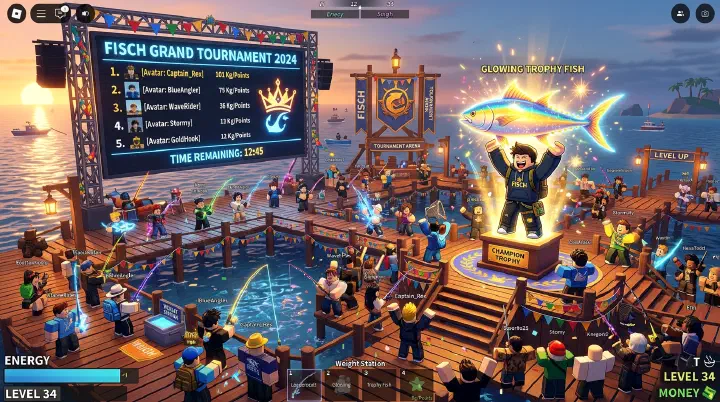
Last updated: August 15, 2026. Scoring rules, prize structures, and gear picks reflect Fisch v1.96 (The Deep update) and the current competitive meta.
You are standing at the Moosewood docks with three minutes left on the tournament timer. Your rod is unequipped, your bait slots are empty, and a slow panic sets in because you realize you never checked which zone this week’s bracket runs in. Around you, every other player is already casting. That is the moment a tournament is won or lost — and it has almost nothing to do with your reel timing.
Fisch tournaments are not harder fishing. They are fishing under rules. A scoring formula, rarity gates, mutation multipliers, and a leaderboard that refreshes every minute all punish the player who treats a bracket like a casual grind. And since The Deep update dropped on August 8, 2026, the gear ceiling moved. The Scalding Hook and the Titanic Scalder harpoon gun quietly changed what “optimal” means, and most of the older rod guides have not caught up.
This guide walks the current competitive format end to end. You will get the scoring system, the Deep-era gear that matters, a decision framework for the leaderboard, and three failure postmortems built from the ways real players throw brackets away.
The Countdown: Ten Minutes Before the Buzzer
The scene: the tournament starts in ten minutes. You are sprinting to the zone, half your inventory is junk from your last farming session, and you only packed twelve bait because “twelve is probably enough.”
Tournaments reward the player who is already fishing when the timer flips, not the player who arrives two minutes in. Here is the pre-game checklist that separates the two:
- Confirm the zone and get there early. Each bracket names a fishing zone — Roslit Bay, Grand Reef, Snowcap Island, or a Deep trench layer now that the expansion is live. Arrive eight to ten minutes early so you are cast-ready at the buzzer.
- Equip the rod and bait for the target pool. Do this before you travel, not after. The first thirty seconds of a bracket are too expensive to spend digging through your inventory.
- Stock fifty or more bait. Tournament fish are picky, and the top brackets are won by players who never stop to wonder if they can afford the next cast.
- Clear your inventory. A full inventory means a catch you cannot bank. Sell or drop junk before the bracket.
- Pre-set your casting spot and auto-cast. If your rod has auto-cast, aim it at the productive pocket you already scouted.
- Check the weather. Rain pushes rare spawns up in most zones; storms push mutation rates up. A storm forecast can change which rod you bring.
Failure postmortem — the empty bait box. A player joins a Seasonal bracket, pays the 2,000 C$ entry, and realizes mid-game he brought fifteen bait. He runs dry at minute forty with no way to restock without leaving the zone. Why it happened: he treated bait like an afterthought instead of a loadout slot. The recovery: if you run out mid-bracket, do not leave for a shop unless you are already out of the top ten. A full round-trip to the vendor costs you more score than the bait it buys. Better: never enter with under fifty, and treat the last ten as untouchable for the endgame push.
How Tournament Scoring Actually Works
Tournament score is not “the biggest fish wins.” It is a points formula, and points are where brackets are silently won and lost.
The base is simple: 1 point per 10 C$ of fish value. A 1,000 C$ fish is worth 100 points before anything else. Then the multipliers stack on top:
- Weight bonus — fish above the species median score disproportionately more per kilogram. A fat Legendary is worth far more than a skinny one of the same species.
- Rarity multiplier — Common 1x, Rare 1.5x, Epic 2x, Legendary 3x, Mythical 5x. This is the single biggest lever in the formula.
- Mutation bonus — Shiny +25%, Albino +10%, Big +15%, Small +5%. These multiply on top of the rarity multiplier.
- Speed bonus — the top three fastest catches in the opening thirty minutes get +50%. This is why the buzzer matters so much.
| |
The takeaway is counterintuitive and most players get it backwards: one Legendary Shiny above median weight out-scores a full hour of common catches. Quality beats quantity in this formula almost every time — but only if you actually land the quality fish. The failure mode is chasing the quality fish you never hook.
Failure postmortem — the common-fish grinder. A player spends an entire bracket reeling in fast, cheap catches, believing “more catches = more score.” He finishes with thirty fish and no top-ten placement. Why it happened: he never ran the formula. Thirty common catches at roughly 80 points each is 2,400 points. One Shiny Legendary with a Big mutation can clear 4,000 on its own. The recovery: if you catch yourself auto-reeling commons at minute sixty, you are already in trouble — switch to your premium bait and hunt one rarity gate before the timer ends. Learn the formula before the bracket, not during it.
Deep-Era Tournament Gear: Scalding Hook vs. the Old Guard
Before The Deep, tournament rod advice was stable: Ethereal Prism Rod for speed, Trident Rod for weight, Mythical Rod for rarity. The v1.96 update added gear that slots into that picture and, in two cases, replaces it.
The Scalding Hook
The Scalding Hook comes from the Vesper of the Deep questline in the Lower Deep. Its tournament stats are why it matters:
- 180% Luck — among the highest Luck values in the game, and Luck is what pushes rare and Mythical spawns onto your line.
- 59.5% Scalded mutation — Scalded is a 9x value mutation, and it procs more than half the time. That is not a rare treat; it is the default outcome.
- +20% Progress Speed — you clear the fish you hook faster, which compounds across a ninety-minute bracket.
Against rarity-gated brackets, this rod out-fishes the old Mythical Rod. Against boss-class targets — the kind that show up in Special Event tournaments — its mutation multiplier turns a single catch into a leaderboard reset. The full quest walkthrough is in our Scalding Hook rod guide; the short version is that it is a Lower Deep reward, not a cash purchase.
The Titanic Scalder Harpoon Gun
Harpoon guns are a new equipment category from The Deep, and they equip in a separate slot — they do not replace your rod. The Titanic Scalder is the one that matters for tournaments: it pulls ahead on rarity catches and boss-class targets, which is exactly the profile a tournament bracket rewards. Because it sits in its own slot, you can harpoon a high-value target to apply its bonus and still reel it in with your rod, stacking the effects.
Old Guard vs. New Pick
| Gear | Type / Source | Luck or Rare Bonus | Standout Passive | Best Bracket |
|---|---|---|---|---|
| Scalding Hook | Rod — Vesper of the Deep quest | 180% Luck | 59.5% Scalded (9x), +20% Progress Speed | Rarity, boss-class |
| Ethereal Prism Rod | Rod — 5,000,000 C$ | +25% rare chance | Auto-lure, +40% catch speed | Speed, all-round |
| Trident Rod | Rod — 800,000 C$ | +15% weight | +30% catch speed | Weight |
| Mythical Rod | Rod — 2,000,000 C$ | +35% rare chance | +10% mutation rate | Rarity (budget) |
| Titanic Scalder | Harpoon gun — The Deep | Rarity + boss bonus | Separate slot, stacks with rod | Rarity, boss-class |
The rule that ties it together: match the gear to the bracket, not to a tier list. A “best rod” list assumes one rod for everything, and tournaments do not work that way. If the bracket weights rarity, the Scalding Hook or a Titanic Scalder plus rod beats an Ethereal Prism. If the bracket weights pure volume, the Ethereal Prism still wins. For the full Deep update gear picture — including the Luminous Rod, Titanium Rod, and Cusk Purger that fund your way to this gear — read our The Deep update guide.
What to Bring: Rod, Bait, Enchants
Bait by Bracket Type
- Weight brackets — Heavy Worm Bait (+20% weight). This is the only place it matters, and it matters a lot.
- Rarity brackets — Golden Lure (+30% rare chance). Bring more than you think you need.
- Speed brackets — Speed Fly (+15% catch speed). Cheap, and it compounds with Progress Speed.
- Mutation brackets — Prism Bait (+10% mutation rate). Pairs badly with a Scalding Hook, whose Scalded already procs 59.5% on its own — spend your Prism Bait elsewhere.
- All-purpose — Magic Worm (+10% all stats) for the mid-game grind.
Enchants
If you are on a budget rod, enchants are the difference between competing and donating your entry fee:
- Lure Speed III — more casts, more chances at the speed bonus window.
- Luck III — pushes rare spawns onto your line.
- Resilient II — stops you from getting snapped on the heavy fish that actually move your score.
Do not enchant blind. Plan the enchant around the bracket the rod is for, the same way you plan the rod around the bracket. Our enchantment timing guide covers when to commit an enchant and when to hold it.
Tournament Phases: Open Fast, Grind Smart, Close Clean
Opening (First 30 Minutes)
The speed bonus is live and the first thirty minutes set your ceiling. Land three to five quality catches fast:
- Fish the nearest productive pocket. Do not travel across the zone while the bonus is ticking.
- Use Golden Lure or Prism Bait now — the +50% speed bonus multiplies on top of whatever you hook, so premium bait is worth more here than anywhere else.
- Target mid-tier fish first. They spawn fast, they score well with the multiplier, and they bank points while you wait for a rare window.
- Release junk. A common under 100 C$ is not worth the reel time while the bonus is live.
Mid-Game (30–90 Minutes)
The speed bonus is gone. Shift to quality:
- Move to deeper water where Legendary and Mythical spawn rates climb — now including the Lower Deep trench layers if the bracket runs there.
- Target the specific high-value species for your zone instead of casting blind.
- Watch the leaderboard. Ahead? Play conservative. Behind? Take a calculated risk on a rare spawn.
- Rotate spots every fifteen minutes; a heavily fished pocket depletes its rare spawns.
Endgame (Final 30 Minutes)
Close the gap or lock it down. The counterintuitive part is that the leaderboard, not your score, decides your endgame aggression. A player who is ahead by 500 points and keeps gambling on Mythical spawns is more likely to lose than the player who grinds medium fish safely. A player outside the top ten needs one big catch, not ten safe ones, so aggression is correct there.
Failure Postmortem: The Wrong Rod for the Rarity Gate
The scene: a bracket announces a rarity gate — score double points on Rare-or-better catches. A player brings his speed rod because “it’s the best rod I own.” He casts fast, hooks a steady stream of Commons, and watches the rarity multiplier do nothing for him while other players with Luck-stacked rods bank 9x Scalded catches.
Why it happened: he picked gear before reading the bracket, then let the bracket run on autopilot. The recovery mid-bracket: swap to whatever Luck or rare-chance you have, even if it is slower. On a rarity gate, catch speed is irrelevant if the fish you catch are Commons. Before the next bracket, read the rules, then read them again — the gate defines the rod, not the other way around.
This is the single most common way experienced players lose to beginners: the beginner reads the rules, the veteran assumes he already knows them.
Rare Targets by Zone
The fish below are the ones that move your score. You do not need to memorize every species — you need to know which ones are worth premium bait.
Roslit Bay: Nurse Shark (Rare, 2,500 C$), Anglerfish (Epic, 5,000 C$), Barracuda (Epic, 4,000 C$), and the Giant Grouper (Legendary, 15,000 C$) that single-handedly resets a leaderboard.
Grand Reef: Reef Shark (Rare, 3,000 C$), Bluefin Tuna (Epic, 6,000 C$), Emperor Fish (Legendary, 20,000 C$), and the Kraken (Mythical, 50,000 C$) — the highest-value tournament target outside The Deep.
Snowcap Island: Ice Fish (Rare, 2,200 C$), Frost Salmon (Epic, 4,500 C$), Mammoth Fish (Legendary, 18,000 C$), and the Frost Leviathan (Mythical, 45,000 C$).
Lower Deep (The Deep expansion): the rarest spawns live here now. If a bracket runs in the trench, the Scalding Hook and a harpoon gun slot in immediately — the rarity density is why The Deep gear was built the way it is.
For spawn conditions and the full map, see the fish location map.
Decision Framework: Read the Leaderboard and Commit
The leaderboard refreshes every sixty seconds, and the way you use it is a decision, not a glance. Here is the framework:
- You are first by 500+ points. Play conservative. Consistent medium-value catches hold the lead. Do not chase Mythicals.
- You are first by less than 500 points. Hold an aggressive pace. One big catch from second place can flip you, so bank points steadily rather than coasting.
- You are second or third. Take one calculated risk every thirty minutes. One Legendary or mutated catch breaks you into first.
- You are fourth through tenth. You need a 10,000 C$+ catch to crack the top three. Spend premium bait and hunt the zone’s top species.
- You are eleventh or lower. All-in on Mythical or Legendary spawns. You have nothing to lose, and one massive catch resets your entire bracket.
The framework’s job is to stop you from playing a feeling. “I feel behind” and “I feel safe” are how brackets are thrown. The number tells you which play is correct.
Bait Economy
The fastest way to waste a bracket is to burn premium bait in the first ten minutes and spend the rest of the game casting Magic Worms at fish that needed Golden Lures.
- Premium bait (Golden Lure, Prism Bait) goes into the speed-bonus window and into a known rare spawn.
- Standard bait (Magic Worm, Night Crawler) carries the mid-game grind.
- Save five to ten premium bait for the endgame push. The final thirty minutes are where a single premium catch wins the bracket.
Common Tournament Mistakes
- Chasing only Legendaries. Low catch count means low score. Balance roughly 60% quality targets with 40% steady catches.
- Ignoring the speed bonus. Missing the opening +50% window costs 500–1,500 points you never get back.
- Full inventory. Missed catches during the buzzer and the endgame are pure lost score.
- Wrong bait for the zone. Bait that does not match the pool is bait you wasted. Check the zone’s fish before you commit.
- Never checking the leaderboard. You play the wrong strategy for your position for an hour.
- Getting snapped on the big fish. Losing a 20,000 C$ catch to a broken line is the most expensive way to lose. Use Resilient and stop auto-reeling during the struggle phase.
Schedule and How to Enter
Weekly Community tournaments run every Saturday at 8:00 PM EST. Join through the Tournament NPC at the Moosewood docks, entry is free, and the format is a sixty-minute server-wide competition. These are your practice ground — free, weekly, zero risk.
Seasonal Official tournaments run the first Saturday of each quarter (January, April, July, October). They are announced a week ahead on the Event Board, cost 1,000–5,000 C$ to enter, and run ninety to 180 minutes on a global leaderboard. Registration opens forty-eight hours before the event.
Special Event tournaments are irregular — tied to updates, holidays, and milestones. They are announced on the Fisch Discord and in-game, and the format varies, sometimes team-based. The Deep update (v1.96) is the kind of thing that spawns these, so expect the trench to be a recurring Special Event arena. These often include exclusive fish species that never return, so treat their rewards as one-time.
Related Guides
- Scalding Hook Rod Guide — full quest walkthrough and stats for the Deep-era rarity rod
- The Deep Update Guide — every new zone, rod, and gear piece from v1.96
- Best Rods Tier List — the full rod rankings behind the bracket picks above
- Money Farming Guide — fund your tournament gear first
- Mutations & Bait Guide — every mutation proc and bait combination that moves your score