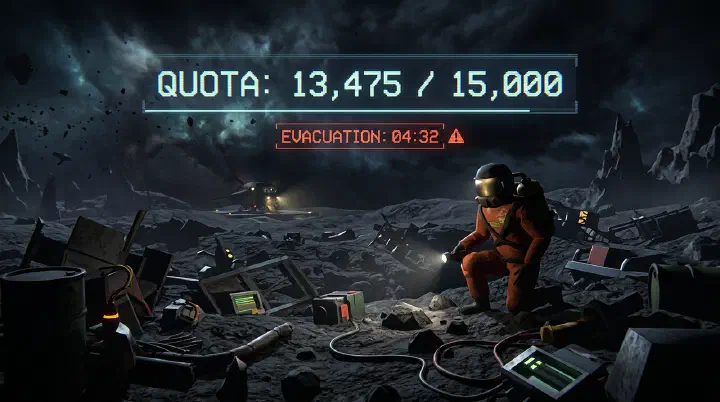
3:18 PM on Rend. Quota 8. Everyone is Alive. That’s the Problem.
Your ship has 6,200 credits in the terminal. The quota is 1,250. You’ve already met it — three gold bars and a Cash Register sit on the ship floor, totaling 1,340 credits. By every early-game metric, you’ve won. The run is over. You can sell, pass the quota, and move on.
Nobody moves toward the sell button.
“We’ve got time for one more run,” the scout says. “Day 2. Clear weather. Rend again. Let’s bank another 800 for next quota.”
The captain nods. Eighteen minutes later, the scout is dead — a Nutcracker caught him in the first room while he was checking his inventory. The second player runs into the hallway to recover the body. A Coil-Head spawns behind them. The ship operator hits the teleport but the second player drops the body. Now you have two dead crew members inside a Rend facility with 5 hours until nightfall and a Coil-Head camping the entrance corridor.
The third player decides to “push through” to recover both bodies. They don’t make it past the main hall.
At 4:47 PM, the ship operator stands alone on the ship. Three crew members dead. 1,340 credits of scrap on the ship floor. Quota met, but at a cost the credits don’t show. The three dead players lost their Pro-Flashlights, their Stun Grenades, their Walkie-Talkies. One of them had saved 800 credits over 7 quotas to buy a Zap Gun. Gone in 18 minutes because the crew couldn’t stop when they were ahead.
Welcome to the Lethal Company late game. Credits don’t die. Crews do.
The late game doesn’t test your ability to find scrap. It tests your ability to say “we have enough” and mean it.
Why Every High Quota Run Ends the Same Way
Late-game failures follow an almost identical pattern across every crew that hits quota 8+. The details change — the moon, the entity, the time of day — but the root cause is always the same.
The Overshoot Spiral
You hit quota by 40%. Feels good. The terminal shows your next quota: 1,680 instead of 1,300. That extra 380 credits isn’t padding — it’s punishment. The game saw your surplus and raised the bar accordingly.
At early quotas, overshooting is fine because the base numbers are small. Overshoot quota 3 by 30%? Your next quota goes from 250 to 325. You barely notice. Overshoot quota 8 by 30%? Your next quota goes from 1,250 to 1,625. That’s a full extra day of facility time on moons that are actively trying to kill you. One extra day of exposure is where the probability math catches up.
A crew that makes 3 facility entries per quota at a 90% survival rate per entry has a 73% chance of surviving that quota. A crew that makes 4 entries at the same 90% rate has a 66% chance. That 7% difference compounds over multiple quotas. By quota 12, the “overshoot” crew has a cumulative survival probability of roughly 12%. The “tight” crew — the one that hits quota by 5-15% every cycle — still has a 28% chance. The difference isn’t luck. It’s discipline.
The Survivorship Bias of the Credit Bank
The most dangerous thought in the late game is “we have credits, we can afford a bad run.” The credit bank makes you feel invincible. It isn’t. Credits buy you re-entry into the atmosphere. They don’t buy your crew members back.
Here’s what actually gets consumed on a wipe:
- Scrap loss: The items on the ship that you would have sold. Gone.
- Equipment loss: Every item the dead crew members were carrying. Replacements cost 100-200 credits per player.
- Time loss: A Day 3 full wipe means you restart at Day 1 of the new quota with one fewer day to collect.
- Momentum loss: The team tilts. Communication degrades. Decision-making slows. This is the cost nobody tracks and the one that hurts the most.
The credit bank masks all four of these. “We lost 1,200 credits of scrap? We have 6,000.” The problem is that those 1,200 credits represent three facility entries of effort, and effort can’t buy you back. The credit bank makes you comfortable taking risks you shouldn’t take. That comfort kills.
The Skill Ceiling of Your Weakest Player
A 4-player crew is only as strong as its weakest member in the late game. At quotas 1-5, the strongest players can carry a weak player — assign them to loot near the entrance, keep them on ship duty, or just have them follow a veteran. At quota 8+, every player needs to make split-second survival decisions independently.
One player who doesn’t understand Coil-Head mechanics — who stares at it, who runs in the wrong direction, who doesn’t communicate — can wipe a full 4-player squad in under 10 seconds. The Coil-Head runs toward the nearest player. That player panics and sprints into the group. Now the whole team has a Coil-Head in their face and nobody can look away in time.
The fix: By quota 6, every player on the crew needs individual competence. If someone is still learning entity patterns, they should not be on Rend or Titan. Put them on Offence with a single experienced buddy while the other two hit the main facility. Splitting into pairs is better than having one weak link collapse the entire chain.
The Late-Game Decision Framework
Forget everything you learned about scrap optimization. The late game uses a different framework entirely. Every decision comes down to one question: “Does this increase our probability of surviving the next quota?”
Moon Selection: Consistency Over Ceiling
| Moon | Landing Cost | Avg Scrap Full Clear | Hazard | Late-Game Verdict |
|---|---|---|---|---|
| Rend | 550 | 800-1,100 | B | Best all-rounder. Clear skies = go. Eclipsed or stormy = skip. |
| Offense | 40 | 500-750 | C | Reliable fallback. Low hazard, fast extraction, consistent returns. |
| March | Free | 400-700 | C | Emergency option. No landing fee means zero financial risk. Double-run for safety. |
| Titan | 700 | 1,200-1,600 | S+ | Win-more moon. Only go when quota is already 70%+ met and weather is clear. Never Day 1. |
| Artifice | 1,200 | 1,500-2,000 | S | Flex moon. Quota 15+ only. Never when quota is the pressure. |
| Rend (bad weather) | 550 | 300-500 | C→S | Trap. Bad weather makes Rend more dangerous than Titan with half the scrap. Skip. |
The pattern is obvious but most crews ignore it: at high quotas, Rend on a clear day is the only moon you need. It consistently delivers 70-90% of your quota in a single run. A clean Rend run on Day 1 means Day 2 and Day 3 are optional. You can sit on the ship, play the terminal game, and wait for the quota to pass. That downtime is the safest possible outcome.
Titan is the trap that catches late-game crews. The scrap potential is higher, but the hazard is exponentially worse. A single Jester spawn on Titan costs you the run. A single Giant at the entrance costs you 2 players minimum. The extra 400 scrap you might get from Titan isn’t worth the 40% chance of a full wipe. Rend delivers 80% of Titan’s scrap at 30% of the risk. That’s the math that wins quotas.
Equipment Priorities: Survival First, Looting Second
| Priority | Item | Cost | Why It Matters at High Quota |
|---|---|---|---|
| 1 | Stun Grenade | 30 | Your only reliable escape from Giants, Jesters, and Forest Keepers. Buy 2-3 per crew. |
| 2 | Zap Gun | 50 | Locks down Coil-Heads permanently during extraction. Buy 1 for the ship operator. |
| 3 | Pro-Flashlight | 45 | At high quota, the extra brightness radius gives you 0.5-1 second more reaction time. That’s a life. |
| 4 | Walkie-Talkie | 12 | Every player must have one. Dead comms at high quota = guaranteed positional death. |
| 5 | Shovel | 30 | Drops from S-tier to C-tier. You should not be fighting at quota 8+. Stun and run. |
The Shovel downgrade is the hardest adjustment for experienced crews. You’ve spent 20 hours learning shovel timing on Thumpers and Bunker Spiders. That skill becomes nearly useless at high quota because the entities that kill you at quota 10+ — Giants, Jesters, Coil-Head swarms — aren’t shovel-viable. A Jester has 8 HP and opens its box in 30 seconds. You can’t kill it before the music starts. A Giant has 8 HP and can eat you in one grab. Even if you kill it, one of your crew is already dead.
Stun Grenades are the new Shovel. A 30-credit item that buys your crew 5 seconds of safe extraction. That’s more valuable than any other item in the shop at high quota. Buy them. Use them. Don’t save them for “the right moment” — the right moment is any moment a crew member is about to die.
The Day-by-Day High Quota Blueprint
This is the proven three-day structure for quotas 8-14:
Day 1: The Rend anchor run. Land on Rend (clear weather only). Three players enter the facility together. One player stays on the ship as operator. Goal: 700-900 scrap. Extract by 3 PM. If the team wipes or returns with less than 400 scrap, the entire quota strategy shifts to survival mode (see below). If you hit 700+, sell immediately and bank the quota.
Day 2: Assess and decide. Two scenarios:
- You’re at 70%+ of quota: Do nothing. Sit on the ship. Play the terminal game. Let the day pass. The safest facility entry is the one you don’t make.
- You’re at 40-70% of quota: Run Rend again (clear weather) or Offense. Same Day 1 routine, but extract earlier (2 PM) and accept lower scrap totals. The goal is to hit the quota, not to pad it.
Day 3: Emergency only. If you’re below 40% of quota on Day 3, run March (free, double-run strategy). First run at 8 AM, extract by noon, sell, re-enter at 1 PM, extract by 4 PM. March on a double-run clears 600-900 scrap with near-zero risk if you stay near the entrance. If March is eclipsed, run Offense with the same double-run structure. If both are eclipsed, take the quota fail — your credit bank absorbs it.
Counter-Intuitive Truths About the Late Game
The late game rewards behaviors that feel wrong to every instinct you developed in the first 15 hours. Here are the counter-intuitive principles that separate quota 8 crews from quota 15 crews.
Having Too Many Credits Is Dangerous
6,000 credits in the bank feels like security. It’s not. It’s permission to make bad decisions.
When you have a credit surplus, you stop treating the landing fee as a real cost. You land on Artifice “just to see.” You land on Titan on eclipsed weather “because we can afford a wipe.” Each of those decisions carries a survival probability well below 50%. You’re burning your crew’s lives because the game’s currency has lost its sting.
The fix: Ignore your credit total after quota 5. Treat every landing as if you have 100 credits and the next quota depends on this single run. That mental model keeps you honest. The credit bank is your insurance policy, not your permission slip.
Selling Less Scrap Can Save Your Run
This sounds insane. Let me explain.
The optimal sell strategy at high quota isn’t “sell everything except what you need for next run.” It’s “sell exactly enough to hit quota, save the rest.”
Here’s why: If you sell 1,400 scrap on a 1,200 quota, your next quota might be 1,560. If you sell 1,250 on that same quota — meeting it by 4% — your next quota might be 1,300. That 260-credit difference means one fewer facility entry next cycle. One fewer entry is a measurable increase in survival probability.
The rule: Hit quota by 5-15%. Sell a gold bar and leave a larger item on the ship for next quota. The scrap you leave behind isn’t wasted — it’s your head start for the next cycle. The credit you don’t earn today is the risk you don’t take tomorrow.
The Best Equipment for Late Game Costs Almost Nothing
Pro-Flashlights (45 credits) are good. Stun Grenades (30 credits) are essential. But the most impactful late-game item costs 0 credits: the ship operator on radar.
A dedicated ship operator multiplies the survival probability of every facility entry by roughly 2x. They see entities the ground team can’t see. They call out approaching threats. They hit the teleport the moment someone goes down. They sell the scrap. They manage the doors. They keep the ship clear of Eyeless Dogs.
Most crews treat the ship operator as the “boring job” and rotate it as punishment. At high quota, the ship operator is the most important role on the crew. The best player should be on radar, not in the facility. The facility players are interchangeable — they loot and they run. The operator is the one who keeps them alive long enough to do both.
A Clean Wipe Is Better Than a Messy Escape
Here’s the decision that separates the pros from the dead: when the crew is 300 credits short on Day 3 and the only available moon is eclipsed Rend, the correct play is to not go.
Let the quota fail. Start the next cycle with your intact crew and your credit bank. Lose the 1,200 quota and start fresh on quota 9 with a 1,400 target. That’s better than the alternative: landing on eclipsed Rend, losing 2-3 crew members, scraping together 200 credits, and failing the quota anyway — but now you enter quota 9 with half the crew’s equipment destroyed and the team’s morale shot.
The sunk-cost fallacy kills more late-game runs than any entity in the game. “We’ve come this far, we can’t give up now.” Yes you can. The game is designed to eventually fire you. The crew that survives 15 quotas isn’t the one that never fails — it’s the one that recognizes a lost position early, cuts losses, and lives to fight the next cycle.
How the Game Changes When Survival Trumps Credits
The transition from mid-game to late-game isn’t gradual. It’s a cliff. You cross from “we need more credits” to “we need everyone to come back alive” in a single quota cycle, and the game never tells you it happened.
Here’s what changes:
The terminal becomes your main interface. At high quotas, you spend more time on the terminal than in the facility. You’re checking weather, managing purchases, tracking scrap values, coordinating via radar. The facility entries become short, focused, and surgical — in and out in 30 minutes with specific targets.
Entity avoidance replaces entity fighting. At quotas 1-5, you kill Thumpers and Spiders because it’s faster. At quotas 8+, you never engage anything you don’t have to. You take the long way around. You wait for patrols to pass. You leave a room with high-value scrap because a Coil-Head is camped there and the risk isn’t worth the reward.
The margin for error shrinks to zero. A single Bracken grab on quota 4 costs you one player and the scrap they were carrying. A single Bracken grab on quota 12 costs you one player, their equipment, two other players who try to recover them, 15 minutes of daylight, and the entire run’s momentum. One mistake compounds differently when the stakes are higher.
Weather becomes the deciding factor. In the early game, weather is a suggestion. “It’s foggy on Rend? Let’s try it anyway.” In the late game, weather is the only variable that matters. A clear Rend beats an eclipsed Offense. A stormy March beats a foggy Titan. Weather dictates moon selection, and moon selection dictates survival probability. Check the weather before you check anything else.
The credit bank becomes a filter, not a strategy. Having credits doesn’t mean you should use them. The best high-quota crews have 5,000-8,000 credits sitting untouched in the terminal because they know that spending credits means taking risks, and taking risks means dying. Credits in the bank are for one thing only: absorbing a quota fail so the crew can restart. They are not for buying Artifice landings.
The Final Truth About High Quota Runs
Lethal Company is not designed to be beaten. The quota scales indefinitely, the moons don’t get easier, and the entities don’t stop spawning. The game will eventually fire you. Every crew’s run ends the same way — with a failed quota and a screen that says “the company has terminated your contract.”
The question isn’t “can you survive forever?” because the answer is no. The question is “how many quotas can you survive before the math catches up?”
At quota 8, most crews are dead because they never adjusted their mindset. They’re still chasing scrap when they should be chasing survival. They’re still landing on Titan for the flex when they should be hitting Rend for the consistency. They’re still buying Shovels when they should be buying Stun Grenades. They’re still treating the credit bank as a resource instead of a trap.
The crews that hit quota 12, 15, even 18 aren’t better looters. They aren’t better fighters. They’re better at saying no. No to the extra run. No to the high-risk moon. No to the equipment that doesn’t serve a specific survival purpose. No to the sunk cost of a bad day turning into a catastrophic week.
The late game of Lethal Company is a constant exercise in discipline. The game tests your ability to play small when every instinct says to play big. It rewards crews that extract early, sell tight, and live to run another day. It punishes crews that confuse confidence with competence.
You don’t beat the late game by getting better at the mechanics you already know. You beat it by learning an entirely new set of skills — restraint, risk assessment, discipline, and the hardest one of all: knowing when to walk away.
FAQ
What is the minimum credit reserve I should keep for quota 8+ runs?
Maintain at least 3,000 credits in reserve at all times during the late game. This covers two quota fails plus equipment replacements. If your reserve drops below 1,500, drop down to safe moons (Offense, March) until you rebuild. Never approach a high quota run with less than 1,000 credits in reserve — a single wipe with no reserve ends the entire campaign.
Should I use the Inverse Teleporter at high quotas?
No. The Inverse Teleporter is a death trap at quota 8+. It drops a player into a random location inside the facility — potentially in a room with a Jester, a Giant-adjacent outdoor area, or a dead-end corridor with a Coil-Head. The lack of positional control makes it the most dangerous item in the game for late-game runs. Spend the 425 credits on something else.
How do I handle a crew member disconnecting mid-quota?
Immediately shift to a 3-player strategy on safer moons. Reduce your quota expectations by 25-30%. Do not attempt Rend or Titan with a disconnected player. The game doesn’t rebalance entity spawns for reduced player counts — you’re facing full-hazard facility spawns with reduced firepower. Run Offense or March, triple-check every corner, and accept that your quota ceiling just dropped by 2-3 cycles.
What’s the biggest difference between quota 5 and quota 10 gameplay?
At quota 5, you operate on a scarcity mindset — every credit counts, every scrap item is precious, and you take risks because the alternative is failing quota. At quota 10, you operate on an abundance mindset with a survival filter — you have credits, you have equipment, and the only thing you can’t replace is a dead crew member. The gameplay shifts from “how do we get enough?” to “how do we not lose what we have?” Most crews make this transition too late, after a preventable wipe costs them a run that was already in the bag.
Can I solo high quota runs (quota 8+)?
Technically yes, practically no. Solo high quota is possible but the survival rate drops below 10% at quota 6 and below 2% at quota 10. The game’s entity spawns and facility layouts are designed for 4-player crews. Solo, a single entity encounter can lock you out of an entire facility section. The time cost of solo looting at high quota — clearing 40+ rooms alone — means you’re exposed to entity spawns for 3-4x longer than a 4-player team, and probability catches up fast. If you want to solo, stay on free moons and accept that quota 7-8 is your realistic ceiling.
How do I manage quotas as a 2-player crew in the late game?
Two-player high quota runs require a specific approach: one player operates the ship (radar, teleport, door control) while one player loots the facility. The solo looter should only enter safe moons (Offense, March, Assurance) and should never go deeper than 8-10 rooms from the entrance. The ship operator calls out every entity ping on radar and hits teleport the moment the looter is grabbed. Expected scrap per run drops to 200-400, meaning you need 3-4 facility entries per quota cycle. Two-player crews hit quota 8-9 as their realistic ceiling.
What moons should I absolutely avoid at quota 10+?
Avoid Dine at any quota above 6. Dine’s map is the largest in the game, meaning you spend 60-70% of your time walking through empty corridors. The time-to-scrap ratio is worse than free moons, and the hazard level (B-tier on paper) is effectively higher because the walk to extraction is longer. Also avoid Artifice unless you have 4 experienced players, 6,000+ credits, and clear weather. Artifice at quota 10 with a 3-player crew has a survival rate of roughly 15% — those are terrible odds for a 1,200-credit landing fee.