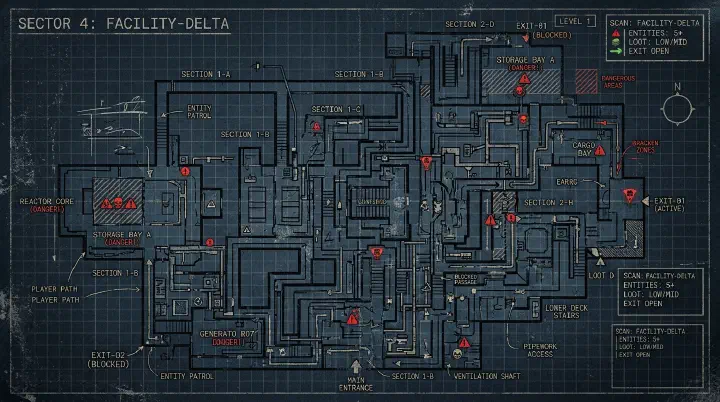
Last updated: July 22, 2026. This guide covers every interior layout in Lethal Company including Facility and Mansion dungeons, detailed room breakdowns with scrap locations and enemy spawns, trap patterns for turrets and landmines, navigation strategies to never get lost, and fire exit routing on every major moon.
The air changes first. One moment you are on the surface — wind, rain, the distant screech of something on the horizon. Then you step through the doorway and the world compresses. The smell of rust and industrial grease hits before your eyes adjust: dim fluorescent strips flicker overhead, casting pools of sickly light across metal grating. Water drips somewhere in the dark. Your boots echo against the catwalk, each step an announcement to whatever waits below.
Behind you, the Main Entrance door hisses shut. Ten seconds. That is all the time it gives you before it seals, cutting off the daylight and the safety of the ship’s viewport. Ahead, the corridor stretches into shadow, branching left and right into unknown rooms. The minimap in your terminal shows only what you have already seen — which is nothing.
This is the moment that separates crews who extract with full pockets from those who become another cautionary tale on the terminal’s bulletin board. Every Lethal Company veteran remembers their first interior: the confusion of identical corridors, the heart-stopping moment a turret’s laser sweeps across your chest, the desperate sprint through unfamiliar rooms with something growling behind you. The interior does not care about your experience level. It follows its own logic, and survival means learning that logic.
Introduction
The interior of every Lethal Company moon is a procedurally generated dungeon. Despite the random generation, every interior follows predictable rules — specific room types have fixed properties, certain connections are guaranteed, and the overall structure follows consistent logic. Understanding these rules separates experienced crews from those who die lost in the dark.
Two distinct interior types exist: Facility interiors (the industrial, sci-fi style found on most moons) and Mansion interiors (the haunted, gothic style found on harder moons). Each has unique room types, hazards, and navigation challenges. This guide breaks down both systems in detail.
For moon-specific recommendations and which interior type to expect on each moon, see our Lethal Company Moon Guide. If you need help with the monsters you will encounter inside, the Lethal Company Monster Bestiary covers every creature’s behavior and weaknesses.
Facility vs Mansion: Overview
| Feature | Facility Interior | Mansion Interior |
|---|---|---|
| Theme | Industrial, metallic, sci-fi | Gothic, wooden, haunted |
| Primary moons (guaranteed or common) | Experimentation, Assurance, Vow, Offense, March, Adamance, Artifice | Rend, Dine, Titan (guaranteed mansion interiors) |
| Mixed moons | Artifice, Titan (can generate either) | — |
| Corridor style | Narrow metal corridors with catwalks | Wide wooden hallways with carpet |
| Room size | Small to medium rooms | Medium to large rooms |
| Default lighting | Fluorescent lights (dim in some rooms) | Chandeliers, candles (dimmer overall) |
| Unique hazards | Catwalks, steam vents, crushers | Falling chandeliers, bookshelf secrets |
| Unique enemies | Turrets (ceiling-mounted), landmines (floor) | Butlers, Ghost Girl (mansion-spawned) |
| Fire exit count | 2-4 depending on moon | 1-3 depending on moon |
| Average scrap density | Moderate | High |
| Average enemy density | Moderate | High |
Facility Interior — Complete Breakdown
The Facility interior is the more common of the two types. It appears on all non-guaranteed-mansion moons and alternates with Mansions on Artifice and Titan. Facility interiors are characterized by metal construction, dim fluorescent lighting, steam pipes, and exposed wiring.
Room Types in Facility Interiors
Every Facility interior is assembled from a pool of room templates. Each room type has specific properties that affect gameplay.
Main Entrance
The Main Entrance is the guaranteed starting point of every Facility dungeon. It always connects to a single corridor heading inward. The entrance itself is a short room with a door on one side and an opening to the first hallway on the other. On moons with a ship-facing entrance, the Main Entrance door opens directly toward the ship’s landing area. Key points:
- The Main Entrance can be locked or unlocked depending on the moon and story progression. If locked, you need a key to enter.
- The Main Entrance door closes behind you after 10 seconds. It does not lock from the inside, so you can always exit through it.
- There is always a light switch near the Main Entrance door. Flicking it turns on the lights in the entrance room and the first few hallway segments.
Apparatus Room
The Apparatus Room is the deepest room in every Facility interior. It contains the Apparatus — a glowing, pulsing device that powers the facility’s electrical systems. This room is always at the maximum distance from the Main Entrance, meaning it is at the far end of the dungeon’s generation. Characteristics:
- The Apparatus Room always has at least 2 exits (often 3-4), connecting it to multiple corridors.
- Pulling the Apparatus from its console causes all lights in the facility to go dark permanently. This triggers an immediate threat escalation: Old Birds and other enemies become more aggressive, and spawn rates increase.
- The Apparatus itself is worth 50-120 scrap depending on the moon’s multiplier. It is a two-handed item and requires a free inventory slot.
- After pulling the Apparatus, you have roughly 30 seconds before the facility’s backup generators kick in — but even then, the lights remain dimmer than before.
- Strategy: Only pull the Apparatus if you are ready to leave immediately. It is almost always the last thing you do before exfiltration.
Server Room
The Server Room contains rows of computer servers, blinking lights, and cabling along the walls. This room has the highest scrap density of any Facility room type:
- High-value scrap spawns: CPUs (value 30-60), Air Horns (50-70), V-Type Engines (60-80), and Bottles (15-30).
- The room has multiple shelf units that often hide scrap behind or underneath them. Check thoroughly.
- Server Rooms are warm and may attract Hygrodere spawns. Listen for slime sounds.
- Lighting is dimmer than average — bring a flashlight or use the Pro-flashlight.
Locker Room
Locker Rooms are narrow rooms lined with metal lockers and benches. They provide excellent hiding spots from roaming enemies:
- Lockers can be opened. Some contain scrap items. Always check all lockers.
- The room has only two entrances (one in, one out), making it a bottleneck. If Coil-Heads or Jesters are active, do not trap yourself here.
- Locker Rooms can spawn with wall-mounted medical kits. These heal 30 HP each when picked up.
- The benches count as low obstacles — you can jump over them but cannot walk through them.
Bathroom
Bathrooms are small rooms with toilets, sinks, and mirrors. They serve as occasional loot locations:
- Toilets and sinks can spawn small scrap: Brushes (5-15), Plastic Cups (5-10), Toothpaste (5-15).
- Bathrooms have a significantly higher chance of spawning Hygrodere than other rooms. Always check the floor before entering.
- Mirrors in bathrooms have a rare chance of triggering ghost events (faces appearing in the reflection). This is cosmetic and harmless.
Storage Room
Storage Rooms contain shelves, crates, and boxes. They are moderate-value loot locations:
- Common scrap: Boxes (10-30), Plastic Cups, Cash Registers (40-80).
- Crates can be destroyed by jumping on them. Destroy all crates to reveal hidden scrap beneath.
- Storage Rooms are often dead ends (only one exit besides the entry corridor). Check the room layout on your minimap before committing to exploring it.
Cafeteria / Break Room
These rooms contain tables, chairs, and vending machines. They are larger than average and serve as landmarks:
- Vending machines can be shaken to produce a can of soda (scrap value 10-20). Shaking the vending machine makes noise that can attract nearby enemies.
- The room provides good sightlines for spotting approaching threats.
- Some Cafeterias have a second floor accessed by a ladder. Check the upper level for additional scrap.
- Tables can be used as temporary platforms to avoid ground-based enemies like Hygrodere.
Catwalk Sections
Catwalks are elevated metal walkways suspended over dark pits. They connect room segments and can span large gaps:
- Catwalks have railings on both sides but the railings can break if you collide with them at high speed.
- Falling off a catwalk deals 30-50 fall damage and places you in a dark sub-floor area. The sub-floor always has a ladder or ramp back up, but you may need to navigate in darkness.
- Some catwalks have gaps that require jumping. Do not sprint across these — you will overshoot and fall.
- Turrets can spawn on catwalks, making them especially dangerous. Listen for the beeping pattern before stepping onto any catwalk.
Facility Procedural Generation Rules
Facility interiors follow consistent generation rules:
- The Main Entrance is always the starting point. The dungeon branches outward from here.
- The Apparatus Room is always the deepest point. It is the room farthest from the Main Entrance by path distance.
- Fire exits are placed at random mid-points. A fire exit can be anywhere between the Main Entrance and the Apparatus Room. There is always at least one fire exit, and larger moons can have up to three.
- Room connections are random but consistent. Large rooms (Apparatus Room, Server Room, Cafeteria) always have 2-4 connections. Small rooms (Bathroom, Locker Room) have 1-2 connections.
- The total number of rooms scales with the moon’s difficulty. Experimentation has roughly 8-12 rooms. Titan can have 20-30 rooms.
- Dead ends are common. Approximately 30% of branches end in a small room with no further connections. These are where you will find the most scrap since fewer players explore them.
Mansion Interior — Complete Breakdown
Mansion interiors appear on the harder paid moons (Rend, Dine, Titan) and occasionally on Artifice. They feature wood-paneled walls, checkered floors, chandeliers, and a much darker atmosphere than Facility interiors. Mansions are larger, have more rooms, and contain more valuable scrap but also more dangerous enemies.
Room Types in Mansion Interiors
Foyer
The Foyer is the Mansion’s equivalent of the Main Entrance. It is a large two-story room with a grand staircase:
- The Foyer always has at least 3 exits: one to the left wing, one to the right wing, and one leading upstairs.
- A chandelier hangs from the ceiling. It can fall if enough noise is made nearby, dealing 60 damage to anything directly beneath it.
- There are always 2-4 decorative vases in the Foyer. Smashing them can yield small scrap items (coins, rings).
- The Foyer’s front doors lock behind you after entering. You must use a fire exit or the Apparatus Room exit to leave.
Library
The Library is a two-story room with tall bookshelves and reading areas:
- Bookshelves can be searched. Some shelves trigger secret passages when pulled, revealing hidden rooms behind them.
- Secret rooms behind bookshelves contain high-value scrap: Gold Bars (60-100), Diamonds (80-120), and Paintings (60-100).
- The Library has a high chance of spawning a Butler. If you hear footsteps on creaking floorboards and no one is visible, the Butler has spawned.
- Lanterns on reading tables can be picked up as scrap (value 15-30).
- The upper floor of the Library overlooks the lower floor and can be used to scout for threats.
Kitchen
The Kitchen is a large room with cooking stations, pantries, and a dining area:
- Food items (sodas, cans, boxes) are common scrap here.
- The pantry often contains multiple shelf units with hidden scrap.
- Butlers frequently spawn in or near the Kitchen. Enter cautiously.
- Kitchen counters can be jumped onto to escape ground-based threats.
- The walk-in freezer in some Kitchen variants has a rare scrap spawn: the Fancy Lamp (value 40-80).
Armory
The Armory is a high-value room that appears in roughly 30% of Mansion generations:
- The Armory always contains at least one shotgun on a wall rack. Shotguns spawn with 2-4 shells loaded.
- Additional shells can be found in ammo boxes inside the Armory.
- The Armory door is sometimes locked, requiring a key to enter. Check nearby rooms for keys if you find a locked door.
- There are no enemies that spawn inside the Armory itself, but enemies can follow you in.
Dungeon / Cellar
The Dungeon is a basement area accessible via a staircase or trapdoor:
- Iron bar doors separate sections of the Dungeon. These doors can be opened manually but make significant noise.
- The Dungeon has the highest concentration of valuable scrap in the entire Mansion. Expect to find Gold Bars, Cash Registers, and Robot Toys here.
- Lightning is very dim in the Dungeon. A flashlight is essential.
- The Dungeon often connects to a fire exit, making it a convenient escape route.
- Enemies: Spider spawn rates are increased in the Dungeon. Coil-Heads also appear more frequently.
Ballroom
The Ballroom is a large open room with a chandelier, dance floor, and balcony:
- The chandelier is the largest in the Mansion and deals 80 damage if it falls. Its collapse can be triggered by gunfire, grenades, or significant noise.
- The dance floor has no cover. If enemies enter the Ballroom while you are inside, you have limited options for escape.
- The balcony provides an elevated position with good sightlines.
- Ballrooms contain multiple decorative items that can be picked up as scrap: Candlesticks (20-40), Plates (10-20), and Vases (15-30).
Bedroom
Bedrooms are smaller rooms with beds, dressers, and wardrobes:
- Dressers and wardrobes can be opened. They contain scrap roughly 30% of the time.
- Beds can be searched for scrap hidden under pillows or mattresses.
- Bedrooms are safe hiding spots with only one entrance. Useful for evading patrols.
- Mirrors in bedrooms have the same rare ghost event as bathroom mirrors.
Mansion Procedural Generation Rules
Mansion interiors follow different generation rules than Facilities:
- The Foyer is the fixed start point. You always enter the Mansion through the Foyer.
- The main staircase connects the ground floor to the upper floor. The Apparatus Room can be on either floor.
- Rooms are larger and more spread out. Mansion interiors feel more open than Facility interiors.
- Secret rooms are always behind bookshelves in the Library or adjacent rooms. Finding these is essential for maximum scrap.
- Fire exits in Mansions are typically on the upper floor or in the Dungeon. Know which one you are taking before you go deep.
- Mansion interiors have approximately 30-50% more total rooms than Facility interiors on the same moon.
Navigation Strategies
Getting lost inside is the most common cause of death in Lethal Company interiors. Once the lights go out or enemies begin chasing you, knowing your route becomes a matter of life and death.
The Left-Wall Rule
The simplest and most reliable navigation technique: always turn left at every intersection. This guarantees that you explore every room in the dungeon systematically without backtracking over explored territory. When you want to exit, turn right at every intersection — this reverses your path and leads you back to the entrance.
This rule works because the dungeon’s procedural generation creates a tree-like structure from the Main Entrance. Turning left systematically explores each branch to its end before moving to the next branch.
Important exceptions: The Left-Wall Rule breaks if rooms loop back on themselves. In Facility interiors, about 10% of generations have circular paths. If you recognize you are passing through the same room twice, the loop has occurred. In this case, mark one of the exits (with a dropped item or a text marker on your map) and continue.
Map Marking
The in-game map (opened with M by default) shows the room layout as you explore. However, it does not mark which rooms you have fully searched. Use text chat markers or physical item drops to indicate explored paths:
- Drop a specific scrap item at unexplored entrances. For example, drop a piece of junk at the entrance of a room you still need to check.
- Use the walkie-talkie callouts. If you are playing with a team, call out “left clear” or “right uncleared” to coordinate.
- Ship radar operator. The player in the ship can view your position on the radar and guide you through the layout. This is particularly useful on large Mansion interiors. See our Lethal Company Co-op Team Roles Guide for more on effective team coordination.
Fire Exit Routing
Fire exits are your lifelines when things go wrong. Every fire exit in an interior leads to a specific exterior location on the moon. Knowing where each fire exit comes out is critical.
| Moon | Typical Fire Exits | Exit Exterior Location |
|---|---|---|
| Experimentation | 2-3 | Side of the main building, cliff edge |
| Assurance | 2 | Behind the main building, near the ravine |
| Vow | 2 | Forest edge near the mansion ruins |
| Offense | 2-3 | Coastal cliff, behind the main structure |
| March | 2 | Near the lake, on the western edge |
| Rend | 1-2 | Rear garden of the mansion |
| Dine | 1-2 | Side courtyard of the mansion |
| Titan | 2-3 | The exterior is itself different — fire exits on Titan lead to different parts of the Titan exterior, not the same moon surface. This is crucial because some fire exits on Titan place you near cliff edges. |
| Artifice | 2-3 | Multiple locations around the factory complex |
Critical rule for Titan and Artifice: Fire exits on these moons do not all lead to the same place. One fire exit might place you near the ship, while another might place you on the opposite side of the map. Always check which fire exit you are taking before using it as an escape route. The radar operator can confirm your exterior position.
The Apparatus Room Exit Strategy
When you pull the Apparatus, you commit to leaving the facility immediately. Here is the optimal exit strategy:
- Before pulling: Clear a path from the Apparatus Room to the nearest fire exit. Kill or avoid all enemies along this route.
- Pull the Apparatus: It takes 3 seconds to remove. The lights go out immediately after.
- Move immediately: Do not linger. Sprint to your pre-cleared exit route. Do not stop for scrap — the Apparatus itself is worth enough.
- Use the fire exit, not the Main Entrance. Fire exits place you closer to the ship on most moons. Re-entering through the Main Entrance means traversing the entire dungeon again.
- Two-handed constraint: The Apparatus occupies both hands. You cannot carry a weapon or flashlight while holding it. If you need to defend yourself, you must drop the Apparatus, fight, and pick it up again.
Trap Patterns and Disarming
Understanding trap mechanics is essential for safe navigation. Each trap type has a consistent pattern you can learn and exploit.
Turrets
Turrets are ceiling-mounted automatic weapons that fire at any moving target in their line of sight.
Activation: Turrets activate when you enter their scanning arc. They have a 90-degree scanning cone in front of them. The turret’s laser sight sweeps this cone. If the laser crosses you, the turret begins a 1-second warning beep sequence, then fires.
Scan patterns: Turrets scan in one of three patterns:
- Horizontal sweep (60%): The laser sweeps left to right and back. Typical ceiling-mounted turrets.
- Vertical sweep (25%): The laser sweeps up and down. Found on wall-mounted turrets.
- Fixed (15%): No sweep — the laser points in one direction. Typically found guarding specific rooms.
Disarming: Turrets can be disabled in two ways:
- Shotgun blast: 2-3 shotgun shells from any angle will destroy a turret. Aim at the base or the barrel.
- Key: Some turrets can be turned off with a key at a nearby control panel. The control panel is usually within 15 meters of the turret.
Counterplay: Before entering a room, listen for the characteristic beeping and look for the red laser. If you hear the beep accelerate, you are in the scan zone. Back out immediately. Crouching does not hide you from turrets — they detect movement, not height.
Landmines
Landmines are floor-based traps that detonate when stepped on or when a sufficiently heavy object passes over them.
Detection: Landmines have a blinking red light and emit a very faint beeping sound. The beep is quieter than turrets and easy to miss in combat. Always scan the floor in rooms where landmines are likely.
Disarming: Landmines can be disarmed by crouching and pressing the interact key on them. This requires you to be within 1 meter of the mine. A disarmed mine can be picked up and carried — it functions as scrap worth 15-30 units at the ship.
Trigger radius: Landmines trigger when a player or creature steps within approximately 0.5 meters of the mine. The explosion radius is 5 meters and deals 90 damage at the center, scaling down to 30 damage at the edge.
Counterplay: If you see a mine, you can safely jump over it. Sprinting over a mine sometimes triggers it even if you clear the distance. The safest approach is to walk around it with at least 1 meter of clearance.
Steam Leaks
Steam leaks are wall- or floor-based vents that release bursts of scalding steam. They are found primarily in Facility interiors, usually near pipes or machinery.
Pattern: Steam vents release a burst every 8 seconds. The burst lasts 2 seconds. The timing is consistent — once you observe one burst, you know when the next will come.
Damage: Standing in the steam deals 10 damage per tick. A full burst (2 seconds) deals roughly 40 damage. You can survive one burst but not two in a row.
Shutoff: Steam vents can be permanently disabled by interacting with a nearby valve. The valve is always within 5 meters of the vent, usually on the same wall or the adjacent wall. The shutoff animation takes 2 seconds. You can cancel by moving.
Counterplay: Time your movement between bursts. Wait for the steam to stop, then move through the area. On your way back, wait again or shut off the valve.
Crushers (Facility Only)
Crushers are ceiling-mounted press platforms that periodically slam down, crushing anything beneath them.
Pattern: Crushers have a 4-second cycle: 1.5 seconds raised, 0.5 seconds descending, 1 second lowered, 1 second ascending. The cycle is consistent.
Damage: Being caught under the crusher deals 100 damage instantly — lethal for most players without full health.
Counterplay: The crusher makes a mechanical whirring sound before descending. If you hear the whirring while under the crusher, sprint forward or backward to clear the area. You have roughly 0.5 seconds to react.
Falling Chandeliers (Mansion Only)
Chandeliers are suspended from the ceiling in Foyers, Ballrooms, and some larger Mansion rooms.
Trigger: Chandeliers fall when sufficient noise is generated within 10 meters. Gunfire, grenades, running footsteps on the second floor, and the Apparatus pull all trigger chandelier drops. The chandelier falls after a 1-second warning (creaking sound).
Damage: 80 damage to anything directly beneath the chandelier. The chandelier then blocks the area as an obstacle.
Counterplay: Avoid standing directly beneath chandeliers in rooms where you anticipate combat or noise. If you hear creaking, sprint sideways immediately.
Interior Enemy Spawning Rules
Enemy spawning inside interiors follows consistent rules that you can anticipate:
- Initial spawn: When you first enter the interior, roughly 60-80% of the enemies are already spawned and placed in rooms throughout the dungeon. The remaining 20-40% are in a “reserve pool” that spawns over time.
- Time-based spawning: After 5 minutes inside, the reserve pool starts deploying enemies at a rate of roughly one enemy every 2 minutes. This is why lingering in the dungeon is dangerous.
- Noise-based spawning: Gunfire, explosions, and the Apparatus pull can trigger immediate enemy spawns from the reserve pool. After pulling the Apparatus, expect 2-3 additional enemies to spawn near your location.
- Moon difficulty scaling: Harder moons spawn more enemies initially and have larger reserve pools. Titan can spawn up to 15 total enemies in a single interior run.
- Enemy cap: Each interior has a maximum enemy cap (varies by moon, typically 8-12 for normal moons, 12-18 for Titan/Artifice). Once the cap is reached, no more enemies spawn until some are killed or despawn.
Counter-Intuitive Insights
Experienced players know that Lethal Company interiors often reward counter-intuitive behavior. What feels wrong is often optimal.
Dead Ends Are Your Best Friends
Most players avoid dead-end rooms because they seem like wasted time. In reality, dead ends account for roughly 30% of branches and contain disproportionately high scrap value because fewer players explore them. The dungeon’s generation algorithm places valuable loot at terminal points to reward thorough exploration. Always check dead ends last — but always check them.
Silence Can Kill You Faster Than Noise
Conventional wisdom says stay quiet to avoid detection. But moving too slowly through the interior increases your time inside, which triggers the reserve enemy pool. After 5 minutes, the game starts deploying enemies at a rate of roughly one every 2 minutes. Sometimes it is better to sprint through a known-clear section, make noise, and cover ground than to creep silently and let the clock work against you.
Flashlights Are a Double-Edged Sword
The Pro-flashlight illuminates dark rooms and helps you spot scrap and traps. But its beam is visible to certain enemies, and using it in a room with ambient light can make peripheral vision worse. Experienced players toggle their flashlight off in well-lit corridors to preserve night vision and avoid broadcasting their position. The best light management is situational, not constant.
The Main Entrance Is a Trap
Your instinct is to return through the door you came in. On most moons, the fire exit places you closer to the ship than the Main Entrance. After pulling the Apparatus, using the Main Entrance means traversing the entire dungeon again. A fire exit cuts that distance by half or more. Train yourself to think of the Main Entrance as a one-way door — once you go in, plan to leave through a fire exit.
Failure Analysis: Why Crews Wipe Inside
Even experienced teams fall to predictable failure patterns. Recognizing these archetypes helps you avoid them.
The Wanderer’s Death
Symptoms: Team spreads out to cover more ground. One player loses orientation in a dead-end corridor. By the time they realize they are lost, the lights go out or an enemy cuts off their path back. Panic sets in, and the player runs deeper into the dungeon instead of backtracking systematically.
Root cause: Failure to maintain spatial awareness. The player stopped paying attention to turns and room connections early in the run.
Prevention: Use the Left-Wall Rule from the moment you enter. Appoint one player as the navigator whose primary job is tracking the route. The ship’s radar operator should call out position every 60 seconds.
The Apparatus Rush
Symptoms: A team finds the Apparatus Room early, pulls the device without clearing an exit path first, and then cannot navigate the darkened facility while carrying a two-handed item. Enemies that were dormant become aggressive. The team scatters, and each player dies alone.
Root cause: Greed over preparation. The Apparatus’s scrap value blinded the team to the operational requirements of extraction.
Prevention: Never pull the Apparatus until you have walked the exit route from the Apparatus Room to the nearest fire exit. Clear enemies along that route. Designate one player as the Apparatus carrier while others provide cover.
Trap Tunnel Vision
Symptoms: Player spots a landmine or turret and becomes fixated on avoiding it. While watching the trap, they back into another hazard — a steam vent, a crusher cycle, or fall off a catwalk. Some players spend 30+ seconds trying to disarm every trap they encounter.
Root cause: Treating traps as puzzles rather than hazards. Not all traps need to be disarmed — many can be bypassed.
Prevention: Ask yourself: “Can I go around this?” If yes, do it. Only disarm traps that block a mandatory path. A turret in a side room can be ignored. A landmine in a corridor you must cross twice should be disarmed or destroyed.
The Overstayer
Symptoms: Team stays inside past the 5-minute mark because “just one more room” keeps yielding scrap. By minute 8, the reserve enemy pool has deployed multiple threats. The return path, which was clear on the way in, is now blocked. The team takes casualties on the way out and fails to extract with any scrap.
Root cause: Loss of discipline around time management. The interior becomes more dangerous the longer you stay, and marginal scrap gains are not worth exponential risk increases.
Prevention: Set a hard time limit before entering. When the timer expires, you leave — regardless of how many rooms remain unchecked. The ship’s radar operator should enforce this timer.
Communication Breakdown
Symptoms: Two players enter the same room from different corridors. One mistakes the other for an enemy and alerts the team. Positional callouts become confused (“left” means different things to different players). By the time communication collapses, the team has lost cohesion and either extracts early or wipes.
Root cause: No shared reference system for navigation callouts.
Prevention: Establish naming conventions before entering. Use “corridor left/right” relative to the direction the team is moving, not individual player orientation. Confirm callouts by having the receiver repeat them back.
Decision Framework: Your Interior Survival Flowchart
Every moment inside a Lethal Company interior is a branching decision. Use this framework to make optimal choices under pressure.
Entry Decision
| Variable | Decision |
|---|---|
| Is it past 2:00 PM in-game? | Enter only if you can extract before 6:00 PM. Night arrival increases enemy spawns by approximately 20%. |
| Is the moon’s hazard level “Stormy” or “Flooded”? | Skip. Weather hazards compound interior risks significantly. |
| Does your team have at least one flashlight? | Do not enter without a light source. The facility is dark and becomes pitch-black after the Apparatus is pulled. |
| Do you have a walkie-talkie? | Mandatory for any moon with a Mansion interior. Facility interiors can be managed without one if the team stays together. |
Navigation Decision Tree
- At each intersection: Apply the Left-Wall Rule. If this is your exit route, apply the Right-Wall Rule instead.
- When you find a dead end: Clear the room, note its location on the minimap, and backtrack to the last unvisited branch.
- When you encounter a trap: Can you bypass it with 1+ meter clearance? If yes, bypass. Is it blocking a path you must cross twice? If yes, disarm. Otherwise, mark it on the minimap and proceed.
- When you find a locked door: Is your team close to the Apparatus Room depth? If yes, search nearby rooms for a key. If not, mark the door and return after clearing closer rooms.
Scrap Prioritization
| Priority | Scrap Type | Action |
|---|---|---|
| 1 (Highest) | Apparatus | Always take. Worth 50-120 credits. Triggers dark exit sequence. |
| 2 | Two-handed high value (Gold Bars, Diamonds, Paintings) | Take if you have a free two-handed slot. |
| 3 | One-handed high value (Cash Registers, V-Type Engines) | Take. Can be carried alongside a weapon or flashlight. |
| 4 | Moderate value (Air Horns, Fancy Lamps, Candlesticks) | Take only if you have inventory space after securing higher priorities. |
| 5 | Low value (Plastic Cups, Brushes, Toothpaste) | Skip unless you have empty slots on the way out. |
Extraction Decision
When should you commit to leaving?
- Trigger events: The Apparatus has been pulled; a Jester has reached its final form; a Coil-Head is active and you cannot maintain eye contact while carrying scrap; the team has taken two or more casualties.
- Time trigger: You have been inside for 5 minutes or more. The reserve enemy pool is now active.
- Scrap trigger: The combined value of carried scrap exceeds 60% of the current quota requirement. Extracting early reduces risk and preserves crew for the next run.
Post-Extraction Review
After each run, answer three questions:
- Did we exit through a fire exit or the Main Entrance? (Fire exit should be the default choice.)
- Did any player get lost? If yes, what navigation failure caused it?
- Did we leave scrap behind that we could have carried out? If yes, was it a route-planning failure or an inventory management failure?
These reviews take 30 seconds and compound into dramatically better performance over dozens of runs.
Conclusion
Mastering interiors in Lethal Company requires three skills: knowing the room types and their properties, understanding navigation logic, and recognizing trap patterns. Facility and Mansion interiors are different enough that you need separate strategies for each. On Facility moons, focus on efficient room clearing and turret management. On Mansion moons, prioritize finding the Library’s secret rooms and navigating the Dungeon safely.
Always establish your exit route before going deep. Always communicate with your team about cleared and uncleared rooms. And always — always — know where your nearest fire exit is before pulling the Apparatus.
For more Lethal Company guides, check our Equipment Guide for gear recommendations and the Weather & Conditions Guide for exterior survival strategies.
Related Guides
- Lethal Company Moon Guide — Moon-by-moon breakdown of interior types, scrap values, and recommended routes
- Lethal Company Monster Bestiary — Complete creature database with spawn locations and counter strategies
- Lethal Company Advanced Strategies Guide — Advanced movement, routing, and loot optimization techniques
- Lethal Company Scrap & Loot Guide — Complete scrap values, room spawn tables, and quota calculator