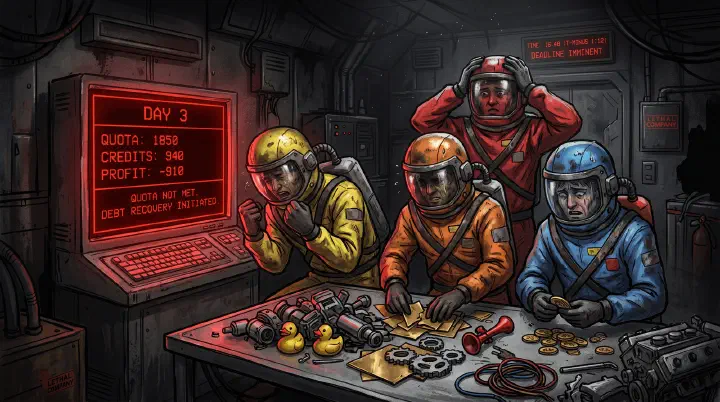
8:07 AM. Day 3. The Terminal Doesn’t Lie.
You type scan and the number stares back. You’re 217 credits short of quota. The Company building opens in 10 hours. Your crew is you and one other guy — the third died on Day 2, ragdolled into a pit on Assurance holding a Big Bolt and two Brass Bells. Those items are gone. The ship has a Pro-Flashlight, three Walkie-Talkies nobody uses, and a single shovel. Yesterday’s run was a disaster.
Your buddy is already typing moons into the terminal, finger hovering over Titan. “We go big or we go home,” he says.
This is the exact moment most runs die.
The instinct to panic-route to Titan is what kills more Day 3 comebacks than any monster. You feel the pressure, you remember Titan’s S-tier scrap pool, and you think one big score fixes everything. Here’s what actually happens: the crew enters Titan split up because you’re desperate to cover ground. Someone triggers a Coil-Head 30 seconds in. The second player dies to a Bracken they didn’t hear because comms were silent while everyone scrambled. The run ends at 9:12 AM with zero scrap collected and a campaign over screen.
The counterintuitive truth about quota crisis: survival isn’t about finding the most scrap. It’s about finding enough scrap and living to sell it. The difference between those two things is everything.
Why Most Last-Minute Scrambles Fail
Before we get to what works, let’s look at why the obvious plays fail. Understanding these failure modes is half the battle — every single one is a trap that looks like the right move when you’re panicking.
The Titan Trap. You’re short 300 scrap, so you route to the moon with the best loot pool. The problem: Titan’s scrap density is balanced by its monster density. The indoor spawn rate is the highest in the game. Enemy variety means you can’t prepare for everything — you’ll hit Brackens, Coil-Heads, and Jesters in the same run. A crew that’s already tilted from a bad Day 2 doesn’t have the coordination to handle Titan’s indoor pressure. The result: you collect 400 scrap, lose two players, and the remaining crew can’t carry it all out. Net scrap sold: zero.
The Split-Up Strategy. You’re racing the clock, so you split the team to cover more rooms. This is logical on paper. In practice, a solo player on Day 3 with no backup dies to the first Bracken that spots them. Now you’re down to two players, then one, and the scrap they collected sits on their corpses. Splitting up works when you’re ahead and can afford to lose someone. When you’re behind, every death is a percentage of your remaining scrap capacity that’s gone forever.
The “One More Room” Greed. You’ve got 180 scrap in hand. Quota gap is 200. You’re at the exit, 20 credits short, and someone says “one more room.” That room has a Thumper. The Thumper kills the player carrying the scrap. Now you’re 200 short again with less time and one fewer crew member. The sunk cost of the scrap you already collected is invisible until it’s gone. When you’re at the exit with partial scrap, leaving is almost always correct — you can sell what you have and do another run.
The Equipment Hoarding Fallacy. The ship has 65 credits of unused gear. You’re 65 credits short. And you never think to sell it because equipment “feels permanent.” It’s not. A Stun Grenade sitting in ship storage contributes exactly zero to your quota. This is the single most common oversight in quota crisis — and it’s the easiest fix.
Counterintuitive Strategy #1: Sell Your Ship First
Before you even pick a moon, open the ship’s storage and sell everything that isn’t actively keeping you alive. This is the highest-percentage move in quota crisis and almost nobody does it.
Here’s the math on a typical Day 3 ship: two spare Walkie-Talkies (24 credits), an unused Stun Grenade (25 credits), an extra Shovel (15 credits), and a Zap Gun someone bought on Day 1 and never used (40 credits). That’s 104 credits sitting in storage. Your quota gap was 217. Now it’s 113.
The keep/sell rules are simple:
- Keep: one Shovel per surviving crew member, one light source per person (Flashlight or Pro-Flashlight), and one Walkie-Talkie for the ship operator if you’re running one.
- Sell: everything else. Zap Guns, spare Shovels, duplicate Walkie-Talkies, unused Stun Grenades, Boomboxes, spare Pro-Flashlights. Sell it all.
If selling your Pro-Flashlight gets you across the line, do it. You can rebuy a standard Flashlight next quota for 15 credits. A failed quota is permanent. A downgraded flashlight is temporary.
The psychological barrier here is real — selling gear feels like admitting you messed up. But that gear isn’t “your stuff.” It’s frozen credits you need right now. Thaw them.
The Moon Decision Framework
Once you’ve sold everything you can, recalculate the gap. This is your real number. Now pick your moon based on the gap, not based on what “feels” like the best moon.
Gap: 0-80 Scrap (After Selling Equipment)
You’re essentially already there. Don’t risk anything.
Route to Offense (40 credits landing fee). Offense has a C-tier hazard rating and a scrap pool that averages 500-750 per full clear. You need 80. You’ll find that in the first 2-3 rooms near the main entrance.
The play: enter together at 8 AM. Stay as a group. Clear rooms near the entrance only — don’t go to the fire exit side, don’t split up. Loot what’s in the first 3 rooms and leave. You should be back on the ship by 9:30 AM with 100-150 scrap. Sell immediately. Campaign saved.
The trap to avoid: getting comfortable because you found your 80 scrap quickly and deciding to “grab a few more rooms.” Every extra room is a chance for a Bracken or Thumper to wipe your progress. When you have what you need, leave. The mission is over.
Gap: 80-250 Scrap
Route to March (free). March is the workhorse of quota crisis. No landing fee means you’re not digging the hole deeper. The scrap pool is a solid B-tier — better than Assurance, more consistent than Offense. The fire exit on March gives you an extraction route that bypasses the long outdoor walk, which matters when you’re racing daylight.
The play: enter through the main entrance as a group. Clear 5-6 rooms. If you find the fire exit, use it — one player ferries scrap back through the fire exit while the rest continue looting forward. The fire exit path dumps you near the ship, cutting extraction time by 60-70 seconds per trip. That adds up to an extra room or two across the run.
Be out by 5 PM. March’s outdoor path is long and exposed. Forest Keepers patrol the treeline at dusk. The walk from the main entrance to the ship after dark is lethal — you’ll hear the giant footsteps before you see the thing. Don’t be the crew that dies with 300 scrap in hand because someone said “one more room” at 4:45 PM.
Gap: 250-450 Scrap
This is the danger zone. You need a real haul, and you need it in one day.
Option A: Two March runs. March is free. You have the full day. First run: enter at 8 AM, clear 4-5 rooms, extract by noon. Sell everything. Second run: enter at 1 PM, push deeper this time (6-8 rooms), extract by 5 PM. Two March clearings net 800-1,300 scrap total. It takes all day and it’s not exciting, but it works.
Option B: Rend (the counterintuitive play). Rend costs 550 credits to land. You’re already short on quota and now you’re spending money. This feels wrong. It’s not.
Here’s the math: you need 400 scrap. Rend averages 800-1,100 scrap per run. The 550 landing fee is recovered by the second or third item you pick up. Rend’s scrap pool is A-tier — Laser Pointers, Fancy Cups, and Gold Bars are common. The indoor layout is more forgiving than Titan’s, with wider corridors that make Coil-Head encounters survivable. Rend is the “spend money to make money” play, and it’s correct more often than most players realize.
The catch: you need 3+ players who know what they’re doing. Coil-Heads spawn on Rend. If you hear one, you leave immediately with whatever you have. A partial Rend load of 400-500 scrap is still a win. Don’t push your luck.
Gap: 500+ Scrap
You’re in a deep hole. The ship has almost nothing left to sell. Your crew is intact but morale is low.
Do not go to Titan. I’ll say it again: Titan with a tilted crew is a guaranteed wipe. The S+ scrap pool is a mirage if nobody survives to sell it.
Your best play is two March runs with a specific twist: on the second run, one player stays on the ship as a dedicated operator. Use the ship operator role — radar pings, door controls, and teleporter timing. The ship operator turns a desperate scramble into a coordinated extraction. They tell you when a Bracken is tracking someone. They teleport the player carrying the most valuable scrap if things go sideways. A good ship operator is the difference between a 500-scrap wipe and a 400-scrap survival.
If you’re down to 2 players, the two-March strategy still works — you just clear fewer rooms per run. The math is the same: two partial clears beat one wipe.
Counterintuitive Strategy #2: Abandon Early, Not Late
The most undervalued skill in quota crisis is knowing when to abort a run. Most crews die because they commit to a bad situation and refuse to cut losses.
Here’s the rule: if your crew takes a death before you’ve collected 50% of your gap in scrap, leave immediately. Teleport everyone out. Sell what you have. Try again.
The logic: every death reduces your scrap-carrying capacity by 25% (in a 4-player crew). A dead player also means one less person watching for Brackens, one less person clearing rooms, and one less person to carry the heavy items. The run gets harder AND less rewarding simultaneously. The expected value of continuing after a death is lower than the expected value of aborting and restarting fresh.
The counterargument is “but we’ve already invested time.” That’s the sunk cost fallacy. The time you spent in the facility is gone whether you abort or not. The question is: given the current state (one dead player, partial scrap), what’s the best move from here? The answer is almost always “leave and reset.”
This is especially true on paid moons. Landing on Rend for 550 credits, losing a player in the first 3 rooms, and then pushing deeper “to make it worth it” is how you lose 550 credits AND a campaign. Eat the loss. Abort. Go to March. Survive.
The Emergency Sell Order
You’re back at the ship. You have scrap in hand. You’re still short. Now you sell from your inventory, not just equipment.
Sell in this exact order:
- Duplicate equipment — spare shovels, extra flashlights, unused stun grenades. Already covered above.
- Low-value scrap (under 30 credits each) — Tattered Metal Sheets (10-20), Old Bottles (15-25), Bolts (10-15), Clown Horns (20-30). These items are filler. You’ll find replacements next quota easily. Don’t get attached to a 12-credit Bolt because “it’s still scrap.”
- Mid-value scrap (30-50 credits each) — only if you’re within striking distance of quota. A 40-credit item sold now is worth more than a failed quota. You can’t spend scrap on a game over screen.
- Your Pro-Flashlight — sell for 30, rebuy a standard Flashlight next quota for 15. Net cost: 15 credits. Worth it if those 30 credits close the gap.
Never sell:
- Your only Shovel. You can’t fight Thumpers or clear Snare Fleas without one. A single Thumper encounter without a shovel is a death sentence.
- Your only light source. Navigating interiors blind is not a strategy — it’s a suicide pact.
- Scrap worth 60+ credits individually. Gold Bars, Laser Pointers, Fancy Cups, and Cash Registers are your foundation for the next quota. Selling a 90-credit Gold Bar to meet a 50-credit gap is a bad trade — you’re solving a small problem by creating a bigger one next cycle.
The Solo Sprint (Last Resort)
Your crew is dead. Or they’re alive but refusing to re-enter the facility. You’re the only one left. The gap is under 150 scrap.
One player enters alone at 8 AM. Shovel in hand. Flashlight equipped. March or Offense — don’t pay for a moon when you’re solo. Clear 2-3 rooms near the entrance. If you see or hear anything that isn’t a Hoarding Bug or Snare Flea, leave immediately. You cannot fight a Bracken alone. You cannot outrun a Coil-Head. You’re not a hero — you’re a delivery driver.
A successful solo sprint nets 80-120 scrap in 5-7 minutes. That’s enough to save a campaign when you’re that close. The key discipline: don’t get greedy. The moment you think “I can grab one more room,” you’ve lost. The solo sprint works because it’s fast, not because it’s thorough.
If the gap is over 150 scrap and you’re solo, the campaign is probably over. You can try the sprint, but the math is against you. Use the time to learn what went wrong on Days 1 and 2 instead.
The Corpse Retrieval
A dead teammate’s body is still in the facility. If they were carrying 100+ credits of scrap when they died, a retrieval run might be worth it.
The conditions: you know exactly where they died (the ship operator noted the room), the path to that room is short, and you have at least 2 players for the retrieval. Enter together. Go directly to the corpse. Grab the scrap. Leave. Don’t loot. Don’t explore. This is a retrieval, not a run.
A corpse retrieval that gets 120 scrap back in 3 minutes is a good trade. A corpse retrieval where someone else dies trying to reach the body is a disaster. If the corpse is deep in the facility — past the 5th room, near the back areas — leave it. The scrap isn’t worth another death.
Related Guides
- Lethal Company Beginner Guide — First Quota, Monsters & Items
- Lethal Company Best Moons for Profit Tier List
- Lethal Company Quota Management & Optimization Guide
- Lethal Company Equipment Economy — What to Buy and When
- Lethal Company Ship Operator Guide — Radar, Doors & Teleporter
- Lethal Company Solo Survival Guide — Strategies & Loadouts
- Lethal Company Beginner Mistakes — 10 Crew-Wiping Errors