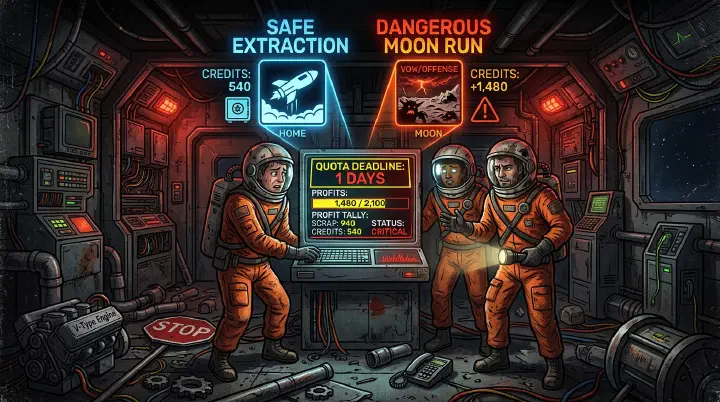
Quota deadline: 14 hours. Current scrap on the ship floor: 487 credits. Target: 550. Your team is already dead — a Bracken got the captain in the furnace room and the intern panicked into a Coil-Head. You’re alone on Vow. The ship’s auto-pilot is counting down. You’re 63 credits short of the quota and the company music is already playing.
You got greedy. You saw the gold bar in the courtyard but skipped the easy 80-credit painting on your way to the apparatus. You thought “big item = big money.” Now you’re standing in the ship doorway, staring at a single metal sheet worth 14 credits, knowing you don’t have time to make another run. The quota didn’t kill you. Your scrap priority did.
You treated a safe, mid-tier moon like a loot piñata instead of a math problem. And the math doesn’t care how close you were. It cares whether you hit the number. This is the story that plays out on easy moons every single day — not because Titan’s Giants are too scary, but because teams walk onto Assurance with a plan and walk off with a wipe because nobody did the addition.
Why Teams Miss Quota on Easy Moons
Easy moons like Assurance, Vow, and March kill more quota runs than Titan ever will. The danger isn’t the entities. It’s the complacency. Here are the specific mistakes that turn a safe moon into a failed quota.
Over-staying for “just one more” scrap. Easy moons feel forgiving, so teams ignore the clock. They clear the main building, then decide to check the fire exit. Then the basement. Then the barn. Every extra room is another dice roll on spawns. On an easy moon, your survival rate drops from 90% to 60% not because the moon got harder, but because you stayed three hours too long.
Not prioritizing two-handed items correctly. Teams see a large axle (36 credits, two-handed, slow) and a painting (80+ credits, one-handed, fast) and grab the axle first because it’s “bigger.” The math is brutal: two trips with an axle costs you four minutes of daylight and blocks your flashlight hand. Two trips with a painting costs two minutes and leaves you mobile. The time-to-credit ratio on two-handed low-value scrap is atrocious.
Ignoring the time-to-scrap ratio. A gold bar takes 30 seconds to extract and sells for 108 credits. A robot toy takes 90 seconds to wrangle out of a tight corner and sells for 56 credits. Easy moons are full of deceptive low-value clutter. If an item requires more than 60 seconds of your time per 20 credits of value, leave it. Time is the real currency on easy moons.
Treating easy moons as risk-free practice. Teams bring no flashlights, no shovels, no meds. “It’s just Assurance.” Then a Bunker Spider spawns in the main hall and nobody has a light to spot the webs. Easy moons still spawn every entity in the game. The only difference is the spawn rate. One unlucky roll still ends your run.
Failing to call extraction at 80% quota. This is the deadliest sin. You hit 80% of quota on an easy moon with plenty of daylight left, and nobody says the word “ship.” Instead, someone says “we’re already here, let’s clear it out.” That 20% buffer is not a signal to keep going. It is a signal that you have won this moon and should leave before the game changes its mind.
Why Teams Actually Fail Quotas (Hint: It Is Not the Monsters)
Most players think quota failure happens because a Bunker Spider caught them off-guard or because the weather turned bad. That is rarely the root cause. The root cause is almost always one of four things, and three of them happen before you ever step foot on a moon.
Greed is the big one. Once a team has 80% of their quota, they get antsy. They start rounding up. “We’re basically there, let’s grab a few more big items.” That “few more” turns into a full second trip. The second trip is where the danger lives. Every extra moon you visit is another dice roll on weather, entity spawns, and team coordination. Two trips to a medium moon is not twice the risk — it is often four to five times the risk because your team is tired, low on supplies, and mentally checked out.
Not tracking scrap value in real-time is the silent killer. Teams walk around with no idea what their loot is actually worth. They find a large axle and think, “That looks heavy, must be good.” It is worth 36 credits. They walk past a gold bar worth 108 because it is small and easy to miss. If nobody on your team is keeping a running tally — mentally, on a notepad, or in voice chat — you are flying blind. You cannot make a sell-vs-push decision if you do not know where you stand.
Ignoring moon weather is pure laziness, and it is expensive. Eclipsed moons are not a flex. They are a tax on your survival rate. Foggy, rainy, and stormy conditions compound entity aggression and visibility problems. If your scrap tally is at 85% of quota and the only affordable moon is eclipsed, you do not “go for it.” You sell. Weather is not ambiance. It is a multiplier on every risk in the game.
Not understanding quota scaling is the long-term mistake that turns a single wipe into a campaign death spiral. The game does not just add a flat number each quota cycle. It scales based on how much you exceeded the previous quota. Sell 600 credits on a 450 quota? Great, you felt safe. Now your next quota is 550 instead of 480. You made the game harder because you were “good.” That is how Lethal Company punishes success. Understanding that math is the difference between a team that survives ten days and a team that wipes on day four because they inflated their own quota.
The Sell vs Push Decision Tree
You need a framework, not a feeling. Here is the decision tree that stops the “one more moon” catastrophe before it starts. Use it at the end of every day before anyone opens the terminal.
Step 1: Do a real scrap count.
Not a guess. Count it. Add it up. If you have to, throw everything on the floor and call out values. Everyone on the team should know the number.
Step 2: Compare against quota.
If your scrap value is at 100% or more of quota, you sell. No exceptions. No “but we could pad the next quota.” You sell. You live. You fight another day.
If your scrap value is at 85-99% of quota, you sell unless the moon you are currently on is free, has good weather, and you have daylight left. That is a very narrow window. If any of those three conditions fail, you sell.
If your scrap value is at 70-84% of quota, you look at the terminal. Is there a cheap, safe moon available? If yes, and your team has full health and good gear, you can consider a quick trip. But the trip must be “quick.” In and out. No deep dives. No “let’s check the basement.” If the cheapest moon is risk-rated or the weather is bad, you sell what you have and accept the partial. A partial save is better than a full wipe.
If your scrap value is below 70% of quota, you have to go out again. But you do not go out blindly. You pick the moon that gives you the best profit per unit of risk, not the most scrap. We will get to that in a second.
Step 3: Set a hard extraction trigger.
Before you land, agree on a number. “We are leaving when we hit 460 credits or when the sun hits 50%, whichever comes first.” If someone tries to extend the trigger mid-mission, the answer is no. The trigger exists because your brain will lie to you when you are three scrap items short and the hoarding bug just dropped something shiny.
Step 4: Sell immediately upon return.
Do not organize the ship. Do not check the store. Do not “see what the next quota looks like.” Open the terminal, hit sell, confirm, and breathe. The credits are safe only when they are in the company bank. Every second they sit as physical scrap is a second they can be lost to a surprise teleport or a fire exit mishap.
The Quota Decision Tree
The sell-vs-push framework tells you whether to launch. The decision tree tells you what to do right now on the ground. Use these rules in the moment, not in the ship.
If you’re at 80% of quota or higher → return to ship NOW. Do not check another room. Do not loop back for that “easy” pickup you saw earlier. Eighty percent is the extraction trigger. Every room you enter past this threshold is gambling with a partial save.
If you have a two-handed item worth less than 60 credits → drop it for smalls. A large axle, a V-type engine, or a metal sheet is not worth the mobility cost unless you are desperate. Drop it, grab a gold bar or a painting, and move. Your extraction speed matters more than your haul size.
If the sun is below 40% and you’re below 70% quota → abandon large items. Late-day runs should prioritize only one-handed, high-value scrap that you can sprint out with. Do not commit to a two-handed carry at 3 PM unless it is worth over 100 credits and the route is clear.
If you find a high-value item but the route back is hot → leave it. A 120-credit apparatus in a room with two Brackens is not 120 credits. It is a respawn screen. Mark it mentally and come back on a fresh day with full health and better spawns.
If a teammate is down and you’re above 60% quota → extract immediately. One dead teammate on the ground means entity aggression is already elevated. Carrying a body back reduces your scrap capacity to zero and slows the whole team. Sell what you have, reset, and come back fresh.
Scrap Thresholds Per Quota Tier
You do not need a spreadsheet. You need a rough sense of where the danger zones are. Here is a quick-reference table for how much scrap you need to feel safe at each tier, and when to stop pushing.
| Quota Tier | Target Scrap Before Sell | Hard Stop (Sell No Matter What) | Risk Moon Tolerance |
|---|---|---|---|
| Day 1-2 (130-220) | 110% of quota | 100% of quota | None — avoid risk moons entirely |
| Day 3-5 (350-550) | 105% of quota | 95% of quota | Low — only if weather is perfect and team is fresh |
| Day 6-8 (600-900) | 100% of quota | 90% of quota | Moderate — cheap risk moons acceptable with good gear |
| Day 9+ (1000+) | 100% of quota | 85% of quota | Higher — you will need risk moons, but never eclipsed unless desperate |
Notice something important: as quotas get bigger, the “hard stop” actually drops slightly. That is not because later days are safer. They are not. It is because on a 1000-credit quota, being at 850 and selling means you are only 150 short. You can make that up on one good moon. On a 200-credit quota, being at 170 and selling means you need 30 more, which sounds easy but the proportional risk is the same — you still need another trip. The difference is that on day 2, you do not have the gear or the experience margin to survive that extra trip. On day 9, you might, but you are also walking into harder moons with more aggressive entities.
The Counter-Intuitive Truth: Meeting the Quota Exactly Is Better Than Beating It
This is the part that breaks brains. Most teams celebrate when they overshoot a quota by 200 credits. They should not. They should be mildly annoyed.
Remember the scaling. The game looks at how much you sold versus what was required. If your quota was 450 and you sold 620, the game says, “Cool, you are good at this. Next quota is 580.” If you had sold exactly 460, the next quota might have been 480. You turned a manageable next day into a harder one by being greedy today.
That does not mean you should intentionally throw away scrap. It means your goal should be “hit quota, stop.” If you are at 455 on a 450 quota and there is still loot on the ship, you do not rush out for more. You sell. You take the small win. You keep the next quota low. Over a ten-day campaign, the teams that consistently hit quota by 5-15% go further than the teams that spike 30-40% over and then wonder why day 8 feels impossible.
The most profitable run is not the one with the highest single-day haul. It is the one with the lowest death count and the shallowest quota curve. Slow and steady genuinely wins this race.
The Most Profitable Moon Is Not the One with the Most Scrap
Another trap: looking at the moon list and picking the one with the highest potential scrap value. Titan has huge scrap numbers. Everyone knows it. Everyone also knows it eats teams alive. The scrap you actually keep is what matters, not the scrap that exists on the moon.
Profit-per-moon is a function of three things: average scrap value, average survival rate, and time cost. A moon that gives you 200 credits of scrap but kills you 40% of the time is mathematically worse than a moon that gives you 120 credits and kills you 5% of the time. Here is the math nobody does:
If you run Titan four times, you might pull 800 credits total. But if you die two of those four times, your expected value per trip is 200 credits, and you are resetting your progress on every other run. If you run Assurance eight times, you might pull 960 credits total with one death. Your expected value per trip is 137 credits, and you are not wiping your save.
Titan is not a farm. It is a casino. The house always wins eventually. If you are behind on quota and desperate, sure, roll the dice. But if you are managing quota properly, you should never be desperate enough to need Titan on a regular basis. Treat high-risk moons as emergency medicine, not a daily vitamin.
For consistent quota management, your workhorse moons are the mid-tier ones: Assurance, Vow, and March. They have enough scrap to hit early quotas reliably, low enough risk that you can extract with partial hauls safely, and cheap enough routes that you can afford a “test trip” to see how the team is playing that day. If the first trip to Assurance goes smoothly and you are ahead of schedule, great. If it goes poorly and you are at 60% quota with two days left, you now know you need to play tighter, not looser.
Quota Scaling: The Math That Hides in Plain Sight
The quota scaling formula is not published by the developers, but the community has reverse-engineed it well enough to plan around. After you sell, the next quota is calculated as:
Next Quota = Previous Quota + Base Increase + (Overshoot Multiplier * Excess Credits)
The base increase is roughly 100-150 credits depending on the day. The overshoot multiplier is what kills you. It is estimated to be around 0.4 to 0.6, meaning if you overshoot by 200 credits, your next quota jumps by an extra 80-120 credits on top of the base increase.
This is why padding is dangerous. A 200-credit overshoot does not just feel good. It literally makes the next quota 80-120 credits harder. Over three days of “good hauls,” you have inflated your quota by 300-400 credits that you did not need to face. The game rewards restraint more than it rewards bravery.
If you want to game the system — and you should — aim for the minimum viable sell. Hit quota, sell immediately, and let the next quota grow as slowly as possible. The only time you should intentionally overshoot is if you are on a moon with scrap you cannot avoid picking up, or if you are at the end of a day and carrying it back would waste a trip anyway. Even then, do not go hunting for extra. Take what is on your path and leave.
The Daylight Clock Is Not a Suggestion
One more piece of the puzzle that teams ignore: time of day. Entity aggression and spawn rates increase as the day progresses. A moon that felt safe at 10 AM is not safe at 4 PM. If you are pushing for a second trip on the same day, you are not just adding moon risk. You are adding time-of-day risk.
The math here is simple. If you land at 8 AM and have a clean 4-hour window, you can afford to be methodical. If you land at 2 PM, you have maybe 2 hours of relative safety before things get hairy. That is not a lot of time to scout, loot, and extract — especially if you hit a snag like a locked door or a Bracken camping the main route.
When you are in the sell-vs-push decision tree, factor in the clock. If you are at 80% quota and it is already 3 PM, you sell. The scrap you have is worth more than the scrap you might find in the next 90 minutes of compressed danger. Time is a resource in Lethal Company, and spending it on the margin is how you go from “almost there” to “wipe screen.”
Counter-Intuitive Advice That Saves Runs
Most of what teams believe about quota management is backwards. Here are four truths that feel wrong but keep you alive.
The best scrap is the one you actually bring back. A 200-credit apparatus on Titan is worth zero if you die on the stairs. A 48-credit hairdryer from Assurance is worth 48 credits in the bank. Stop measuring scrap by what it could be worth and start measuring it by what you will deposit. The ship’s sell counter is the only scoreboard that matters.
Quitting early is better than dying late. Teams think extracting at 80% is “giving up.” It is not. It is banking a partial save, preserving your gear, and keeping your next quota manageable. The only failed quota is the one that ends in a wipe. A 90% sell with everyone alive is a successful day. A 110% sell with two dead teammates is a disaster that inflates your quota and costs you supplies.
A small sell beats a big wipe every single time. If you sell 400 on a 450 quota, you are 50 short. That feels bad. But you are alive, your quota scaling stayed low, and you can make up 50 credits tomorrow. If you push for those 50 credits and wipe, you lose the 400, you lose your progress, and your next quota still scales off whatever you sold last time you survived. The math of survival is cumulative. One wipe erases three good days.
Easy moons are dangerous because they feel safe. Titan makes you alert. Assurance makes you lazy. The team that walks onto a moon thinking “this is free money” is the team that forgets to check corners, splits up, and ignores the clock. Respect every moon equally. The only difference between Assurance and Titan is how many warnings you get before you die.
TL;DR: The Rules That Actually Matter
Here is the cheat sheet you can read aloud in the ship before anyone touches the terminal.
Count your scrap honestly. If you do not know the number, you cannot make the decision.
At 100% quota, sell. No exceptions.
At 85-99%, sell unless the moon is free, safe, and you have daylight. That is rare.
At 70-84%, consider one quick trip on a cheap moon. Set a hard extraction number before you land.
Below 70%, you have to go out, but pick the safest moon that gets you there. Do not chase Titan.
Never sell above quota intentionally. Overshooting makes the next quota harder. The game punishes success.
Check the weather. Eclipsed is not a flex. It is a tax.
Watch the clock. Late-day trips are not the same as morning trips. Extract earlier than you think you need to.
If you follow these rules, you will stop wiping on “almost there.” You will stop watching the quota screen turn red because someone wanted 70 more credits. You will start hitting quota consistently, and you will realize the real horror in Lethal Company is not the monsters. It is the temptation to push your luck just a little bit further. Do not push. Sell. Survive. The math is on your side only if you use it.