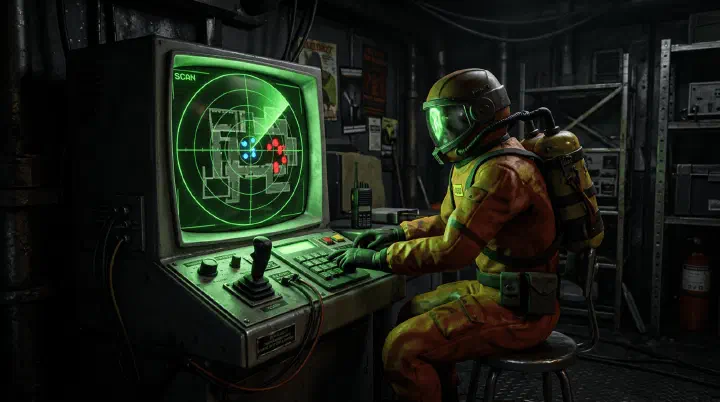
Every Lethal Company crew has someone who volunteers for ship duty. “I will stay on radar.” The rest of the crew rolls their eyes. They think the ship operator is the player who is too scared to enter the facility. Someone who will scroll their phone while the real players collect scrap. This assumption is completely backward. The ship operator is the most important role on the entire crew. A good ship operator prevents more deaths from a chair than any Shovel, any Flashlight, or any Stun Grenade ever will. A bad ship operator — or worse, no operator at all — means the crew is walking blind into every room with no idea whether a Bracken is waiting around the next corner or a Coil-Head is standing motionless in the dark.
The radar terminal displays a top-down map of the facility interior. Every crew member appears as a blue dot — you can see exactly which room each player is in, which direction they are facing, and how fast they are moving. Every enemy — Brackens, Thumpers, Coil-Heads, Jesters, Bunker Spiders, Snare Fleas, everything — appears as a red dot. Every piece of scrap appears as a yellow dot. The ship operator sees the entire map in real time, simultaneously. The players inside the facility can see roughly fifteen studs ahead of them in the dark. The operator sees everything, everywhere, all at once.
The single most important callout you will ever make as ship operator: warning a player about an enemy they cannot see yet. Here is how it plays out in real time. You watch a blue dot walking down a corridor toward a door. On your radar screen, a red dot is sitting in the room on the other side of that door. The player inside the facility has no idea. They cannot see through walls. They are about to open a door and walk directly into a Bracken. You press the walkie-talkie: “Stop. Bracken in the next room. Turn around and go through the left corridor.” The player changes direction. They never see the Bracken. They never know it was there. You just saved a life and nobody realized you did anything. If you make this callout three to four times per facility entry — and you will, because the radar shows threats constantly — you are preventing deaths that would cascade into full crew wipes.
The second most important callout is scrap direction. Yellow dots appear on radar as soon as scrap items spawn in a room. You can see which rooms have the most valuable scrap clusters before anyone enters them. You call out: “Room seven has three yellow dots — that is likely high-value scrap. Room twelve has one — probably a single tattered metal sheet worth twelve credits. Go to Room seven, skip Room twelve.” Your crew earns thirty to forty percent more scrap per facility entry because you are directing them to valuable rooms and telling them to skip dead ones. Over a three-day quota cycle, that is hundreds of extra credits that mean the difference between meeting quota comfortably and failing by thirty credits on Day 3.
The teleporter is your emergency button. It pulls a player back to the ship instantly with all their scrap intact. A teleported player keeps everything they collected. A dead player drops everything on the floor in a room that now has whatever killed them guarding the corpse. When a player’s HP drops below thirty — or when they scream “TELEPORT ME” into the walkie-talkie — you hit that button immediately. Do not wait for confirmation. Do not ask “are you sure.” Teleport on the first warning. The worst outcome is pulling someone out who was fine, which costs thirty seconds of walking back to the entrance. The alternative is not teleporting and having them die, which costs all their scrap and potentially the entire crew if someone dies trying to retrieve the body.
The terminal has commands the tutorial never teaches you. Typing view monitor cycles through each player’s first-person perspective — you see exactly what they see through their own eyes. When a player says “there is something in this room but I cannot identify it,” switch to their perspective, identify the entity by sight, and tell them what it is and how to counter it. Typing ping [player name] sends an audio cue that only that specific player can hear through their headset. One ping means “check your surroundings.” Two rapid pings means “THREAT — MOVE NOW.” This works even when their walkie-talkie battery is dead. Typing switch [player name] remotely toggles their flashlight on or off, which can save a player who is trapped in total darkness because their battery died. The terminal stores command history — press the up arrow to cycle through previous commands instead of retyping moons or store every single time.
Two identical crews were tracked over five quotas to measure the operator’s impact. Crew A had no dedicated operator — all four players entered the facility together with nobody on radar. Crew B had one player on radar full-time. Both crews were equally skilled and equally equipped. After five quotas: Crew A had lost eleven crew members, failed two quotas entirely due to full-team wipes, averaged 180 scrap per successful facility entry, and abandoned forty percent of entries early because someone died and the team panicked. Crew B had lost two crew members, failed zero quotas, averaged 310 scrap per entry — seventy-two percent more than Crew A — and abandoned zero entries. The only variable was the ship operator. Eleven deaths versus two. Eleven.
Three mistakes wipe more crews than any monster. First: leaving the terminal to help carry scrap. A crew member dies inside. The walk back is fifteen seconds. The operator thinks “I will run out and help.” They leave the terminal. During those thirty seconds off radar, a Bracken stalks a crew member two rooms away. Nobody sees it. Nobody warns them. They die. Never leave the terminal while crew members are inside the facility. Second: teleporting too late. A player says “I might need a teleport soon.” The operator waits. The player says “OK teleport me now.” The operator hits the button. The teleporter takes 1.5 seconds to activate. The Bracken kills in 1.0 seconds. The player dies mid-teleport. Teleport on the first warning, not the confirmation. Third: not counting crew members. The operator sees three blue dots and assumes everything is fine. The crew entered with four. One died five minutes ago and the operator did not notice because they were focused on scrap directions. Count blue dots every thirty seconds. Know exactly how many crew members are alive at all times. The ship operator carries no Shovel and no Flashlight. They save more lives from a chair than any item in the game. When your crew survives quota 12 and someone says “we got lucky,” the operator knows luck had nothing to do with it. They watched the radar. They made the callouts. They hit the teleporter at the right moment. Luck is what crews without an operator rely on. Your crew does not need luck.