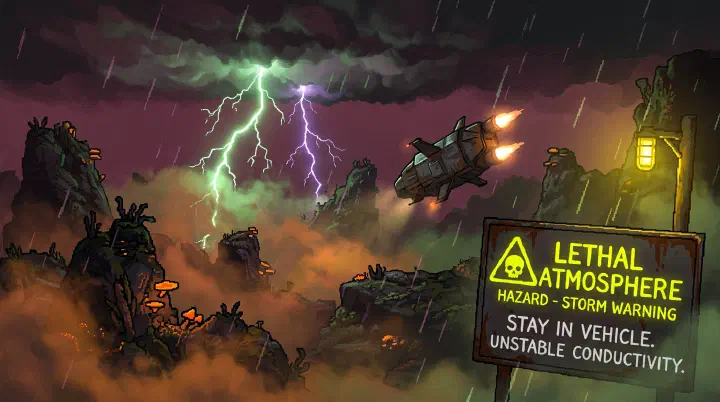
Your ship’s speaker crackles. “Titan. Eclipsed.” The words hang in the cabin air. Through the window, the moon looms — not the familiar grey-brown you know, but a dark silhouette against a corona of light. The sun is a thin ring of fire behind the planet’s edge. Below, you can already see movement. Shadows that should not be there at this hour. Forest Keepers. Multiple of them. The ship’s radar console blinks to life, showing red dots clustering around the landing pad. Your crew exchanges glances. The safe window — those precious first minutes where you can scout the exterior before enemies fully spawn — does not exist today. As the ship begins its descent, one thought crystallizes: this is going to be a very different run. The landing gear touches down. The ramp lowers. The air is cold and still. Somewhere in the distance, a Forest Keeper’s breathing echoes. Your grip tightens on the stun grenade. It is time to move.
Last updated: July 20, 2026. This guide covers every weather condition in Lethal Company including Eclipsed, Flooded, Stormy, Foggy, and Rainy. You will find detailed mechanical explanations, scrap value multipliers, enemy spawn changes, moon-specific weather probabilities, survival strategies for each condition, and how to check and interpret the weather report.
Introduction
Weather conditions in Lethal Company transform every moon into a different beast. The strategic layer of choosing where to land based on weather is as important as your equipment loadout or team composition. This guide covers every weather type — Eclipsed, Flooded, Stormy, Foggy, and Rainy — with mechanical breakdowns, scrap multipliers, enemy spawn changes, and survival strategies for each.
For general survival strategies that pair well with weather knowledge, see our Lethal Company Advanced Strategies Guide. If you need equipment recommendations for different weather conditions, the Lethal Company Equipment Guide covers what to bring.
The Weather System
How Weather Works
Weather is determined per moon at the start of each in-game day. The weather forecast can be checked in two ways:
- Terminal command: While on the ship, use the
weathercommand at the Terminal. This displays the current weather for every moon in the current rotation. - Orbit view: When orbiting a moon (after selecting it but before landing), the weather icon appears next to the moon’s name in the ship’s UI.
Weather is assigned randomly from a weighted pool. Each moon has different probabilities for each weather type. The weather for a given moon is set when the day begins and does not change until the next day, even if you land and leave multiple times.
Weather Types Overview
| Weather | Scrap Multiplier | Exterior Danger | Interior Effect | Overall Risk Level |
|---|---|---|---|---|
| Clear / None | 1.0x | None | None | None |
| Rainy | 1.0x | Low (mud/quicksand) | None | Low |
| Foggy | 1.0x | High (stealth threats) | None | Medium |
| Stormy | 1.2x | High (lightning) | None | Medium-High |
| Flooded | 1.0x | Medium (rising water) | Fire exits may flood | Medium |
| Eclipsed | 1.5x | Extreme (all outdoor enemies) | None | Extreme |
Weather Probabilities by Moon
Not all weather types can occur on all moons. Here are the approximate probabilities based on community data collection:
| Moon | Clear | Rainy | Foggy | Stormy | Flooded | Eclipsed | Notes |
|---|---|---|---|---|---|---|---|
| Experimentation | 50% | 15% | 15% | 10% | 10% | 0% | Cannot eclipse |
| Assurance | 45% | 15% | 15% | 10% | 15% | 0% | Cannot eclipse |
| Vow | 35% | 20% | 15% | 10% | 15% | 5% | Rare eclipse possible |
| Offense | 40% | 15% | 10% | 15% | 15% | 5% | Higher storm rate |
| March | 30% | 15% | 15% | 10% | 25% | 5% | Very flood-prone |
| Rend | 30% | 10% | 30% | 10% | 10% | 10% | Very foggy; rare eclipse |
| Dine | 25% | 10% | 25% | 15% | 10% | 15% | Similar to Rend |
| Titan | 20% | 5% | 20% | 20% | 10% | 25% | Highest eclipse rate |
| Adamance | 35% | 20% | 15% | 10% | 15% | 5% | Similar to Vow |
| Artifice | 15% | 5% | 15% | 25% | 10% | 30% | Highest eclipse + storm |
Key insight: Titan and Artifice have the highest Eclipse rates at 25% and 30% respectively. These are also the highest-value moons in the game. You will frequently face the decision of whether to brave an Eclipse on Titan or settle for a lower-value moon with better weather.
Eclipsed — The Deadliest Condition
What Eclipse Does
Eclipsed is the rarest and most dangerous weather condition in Lethal Company. When a moon is Eclipsed, the following changes occur:
Exterior enemy spawns: All outdoor enemy types spawn from the very start of the day. Normally, outdoor enemies only appear after a certain time has passed (roughly 30-60 minutes into the day), giving you a window of safe exterior movement. Under Eclipse, this window is eliminated. Forest Keepers, Eyeless Dogs, Old Birds, and Baboon Hawks can all spawn the moment you land.
Enemy spawn density: The spawn rate for outdoor enemies is increased by approximately 200-300% compared to daytime spawning on the same moon. Expect 2-3x the normal number of enemies on the exterior.
Scrap multiplier: 1.5x. This is the highest scrap multiplier in the game. A single piece of scrap that is normally worth 50 units becomes worth 75 under Eclipse. If your team can survive the exterior long enough to reach the interior and return, Eclipse runs are extraordinarily profitable.
Interior effects: Eclipse does not directly affect interior spawns or mechanics. Once you are inside, the dungeon plays the same as always. The danger is entirely in the exterior traversal.
Survival Strategy for Eclipsed Moons
Do not go alone. Solo Eclipse runs are suicide. You need at least two people: one to watch for threats and one to carry items, or one to create diversions.
The rush strategy:
- Land the ship as close to the Main Entrance as possible. Study the landing zone during the descent.
- All crew members exit the ship simultaneously. Do not linger on the ship ramp — Eyeless Dogs can patrol right up to the ship.
- Sprint directly to the entrance. Do not stop for exterior scrap — the interior has plenty.
- Once inside, standard interior play applies. The scrap multiplier makes every item worth more.
- On exit, use the same rush tactics. Coordinate a simultaneous sprint back to the ship.
Equipment for Eclipse runs:
- Stun Grenade (mandatory): 2 per person minimum. If a Forest Keeper spots you, a well-timed stun grenade gives you 5 seconds of sprint time.
- Shotgun (strongly recommended): 1 per person with at least 8 shells each. Shotguns can kill Baboon Hawks in 1-2 shots and can deter Forest Keepers (though killing a Keeper requires 10+ shells).
- Walkie-talkie (mandatory): Coordinate exterior movement. If one person spots an Eyeless Dog, everyone needs to know.
- Pro-flashlight (recommended): Eclipse conditions darken the exterior slightly. A flashlight helps spot enemies at range.
The radar operator: Assign one person to stay on the ship. Their job is to use the ship’s radar to track exterior enemies and call out their positions to the ground crew. The radar shows enemy icons in real time. When an Eyeless Dog wanders near the entrance path, the radar operator calls a hold. When the path is clear, they call the go. This coordination dramatically improves Eclipse survival rates.
What not to do:
- Do not try to clear exterior enemies. They respawn. Killing them is a waste of ammo and time.
- Do not split up outside. Three people bunched together can cover more angles and react faster to threats.
- Do not stay outside longer than necessary. Every second on the exterior under Eclipse is a roll of the dice.
When to Skip an Eclipse
Eclipse on Titan or Artifice is always worth attempting if your team is prepared. Eclipse on lower-value moons (Vow, March, Offense) may not be worth the risk. Consider the math:
- Titan under Eclipse: A full clear of Titan’s interior yields roughly 1,500-2,500 scrap value before multiplier. With 1.5x, that becomes 2,250-3,750. This is worth the risk.
- March under Eclipse: A full clear of March yields roughly 500-800 scrap before multiplier. With 1.5x, that is 750-1,200. This is good but not exceptional — and March has fewer fire exits, making emergency extraction harder.
If your team is inexperienced or under-equipped, skip Eclipse on moons you do not know well. The profit increase does not compensate for the near-certain death.
Flooded — The Rising Tide
What Flooded Does
When a moon is Flooded, the exterior water level rises progressively throughout the day. This affects navigation, fire exit accessibility, and movement speed.
Water level progression:
- 8 AM (arrival): Normal water level. No visible flooding.
- 9 AM: Water begins rising. Low-lying areas become wet.
- 10 AM: Water reaches ankle depth in some areas. Movement speed reduced by 10% in these zones.
- 11 AM: Water is knee-deep in low areas. Some paths become blocked.
- 12 PM (noon): Water is waist-deep in the lowest areas. The lowest fire exits may become partially submerged.
- 1 PM: Water reaches chest depth in low areas. Some fire exits become inaccessible — their doors are underwater.
- 2 PM: Peak flooding. The lowest 30-40% of the exterior map is under deep water. Fire exits in these zones cannot be used.
- 3 PM: Water begins receding slowly.
- 4 PM: Back to knee-deep in most areas.
- 5 PM: Back to near-normal levels.
Movement penalties: Moving through deep water slows you by up to 50% when the water is chest-deep. This makes escaping pursuing enemies significantly harder.
Scrap effects: Flooded conditions do not have a scrap multiplier. The economy is neutral. The challenge is entirely navigational.
Survival Strategy for Flooded Moons
Enter early, leave early. The most important rule of Flooded moons. Land at 8 AM and enter the facility immediately. Aim to be back at the ship by 11 AM at the latest. If you are still inside at 12 PM, you risk fire exits becoming inaccessible, forcing you to exit through the Main Entrance — which means traversing the entire exterior in deep water.
Plan your exit route before entering:
- Identify which fire exits are in low-lying areas. Watch for puddles and drainage patterns on the exterior.
- Mark the high-ground fire exits as primary escape routes. If a fire exit is on elevated terrain, it will remain accessible all day.
- If the Main Entrance is on low ground, it may become harder to reach as flooding progresses. Do not rely on it as your only exit.
Equipment considerations:
- Flooding does not damage equipment. You can bring any loadout.
- A walkie-talkie is useful for coordinating exit routes.
- Consider bringing less scrap per trip and making more trips. Smaller loads mean you can move faster through flood water.
- Jetpacks can bypass flooded areas entirely. If you have a jetpack, Flooded moons become much safer.
Moons most affected by Flooded:
- March: The most flood-prone moon in the game. Its exterior has many low-lying areas, and the fire exits are at ground level.
- Vow: The forest floor floods significantly. The fire exit near the pond area becomes inaccessible by noon.
- Offense: The coastal areas flood heavily. The fire exit closest to the coast is unusable after 11 AM.
Moons least affected by Flooded:
- Experimentation: Relatively flat and well-drained. Flooding is a minor inconvenience.
- Artifice: Most of the exterior is elevated. Flooding only affects the lower cargo bay areas.
Stormy — Lightning Strikes
What Stormy Does
Stormy weather brings lightning strikes to the exterior. Lightning is attracted to metal objects and elevated positions, creating a constant hazard for anyone outside the ship.
Lightning mechanics:
- Lightning strikes occur in waves. A typical wave consists of 5-8 strikes over 20-30 seconds, followed by a calm period of 45-90 seconds.
- Lightning targets the highest point in a given area. If you are holding a metal item (key, weapon, scrap), you become the highest target in your immediate vicinity.
- Lightning strikes for 100 damage — instant kill for any player at full health. There is no damage reduction. If lightning hits you, you die.
- Lightning can also strike ship equipment (the radar dish, signal transmitter) but these strikes do not damage the ship’s interior.
Scrap multiplier: 1.2x. Stormy weather provides a moderate economic incentive to offset the risk.
Outdoor enemy spawns: Stormy weather slightly reduces outdoor enemy spawn rates (roughly 20-30% reduction). Enemies seem to take cover during storms. This is a small benefit that partially offsets the lightning risk.
Survival Strategy for Stormy Moons
Drop metal items during lightning waves. The most important Stormy rule. When you see the flash or hear the static crackle that precedes a strike, drop everything metal you are holding:
- Keys (metal)
- Scrap metal items (vases, pans, cash registers, etc.)
- Weapons (shotgun, shovel, stop sign)
- Equipment (pro-flashlight is metal)
Keep walking away from the dropped items. The lightning will target the pile of metal items rather than you.
One person outside at a time. Designate one crew member to be outside during lightning waves while everyone else stays in the ship. This minimizes the chance of a party wipe. The outside person drops their metal items during strikes and retrieves them during calm periods.
Movement between strikes: During calm periods, move quickly. You have roughly 60 seconds of safe movement between lightning waves. Cover as much ground as possible during these windows.
What not to do:
- Do not run while holding scrap during a lightning wave. You are just a taller target.
- Do not group up outside. Lightning has a small AOE (roughly 2 meters). If two people stand close together and one gets struck, the other takes significant splash damage.
- Do not stand on the ship’s roof. The roof is the highest point and attracts lightning.
Equipment for Stormy moons:
- Walkie-talkie (mandatory): Call out lightning waves to your team.
- Avoid jetpacks: The jetpack makes you the highest target on the map. You will be struck almost immediately.
- Avoid the extension ladder: The ladder on the ship’s side attracts lightning if extended.
The lightning waiting game: If you are outside when a lightning wave starts and there is no cover nearby, drop all metal items, crouch (lower profile), and wait. Do not try to sprint to the ship during an active wave. The sprint will likely attract a strike.
Foggy — The Hidden Threat
What Foggy Does
Foggy weather reduces exterior visibility to approximately 10-15 meters. Beyond this range, enemies and terrain features become invisible until you are nearly on top of them.
Visibility mechanics:
- Clear day visibility: ~100 meters (unlimited for practical purposes)
- Foggy visibility: ~10-15 meters
- Objects beyond 15 meters appear as silhouettes or not at all
- The fog is thicker near the ground. Low-profile enemies (Baboon Hawks, Eyeless Dogs) are harder to spot than tall enemies (Forest Keepers).
Scrap multiplier: 1.0x. There is no economic benefit to Foggy weather.
Enemy spawns: Foggy weather does not increase enemy spawn rates directly. However, because you cannot see enemies at range, you will stumble into them more often, making the effective encounter rate feel much higher.
Interior effects: Foggy weather does not affect interior visibility. Once you are inside, you are safe from fog-related danger.
Survival Strategy for Foggy Moons
Forest Keepers are the primary threat. Forest Keepers are difficult to see in fog until you are well within their grab range (roughly 15 meters — coincidentally the same as fog visibility). By the time you see a Forest Keeper in fog, it has already seen you.
Stay in pairs. Never split up on the exterior during fog. Two people together can cover more angles, and if one person gets grabbed by a Forest Keeper, the other can stun it or provide covering fire.
Use the ship’s external camera. The camera mounted on the ship has a longer effective range than the player’s eyes in fog. The radar operator can spot threats at 30+ meters and guide ground crew around them.
Walkie-talkie coordination: Constant communication is essential. Call out every direction check: “Left clear”, “Right I see something — hold position.”
Memorize the path. On moons you visit frequently (Experimentation, Assurance), memorize the route from the ship to the Main Entrance. In fog, you cannot rely on visual landmarks, but muscle memory will carry you.
The line technique: Have one person stay at the ship while the other moves toward the entrance. The ship person calls out directions based on the stationary ship’s camera. When the moving person reaches the entrance, the roles swap. This prevents anyone from getting lost.
Moons Most Affected by Foggy
- Rend: 30% foggy rate. Rend’s Mansion interior is already dangerous, and fog makes the exterior approach treacherous. The Mansion’s entrance is also farther from the ship than most moons.
- Dine: 25% foggy rate. Similar to Rend. The open exterior gives no cover, and Forest Keepers have clear sightlines that are invisible in fog.
- Vow: The forested terrain is bad enough in clear weather. In fog, Forest Keepers blend into the tree line and become nearly undetectable.
Rainy — Mild but Tricky
What Rainy Does
Rainy is the mildest weather condition. It adds cosmetic rain effects and creates mud/quicksand patches on certain moons, but does not affect interior gameplay or scrap values.
Visibility: Slightly reduced (maybe 20-30% reduction). Not enough to be a significant hindrance.
Scrap multiplier: 1.0x. No economic benefit.
Movement effects: Mud patches form in low-lying areas on specific moons. These patches slow movement by approximately 30% while you are in them. The mud patches are visible as darker brown areas on the ground.
Moons affected by mud/quicksand during Rainy:
- March: Multiple mud patches form near the lake and along the path to the fire exit.
- Vow: Mud forms in the forest floor depressions. The path to the fire exit near the ruins becomes muddy.
- Offense: Minimal mud. Rainy on Offense is essentially cosmetic.
Survival Strategy for Rainy Moons
Rainy weather is barely a threat. The only real danger is getting caught in mud while being chased. If you know where the mud patches are (they are consistent per moon), you can avoid them.
If you are being chased: Do not run through mud patches. The speed reduction will let the pursuer catch you. Run around mud patches even if it means taking a longer path.
Equipment: Rainy weather does not require any special equipment. Play normally.
Weather Combinations
On very rare occasions, multiple weather conditions can occur simultaneously on the same moon. These are extremely rare (estimated 1-2% chance) and create truly chaotic gameplay.
Eclipsed + Stormy: The most dangerous combination possible. Eclipse brings all outdoor enemies, and Stormy brings lightning. You must manage both threats simultaneously. Strategy: use lightning waves to your advantage — the thunder masks your footsteps, and the bright flashes briefly illuminate enemies in the dark. Drop metal items during lightning, pick them up between strikes. This combination is almost certainly fatal for unprepared teams.
Eclipsed + Foggy: Forest Keepers become invisible until you are right next to them, and they are already spawned from the Eclipse. This combination has wiped many well-prepared teams. The only counter-strategy is to never leave the ship until the fog lifts — but fog can persist all day.
Flooded + Stormy: The water conducts electricity. While this is not mechanically implemented in the game (standing in water does not increase lightning damage), the combination is still dangerous because you are slowed by water and subject to lightning. The slow movement makes it harder to dodge into cover during lightning waves.
Flooded + Foggy: You cannot see the rising water’s extent, making navigation even more treacherous. You might wade into a deep area thinking it is shallow.
Failure Analysis — Common Mistakes
Overconfidence on Eclipsed Moons
The deadliest mistake in the game: landing on an Eclipsed moon and acting like you have the usual 30-minute safe window. Players stop to pick up exterior scrap, wander off alone, or take their time approaching the entrance. An Eyeless Dog or Forest Keeper that spawned at the very start catches them in the open. The fix: treat Eclipse as a speedrun. Every second outside is borrowed time. Move as a unit, sprint to the entrance, and do not stop for anything.
Ignoring the Flood Timer
Flooded moons have a predictable water schedule, but most players do not track it. They enter the facility at 10 AM, explore deep into the dungeon, and emerge at 1 PM to find their planned fire exit completely underwater. The fix: set a mental timer when you enter. If you are not heading back by 11 AM, abort and extract through the Main Entrance before it becomes unreachable.
Grouping Up During Stormy Lightning Waves
Stormy lightning has a small area-of-effect splash damage. When two players stand close together during a lightning wave, a single strike can kill or severely damage both. The fix: enforce a minimum 5-meter distance between crew members on the exterior during Stormy. One person outside at a time is the safest approach.
Over-Reliance on Radar in Foggy Weather
The radar only shows moving enemies. A stationary Forest Keeper waiting near the entrance path will not appear on radar until it moves. Players who trust radar too much walk directly into ambushes. The fix: use radar as a supplement, not a replacement, for visual scanning and audio cues. Listen for breathing and footsteps.
The “One More Scrap” Trap
Under any weather with a scrap multiplier, players get greedy. “One more piece of scrap” becomes “one more trip” becomes a wiped crew. The fix: set a hard scrap goal before landing and leave when you hit it. The profit lost by dying early far exceeds the profit from one extra piece. Discipline beats greed every time.
Weather and Moon Selection Strategy
Choosing which moon to visit based on weather is a core strategic skill in Lethal Company. Here is a decision framework:
The Weather Decision Tree
When choosing a moon, run through this mental checklist:
- What is your quota? If you need 2,000+ scrap, you need Titan or Artifice. Weather is secondary.
- What is the weather on your target moon? Eclipse is high-risk, high-reward. Stormy is moderate-risk, moderate-reward. Foggy and Flooded are risk-neutral with no payout.
- Is your team prepared? Eclipse requires stun grenades, walkie-talkies, and a radar operator. Stormy requires lightning discipline. If your team lacks the gear or experience, downgrade to a safer moon.
- What is the fallback? Always have a backup moon in mind. If you land on Titan under Eclipse and immediately regret it, knowing where to go instead saves precious in-game time.
The golden rule: a clear day on a lower-value moon is better than a wipe on a high-value moon under bad weather. Surviving to fight another day always beats dying with full pockets.
Day 1 (Starting Quota, usually ~130)
Best choice: Experimentation regardless of weather. The starter moon is always safe enough. Avoid Titan on Day 1 even if clear — you lack the equipment.
Early Quota (Days 1-3)
| Weather | Recommended Moons | Moons to Avoid |
|---|---|---|
| Clear | Any | None |
| Rainy | Any | March (mud slows scrap runs) |
| Foggy | Experimentation, Assurance | Rend, Dine, Vow |
| Stormy | Experimentation, Assurance | Titan, Artifice (too much open ground) |
| Flooded | Offense, Assurance | March, Vow |
| Eclipsed | Skip unless well-equipped | All (consider skipping) |
Mid Quota (Days 3-6)
| Weather | Recommended Moons | Moons to Avoid |
|---|---|---|
| Clear | Titan, Artifice | None |
| Stormy | Rend, Dine (1.2x multiplier helps) | Titan (too risky) |
| Flooded | Offense, Adamance | March, Vow |
| Eclipsed | Titan (if well-equipped), Artifice (if well-equipped) | Lower-value moons (not worth the risk) |
| Foggy | Offense, Assurance | Rend, Dine, Vow |
Late Quota (Days 6+, high quotas)
At this point, you cannot afford to be picky. You need Titan or Artifice value, regardless of weather. Invest in good equipment and Eclipse-proof your strategy.
Using the Radar for Weather Safety
The ship’s radar console is your best tool for weather survival. Here is how to use it effectively under each condition:
All weather types: The radar displays enemy icons in real time. Use it to track outdoor enemy positions while you are inside, so you know the safe windows for exiting.
Foggy specifically: The radar has a longer detection range than the player’s vision in fog. The radar operator can spot Forest Keepers and Eyeless Dogs at the normal detection range (50+ meters) and guide ground crew away from them. This is the single biggest safety advantage for Foggy moons.
Stormy specifically: The radar does not show lightning strike patterns, but the operator can see the flashes and warn ground crew.
Eclipsed specifically: The radar is essential for tracking the high number of outdoor enemies. With Eclipse spawning 3x the normal enemies, the radar operator’s job becomes critical. They must track multiple threats simultaneously and give precise navigation instructions.
Counter-Intuitive Tips
Stormy Weather Reduces Enemy Spawns
Stormy is not purely a negative condition. The lightning scares away outdoor enemies, reducing spawn rates by roughly 20-30%. This means Stormy weather can actually make the exterior safer than a clear day in terms of enemy threats — if you can manage the lightning. The 1.2x scrap multiplier is a bonus on top of reduced enemy density. A team that masters lightning discipline can profit more from Stormy than from a clear day on the same moon.
Eclipse Makes Interior Runs Predictable
Since Eclipse only affects the exterior, the interior plays exactly the same as always. This means you can plan your interior route with complete confidence — the dungeon layout, enemy spawns, and loot distribution are unchanged. The danger is entirely about getting in and out. Once you are inside, the run is actually more predictable than a clear day where the exterior threat level escalates over time. The trade-off is clear: extreme exterior danger for predictable interior profit.
Foggy Weather Favors Experienced Teams
Foggy weather hurts new players more than veterans. Experienced players know the terrain by muscle memory — they can navigate from the ship to the entrance without visual landmarks. For veterans, fog is a minor inconvenience. For new players who rely on sightlines, fog is a death sentence. This means Foggy weather actually widens the skill gap: if you know the moon well, Foggy is barely harder than Clear, while inexperienced teams should avoid it entirely.
Lightning Can Be Used as a Navigation Tool
During Stormy weather, lightning flashes briefly illuminate the entire exterior, including enemies that would otherwise be hidden in darkness or behind terrain. A well-timed lightning flash can reveal a Forest Keeper’s position at 50 meters — far beyond normal visibility range. Instead of fearing lightning, learn to use the flashes as free reconnaissance. The flash also masks your footsteps, making it harder for enemies to track you by sound.
Flooded Moons Build Better Habits
Flooded moons have no scrap multiplier, but they offer a hidden benefit: the rising water forces you to be efficient. Teams that play Flooded moons learn to move quickly, plan routes, and extract early. These skills carry over to clear days and make you a better player overall. A team that regularly plays Flooded moons will outperform a team that only plays clear days, because the time pressure builds better habits.
Conclusion
Weather conditions transform Lethal Company’s gameplay by adding exterior-layer challenges that complement the interior dungeon crawling. Eclipsed tests your ability to survive constant outdoor threats for a 1.5x profit multiplier. Flooded tests your time management and route planning. Stormy tests your equipment discipline and wave-timing. Foggy tests your communication and navigation skills.
The best teams learn to adapt to any weather condition. A team that can consistently handle Eclipse on Titan will out-earn a team that only plays clear days by a wide margin. Use the scrap multipliers to your advantage, invest in the right equipment for each condition, and always — always — have a radar operator watching your back.
For more on team coordination, see our Lethal Company Co-op Team Roles Guide. For moon-specific advice under different weather conditions, the Lethal Company Moon Guide has detailed breakdowns for every location.
Related Guides
- Lethal Company Moon Guide — Detailed moon-by-moon analysis for weather-impacted route planning
- Lethal Company Advanced Strategies Guide — Advanced movement, timing, and survival techniques for all conditions
- Lethal Company Equipment Guide — Gear recommendations for every weather type and situation
- Lethal Company Co-op Team Roles Guide — Effective team composition and role assignments for weather survival