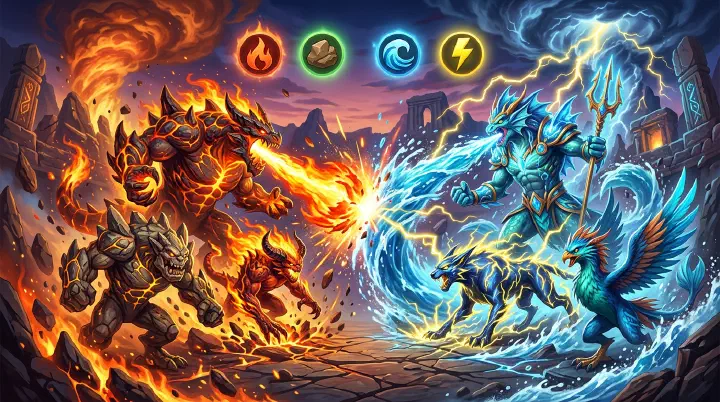
You hit auto-battle on the third arena match of the morning, confident your all-fire squad would melt through the weekend bracket. Two turns later, a single water epic named Cavenfish wiped your entire team. You stared at the defeat screen for a full minute. Your mythics were faster, higher level, and max runed. None of that mattered because every attack bounced off like a pebble hitting a tank, and Cavenfish’s water moves carved through your fire monsters like they were made of paper.
That was the moment I realized I had never actually checked the elemental type chart. I just assumed rarity solved everything. It doesn’t. Elemental advantage in Monster Legends is a flat damage multiplier that ignores your shiny borders and your gem investment. Ignore it and you will lose to teams that look weaker on paper. This guide fixes that gap. It covers how the 10-element system actually works, how to read type matchups without memorizing a wall of numbers, how dual-element monsters change the math, and how to build teams that don’t fold the second someone brings a counter.
How the Element System Actually Works
Monster Legends runs on a simple triangle-and-branch system. Fire beats Nature. Nature beats Water. Water beats Fire. That is the core triangle every player learns in the tutorial. But the game hides six more elements behind progression, and each one adds a new relationship that rewrites what “balanced” means.
Here is the full type chart in plain terms:
- Fire is strong against Nature and weak against Water
- Nature is strong against Water and weak against Fire
- Water is strong against Fire and weak against Nature
- Thunder is strong against Water and weak against Earth
- Earth is strong against Thunder and weak against Dark
- Dark is strong against Earth and weak against Light
- Light is strong against Dark and weak against Magic
- Magic is strong against Light and weak against Metal
- Metal is strong against Magic and weak against Nature
- Special has no strengths and no weaknesses against anything
Quick Reference Type Chart
Use this table as a lookup. Find your attacking element on the left, read across to see what it’s strong against (S), weak against (W), or neutral with (—).
| Attacking ↓ / Defending → | Fire | Nature | Water | Thunder | Earth | Dark | Light | Magic | Metal | Special |
|---|---|---|---|---|---|---|---|---|---|---|
| Fire | — | S | W | — | — | — | — | — | — | — |
| Nature | W | — | S | — | — | — | — | — | W | — |
| Water | S | W | — | W | — | — | — | — | — | — |
| Thunder | — | — | S | — | W | — | — | — | — | — |
| Earth | — | — | — | S | — | W | — | — | — | — |
| Dark | — | — | — | — | S | — | W | — | — | — |
| Light | — | — | — | — | — | S | — | W | — | — |
| Magic | — | — | — | — | — | W | S | — | W | — |
| Metal | — | W | — | — | — | — | — | S | — | — |
| Special | — | — | — | — | — | — | — | — | — | — |
S = Super effective (roughly 2x damage) · W = Weak (roughly 0.5x damage) · — = Neutral
If you memorize nothing else, memorize the core triangle: Fire → Nature → Water → Fire. Everything else branches from there.
When a monster uses a move that matches its own element and the target is weak to that element, the damage gets a significant boost. In practice, this usually means roughly double damage. When the target resists the element, the damage drops hard. Neutral matchups deal standard damage. There is no partial resistance. It is binary: weak, neutral, or strong.
Special element monsters throw a wrench into this because they do not care about the chart. They also do not benefit from it. A Special monster hitting a Fire target deals the same damage as hitting a Water target. That makes Special monsters predictable but safe. They are the vanilla ice cream of Monster Legends: never a bad pick, never a perfect counter.
Why Single-Element Teams Are a Trap
The most common mistake I see in arena and adventure mode is players stacking one element because they got lucky with a breed or a chest. Three fire monsters look cool. They share runes, they share books, they even share some team synergies. Then they walk into a water dungeon or a water-heavy PvP meta and evaporate.
Here is what stacking one element actually costs you. If your entire team is Fire, any Water monster on the enemy side gets free super-effective damage on all three of your monsters. You are not just weak to one slot. You are weak to the entire enemy team. Meanwhile, your attacks into that Water monster are reduced. That is a double penalty: you take more, you deal less. Rarity does not close that gap until you are talking about a massive level and rune difference, and even then, you are fighting uphill.
Another trap is ignoring dual-element monsters. When a monster has two elements, it checks weakness against both. If either element hits a weakness, the move gets the boost. If the target resists one element but not the other, the move still gets full damage through the non-resisted element. This makes dual-element attackers incredibly flexible. A Fire-Nature monster can hit Water for full Fire damage or hit Earth for full Nature damage. It is not just a stat stick. It is a coverage tool.
Dual-element defenders are trickier. They carry the weaknesses of both elements. A Fire-Water monster is weak to both Water and Nature. That sounds bad, but the flip side is that they also resist what each element resists. Fire resists Nature. Water resists Fire. A Fire-Water monster resists both. Building around dual-element defenders means accepting broader vulnerabilities in exchange for broader coverage. Most top-tier teams run at least one dual-element monster specifically to patch holes in their coverage.
Elemental Dungeons and Why Your B-Team Matters
Elemental dungeons rotate on a schedule, and each one restricts you to a specific element or gives heavy bonuses to that element. The Fire dungeon, for example, often punishes non-Fire monsters with reduced damage taken by enemies. That means your A-team of mixed elements hits like wet noodles while your benchwarmer Fire epic suddenly becomes your best carry.
I used to skip elemental dungeons until I had a full mythic squad for each element. That was a mistake. Elemental dungeons give cells, runes, and food that scale with your league. Waiting until you are “ready” means leaving resources on the table for months. The right play is building one solid monster per element as early as possible, even if that monster is only epic or legendary rarity. Level them to 100, slap basic runes on them, and clear what you can. The return on investment is immediate.
The same logic applies to the Team Wars map. Some nodes restrict elements, and some nodes give elemental buffs to defenders. If your guild only has three players with a decent Earth monster, you are losing Earth nodes by default. Depth beats height here. One mythic does not help on three nodes.
Failure Analysis: What Players Get Wrong and Why They Lose
Let me break down the three elemental mistakes I see most often, and why each one costs matches.
Mistake one: Stacking one element because you got a lucky drop.
I did this with Fire after hatching three mythic fire monsters in the same week. It felt like the game was telling me to go all-in. I climbed two arena leagues, then hit a wall of water teams and dropped back down over a single afternoon. The reason this fails is that Monster Legends matchmaking does not care about your element spread. It cares about trophies and league. A player who built a balanced water-heavy team will farm you for free points. You cannot out-stat a type disadvantage without throwing absurd resources at the problem.
Mistake two: Ignoring the enemy team’s elements before attacking.
In PvP, you get a preview screen before the match starts. Most players check rarity and rune glows. Almost nobody checks element icons. I lost a war match last month because I brought a Light attacker against an enemy whose first monster was a Dark tank with a Light weakness shield trait. My opener was supposed to one-shot. Instead, it tickled, the tank stunned me, and their Dark attacker swept my team. That loss was 100 percent preventable. I just didn’t look at the icons.
Mistake three: Treating dual-element monsters as strictly better.
Dual-element attackers are usually better. Dual-element defenders are situational. I ran a Fire-Earth tank for weeks because the stats looked great. Then I hit a Water-Nature meta in Team Wars and watched that tank get shredded by both common attacking types. Dual-element defenders expose more weaknesses. You have to pair them with teammates who cover those weaknesses, or you are just running a bigger target.
Decision Framework: Building a Balanced Elemental Team
This is the system I use now when assembling a team for any content type. It works for arena, dungeons, wars, and adventure.
Step one: Cover at least four elements across three monsters.
With three monsters, each with up to two elements, you can theoretically cover six elements. Aim for four as a minimum floor. If your team only covers two or three, you have blind spots. If your team covers five or six, you have flexibility.
Step two: No shared weaknesses across more than one monster.
If two of your three monsters are weak to Water, any Water attacker on the enemy team gets two free targets. That is too much. Ideally, none of your monsters share a weakness. Realistically, make sure no single element counters more than one slot on your team.
Step three: Build around your attacker’s coverage, not just its stats.
Your primary damage dealer should hit common defending types for super-effective damage. If the current meta is heavy on Dark tanks, run a Light or Magic attacker. If Earth is popular, run Thunder. Stats matter, but a slightly weaker attacker with type advantage will outdamage a stronger neutral attacker.
Step four: Always check the enemy preview.
Before every arena match and war node, look at the three element icons on the enemy side. If you see two monsters weak to your opener’s element, you probably have a good match. If you see your opener’s weakness twice, switch your lead. This takes five seconds and wins games.
Step five: Keep a B-team for restricted content.
Elemental dungeons and some war nodes require specific elements. Build one level-100 monster for each element, even if they are not your main squad. You do not need mythics for this. A well-runed legendary will clear 90 percent of dungeon content.
If-Then Decision Table
Use this for quick decisions before battles.
| If you see… | Then you should… | Why |
|---|---|---|
| Enemy team has 2+ Fire monsters | Lead with Water attacker | Double super-effective targets = fast kills |
| Enemy team has 2+ Water monsters | Lead with Thunder or Nature attacker | Both hit Water super-effectively |
| Enemy lead is Dark | Bring Light attacker first | Light one-shots most Dark tanks |
| Enemy lead is a tank with shield trait | Don’t use same-element opener | Shield trait reduces same-element damage |
| Your team only covers 3 elements | Swap one monster for broader coverage | 3 elements = too many blind spots |
| Dungeon is element-restricted | Build a mono-element team for it | Neutral damage is 50% less than super-effective |
| You’re facing a meta you don’t know | Run Special support monster | Special never gets countered |
| War node has element buff for defender | Attack with the counter element | The defender’s buff doesn’t matter if you one-shot it |
Counter-Intuitive Tips That Actually Work
Here is the advice that sounds wrong until you try it.
Sometimes a lower-rarity monster with the right element beats a mythic with the wrong one.
I keep a legendary Water monster at level 100 specifically to counter Fire-heavy arena teams. My mythic Fire attacker has higher base stats, better traits, and superior skills. But when I face a triple-Fire squad, that Water legendary deals double damage and takes half. The math wins. I have beaten teams with double my total power level purely because I brought a type counter they didn’t expect. Rarity is a multiplier, but element is a gate. If the gate is closed, the multiplier does not matter.
Special element monsters are underrated for consistency.
They never get countered. They never get super-effective damage either, but in a meta where everyone is building around the type chart, being immune to it has value. I run a Special support monster on my arena defense specifically because attackers cannot exploit its element. It forces the enemy to win on stats and skills alone.
Dual-element monsters with conflicting weaknesses can cover each other in a team.
A Fire-Water monster is weak to both Water and Nature. Pair it with a Nature-Thunder monster, which resists Water and Nature. Now your team’s shared weaknesses are patched. The Fire-Water monster handles Fire and Earth threats. The Nature-Thunder monster handles Water and Nature threats. Alone, each has holes. Together, they cover the board. This is how top war teams are built. Not with solo carries, but with pairs that cancel each other’s vulnerabilities.
How to Practice Elemental Mastery
You can’t read a chart and suddenly be good at elements. You need to build the habit of checking elements before every fight. Here are three drills that work.
Drill 1: The 5-Second Preview Check
For 10 straight Arena battles, pause for 5 seconds on the preview screen before starting. Look at the enemy’s element icons. Ask yourself: “What is my lead monster strong against? What is it weak to?” Then decide whether to swap your lead.
That’s it. Just 5 seconds per battle. Most players skip this entirely. After 10 battles, you’ll have the habit. After 50 battles, you’ll be able to read an enemy team in under a second.
The biggest improvement from this drill isn’t even the wins — it’s the losses you avoid. I estimate I lose 30% fewer Arena battles just from the 5-second check.
Drill 2: The Counter-Element Challenge
For one full day of play, only attack with the element that counters the enemy. If the enemy lead is Fire, use Water. If it’s Water, use Thunder. Force yourself to swap leads and think about matchups every single fight.
You will lose some battles this way. Your counter-element monster might be weaker or lower level. That’s fine. The point is to train your brain to think in terms of elements first, stats second. After a day of this, you’ll start seeing counters automatically even when you’re not trying.
Drill 3: The Mono-Element Dungeon Run
Pick one element you don’t usually use. Build a team around it — even if the monsters are benchwarmers. Then run the corresponding elemental dungeon.
This drill does two things:
- It forces you to learn the strengths and weaknesses of an element you’ve been ignoring
- It gives you a usable B-team for future dungeons and war nodes
Do this once per month for each element, and within three months you’ll have a usable monster for every element. That’s a massive advantage in Team Wars.
Frequently Asked Questions
How many elements are in Monster Legends?
There are 10 elements: Fire, Nature, Water, Thunder, Earth, Dark, Light, Magic, Metal, and Special. Each monster can have one or two elements. Dual-element monsters have more offensive coverage but also more defensive weaknesses.
What is the best elemental team composition?
A balanced team covers at least 4-5 elements across 3 monsters, with no shared weaknesses. The ideal setup is a dual-element attacker, a support with complementary coverage, and a tank that patches the remaining holes. Dual-element pairs that cancel each other’s weaknesses — like Fire-Water + Nature-Thunder — are the meta standard for Arena and Team Wars.
Does element matter more than rarity?
It depends on the gap. A Legendary with elemental advantage deals roughly double damage and takes half damage — that’s usually enough to beat a Mythic with neutral typing. But a 2+ rarity gap (Epic vs Mythic) is too big for elements to overcome. Think of it this way: element decides close fights, rarity decides blowouts.
What element is the strongest overall?
There is no single strongest element — every element has counters. That said, Dark and Light are generally considered the best offensive elements because their resistances are relatively rare. Special is the most defensive because nothing counters it. Meta teams are built around coverage and synergy, not stacking the “best” element.
How do you beat an elemental dungeon?
Use a mono-element team of the element the dungeon is weak to, with type-advantage runes and relics. For example, a Fire dungeon needs a Water team. Build one strong monster per element as early as possible — even a well-runed Epic or Legendary clears 90% of dungeon content. You don’t need Mythics to get 90% of the rewards.
What is the Special element good for?
Special element monsters deal neutral damage to everything and take neutral damage from everything. They never get countered, but they also never get super-effective damage. They’re great for Arena defense (enemies can’t exploit them) and for filling gaps in your team when you need consistent, reliable damage that won’t bounce off an unexpected counter.
More Monster Legends guides in the Related Guides section below, or visit the Monster Legends hub page for everything in one place.
Disclaimer: Elemental mechanics and type chart based on Monster Legends as of September 2026. Social Point occasionally adjusts element balance in major updates. Check the official Monster Legends socials for the latest patch notes.