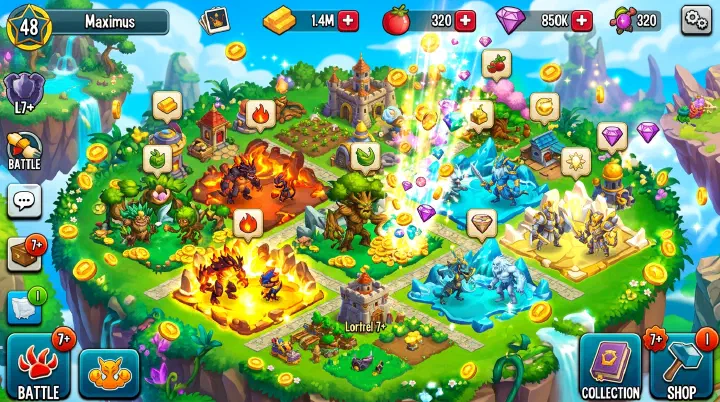
You just bred your first Mythic monster. The animation popped, the sound effect hit, and you felt that rush. Then you tapped the “Hatch” button and realized you had 340 gold in your account and a level 1 Fire habitat with two empty slots. Your new Mythic sat in the Hatchery for six hours while you scrambled to build a habitat you could not even afford. By the time you sold three extra monsters to make space, the excitement had turned into a math problem.
That moment is the gold and gem problem in Monster Legends. Everyone obsesses over the monster. Almost nobody obsesses over the wallet that feeds it.
This guide is not about which monsters to breed. It is about the two resources that actually gate your progress: gold and gems. If you fix your economy, your monster collection fixes itself.
What Players Get Wrong About Gold and Gem Farming
Most players treat gold like an afterthought. They collect it when the red notification bubble annoys them enough, then they dump it into the first thing that catches their eye. That approach works until level 25, then it collapses.
Here are the three most common failures I see:
Habitat sprawl over habitat depth. Players build six different level 1 habitats instead of two level 4 habitats. Each level 1 habitat has a tiny gold cap and slow generation. A single level 4 Nature habitat holds 50,000 gold and produces it faster than four level 1 habitats combined. Sprawl costs island space, building time, and eventually gold you do not have.
Ignoring the element match bonus. A monster placed in a habitat that matches its element generates gold at 100% efficiency. Move that same monster to an off-element habitat and the production drops by 20%. When you are running 50+ monsters, that 20% penalty is thousands of gold per hour left on the table. The fix is simple: sort your monsters by element and assign them to matching habitats. It takes five minutes and pays forever.
Gems spent on impulse. The average new player sees gems as “speed up tokens.” They burn 10 gems to finish a 3-hour hatch, then complain they cannot afford the Team Shop monster that costs 310 gems. Gems are a currency, not a convenience button. Every gem you spend on timers is a gem you do not spend on the permanent upgrades that actually change your account.
The players who hit the top of the Leaderboard are not luckier. They just run a tighter economy.
Gold Farming: The Real Production Chain
Gold is the engine. It buys food, habitats, and expansions. Without it, your monsters do not level up and your island stalls. Here is how to build a gold economy that scales.
Start With the Right Habitat Priority
Not all habitats are equal. Early game, your gold-per-habitat-space matters most because you do not have many islands unlocked yet.
Fire and Nature habitats are your best starting investments. They are cheap to build, fast to upgrade, and their monsters tend to have decent base gold generation. Dark and Magic habitats look cool but cost more and produce less per coin invested until you hit the mid-30s in player level.
Once you unlock Legendary habitats, they become the goal. A fully upgraded Legendary habitat holds 90,000 gold and houses four monsters. The catch? It costs 2.5 million gold to build. Do not rush for Legendary habitats until your existing economy can handle the hit. Save up first, build one, upgrade it fully, then build the next. Trying to build three Legendary habitats at once is how players go broke and quit.
Monster Gold Generation Matters More Than Rarity
A common myth: Mythic monsters always make the most gold. They do not. Gold generation is a hidden stat tied to each monster, not its rarity. Some Epic monsters out-earn Legendary ones.
Check your monster stats. Tap the gold icon in the monster profile. If you have a Legendary monster generating 120 gold per minute and an Epic generating 180 per minute, the Epic pays the rent. Rarity is about combat power. Gold generation is about economics. Treat them as separate systems.
The Offline Collection Trap
Monster Legends keeps producing gold while you are offline, but only up to the habitat cap. If your habitat holds 10,000 gold and you sleep for eight hours, you wake up to 10,000 gold, not eight hours of production. The excess is gone.
This is why upgrading habitats is more important than buying new monsters. A higher cap means you can sleep, work, or live your life without leaking gold. Before you log off, do a quick pass. Collect from any habitat that is near full. If you have habitats sitting at 90% capacity, that is gold evaporating into the air.
The Boost Building You Forgot About
The Maximum Security Vault boosts gold production for all habitats by 20% when upgraded. It also stores overflow gold. Most players build it once and ignore it. Do not be most players. Upgrade your Vault as high as your level allows. A 20% boost on a 50,000-gold economy is 10,000 extra gold per cycle. Over a month, that is enough gold to fund a full island expansion.
Gem Farming: Every Free Source, Ranked
Gems are the premium currency. They buy the best monsters, skip the worst grinds, and unlock the features that free players wait weeks to access. The good news: you can earn a meaningful amount without spending money. The bad news: most players ignore half the sources.
Monsterwood (The Daily Habit That Matters)
Monsterwood is the video-offer building in the corner of your island. Every few hours, it serves a batch of ads. Watch them, get 1–2 gems per batch. It sounds tiny. It is not.
A full day of Monsterwood cycles yields roughly 2 gems. Do that for 30 days and you have 60 gems. That is enough for a Team Shop monster or a critical rune upgrade. The players who say “I cannot get gems free” are usually the ones who tapped Monsterwood once, got bored, and never went back. It is a slow drip, but slow drips fill buckets.
Daily Missions and Streaks
The Daily Missions tab is easy to overlook because the rewards are small per day. But the streak bonus is where the value hides. Complete all daily missions for seven straight days and the gem payout spikes. Missing a day resets the streak to zero.
If you only have five minutes to play, do the Daily Missions first. They take under two minutes and they keep your streak alive. The gem reward at day 7 is worth more than the sum of the individual days.
Adventure Map First-Clears
Every island on the Adventure Map pays gems the first time you clear it. Early islands pay 1–3 gems. Later islands pay 10–20. The map is permanent content, so these gems never expire. If you are stuck on a hard island, it is still worth grinding the easier ones for the first-clear bonus you have not collected yet.
Many players rush the Adventure Map for the food rewards and ignore the gem payouts. Do not make that mistake. The gems are the real prize.
Events and Limited-Time Challenges
Monster Legends runs events constantly. Some are combat-focused, some are resource-focused, and almost all of them pay gems. Even if you cannot finish the full event, partial progress usually pays out at the 25% and 50% marks.
The trick is to start every event, even if you think you will fail. Open the event menu, check the milestones, and aim for the lowest gem payout. It takes five minutes and it adds up over a month. Skipping events because “I cannot win the top prize” is leaving gems on the floor.
League Promotions
The Multiplayer League pays gems for promotion. Climbing from Bronze II to Silver I pays a small gem bundle. Climbing to Gold pays more. The catch is that you need a competitive PvP team to climb consistently.
If you are stuck in a league, do not stress about it. But if you are close to a promotion threshold, it is worth spending an hour pushing your rating. The gem payout for promotion is a one-time bonus, but those one-time bonuses stack across a full season.
The Decision Framework: Where to Spend First
You have gold and gems coming in. Now what? The order you spend them determines whether you grow smoothly or hit a wall.
Use this priority list every time you log in:
- Habitat upgrades before new monsters. If your habitats are full, upgrading an existing habitat gives you more gold capacity and production. Buying a new monster when you have nowhere to put it is a waste.
- Vault upgrade before island expansion. The Vault boosts everything. Expanding the island just gives you space to build more. Build more of what? If your existing buildings are under-leveled, the new space is empty glory.
- Food production before runes. Runes are powerful, but they go on monsters that need levels. Food levels monsters. If your monsters are under-leveled, runes are a luxury.
- Gems on permanent features before timers. Spending gems on hatch speed-ups or build timers is a trap. Spend gems on the Breeding Tree upgrade, the Hatchery slot, or the Team Shop monster. Those are permanent. A timer skip is gone in five minutes.
This framework assumes you are playing for the long term. If you are a casual player who logs in twice a week, the advice shifts slightly: focus on collection and cap upgrades. You do not need the perfect team; you need an economy that does not punish your schedule.
Counter-Intuitive Advice: Sell Your Monsters
This is the one that sounds wrong. But it is the highest-impact gold trick in the game.
When you are breeding for a specific Mythic or Legendary, you generate a mountain of Epic and Rare fails. Most players keep them “just in case.” That case almost never comes. Meanwhile, those monsters are sitting in habitats you could be using for gold-generating monsters you actually care about.
Here is the move: sell the fails. You get gold back, and you free up a habitat slot. That slot goes to a monster with better gold generation or a monster you are actually leveling. The emotional attachment to a Rare monster you will never use is costing you thousands of gold per day.
The only exception is monsters with exclusive skills or breed-specific combinations. If a monster is a required parent for a future breed, keep it in the Storage Building. Everything else is inventory clutter. Sell it, build your economy, and buy the monsters you actually want later.
Daily Routine for Maximum Income
Consistency beats intensity. A 10-minute daily routine generates more resources than a 3-hour binge once a week.
Here is the routine that works:
- Collect from all habitats. Tap the “Collect All” button if you have it unlocked, otherwise do a quick pass.
- Check Monsterwood. Watch the ad batch if it is ready.
- Complete Daily Missions. Do the easy ones first (collect gold, feed a monster, win a PvP fight).
- Check the active events. Claim any milestones you have hit, and start the next tier if it is free.
- Spend your gold before logging off. If you have gold sitting in your account, it is not working. Buy food, upgrade a habitat, or save toward a Vault level. Idle gold is lazy gold.
- Collect again before bed. Make sure nothing is sitting near cap.
That is it. Ten minutes, twice a day, and your economy runs itself.
What the Game Does Not Tell You
There are a few hidden mechanics that affect your gold and gem income. Knowing them saves you from bad decisions.
Habitat capacity scales with level, but the UI does not highlight it. When you upgrade a habitat, the gold cap increases by a multiple, not an increment. A level 2 habitat does not hold “a little more” than a level 1. It often holds double. The upgrade button looks expensive, but the math favors it heavily.
Gems do not appear in the Adventure Map replay rewards. You only get gems on the first clear. Do not farm old islands expecting gem drops. Farm them for food and gold, not gems.
The daily gem cap from Monsterwood is soft, not hard. Some days you get 3 gem batches, some days you get 1. It depends on your region and ad inventory. If you see a good batch, watch it immediately. Waiting a few hours does not guarantee a better one.
Related Guides
- Monster Legends Beginner Guide
- Monster Legends Breeding Guide
- Monster Legends Farming Guide
- Monster Legends Habitats and Island Layout
- Monster Legends Island Layout Guide
- Monster Legends Runes and Relics Guide
- Monster Legends Events Guide
- Monster Legends Codes Guide
- Monster Legends Dungeon Adventure Guide
- Monster Legends Dungeon Adventure Strategy
- Monster Legends Arena PvP Guide
- Monster Legends Team Wars Guide
- Monster Legends Battle Strategy
- Monster Legends Tier List
- Monster Legends Elemental Mastery Guide
- Monster Legends Legendary Breeding Recipes
- Monster Legends Mythic Breeding Optimization Guide
- Monster Legends Mythic Breeding Fails