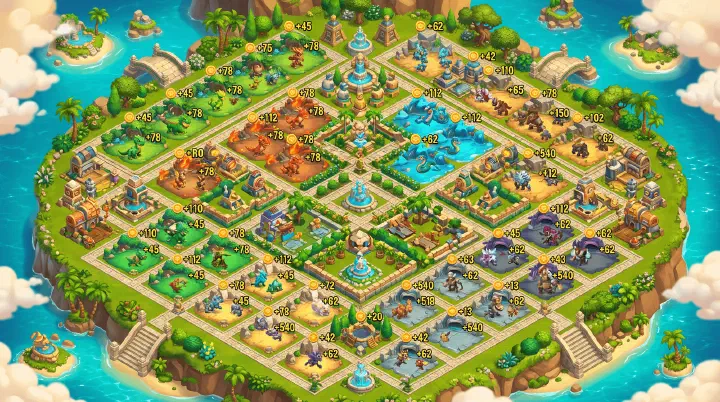
You just unlocked your fourth Legendary habitat. You tap it onto your main island, squeeze it next to two Epic habitats and a Temple, and go to bed. Next morning you open the game — and your gold total barely moved. What happened? The new habitat was too far from your Gold Farms, the Temple wasn’t matching its element, and three of your habitats capped out at 2 AM because their capacity was too small.
Habitats are the engine of your Monster Legends economy. Every gold coin you spend on upgrades, breeding, and food comes from them. A bad layout costs you millions over a month. A good one pays for itself in under a week.
This guide walks through the actual mechanics behind habitat production, how to lay out your islands for maximum gold per tile, which upgrades return their cost fastest, and the mistakes that silently drain your income.
How Habitats Actually Work (It’s Not Just “Place Monster, Get Gold”)
Every habitat in Monster Legends has three numbers that matter: gold capacity, production rate, and monster slots. The game doesn’t surface these clearly, so most players treat habitats as interchangeable boxes. They’re not.
The Production Formula
A habitat’s gold per minute is determined by three things:
- The monsters inside it — each monster has a base gold/min stat, visible on its info screen
- The habitat’s level — higher levels unlock more monster slots and increase the capacity ceiling
- Adjacency bonuses — decorations (Gold Farms, Element Temples) multiply the output of habitats within range
Here’s the formula in practice. Say you put a level 40 Legendary monster (base 120 gold/min) into a level 3 Legendary habitat. The habitat holds 3 monsters at that level. Fill it with three similar Legendaries and you get roughly 360 gold/min — about 21,600 gold per hour. Now throw a matching Element Temple (+15%) and one Gold Farm (+10%) within range, and that same habitat jumps to 450 gold/min. Over 24 hours, the difference between boosted and unboosted is over 129,000 gold. Per habitat.
Scene: You Just Unlocked Your Second Island
You buy the Dark Island for 250,000 gold. You have 4 Legendary habitats, 3 Epic, and a handful of Rares. You decide to split them — half on the main island, half on Dark.
What most players do: Move the Epics and Rares to Dark, keep Legendaries on Main. Feels logical — keep the “good” stuff on the starter island.
What actually happens: Your Legendaries are now crammed together on Main. You can only fit 2 Gold Farms around them. The Epics on Dark sit isolated — no Temples, no Farms, because you haven’t bought decorations for the new island yet. Your total gold per hour drops compared to when everything was on Main with full decoration coverage.
The fix: Don’t split habitats until you can afford decorations for the new island. A bare island with 4 habitats produces less than a crowded island with 6 habitats and full decoration coverage. The math is simple: a habitat with +25% bonus makes 125% output. Two habitats with no bonus make 100% each. You’d rather have 6 habitats at 125% (750% effective output) than 10 habitats at 100% (1000% effective output) if the 10-habitat setup costs you 3x the space and leaves no room for future Temples.
Habitat Tier Breakdown
| Habitat Tier | Max Monsters (at Lv4+) | Base Gold Capacity | Max Capacity (Lv5) | Upgrade ROI |
|---|---|---|---|---|
| Legendary | 4 | 500,000 | 2,000,000 | Fastest payoff |
| Mythic | 4 | 750,000 | 2,500,000 | Fast, if you own Mythics |
| Epic | 3 | 250,000 | 1,000,000 | Good mid-game |
| Rare | 2 | 100,000 | 500,000 | Slow, situational |
| Common | 2 | 50,000 | 200,000 | Never worth it past Lv3 |
Mythic habitats are a special case. They hold 4 monsters like Legendaries, but they produce faster — Mythic monsters have higher base gold/min stats. If you own 3-4 Mythic monsters of the same element, a Mythic habitat beats a Legendary habitat for raw output. But Mythic habitats cost more to upgrade, and Mythic monsters are harder to acquire. For most players, Legendary habitats are the bread and butter.
Island Layout: The Difference Between 200K/Day and 80K/Day
Island layout is not cosmetic. Every tile matters because:
- Movement paths — monsters walk between habitats and the Breeding Tree. If you scatter habitats across the island, collection takes longer. It adds up.
- Decoration range — Gold Farms cover 1 tile radius. Element Temples cover 2 tiles. If you place a habitat 3 tiles from a Temple, you get zero bonus. Players lose 15% output on that habitat and don’t notice for weeks.
- Expansion headroom — you will buy more habitats. If your current layout is a tight jigsaw puzzle with no gaps, every new habitat forces a full island redesign.
The Hub-and-Spoke Layout
This is the most efficient layout pattern for islands up to mid-game. Here’s how it works:
| |
- H1-H6 = Habitats (Legendary or Epic)
- GF = Gold Farm (+10% to adjacent tiles, 1-tile range)
- TM = Element Temple (+15% to matching-element habitats, 2-tile range)
In this 3×3 block, the Temple touches all 6 habitats for the +15% bonus. The two Gold Farms each touch 3 habitats (the ones above, below, and beside them). The corner habitats get +25% total. The middle-edge habitats get +15% from the Temple plus +10% from one Gold Farm — also +25%.
Six habitats, all boosted by at least +25%. That’s the benchmark.
Scene: The “Cram It Anywhere” Disaster
You’re level 25. You just bred a new Legendary and need a habitat for it. Your main island is full — 8 habitats, a Breeding Tree, a Temple, two Gold Farms, and a few random decorations from early-game quests. You have no empty 4×4 space.
You shove the new habitat into the corner of your Dark Island, far from any decorations. It sits there, alone, producing base-rate gold. You forget about it.
A week later you check your gold history. That habitat has been producing 72 gold/min instead of the 108 it would make with a Temple nearby. Over 7 days, that’s 36,288 gold you lost. Multiply by the 3 orphaned habitats most mid-game players have, and you’re bleeding over 100K gold per week.
The fix: Before you place a new habitat, walk through your islands and count how many habitats have zero decoration coverage. Those are your “dead slots.” Either move them into decoration range, or buy the decoration first — then drop the habitat.
Decorations: Buy the Temple, Not the Tree
New players love buying cosmetic decorations. The game throws them at you constantly — statues, rocks, trees, fences. They do nothing for gold.
The only decorations that matter for income:
- Gold Farm (100,000 gold) — +10% gold to adjacent habitats. Buy one per 3-4 habitats.
- Element Temple (200,000 gold) — +15% gold to matching-element habitats within 2 tiles. Buy one per element you use heavily.
- Ultra Breeding Tree (100 gems) — -20% breeding time. Not a gold booster, but a time saver that indirectly increases monster output.
Everything else is visual clutter. If you’re short on gold, sell the cosmetic decorations. Each one gives back 50% of its purchase price. A cluttered island with 10 useless statues is a gold pile you’re sitting on.
Gold Management: When to Collect, When to Upgrade, When to Save
Gold management in Monster Legends has three layers. Missing any one of them costs you efficiency.
Layer 1: Collection Timing
Habitats stop producing gold when they hit their capacity. The gold icon above the habitat turns into a coin stack — that’s your signal that production has halted.
Here’s the capacity-to-fill-time math for a Legendary habitat with 4 decent Legendary monsters:
| Habitat Level | Capacity | Approx. Fill Time | Check Frequency |
|---|---|---|---|
| Level 1 | 500,000 | ~2.5 hours | Every 2-3 hours |
| Level 2 | 750,000 | ~3.5 hours | Every 3-4 hours |
| Level 3 | 1,000,000 | ~5 hours | Every 4-5 hours |
| Level 4 | 1,500,000 | ~7 hours | Twice daily |
| Level 5 | 2,000,000 | ~10 hours | Twice daily |
If you sleep 8 hours and your habitats cap at hour 5, you lose 3 hours of production. That’s 3 hours × 6 habitats × ~360 gold/min = ~388,800 gold. Every night. The fix is simple: upgrade habitats to at least level 3 so their capacity covers your sleep window.
Scene: The “I’ll Collect Later” Trap
It’s 10 PM. You check Monster Legends. Your habitats are at ~80% capacity. You think, “I’ll collect in the morning, they won’t overflow.” You close the app.
At 2:30 AM, your level 2 Legendary habitats hit 750,000 gold and stop. They sit idle for 5.5 hours until you wake up at 8 AM. Each one lost roughly 5.5 hours of production. With 4 Legendary habitats, that’s ~475,200 gold lost in one night.
The fix: Always collect before bed, even if habitats aren’t full. The goal is to reset the timer. A half-full habitat collected at 10 PM refills to 100% around 3 AM. A 90%-full habitat collected at 10 PM refills to 100% around 12:30 AM — then sits idle for 7.5 hours. Collecting early is always better than collecting late.
Layer 2: Upgrade Priority (The Decision Framework)
You have 500,000 gold. You could:
- Option A: Upgrade one Legendary habitat from level 2 to level 3 (cost: 150,000 gold)
- Option B: Buy a Gold Farm decoration (cost: 100,000 gold)
- Option C: Save 250,000 more and buy the Dark Island
Which is right? It depends on what you already have.
Decision framework:
- If none of your habitats have decoration coverage → Buy the Gold Farm first. A +10% bonus on 4 habitats pays back its 100K cost in under 3 days.
- If your habitats are level 2 and you check the game every 3-4 hours → Upgrade to level 3. The capacity increase prevents overnight overflow. That alone saves more gold than a decoration would add.
- If you have 8+ habitats and your main island is full → Save for the next island. A new island doubles your habitat count. It’s a 500K-1M investment that pays back in 1-2 weeks.
- If your Legendary habitats are level 3 and you have 3 Legendary monsters per habitat → Upgrade to level 4. The 4th monster slot is the single biggest gold boost in the game — it adds a whole monster’s output to an existing habitat.
The common mistake: Upgrading Common or Rare habitats instead of saving for Legendary upgrades. A level 4 Common habitat costs 100K and adds 50K capacity. A level 4 Legendary habitat costs 500K and adds 500K capacity plus a monster slot. The gold-per-gold-spent ratio is 5x better on Legendary.
Layer 3: The Habitat Vault Question
The Habitat Vault automatically collects gold when habitats overflow. It sounds convenient. It costs 10% of all gold collected.
Let’s do the math on a mid-game account producing 2 million gold per day:
- Manual collection: 2,000,000 gold/day × 30 days = 60,000,000 gold/month
- Habitat Vault (10% fee): 1,800,000 gold/day × 30 days = 54,000,000 gold/month
The Vault costs you 6 million gold per month. That’s enough to upgrade 4 Legendary habitats from level 3 to level 4.
When to use the Vault: If you play once per day. The overflow gold you’d lose without the Vault is larger than the 10% fee. If you play 2+ times per day, manual collection is always better.
The Anti-Intuitive Layout Trick: Don’t Put Your Best Habitats in the Center
Conventional wisdom says: put your highest-producing habitats in the center of the island, surrounded by decorations, so they soak up all the bonuses.
Here’s why that’s wrong.
Element Temples have a 2-tile radius. Gold Farms have a 1-tile radius. If you put your best Legendary habitat dead center, it touches both decorations — great. But the habitats around it, pushed to the edges, lose decoration coverage. You optimized one habitat at the expense of five.
The better approach: Put your lowest-producing habitats in the center — the ones that benefit least from percentage bonuses. A Common habitat producing 50 gold/min gets +12.5 gold/min from a 25% bonus. A Legendary habitat producing 360 gold/min gets +90 gold/min from the same bonus. Place the Legendaries around the edges of your decoration cluster, where they still get the bonus, and put the filler habitats in the dead center slot where they’d get the bonus anyway — but you’re not losing much if they don’t.
This is called the donut layout: decorations in the center ring, high-value habitats in the middle ring, low-value habitats on the outer ring. It maximizes the gold-per-bonus-per-tile ratio.
Scene: Applying the Donut on a Crowded Island
You have 6 Legendary habitats, 2 Epic, and 2 Rare. Your main island is full. You currently have a Temple in the center, 4 Legendaries around it, and the rest scattered.
Before (center-heavy):
- 4 Legendaries get +15% from Temple = +54 gold/min each
- 2 Legendaries, 2 Epics, 2 Rares get zero bonus
- Total bonus: 216 gold/min
After (donut):
- All 6 Legendaries get +15% from Temple (placed so its 2-tile radius covers all of them)
- 2 Epics get +10% from one Gold Farm
- 2 Rares in the center, no bonus
- Total bonus: 324 gold/min from Temple + ~20 gold/min from Gold Farm = 344 gold/min
The donut layout adds 128 gold/min — that’s 184,320 extra gold per day. Just from rearranging what you already own.
Common Layout Mistakes and How to Recover
Mistake 1: The Straight Line
You line up all your habitats in a single row, left to right, across the island. It looks clean. It’s a disaster.
Why it fails: A straight line means only 2 habitats can touch a Gold Farm (one on each side). The Element Temple’s 2-tile radius covers 5 habitats at most. The rest sit in a dead zone at the ends of the row.
Recovery: Switch to a 2×3 or 3×3 grid. It takes 15 minutes to rearrange. The gold gain is immediate.
Mistake 2: Buying Habitats Before Decorations
You save up 500,000 gold. You buy a new Legendary habitat. You have no Gold Farm or Temple for it. You place it on an empty island.
Why it fails: An unboosted Legendary habitat produces base-rate gold. If you’d spent 200K on an Element Temple first, then placed the habitat next to it, the habitat would produce 15% more from day one. The 300K you saved on the habitat could have waited 2 days while the Temple boosted your existing habitats.
Recovery: Always buy the decoration first. A Temple boosts 4-6 habitats. A new habitat adds one. The Temple’s ROI is 4-6x higher.
Mistake 3: Element Mismatch
You have a Fire Temple. You place Water, Nature, and Dark habitats around it. The Temple says +15% — but it’s +15% to Fire habitats only. Your non-Fire habitats get nothing.
Why it fails: The game doesn’t warn you. The Temple looks active. The bonus text never shows a mismatch. You can go months without realizing half your habitats are unbuffed.
Recovery: Open each Temple’s info panel. It lists the element it boosts. Group matching-element habitats around that Temple. If you have 3 Fire Legendaries and 3 Nature Legendaries, buy one Temple for each element and cluster them separately.
Mistake 4: The “Save for Level 5” Trap
Level 5 habitats look amazing. They double capacity and get a visual upgrade. They also cost 1,500,000 gold each.
A mid-game player sees that price tag and starts saving. They skip level 3 and 4 upgrades on their other habitats, hoarding gold for the big level 5. Three weeks later, they have one maxed habitat and seven level 2 habitats that overflow every 3 hours.
Why it fails: One level 5 habitat produces the same as two level 3 habitats — but costs 5x more. The math: level 3 upgrade costs 150K and adds ~500K capacity. Level 5 upgrade costs 1.5M and adds 500K capacity. The gold-per-capacity ratio is 10x worse.
Recovery: Upgrade all habitats to level 3 first. Then all to level 4 (for the extra monster slot). Only push to level 5 when every habitat on your account is at least level 4.
The Early-Game Gold Roadmap (Levels 1-30)
If you’re starting fresh or on a new account, here’s the exact upgrade order that maximizes gold per day:
- Levels 1-10: Fill your starter habitats with any monsters you breed. Don’t upgrade anything yet. Collect gold every 30-60 minutes. Save everything.
- Levels 10-15: Buy your first Gold Farm (100K). Place it touching at least 3 habitats. This one decoration adds ~10% to your total income — it pays for itself in 3 days.
- Levels 15-20: Upgrade your Legendary habitats to level 2. It’s cheap (50K) and doubles capacity. Buy a second Gold Farm.
- Levels 20-25: Buy the Dark Island (250K). Move your Epic and Rare habitats there. Keep Legendaries on the Main Island with full decoration coverage. Upgrade Legendaries to level 3.
- Levels 25-30: Buy one Element Temple matching your most common Legendary monster element. Group those habitats around it. Upgrade Legendaries to level 4. Start buying the Fire Island.
This roadmap keeps your gold constantly reinvested into the highest-return upgrades. No dead time, no hoarding, no wasted spending on Common habitats or cosmetics.
Island Unlock Order: Full Cost, Level Requirements & ROI
You know what the single biggest gold decision in Monster Legends is? Not which habitat to upgrade. Not which monster to breed. It’s which island to unlock next.
An island costs anywhere from 50,000 to 10,000,000 gold. A wrong buy sets you back a week or more. A right one doubles your habitat space and pays itself back in days. Most players just unlock islands in the order they appear on the map. That works for the first three, then it stops working — because the expensive islands aren’t always the most useful ones.
The Complete Island Cost & Level List
Here’s every island with its unlock cost and the level you need to reach before it becomes available:
| Island | Unlock Cost | Level Requirement | Tiles / Space | Recommended Priority |
|---|---|---|---|---|
| Main Island | Free (starter) | 1 | Standard | #1 — you start here |
| Nature Island | 50,000 gold | 8 | Medium | #2 — cheapest, fastest ROI |
| Fire Island | 150,000 gold | 12 | Medium | #3 — still cheap, more space |
| Water Island | 500,000 gold | 18 | Medium | #4 — first “real” investment |
| Dark Island | 3,000,000 gold | 30 | Large | #5 — big jump, but worth it |
| Magic Island | 1,500,000 gold | 25 | Medium | #6 — cheaper than Dark but less useful |
| Thunder Island | 3,000,000 gold | 32 | Large | #7 — same cost as Dark, comes later |
| Earth Island | 4,000,000 gold | 34 | Large | #8 |
| Light Island | 5,000,000 gold | 35 | Large | #9 |
| Metal Island | 6,000,000 gold | 40 | Large | #10 |
| Ice Island | 6,000,000 gold | 42 | Large | #11 |
| Legendary Island | 10,000,000 gold | 50 | Extra Large | #12 — endgame only |
The Priority Question: Dark Before Magic?
Wait — Magic Island is 1.5M and unlocks at level 25. Dark Island is 3M and unlocks at level 30. Why would you skip the cheaper one and unlock Dark first?
Because space beats cost per gold. Dark Island is significantly larger — it fits more habitats, more decorations, and generates more gold once filled. Magic Island is cheaper but smaller and in an awkward shape that makes efficient layout harder. If you can afford Dark Island by level 30, it’s a better investment than Magic was at level 25.
The math: if Dark Island holds 2 more Legendary habitats than Magic, that’s roughly 400-600 gold/min extra output — about 576,000-864,000 gold per day. The 1.5M price difference between Magic and Dark gets covered in 2-3 days of full occupancy.
Exception: if you’re not filling the islands you already have, don’t buy more space. An empty island earns zero. Fill your current islands to 80%+ first, then unlock the next one.
Failure Retrospective: The Island I Bought Too Early
I unlocked Magic Island at level 25 because it was the next one on the map and 1.5M felt like a lot of gold I should “spend on something.” I moved a couple of habitats there, added a Gold Farm, and went back to my main island.
For two weeks, Magic Island sat half-empty. I was still upgrading habitats on Main and Nature. I didn’t have enough monsters to fill the new space. The 1.5M I spent on Magic would have been better used upgrading my existing habitats to level 4 — which would have added the 4th monster slot and increased gold output by 25% across the board.
The lesson: unlock an island only when you have monsters ready to fill it. The island itself produces nothing. The habitats and monsters on it do. If you buy space before you have the monsters to put in it, you’ve tied up gold in an asset that’s sitting idle.
How Long Does Each Island Take to Pay For Itself?
This is the question nobody answers, and it’s the one that matters most. Here’s the rough math for a mid-game account producing ~1M gold per day before the new island:
- Nature / Fire: 2-3 days. Cheap enough that just filling them with whatever you have pays back fast.
- Water Island: 4-6 days. The first real investment, but it doubles your usable space from 2 islands to 3.
- Dark Island: 7-10 days. Expensive, but the size means you can move all your Legendary habitats there with full decoration coverage and see a real income jump.
- Light / Earth / Thunder: 10-14 days each. By this point you’re optimizing, not accelerating.
- Metal / Ice / Legendary: 2-3 weeks+. Endgame purchases you make when you have nothing else to spend gold on.
These numbers assume you fill the island with level-3+ habitats and matching decorations within a few days. If the island sits half-empty for a week, the ROI period stretches accordingly.
The “Should I Unlock the Next Island?” Test
Before you tap that buy button, run this checklist:
- Are all habitats on your current islands at least level 3? If not, upgrade first.
- Do you have at least 2-3 monsters waiting for a new habitat? If not, breed more before you buy space.
- Do you have the decorations (Gold Farm + Temple) ready to place on the new island? If not, buy those first — they boost existing habitats too.
- Will you still have at least 500K gold in reserve after the purchase? If buying the island leaves you broke, you can’t afford the habitats to put on it.
If you answer “no” to any of the first three, don’t buy the island yet. The ROI clock doesn’t start ticking until the island is producing.
The Mid-Game Plateau (Levels 30-50): What to Unlock When
Levels 30 to 50 are where most accounts slow down. You’ve got 4-5 islands, your Legendary habitats are mostly level 3, and every new purchase costs millions. The strategy that worked early — “buy the next thing” — stops working because nothing you buy feels like a big win anymore.
Here’s how to break through it.
The Three Priorities, In Order
Priority 1: Max your Legendary habitats to level 4. The 4th monster slot is the single biggest per-habitat gold boost in the game. If you’re at level 32 and still have level-3 Legendaries, stop reading and go upgrade one. The 4th monster adds ~33% more gold production per habitat. That’s a bigger bump than any island unlock.
Priority 2: Fill Dark Island completely. Once it’s full of level-4 Legendaries with full decoration coverage, Dark Island alone can produce 30-40% of your total daily gold. Most players unlock it and then spread habitats across 5 islands. Cluster them on Dark instead — one Temple + two Gold Farms covers everything.
Priority 3: Unlock Thunder, then Earth, then Light. After Dark Island is fully optimized, start working through the expensive islands. Do them one at a time — unlock, fill, optimize, then unlock the next one. Jumping between five half-filled islands is how you stay at 1M gold/day for six months.
The Trap: Chasing Island Count
Players love posting screenshots of their 10-island bases. More islands = more progress, right? Not always.
A player with 6 fully optimized islands can easily out-produce a player with 10 half-filled islands. The 10-island player spent 30M+ gold on island unlocks. The 6-island player spent that same 30M on habitat upgrades, decorations, and monster leveling. The 6-island base produces more gold per day — even though it’s “smaller.”
Island count is a vanity metric. Gold per day is the real one.
For a deeper dive on gold farming strategies that go beyond habitats, check our Monster Legends Gold & Gem Farming Guide. If you’re still building your monster roster, the Monster Legends Farming Guide covers food production and breeding optimization.
Frequently Asked Questions (More Answers)
What’s the best island to unlock first in Monster Legends?
Nature Island. It costs only 50,000 gold, unlocks at level 8, and pays itself back in 2-3 days. After Nature, go Fire Island (150K, level 12), then Water Island (500K, level 18). The first three islands are all no-brainers — they’re cheap and you’ll fill them fast.
How many islands are there in Monster Legends?
As of 2026 there are 12 islands total, from the free starter Main Island up to the 10-million-gold Legendary Island at level 50. Most mid-game players (levels 25-40) have 4-6 islands. Endgame players (level 50+) have all 12.
Is Dark Island worth the 3 million gold?
Yes — if you already have 8+ Legendary monsters to fill it with. Dark Island’s large size lets you cluster 6+ Legendary habitats with full decoration coverage from a single Temple + two Gold Farms. If you’ve only got 3-4 Legendaries, wait on the purchase and focus on breeding more monsters first.
Should I unlock islands in the order they appear on the map?
No — at least, not after the first three. Magic Island (1.5M, level 25) looks like the logical next step after Water, but Dark Island (3M, level 30) is bigger and produces more gold once filled. If you can afford it by level 30, skip Magic temporarily and go Dark first — you can always circle back to Magic later.