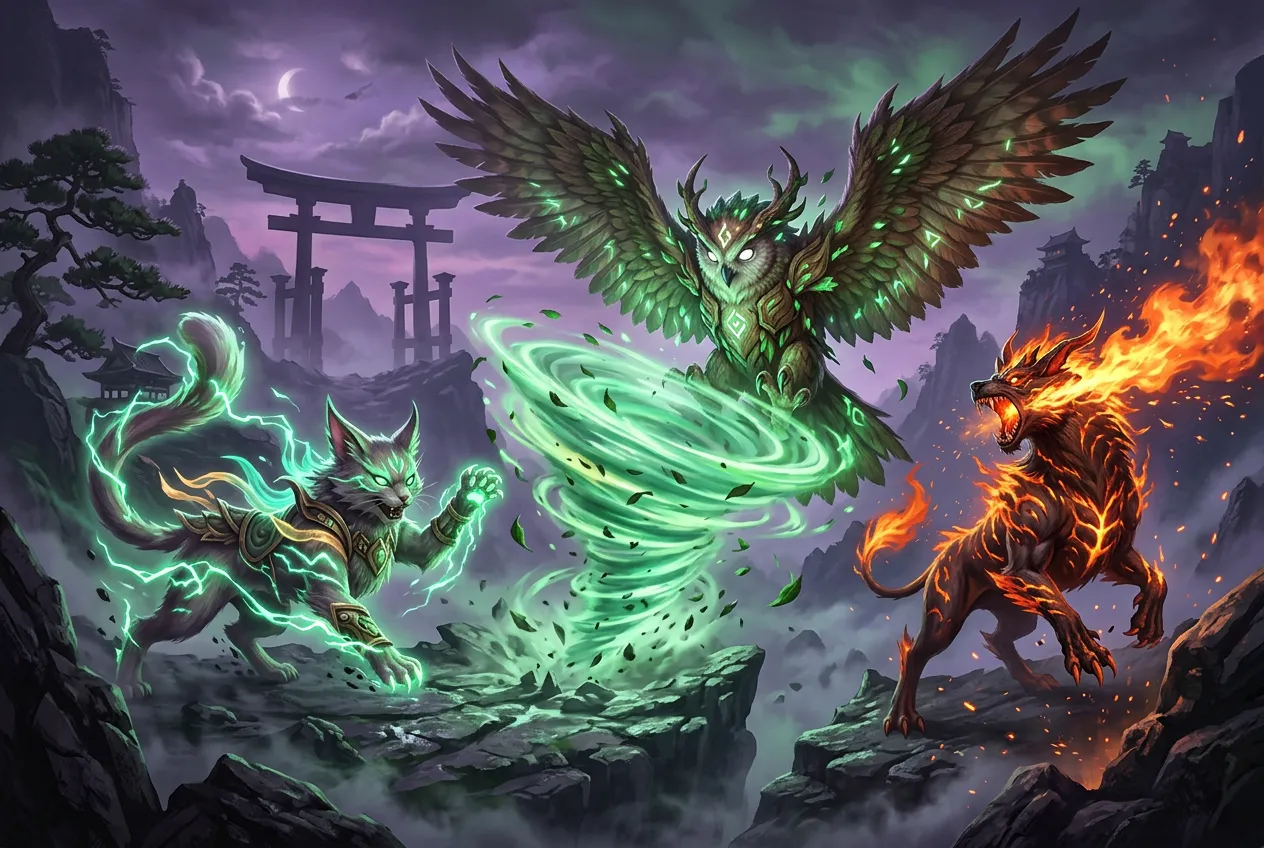
You open Monster Legends on the morning of August 13, 2026, and the home screen is different. The Nintendo Era banner is gone. In its place sits the Kitakami Era, a new Mythic cycle, and under it a timer that reads 27 days. You have a stash of gems, a pile of event tokens, and a plan that amounts to “wait and see what’s good.” Then you tap the Season 1 menu and see four new monsters sitting behind four different currencies, and “wait and see” quietly becomes “decide before September 9 or lose the window.”
That is the exact spot most players are in right now. The Kitakami Era is two days old, the info is scattered across maze events, token shops, and a new card game nobody has figured out yet, and everyone is asking the same question: which monster is worth chasing and which channel is a trap. This guide answers that. It covers how the Kitakami Era actually works, what the new Wind element changes, what all four Season 1 monsters do, how to spend your resources without wasting them, and the two non-Season monsters you should not sleep on while the era is fresh.
What the Kitakami Era Actually Is
The Kitakami Era is the next big Mythic content cycle in Monster Legends, replacing the Nintendo Era. It launched on August 13, 2026, and it works the same way past eras have: instead of one big drop, the era releases its monsters in slices called Kitakami Seasons. Each season runs 27 days and pushes out a fresh batch of high-stat Mythic monsters through a mix of event channels.
Season 1 runs August 13 to September 9. That 27-day number is the key thing to remember, because every decision below happens against a clock. Once September 9 passes, Season 1’s channels rotate out and the monsters tied to them stop being easy to get.
The era also introduces a new element, Wind, and a set of era-themed Pseudo Ancestor monsters that sit above the normal Mythic pool. Between the new element and the new rarity, the Kitakami Era is more than a reskin of the last era. It changes how you build teams, at least for the next few months.
The Wind Element: New, But Not Automatically Best
Here is the counterintuitive part that a lot of players are getting wrong on day two: the new element is not the strongest element. Wind is the 17th element in the roster, and its matchups are simple. Wind is strong against Earth and weak against Dark.
| Element | Strong Against | Weak Against |
|---|---|---|
| Wind | Earth | Dark |
That is the entire Wind chart. Wind monsters hit Earth monsters hard, and they get hit hard by Dark monsters. If you read the existing elemental mastery guide, you know Dark was already strong against Earth, so Wind slots in as another anti-Earth tool while Dark becomes the check on Wind.
The practical effect is this: Wind is a fine offensive element into Earth-heavy defenses, but it is risky in PvP because Dark attackers are everywhere. You do not stack three Wind monsters and expect to climb the arena ladder. You bring one Wind monster when you see Earth, and you keep a Dark answer ready for the mirror. New element, same rules.
Kitakami Season 1: The Four New Monsters
Season 1 dropped four new monsters, each tied to a different acquisition channel. Here is the full list so you can see the spread at a glance:
| Monster | Element | How You Get It |
|---|---|---|
| Extremely Bad Kitty | Wind | Pandalf’s Conjuring |
| Owlroot | Nature | 35 Tokens reward |
| Dogburn | Fire | 135 Tokens reward |
| Geckodepth | Water | Hall of Cards |
The important detail is that these four are not all created equal. Two of them are token rewards, one comes from a conjuring event, and one comes from a card game. That split is exactly why so many players are overspending on the wrong thing on day two.
Extremely Bad Kitty is the Wind rep of the batch, and it comes from Pandalf’s Conjuring, a limited-time summon-style event. Owlroot is a Nature monster you can buy for 35 tokens. Dogburn is a Fire monster at 135 tokens. Geckodepth is a Water monster locked behind the Hall of Cards, a new card-based event where you grind or spend to pull cards and complete a set.
Where Every Season 1 Monster Lives
Beyond the four named monsters, the Kitakami Era spreads its content across six distinct activity types. If you have played past eras, the pattern will feel familiar, but the specific assignments matter, because missing one activity means missing that monster entirely.
The free Legends Pass monster shows up in the maze. The Golden Legends Pass has its own monster behind the paid track. There is one monster in the race event, one in the Bounty Hunt, one in multiplayer, and one as an Era Shop special. That is six channels feeding the era, and the trick is knowing which channel you can actually clear with the resources you have.
Most players cannot max out all six at once. The maze and the Bounty Hunt are the grind-friendly ones. The race event rewards early clears. The multiplayer channel punishes you if your arena team is still running last era’s meta. The Era Shop special is the cleanest one, but it costs gems, so it competes with everything else you were saving for.
How to Spend Season 1 Resources: A Decision Framework
This is the part where most players burn their tokens in the first 48 hours and regret it. Here is a simple priority order for Season 1 that keeps you from wasting the two currencies that matter most: tokens and conjuring pulls.
Step one: figure out if you can hit 135 tokens by September 9. Dogburn is the strongest token pick of the season, and it is the monster most likely to hold value after the era moves on. If 135 tokens is reachable with your daily activity, save everything toward it and do not spend a single token on Owlroot yet.
Step two: only after Dogburn is secured, decide if Owlroot at 35 tokens is worth it. Owlroot is a Nature monster, and Nature is a common element with plenty of strong options already in the game. It is a fine pickup if you have spare tokens, but it is a bad first pick. Spending 35 on Owlroot early is the fastest way to end up 35 short of Dogburn when the timer runs low.
Step three: treat Pandalf’s Conjuring and the Hall of Cards as separate budgets. Extremely Bad Kitty and Geckodepth do not compete with your token pile, but they do compete with your gems. If you are free-to-play, pick one of the two to commit to rather than half-funding both and getting neither.
Step four: only touch the Era Shop special after the above. The Era Shop monster is a gem sink, and gems are the one currency that carries over to the next era. Tokens and conjuring pulls expire; gems do not.
That is the whole framework: Dogburn first, Owlroot only if spare, one of Conjuring or Hall of Cards, Era Shop last.
The Two Non-Season Monsters You Should Not Ignore
While everyone argues about the four Season 1 monsters, two other monsters dropped at the same time, and both are worth a look because they are not locked to the season clock.
Olnir is a Thunder heavy attacker that comes from the Rainbow Bridge Maze. Its kit is built around Shock. It applies Shock, carries a Shock Hater effect to hit shocked targets harder, and it has a self-sacrifice that revives its teammates. On top of that, it grants its team immunity to Tortures at the start of battle. That is a lot of utility packed into one attacker, and the Rainbow Bridge Maze is a PvE channel, which means you can grind Olnir without touching your arena rank.
Luponudo is a Quest monster and a pure support. Its Evolving Trait scales as you rank it up: at rank 0 it is immune to Blind, at rank 1 it blocks enemy revival, and at rank 3 it applies Reverse Healing to enemies. On the skill side, Luponudo can heal, cleanse, transfer its turn to an ally, and boost an ally’s damage. If you run a heavy hitter, Luponudo is the kind of support that makes that hitter win turns it should not.
Neither Olnir nor Luponudo is a Season 1 monster, so neither is on the September 9 clock the way the four Mythic drops are. That makes them the safer long-term investments while the Season 1 panic is still happening.
Where Players Are Screwing Up on Day Two
I watched a friend dump his entire token stash on Owlroot the moment the season opened, because 35 tokens was within reach and 135 felt far away. Forty-eight hours later he had Owlroot, zero tokens, and a spreadsheet showing he was not going to hit 135 before September 9. He had locked himself out of the best token monster of the season to grab a Nature monster he already had three substitutes for.
The fix is the framework above: check your reach before you spend. If you cannot hit 135 tokens no matter what, then spending on Owlroot is fine. But most players who spend early on Owlroot do it without ever doing that math, and they find out too late that Dogburn was reachable.
The second failure I keep seeing is the Wind team. Players get a Wind monster, assume the new element is a power spike, and build their whole arena defense around it. Then they queue into a Dark-heavy bracket and get farmed. Wind is weak to Dark. Dark attackers like Zombic and other meta staples are everywhere in PvP, and they do not care that your monster is the shiny new element. They care that it is weak to their element.
The recovery is the same as any element mistake: run one Wind monster as an anti-Earth answer, not three Wind monsters as a strategy. Check the tier list and the PvP guide before you commit your runes and books to the new toy.
Building a Team for the Wind Meta
The practical question is how Wind changes your lineup. For most players, the answer is small and boring, and that is the point.
Wind gives you another tool against Earth, but Earth was never the dominant defensive element. Dark is a far bigger threat in PvP, and Wind loses to Dark. So the sensible move is to treat a Wind monster as a flex slot: bring it when you scout Earth-heavy defenses, and bench it when you expect Dark.
If you want to build around Wind anyway, you need a Dark answer next to it. A Wind monster plus a Light or Magic monster covers the Wind weakness reasonably well, but remember that Light is weak to Magic and Magic is weak to Metal, so you are playing the same element chess you always were. Wind did not simplify the meta. It added one more piece.
For PvE, Wind is much safer. Dungeons and maze content skew toward scripted enemy lineups, so when the game throws Earth enemies at you, a Wind attacker is a clean answer. That is where Wind actually shines, and it is the least glamorous use of the new element, which is probably why so many players are ignoring it.
The Real Cost of Missing Season 1 Channels
The last thing to understand is that the Kitakami Era punishes hesitation harder than it punishes bad picks. The four Season 1 monsters are tied to channels that rotate out on September 9. Extremely Bad Kitty is in Pandalf’s Conjuring. Geckodepth is in the Hall of Cards. When those events close, the monsters do not move to a permanent shop at the same rate. They usually go quiet for a while.
That means the worst outcome is not spending on a mediocre monster. The worst outcome is deciding to wait, letting the season close, and finding out the monster you wanted is no longer obtainable without waiting months or paying a premium. The framework above exists precisely to keep you from ending up there: commit early to the one or two monsters you can actually reach, and get them before the timer hits zero.
Version 20.1.1 dropped on August 6, a week before the era, and it was just a minor stability fix. The Kitakami Era itself is the real content, and it is live now. Pick your targets, do the token math, and get in before September 9.