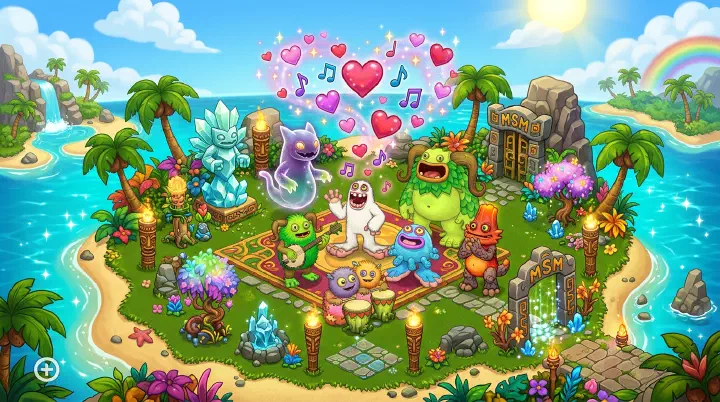
You know the feeling. You open My Singing Monsters before breakfast, tap through Plant Island, Cold Island, Air Island, Water Island, Earth Island, and somehow the total barely moves. Maybe 50,000 coins. Maybe 80,000 if you remembered to collect before bed. Your islands look busy. You have monsters everywhere. The songs are full. The castles are upgraded. So why does buying one serious structure still feel like draining your whole account?
Then you fix happiness on the right monsters.
Not every monster. Not every island. Just the Entbrats, Deedges, Riffs, Shellbeats, Quarristers, Ethereals, and high-level producers that were sitting at 25% or 50% happiness for weeks. You buy a few specific decorations instead of random pretty ones. You stop spreading coins across low-value likes. You collect the next morning and the number is different. Not slightly different. Staggering different. The island that used to hand you 50K now throws off hundreds of thousands over repeated collections, and the expensive upgrades that felt impossible suddenly become scheduled purchases.
That is the real power of happiness in My Singing Monsters. It is not cosmetic. It is not a late-game decoration hobby. It is one of the biggest coin multipliers in the game, but only if you apply it where the math actually matters.
How the Happiness System Works
Monster happiness is a production multiplier. A monster at 0% happiness earns its normal base coin rate. A monster at 100% happiness earns double that rate. The system looks friendly because it is wrapped in decorations and monster preferences, but underneath it is pure economy.
Most monsters have four likes. Each liked item or liked monster usually contributes 25% happiness, up to 100%. That means one correct like is useful, two is strong, three is excellent, and four is the full double-income setup.
The important part is this: happiness multiplies the monster you already built. A level 4 single-element monster with 100% happiness is still a weak earner. A level 15 four-element monster with 100% happiness is a machine. The same 25% bonus is not worth the same amount on every monster.
Think of happiness as a lens. Put it over a tiny coin stream and you get a slightly larger tiny stream. Put it over your best monsters and the entire island economy changes.
A simple way to read the system:
| Happiness | Production Effect | Practical Meaning |
|---|---|---|
| 0% | 1.00x | Base production only |
| 25% | 1.25x | One correct like; cheap first step |
| 50% | 1.50x | Strong for mid-game monsters |
| 75% | 1.75x | Usually enough for expensive likes |
| 100% | 2.00x | Best for top earners |
Do not obsess over making every monster perfect. Obsess over making the right monsters profitable.
Monster Likes: What You Should Actually Check
Every monster has its own liked decorations, liked monsters, or special items. The mistake is assuming that a good-looking island is an optimized island. It is not. A beautiful island can be economically terrible if the decorations do not match the monsters earning most of your coins.
Open a monster’s info panel and check its likes before buying anything. This takes a few seconds and saves thousands or millions of coins over time. If a monster likes a cheap decoration, that is usually the best first purchase. If it likes another monster already on the island, even better. You get happiness without spending extra decoration money.
Your first happiness pass should look like this:
- Pick the highest-earning monsters on the island.
- Check each monster’s likes manually.
- Buy the cheapest liked decoration that works on that island.
- Use existing liked monsters when possible.
- Stop at 50% or 75% if the next like is too expensive.
That last step matters. Players waste huge amounts of coins chasing 100% happiness on monsters that do not deserve it yet. A 75% happy Entbrat is often better than a 100% happy Mammott if your budget is limited. The goal is not clean numbers. The goal is faster payback.
For breeding and roster planning, pair this with the My Singing Monsters breeding guide. The sooner you build high-value monsters, the sooner happiness optimization becomes worth real money.
Decoration Placement: The Rule Most Players Get Wrong
Here is the relief: liked decorations do not need to sit next to the monster to count. The decoration only needs to exist on the same island. You can place it beside the monster if you like the look, but the bonus is not about physical adjacency.
This changes everything.
You do not need to ruin your island layout by surrounding every monster with a messy ring of objects. You can cluster disliked-looking but useful decorations in a corner. You can keep your song stage clean. You can build a compact “happiness warehouse” behind the castle or along the edge of the island. The monster still receives the happiness bonus as long as the correct liked item is present on that island.
That said, there are two practical placement rules:
- Keep decorations organized by island purpose. Put coin-boosting likes in one area so you can audit them quickly.
- Do not sell decorations casually. Selling one odd-looking item may drop multiple monsters by 25% happiness without you noticing.
This is why random redecorating can hurt income. You remove a tree or statue because it looks awkward, then your best monster quietly loses a quarter of its production bonus. Before selling decorations, check whether any high-value monster likes them.
Maximizing Coin Production Through Happiness
Coin optimization is not one action. It is a stack: monster rarity, monster elements, level, collection frequency, castle capacity, and happiness. Happiness is powerful because it multiplies the rest of the stack.
Start with your strongest producers:
- Four-element Natural monsters such as Entbrat, Deedge, Riff, Shellbeat, and Quarrister
- Rare and Epic versions of already valuable monsters
- Ethereals on islands where their production matters
- Legendaries and other special monsters with strong earning rates
- Any monster you have already fed to level 10 or level 15
The level point is easy to miss. A low-level monster with 100% happiness may still be weaker than a high-level monster with 50% happiness. Food and happiness should support each other. If you feed a monster heavily, check its happiness. If you make a monster 100% happy, consider whether it deserves more food.
A good mid-game island routine looks like this:
First pass: core earners
Get your best four-element monsters to 50% happiness with cheap likes. This is the fastest improvement for most accounts.
Second pass: high-level monsters
Any monster above level 10 deserves a happiness check. You have already invested food. Do not leave that investment under-multiplied.
Third pass: expensive final likes
Only chase 75% to 100% happiness when the monster earns enough to repay the decoration in a reasonable time.
Fourth pass: cosmetic completion
Once your economy is comfortable, buy decorations for looks, collection goals, or full happiness completion. Just do not pretend this is the same as optimization.
If your main issue is still daily income, read the diamond and coin farming guide after this. Happiness is one multiplier; farming habits decide how often you actually collect the multiplied coins.
Failure Analysis: Why Players Stay Poor Even With Decorations
Most bad happiness setups fail in one of five ways.
1. Buying Random Decorations
This is the classic mistake. A player unlocks decorations, buys whatever looks cool, and assumes the island is now “boosted.” It is not. Decorations only help when a monster specifically likes them. A pretty statue that no important monster likes is just a cosmetic purchase.
Cosmetics are fine. Just do not buy them with your coin-production budget.
2. Ignoring the Likes Panel
The game tells you what monsters like, but many players stop checking after the first few islands. They rely on memory, guesses, or old habits. That is how you end up with expensive items that boost a weak monster while your best earner sits at 25% happiness.
Check the panel. Every time. It is faster than recovering from a bad purchase.
3. Overspending on Low-Level Monsters
A level 3 single-element monster does not need a luxury happiness setup. It may eventually, if you are completing the island, but not while you are trying to build income. Buying three decorations for a low-level monster can delay a castle upgrade, a new island, or food production that would have paid back faster.
Early coins should create more earning power. They should not vanish into decorations that take weeks to repay.
4. Chasing 100% Too Early
The jump from 0% to 50% happiness is often cheap. The jump from 75% to 100% may be expensive. Players see an unfinished number and feel compelled to complete it. That feeling is not strategy. It is the game baiting your completionist brain.
If the final like costs too much, stop. A 75% happy high-earner is already excellent.
5. Treating Every Monster Equally
Every monster can be loved. Not every monster should be funded first. MSM economies collapse when players spread resources evenly. Your best monsters deserve priority because every happiness point on them returns more coins.
Equal treatment feels fair. Optimization is not fair.
Decision Framework: Which Monsters Deserve Happiness First?
Use this framework whenever you are about to buy a decoration.
Priority 1: High Earners You Collect Often
If a monster earns well and you collect from that island multiple times a day, happiness pays back quickly. Four-element monsters on Natural Islands usually belong here, especially if they are level 10 or higher.
Ask: “Will I collect this monster’s coins often enough for the boost to matter?”
If yes, buy the cheap likes immediately.
Priority 2: Monsters You Already Fed Heavily
Food is an investment. Happiness protects that investment. A level 15 monster at low happiness is like buying a fast car and driving it with the parking brake on.
Ask: “Have I already spent serious food here?”
If yes, fix happiness before feeding weaker monsters.
Priority 3: Rare, Epic, Ethereal, and Legendary Monsters
Special monsters often justify better happiness setups because their production ceiling is higher or because you keep them long-term. They are less likely to be replaced, so the decoration investment has more time to pay back.
Ask: “Is this monster part of my permanent island economy?”
If yes, 75% or 100% happiness is easier to justify.
Priority 4: Monsters Needed for Song or Collection Only
Some monsters are there because you like the sound, need collection progress, or want the island complete. That is valid. Just separate emotional value from coin value.
Ask: “Would I still buy this decoration if it did not complete a collection?”
If no, wait until your income is stable.
Priority 5: Low-Level Single-Element Monsters
These are the last priority for coin optimization. Give them cheap likes if the decoration also helps other monsters, but do not build a custom expensive setup around them early.
Ask: “Could these coins buy something with a better return?”
Usually, yes.
Cost-Benefit: Decorations vs Saving Coins
The right question is not “Can I afford this decoration?” The right question is “How long until this decoration pays for itself?”
A cheap decoration that adds 25% happiness to a high-level Entbrat may pay back quickly. An expensive decoration that adds the final 25% to a weak monster may take ages. The displayed happiness gain is the same. The return is not.
Use this quick mental test before buying:
- Is the monster one of my top earners on this island?
- Is the monster level 10 or higher, or will I feed it soon?
- Does the decoration help more than one important monster?
- Is this one of the cheaper likes available?
- Will buying it delay a castle upgrade, breeding structure, or important island unlock?
If the answer is yes to the first four and no to the last one, buy it. If the decoration delays a major progression upgrade, wait.
Castle upgrades and breeding progress often beat decoration spending in the early game. More beds let you place more productive monsters. Better breeding gives you stronger monsters to multiply later. Happiness becomes more valuable as your monster roster improves.
That is why the best players do not buy decorations randomly as soon as they unlock them. They build the engine first, then tune it.
Counter-Intuitive Tips That Actually Work
Sometimes 75% Happiness Is the Correct Stopping Point
This feels wrong because the game shows an unfinished bar. But the final like can be a bad purchase. If a monster’s fourth like costs a fortune and only adds 25% more production, the break-even time may be weeks or months. During that time, the same coins could upgrade a castle, buy food, or support a better monster.
Stopping at 75% is not lazy. It is often optimal.
Ugly Decoration Corners Are Efficient
Many players spread decorations around each monster because it feels natural. Since placement proximity does not matter for liked decorations, a compact corner is usually cleaner and easier to manage. It may look less immersive, but it protects your income and makes audits faster.
If you care about aesthetics, hide the utility decorations at the edge and decorate the visible stage separately.
Do Not Optimize Every New Monster Immediately
New monster does not mean new decoration budget. Place the monster, check whether it shares existing likes, then wait. If the monster becomes a serious earner or gets fed heavily, optimize it. If it stays low-level, let it sit.
This is especially important when you are expanding to new islands. New islands eat coins fast. Spending heavily on happiness before the island has real producers slows everything down.
Buy Shared Likes Before Personal Likes
A decoration liked by multiple valuable monsters is much better than a decoration liked by only one weak monster. Shared likes turn one purchase into multiple production boosts. When two purchase options look similar, choose the one that helps the most high-value monsters.
Your Best Happiness Upgrade Might Be Food
This sounds backwards, but sometimes the monster is already happy enough and simply too low-level. If a monster is at 75% happiness but only level 6, feeding it may return more than buying the fourth like. Happiness multiplies production; food raises the base that gets multiplied.
Do not separate these systems. The best coin plans use both.
A Practical Island Audit You Can Do Today
If you want a simple action plan, do this on your main Natural Island first.
- Sort your attention by income, not by island beauty.
- Tap each four-element monster and note its happiness.
- Buy the cheapest missing like for any high-earner below 50%.
- Push level 10+ monsters toward 75% if the decorations are affordable.
- Skip expensive final likes unless the monster is a permanent top earner.
- Move all utility decorations into one corner so you stop accidentally selling them.
- Collect coins for two days and compare the difference.
Do not judge the result from one collection if your monsters were not full. Judge it across a normal day of play. Happiness rewards consistent collection. The more often you empty coin storage, the more you feel the multiplier.
If you are still early and making broad progression mistakes, the beginner mistakes guide will probably save you more coins than any single decoration purchase.
FAQ
How much does 100% happiness increase coin production?
100% happiness doubles a monster’s coin production compared to 0% happiness. Each liked decoration or liked monster generally adds 25% happiness, and most monsters have four likes for a total of 100%.
Should I buy decorations for every monster?
No. Prioritize high-earning monsters first: four-element monsters, Rare and Epic monsters, Ethereals, Legendaries, and anything you have leveled heavily. Low-earning single-element monsters usually do not justify expensive decorations until your economy is already comfortable.
Do decorations need to be placed near the monster to work?
No. Liked decorations only need to exist on the same island. They do not need to be adjacent to the monster. You can cluster functional decorations in a corner and still receive the happiness bonus.