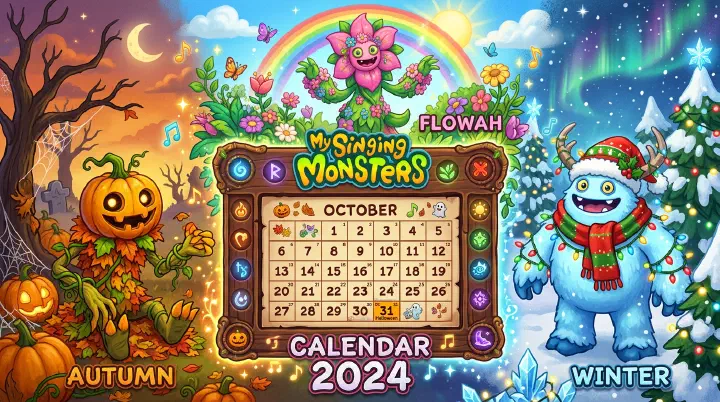
Spooktacle ends in thirty minutes. You’re frantically mashing the breed button on Plant Island, cycling through Bowgart + T-Rox. Failed. Bowgart + T-Rox. Failed again. Your breeding structure locks in for twelve hours. The event ends before the egg even hatches. You started breeding on the last day of a three-week event because you didn’t know the calendar. Meanwhile, the guy in your Discord server with four Punkletons on his island started breeding on day one and spent the rest of the event decorating.
This is the seasonal monster trap. MSM’s limited-time events run like clockwork, but players treat them like surprise pop-ups. They aren’t. Every core seasonal monster returns every year on roughly the same schedule. The players who collect them all aren’t lucky. They’re just looking at a calendar.
This guide gives you that calendar. We’ll map the full yearly event cycle, break down what to prepare before each event starts, and explain the resource economy so you stop wasting diamonds on panic speed-ups.
Why Players Keep Missing Seasonal Monsters
The failure isn’t random. Most players who miss a seasonal monster make one of three mistakes.
First, they don’t track the calendar. They log in, see Spooktacle decorations, and think “oh cool, a Halloween event.” They don’t realize it’s a three-week breeding window that started two weeks ago. By the time they start trying, they’ve got maybe five days left. With Punkleton’s roughly 10% base breeding chance, five days isn’t enough if RNG isn’t friendly.
Second, they don’t pre-build structures. Every seasonal event needs a free breeding structure and nursery. If your structures are tied up breeding a random Quad for coins, you can’t even start the seasonal attempt until that clears. That’s a twelve-hour delay you didn’t need.
Third, they burn diamonds at the wrong time. Speeding up a failed breed at 2 AM because you’re stressed is the worst value in the game. The diamond economy during events is fragile. You’ll spend forty diamonds to skip a timer on a combination that fails anyway. Meanwhile, the same forty diamonds could’ve bought the monster outright from the StarShop during the event’s final days.
Knowing the calendar fixes all of this. When you know an event is coming, you clear your structures early, save your diamonds, and start breeding on day one. That’s the whole difference.
The Full Yearly Event Calendar
MSM’s seasonal events follow a mostly fixed yearly rhythm. Here’s the cycle month by month, with the monster you’ll want, the island it lives on, and exactly what to do before and during the window.
January - Crescendo Moon
Monster: Ffidyll on Faerie Island. Combo: Cantorell + Bridg-it. Duration: Roughly three to four weeks around Lunar New Year.
Before this event, unlock Faerie Island if you haven’t already. It’s a magical island that takes some progression to reach. During the event, Ffidyll isn’t technically hard to breed, but the Cantorell + Bridg-it combo has decent odds of producing either parent instead. You’ll want both breeding structures running this combo continuously. Don’t split your focus across other islands. Ffidyll only exists on Faerie Island, so there’s no point burning tries elsewhere.
February - Season of Love
Monster: Schmoochle on Air Island. Combo: Riff + Tweedle (or T-Rox + Pango). Duration: About three weeks starting mid-February.
This is the first seasonal event most new players hit. Prep is simple: get Air Island unlocked and leveled enough to have a stable coin income. Schmoochle’s breeding combo uses common monsters, so you don’t need rare variants. The trap here is trying to breed Schmoochle on other islands. It doesn’t exist anywhere else. During the event, run both breeding structures with Riff + Tweedle. If you get Riff instead, that’s fine. Riff sells for coins and frees the nursery.
March - Cloverspell
Monster: Carillong on Magical Sanctum. Combo: Larvaluss + Frondley. Duration: Mid to late March, around three weeks.
Magical Sanctum is a late-game island. If you’re not there yet, skip this one. If you are, prep by making sure you have Larvaluss and Frondley available. The combo is relatively straightforward, but Carillong’s odds aren’t generous. Run both structures. Don’t waste time trying for the rare variant until you have the common one secured.
March/April - Eggs-Travaganza
Monster: Blabbit on Water Island. Combo: Spunge + Scups. Duration: Roughly three to four weeks around Easter.
Blabbit is one of the easier seasonal monsters to breed because Spunge and Scups are both common Water Island monsters. The prep is clearing Water Island and getting both breeding structures built. During the event, this is a great opportunity to try for the Epic variant if it’s available, but only after you’ve secured the common Blabbit. The breeding window for Epics is usually narrower.
April - Echoes of Eco
Monster: Viveine on Bone Island. Combo: Withur + Clackula. Duration: Around Earth Day, roughly three weeks.
Bone Island is another late-game magical island. Viveine is a relatively recent addition to the seasonal lineup. If you have Bone Island, the prep is the same: have the combo parents ready, clear your structures, and start on day one. The playerbase is smaller here, so there’s less community noise reminding you the event is live. Set a phone reminder.
July - SummerSong
Monster: Hoola on Air Island and Earth Island. Combo: PomPom + Pango (Air Island) or Quibble + Drumpler (Earth Island). Duration: Around three to four weeks in mid-summer.
Hoola is unique because it lives on two islands. The Air Island combo (PomPom + Pango) is usually easier because those monsters are more commonly leveled. The Earth Island combo requires Quibble, which is less of a priority for most players. If you can only pick one island, go Air Island. Before the event, make sure both islands have free breeding structures. During the event, run both Air Island structures on Hoola. Only switch to Earth Island if you already have Hoola on Air and want the duplicate for the coin boost.
September - Anniversary Month / MindBoggle
Monster: Whiz-bang on Light Island. Combo: Bulbo + Fwog. Duration: Around three weeks, usually late August into September.
Anniversary Month also brings back various seasonal monsters in the StarShop, but Whiz-bang is the new seasonal target. Light Island is accessible to mid-game players. The Bulbo + Fwog combo is simple, but Whiz-bang’s odds feel stingier than some older seasonals. Start early. Don’t assume you’ll get it in the first week.
October - Spooktacle
Monster: Punkleton on Plant Island. Combo: Bowgart + T-Rox. Duration: The full month of October, sometimes bleeding slightly into early November. Around three to four weeks.
This is the biggest seasonal event in MSM. Punkleton is iconic. Everyone wants it. The problem is “everyone wants it” means the community is loud, which makes players think they have more time than they do. You don’t. Start breeding Bowgart + T-Rox on both Plant Island structures on day one. The base odds are about 10%. That means over a three-week event, two structures running constantly will usually get you one, maybe two if you’re lucky. But if you start on day fourteen, you’re gambling.
Spooktacle also brings back the Beat Hereafter event later in the month for Clavavera on Bone Island. If you have Bone Island, that’s a second target. Clavavera uses Denchuhs + Hawlo. Don’t split your focus unless you already have Punkleton locked in.
November - Feast-Ember
Monster: Gobbleygourd on Fire Haven and Fire Oasis. Combo: Kayna + Glowl (Fire Haven) or Kayna + Boskus (Fire Oasis). Duration: Mid to late November, roughly three weeks around Thanksgiving.
Gobbleygourd is another dual-island seasonal. Fire Haven is the easier target for most players because Kayna + Glowl is simpler. Fire Oasis requires more progression. Before the event, have your Fire Haven structures ready. During the event, run both. If you secure Gobbleygourd early, you can try for the duplicate on Fire Oasis, but the coin income from Fire Haven usually makes it the better priority.
December - Festival of Yay
Monster: Yool on Cold Island. Combo: Thumpies + Congle. Duration: Mid to late December, roughly three to four weeks.
Yool is the classic “I missed it” monster because the event overlaps with holidays. People are busy. They log in less. They start breeding on December 23rd and wonder why they didn’t get Yool before the event closed. The prep is simple: don’t let real life distract you. Thumpies + Congle is an easy combo. The hard part is remembering to start breeding on day one while you’re also doing holiday stuff. Set a calendar invite. Seriously.
The Seasonal Resource Economy: How to Spend Smart
Here’s the counter-intuitive part that separates casual players from collectors.
The rarest seasonal monsters aren’t always the hardest to get. Punkleton and Yool have been around forever. Their combos are known. Their odds are fixed. The newer seasonals like Viveine or Whiz-bang often have identical or worse odds, but fewer players talk about them. Everyone obsesses over Punkleton in October. Meanwhile, the March events for Carillong or Ffidyll slip by with less community noise. If you want the full collection, the old monsters are easy because you remember them. The new ones are the real test of your calendar discipline.
Buying seasonal monsters with diamonds is sometimes smarter than breeding. This sounds like heresy, but do the math. If you’ve been breeding Punkleton for two weeks with both structures and haven’t gotten it, you’ve probably spent thirty to forty diamonds on speed-ups already. The StarShop often sells the common seasonal for 225-250 diamonds during the event’s final days. If you’re forty diamonds in and still empty-handed, buying it outright is cheaper than another week of failed breeds and panic speed-ups. Breeding is free if you have time. If you’re down to the wire, the StarShop is the safety net.
Don’t chase Rare seasonals until you have the common version. Rare seasonal variants show up for shorter windows, usually the last week or weekend of the event. Their odds are worse. If you don’t have the common seasonal yet, every Rare attempt is a gamble that could leave you with neither. Secure the common monster first. Then, if time and resources allow, try for the Rare.
Epics are for year two. Epic seasonal monsters are the hardest to breed in the entire game. Their combos are complex, their odds are brutal, and their availability windows are narrow. If you’re a newer player, ignore Epics during your first year. Focus on commons. Build your collection baseline. In year two, when you already have the common and Rare versions, then you can chase Epics without risk of missing the base monster entirely.
The Preparation Checklist (Use This Before Every Event)
Don’t rely on memory. Run this checklist three days before any seasonal event starts.
- Clear both breeding structures on the target island. If they’re running Quads or Ethereals, let them finish or sell them early. You need both slots free on day one.
- Clear the nursery. You need space for the seasonal egg immediately. A full nursery means a twelve-hour delay while you free up a bed.
- Stockpile diamonds, but don’t spend them early. You want a reserve for the final days in case RNG fails you. Spending diamonds on speed-ups in week one is a trap.
- Level the combo parents to at least level 10 if possible. Higher-level parents have slightly better breeding odds. It’s not a huge boost, but over three weeks of constant breeding, it adds up.
- Set a phone reminder for the event’s halfway point. If you don’t have the monster by day ten, you need to get serious. If you don’t have it by day fifteen, consider the StarShop.
- Check the StarShop prices on day one. Know what the buyout cost is. That way, if you’re desperate on the final day, you already know whether you can afford it.
Common Mistakes Even Experienced Players Make
- Trying to breed on the wrong island. Every seasonal is island-locked. Schmoochle is only on Air Island. Blabbit is only on Water Island. Hoola is only on Air and Earth. Don’t waste a week breeding on Plant Island for a monster that doesn’t exist there.
- Ignoring the event’s end time. MSM events usually end at a specific time of day, not at midnight. Check the in-game countdown. “Three days left” can mean three days and two hours, or three days and one minute. Don’t be the guy who breeds a twelve-hour combo with four hours left on the clock.
- Not using the mirror islands. If you have a Mirror Island unlocked, that’s a second set of breeding structures. Mirror Plant Island can run a second Punkleton attempt. Mirror Cold Island can run a second Yool. The catch is you need the combo parents on the mirror island too, so prep those in advance.
- Selling the monster for coins. Once you get a seasonal, keep it. The coin income is solid, and you can’t easily re-breed it until next year. That “I’ll just buy it back later” thought costs you a full year of waiting.
Final Thoughts
My Singing Monsters isn’t a game that punishes you for missing a seasonal. It just makes you wait eleven months. That’s worse. The yearly calendar is predictable. The monsters come back on schedule. The only variable is whether you were ready.
Stop treating seasonal events like surprises. They aren’t. Punkleton comes every October. Yool comes every December. The players with full seasonal collections didn’t do anything magical. They just started breeding on day one, kept their structures clear, and didn’t panic-spend diamonds on the final night.
Get the calendar in your head. Set your phone reminders. Clear your structures. And when the next event starts, you’ll be the one in Discord with four seasonals on your island while someone else frantically mashes Bowgart + T-Rox with thirty minutes left.