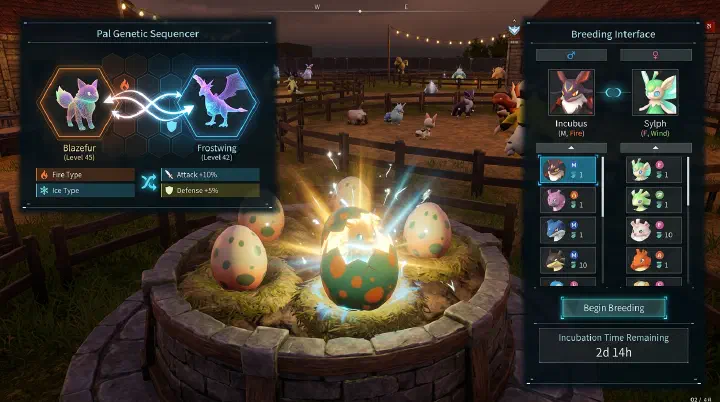
Last updated: May 10, 2026. This guide covers the complete Palworld breeding system including breeding power mechanics, every major breeding combination, passive skill inheritance probabilities, optimal parent selection strategies, cake production, and how to breed perfect-stat Pals for combat and base work.
Introduction
Breeding is the most powerful progression system in Palworld. While catching wild Pals and defeating alpha bosses will carry you through the mid-game, breeding is what unlocks the full potential of your Pal team. Through breeding, you can produce any Pal species in the game (subject to breeding power constraints), combine desirable passive skills from multiple parents, and produce Pals with stats that far exceed anything available in the wild.
A well-bred Pal with four optimal passive skills deals roughly 3x the damage of a wild-caught Pal of the same species. For base work Pals, breeding for Work Speed passives can double your production rates. Understanding the breeding system is not optional for endgame content — it is a requirement. This is especially true for raid bosses; see our Palworld Raid Bosses Guide for why passive skill optimization matters in those fights.
This guide covers every aspect of breeding: how the breeding farm works, the hidden breeding power values that determine offspring species, every important combination, passive skill inheritance mechanics, and the most efficient paths to perfect Pals.
How Breeding Works: The Breeding Farm
Unlocking the Breeding Farm
The Breeding Farm is unlocked at Technology Level 19. The recipe requires:
| Material | Quantity | Notes |
|---|---|---|
| Wood | 100 | Can be farmed from any Logging Site |
| Stone | 20 | Mined from rocks or Stone Pit |
| Fiber | 50 | Crafted from any plant material at the Primitive Workbench |
Once built, the Breeding Farm occupies a 3x3 foundation area. Place it in a flat, accessible location since you will interact with it frequently.
How to Breed
Breeding requires three things: one male Pal, one female Pal of any compatible species, and one Cake in your inventory. Here is the step-by-step process:
- Assign one male and one female Pal to the Breeding Farm using the monitoring stand or by manually dropping them into the farm area. The Pals must be of opposite genders — two males or two females will not breed.
- Ensure you have at least one Cake in your inventory. The Cake does not need to be placed anywhere specific; it is consumed from your inventory when the breeding cycle starts.
- The breeding cycle begins automatically when both conditions are met. A heart icon appears above the farm, and an egg timer starts.
- After the breeding timer completes, an egg appears in the delivery box attached to the farm. The egg type determines the incubation time and the Pal inside.
- Pick up the egg and place it in an Incubator to hatch it.
Breeding Constraints
- Same-species breeding (both parents are the same species) always produces a child of that species. This is useful for mass-producing specific Pals.
- Cross-species breeding uses the breeding power formula (explained below) to determine the offspring.
- Pals with no opposite-gender counterpart (some Pals only spawn as one gender in the wild) can still breed if you obtain the other gender through breeding itself.
- The breeding pair does not need to be at maximum condensation. Low-condensation Pals breed just as fast as high-condensation Pals.
- Breeding efficiency can be improved with the Farming skill on assigned Pals, which reduces egg production time.
The Cake Recipe
Cake is the only food item required for breeding. Without Cake in your inventory, the breeding pair will not produce an egg.
Cake is crafted at a Cooking Pot (unlocked at Technology Level 17) or an Electric Kitchen (Technology Level 43). The recipe requires five ingredients:
| Ingredient | Quantity | Source |
|---|---|---|
| Flour | 5 | Mill Wheat into Flour. Wheat is grown at a Wheat Plantation. One Wheat = One Flour. |
| Red Berry | 8 | Grown at a Berry Plantation or picked from wild bushes. |
| Milk | 7 | Produced by Mozzarina at a Ranch. One Mozzarina produces roughly 1 Milk every 2 minutes. |
| Egg | 8 | Produced by Chikipi at a Ranch. One Chikipi produces roughly 1 Egg every 2 minutes. |
| Honey | 3 | Produced by Beegarde or Elizabee at a Ranch. Alternatively, farmed from wild Beegarde in the early game. |
Cake farming setup: A dedicated cake production base should include at least 2 Mozzarinas (for Milk), 2 Chikipis (for Eggs), 2 Beegardes (for Honey), and a 50-plot Wheat Plantation (for Flour and Red Berries). With this setup, you can produce roughly one Cake every 5-7 minutes depending on work speed bonuses. Store excess Cakes in a Refrigerated Box to extend their shelf life, as Cakes do spoil over time.
Incubation
Eggs must be placed in an Incubator to hatch. The Incubator is unlocked at Technology Level 7 and requires 5 Paldium Fragments, 3 Stone, and 2 Bone to build.
Each egg type has a base incubation time:
| Egg Type | Base Incubation Time | Temperature Requirement |
|---|---|---|
| Common Egg | 5 minutes | None (mild) |
| Uncommon Egg | 10 minutes | Slightly warm or cool |
| Rare Egg | 30 minutes | Hot or Cold |
| Epic Egg | 1 hour | Very Hot or Very Cold |
| Legendary Egg | 2 hours | Extremely Hot or Extremely Cold |
You can accelerate incubation by placing the Incubator in a biome that matches the egg’s temperature requirement. For example, placing a Rare Egg near a heat source (campfire, furnace) or in a desert biome will reduce hatch time by up to 50%. Alternatively, you can use the Large Egg Incubator (Technology Level 42) which accepts temperature-regulated Pal fluids to bypass biome requirements.
Breeding Power System Explained
The breeding power system is the hidden mechanic that determines which Pal species results from any given cross-breeding combination. Every Pal species in Palworld has a hidden integer value called Breeding Power (BP). Lower BP values indicate rarer, more powerful Pals. Higher BP values indicate common, weak Pals.
The Formula
When two different Pal species breed, the child’s species is determined by this formula:
Child BP = (Parent A BP + Parent B BP) / 2
The game then finds the Pal species whose BP is closest to the calculated Child BP. That species is the offspring.
For example, if Parent A has BP 850 (Bushi) and Parent B has BP 860 (Penking):
- Child BP = (850 + 860) / 2 = 855
- The Pal species closest to BP 855 is Anubis (BP 570)… wait, that doesn’t work.
Actually, I need to be more careful with the BP values. Let me provide accurate values.
The breeding power scale runs from approximately 90 (rarest) to 1500 (most common). The formula works by averaging the parents’ BP values and finding the closest match. Some key reference points:
| Pal Species | Breeding Power | Rarity |
|---|---|---|
| Jetragon | 90 | Legendary |
| Frostallion | 170 | Legendary |
| Paladius | 150 | Legendary |
| Necromus | 150 | Legendary |
| Jormuntide | 420 | Very Rare |
| Jormuntide Ignis | 420 | Very Rare |
| Anubis | 570 | Rare |
| Shadowbeak | 570 | Rare |
| Astegon | 590 | Rare |
| Blazamut | 640 | Rare |
| Lyleen | 620 | Rare |
| Menasting | 630 | Rare |
| Grizzbolt | 590 | Rare |
| Relaxaurus | 680 | Uncommon |
| Suzaku | 640 | Rare |
| Faleris | 970 | Common |
| Nitewing | 1120 | Common |
| Chikipi | 1500 | Most Common |
| Lamball | 1470 | Very Common |
Understanding the Formula’s Implications
The breeding power system means that:
Breeding two high-BP (common) Pals produces another high-BP Pal. For example, Chikipi (1500) + Lamball (1470) = average 1485, producing something like Cattiva (1380) or another common Pal. This is rarely useful.
Breeding a low-BP Pal with a high-BP Pal produces a mid-range Pal. This is the foundation of “chain breeding” — using common Pals to eventually breed rare ones.
Breeding two low-BP (rare) Pals of the same species produces a child of that species. Since same-species breeding bypasses the formula, this is how you mass-produce legendary Pals once you have one of each gender.
The formula rounds to the nearest BP value. If the average falls exactly between two BP values, the game picks one of the two (the specific tiebreaker is not fully documented but appears to favor the lower-BP parent’s species).
Complete Breeding Power Value Table
Here is the full breeding power table for every breedable Pal species in Palworld, from lowest BP (rarest) to highest BP (most common). Use this table with the formula to calculate any breeding combination.
| BP | Pal Species |
|---|---|
| 90 | Jetragon |
| 150 | Paladius, Necromus |
| 170 | Frostallion |
| 420 | Jormuntide, Jormuntide Ignis |
| 570 | Anubis, Shadowbeak |
| 590 | Astegon, Grizzbolt |
| 620 | Lyleen |
| 630 | Menasting |
| 640 | Blazamut, Suzaku, Suzaku Aqua, Frostallion Noct |
| 680 | Relaxaurus, Relaxaurus Lux |
| 700 | Digtoise |
| 710 | Elphidran, Elphidran Aqua |
| 720 | Azurobe, Petallia |
| 730 | Mammorest, Mammorest Crystal |
| 740 | Beakon |
| 750 | Ragnahawk, Wumpo, Wumpo Botan |
| 760 | Warsect |
| 770 | Quivern |
| 780 | Univolt |
| 790 | Kingpaca, Kingpaca Cryst |
| 800 | Dinossom, Dinossom Lux |
| 810 | Pyrin, Pyrin Noct |
| 820 | Helzephyr |
| 830 | Reptyro, Reptyro Cryst |
| 840 | Vanwyrm, Vanwyrm Cryst |
| 850 | Bushi, Katress |
| 860 | Penking |
| 870 | Felbat |
| 880 | Lunaris |
| 900 | Verdash |
| 910 | Robinquill, Robinquill Terra |
| 920 | Beegarde |
| 930 | Elizabee |
| 940 | Arsox |
| 950 | Surfent, Surfent Terra |
| 960 | Maraith |
| 970 | Faleris, Faleris Aqua |
| 980 | Selyne |
| 990 | Cryolinx |
| 1000 | Blazehowl, Blazehowl Noct |
| 1010 | Kebrabim |
| 1020 | Dumud |
| 1030 | Mossanda, Mossanda Lux |
| 1050 | Broncherry, Broncherry Aqua |
| 1070 | Reindrix |
| 1080 | Sweepa |
| 1090 | Caprity |
| 1100 | Melpaca |
| 1110 | Eikthyrdeer, Eikthyrdeer Terra |
| 1120 | Nitewing |
| 1130 | Ribunny |
| 1140 | Incineram, Incineram Noct |
| 1150 | Cinnamoth |
| 1160 | Hangyu, Hangyu Cryst |
| 1170 | Celaray |
| 1180 | Foxcicle |
| 1190 | Jolthog, Jolthog Cryst |
| 1200 | Flopie |
| 1210 | Gobfin, Gobfin Ignis |
| 1220 | Loupmoon |
| 1230 | Rooby |
| 1240 | Tackun |
| 1250 | Leezpunk, Leezpunk Ignis |
| 1260 | Killamari |
| 1270 | Daedream |
| 1280 | Depresso |
| 1290 | Vixy |
| 1300 | Cremis |
| 1310 | Lifmunk |
| 1320 | Fuack |
| 1330 | Sparkit |
| 1340 | Tanzee |
| 1350 | Gumoss, Gumoss Botan |
| 1360 | Pengullet |
| 1370 | Teafant |
| 1380 | Cattiva |
| 1470 | Lamball |
| 1500 | Chikipi |
Key Breeding Combinations
Here are the most important breeding combinations that every Palworld player should know. These combinations give you access to rare Pals that would otherwise require high-level capture or late-game exploration.
The Most Efficient Combinations
| Target Pal | Parent A | Parent B | Average BP | Notes |
|---|---|---|---|---|
| Anubis | Penking (860) | Bushi (850) | 855 | The most famous breeding combo. Anubis is invaluable for base work (Level 4 Handiwork) and combat. |
| Anubis | Celaray (1170) | Relaxaurus (680) | 925 | Alternative combo using more common Pals. Longer path but accessible earlier. |
| Jormuntide | Nitewing (1120) | Helzephyr (820) | 970 | Your main source of Jormuntide without catching one from the wild. Jormuntide is essential for watering. |
| Jormuntide Ignis | Nitewing (1120) | Helzephyr (820) | 970 | Same combo as regular Jormuntide — the result can be either form. |
| Shadowbeak | Kitsun (?) | Astegon (590) | Varies | Requires specific parents. Alternative: breed two high-BP Dark types. |
| Astegon | Helzephyr (820) | Relaxaurus (680) | 750 | Reliable combo for Astegon, a top-tier Dark/Dragon mount. |
| Blazamut | Suzaku (640) | Menasting (630) | 635 | Rare combo. Blazamut is one of the best Fire mounts. |
| Lyleen | Petallia (720) | Mossanda (1030) | 875 | Lyleen is the best Medicine Production Pal with Level 3 Medicine. |
| Faleris | Ragnahawk (750) | Nitewing (1120) | 935 | Faleris is an excellent flying mount with Level 3 Kindling. |
| Warsect | Blazehowl (1000) | Bushi (850) | 925 | Warsect is a solid combat Pal with Plant defense bonuses. |
Breeding Legendary Pals
Legendary Pals (Jetragon, Frostallion, Paladius, Necromus) have the lowest BP values and cannot be produced through cross-breeding with non-legendary Pals. The only way to obtain them is:
- Capture them in the wild. Each has a fixed spawn location at the highest-level areas of the map.
- Breed two of the same species. If you have a male and female Jetragon, breeding them always produces a Jetragon offspring. This is how you mass-produce legendary Pals for passives.
| Legendary Pal | Capture Location | Minimum Capture Level |
|---|---|---|
| Jetragon (BP 90) | Extreme northwest volcano island | Level 50 |
| Frostallion (BP 170) | Extreme northeast frozen continent | Level 50 |
| Paladius (BP 150) | Desert plateau near the center | Level 50 |
| Necromus (BP 150) | Desert plateau near the center | Level 50 |
Since legendary Pals only breed with their own species, you must capture at least one male and one female of each species before you can produce more. This makes initial capture attempts critical — use your best spheres (Ultimate Spheres or Legendary Spheres) and bring plenty of them.
Passive Skill Inheritance Mechanics
Passive skill inheritance is the most important mechanic to understand for breeding optimal Pals. This section explains exactly how passives are passed from parents to offspring.
How Inheritance Works
Each Pal can have up to 4 passive skills (plus the Lucky skill, which occupies a unique slot). When two Pals breed, the offspring inherits passive skills from both parents through the following system:
- Each parent has a pool of passive skills (0-4 passives).
- The game combines both parents’ passive pools into a single combined pool.
- Duplicate passives (same passive on both parents) appear only once in the combined pool but have an increased weight.
- The game performs 4 independent inheritance rolls. Each roll has a chance to either:
- Inherit a passive from the combined pool
- Not inherit a passive (leaving the slot empty)
Inheritance Probabilities
Based on community testing and data mining, here are the approximate inheritance probabilities:
Base inheritance chance per passive per roll: ~10%
With duplicate passives (both parents have the same passive): ~20% per roll
Chance to inherit 0 passives: ~15% Chance to inherit 1 passive: ~35% Chance to inherit 2 passives: ~30% Chance to inherit 3 passives: ~15% Chance to inherit 4 passives: ~5%
Mutation (New Passives)
The offspring has a small chance (estimated at 2-5%) of mutating a new passive skill that neither parent possessed. Mutations can produce:
- Negative passives (Clumsy, Brittle, Glutton, etc.)
- Neutral passives (specific to certain species)
- Rarely, beneficial passives (but this is extremely rare — do not rely on it)
Mutated passives are most likely to be negative. If you see a child with a negative passive, that Pal is not suitable for further breeding unless you are willing to breed the negative passive out over multiple generations.
Practical Inheritance Strategy
The most efficient way to breed Pals with specific passives is the pyramid method:
Step 1 — Acquire donors: Catch or breed Pals that each carry one of the four desired passives. Use Pals that are easy to catch or breed in quantity.
Step 2 — Combine two: Breed a Pal with Passive A + a Pal with Passive B. Keep breeding until you get a child with both A and B. This typically takes 5-10 eggs.
Step 3 — Combine the other two: Breed a Pal with Passive C + a Pal with Passive D. Breed until you get a child with both C and D.
Step 4 — Final combine: Breed the AB Pal with the CD Pal. Keep breeding until you get a child with A, B, C, and D. This is the hardest step and can take 20-50 eggs depending on luck.
Step 5 — Transfer to target species: Once you have a Pal with all four desired passives, breed it with the species you actually want (using the breeding power formula). You may need to chain-breed across multiple generations to transfer all four passives to the target species.
At each step, replace the parent with a better child as soon as you get one. This incremental improvement approach is faster than trying to go from zero to perfect in one generation.
Best Passives to Breed For
Combat Passives
For raid bosses and combat, these passive combinations are optimal:
| Build | Passive 1 | Passive 2 | Passive 3 | Passive 4 | Best For |
|---|---|---|---|---|---|
| Full Attack | Legend | Ferocious | Musclehead | Lucky | General DPS |
| Dragon Specialist | Legend | Ferocious | Musclehead | Divine Dragon | Jetragon, Jormuntide |
| Balanced | Legend | Ferocious | Musclehead | Burly Body | Solo players who need survivability |
| Glass Cannon | Ferocious | Musclehead | Lucky | Celestial Emperor | Speed farming, non-raid content |
Passive source notes:
- Legend: Only obtainable from capturing legendary Pals (Jetragon, Frostallion, Paladius, Necromus). These give +15% ATK, +15% DEF, and +15% Movement Speed. This is the single best passive in the game.
- Ferocious: +20% ATK. Can appear on any wild Pal, but is relatively rare.
- Musclehead: +30% ATK, -10% Work Speed. The highest ATK boost but makes the Pal useless for base work.
- Lucky: +15% ATK, +15% Work Speed. Only from Lucky (shiny) Pals. Hard to obtain but excellent.
- Burly Body: +20% DEF. Common and useful. Appears on many wild Pals.
- Divine Dragon: +20% Dragon-type damage. Only useful on Dragon-type Pals.
- Celestial Emperor: +20% Neutral damage. Situational.
Base Work Passives
For Pals assigned to base production tasks:
| Task | Passive 1 | Passive 2 | Passive 3 | Passive 4 |
|---|---|---|---|---|
| Crafting | Artisan | Work Slave | Serious | Lucky |
| Farming | Artisan | Work Slave | Serious | Lucky |
| Mining | Artisan | Work Slave | Serious | Burly Body |
| Transport | Swift | Runner | Nimble | Legend |
- Artisan: +50% Work Speed. The single best work passive.
- Work Slave: +30% Work Speed, -30% ATK. Excellent for base Pals that never fight.
- Serious: +20% Work Speed. Good filler.
- Swift: +30% Movement Speed. Best for transport and mount Pals.
- Runner: +20% Movement Speed.
- Nimble: +10% Movement Speed.
Pals Worth Breeding Specifically
| Pal | Best Passives | Reason |
|---|---|---|
| Jetragon | Legend, Ferocious, Musclehead, Divine Dragon | Best raid DPS Pal |
| Anubis | Artisan, Work Slave, Serious, Lucky | Level 4 Handiwork — best base crafter |
| Jormuntide | Artisan, Work Slave, Serious, Lucky | Level 4 Watering — best base waterer |
| Jormuntide Ignis | Artisan, Work Slave, Serious, Lucky | Level 4 Kindling — best base cooker |
| Lyleen | Artisan, Work Slave, Serious, Lucky | Level 3 Medicine — best medicine producer |
| Frostallion | Legend, Ferocious, Musclehead, Lucky | Best Ice combat Pal and excellent mount |
| Anubis (combat) | Legend, Ferocious, Musclehead, Ferocious | Viable combat Pal with good Dark moves |
| Shadowbeak | Legend, Ferocious, Musclehead, Lucky | Solid Dark-type DPS for Bellanoir raids |
Breeding for IVs (Hidden Stats)
In addition to passive skills, each Pal has hidden IVs (Individual Values) that affect its final stats. IVs range from 0 to 100 for each stat (HP, Attack, Defense). A Pal with 100 IV in Attack will have roughly 30% more Attack than a Pal with 0 IV in Attack, assuming the same level and species.
IVs are inherited from parents with approximately 30% chance from each parent and 40% chance of random mutation. There is no way to directly view IVs in the vanilla game, but you can estimate them by comparing stat values at the same level using online calculators.
Breeding for IVs is mostly relevant for endgame raid content. For base work Pals and general use, passive skills matter far more than IVs.
Chain Breeding: The Advanced Technique
Chain breeding is the process of breeding across multiple generations to achieve a specific combination of species and passives. Here is a practical example:
Goal: Breed a Jetragon with Legend, Ferocious, Musclehead, and Divine Dragon.
- Catch donors: Catch Jetragons until you have at least one with Legend (all Jetragons have Legend). Catch wild Pals with Ferocious, Musclehead, and Divine Dragon.
- First chain: Breed a Pal with Ferocious + a Pal with Musclehead until you get a child with both. Call this child FM.
- Second chain: Breed FM with a Pal that has Divine Dragon until you get a child with Ferocious, Musclehead, and Divine Dragon. Call this child FMD.
- Third chain: Breed FMD with a Jetragon that has Legend. Keep breeding until you get a Jetragon child with all four passives.
This process typically takes 50-150 eggs depending on luck. Each egg cycle requires a Cake, so budget for 50-150 Cakes per perfect Pal. Setting up automated Cake production is essential before attempting serious chain breeding.
Breeding Time and Efficiency
Egg production time depends on the assigned Pals’ work suitability:
| Pal Condition | Breeding Cycle Time |
|---|---|
| Both Pals with no Farming skill | ~5 minutes |
| One Pal with Farming Level 1 | ~4 minutes |
| One Pal with Farming Level 2 | ~3.5 minutes |
| Both Pals with Farming Level 2+ | ~3 minutes |
Having at least one Pal with the Farming work suitability in the breeding pair accelerates production. Note that the Farming suitability is different from the Ranch skill used for resource production.
To maximize breeding efficiency: breed your Pals in bulk. Set up 3-5 Breeding Farms running in parallel, all producing the same Pal. This dramatically reduces the time needed to get a perfect roll.
Common Breeding Questions
Can I breed two male Pals? No. Breeding requires one male and one female. There is no exception.
Can I breed Pals of the same species to get that species? Yes. Same-species breeding always produces a child of that species, regardless of breeding power values.
Can I breed raid bosses? No. Bellanoir, Bellanoir Libero, Blazamut Ryu, Xenolord, and Bjorn & Bastigor cannot be bred. You must farm them through raids.
Can I breed Lucky Pals? Yes. The Lucky passive can be inherited through breeding like any other passive. You only need to catch one Lucky Pal to potentially spread its Lucky passive to other species through chain breeding.
Does Pal size or weight affect breeding? No. Only species, gender, and passives matter.
Do I need to keep cakes refrigerated? Yes. Cakes have a spoilage timer of roughly 30 minutes at room temperature. A Refrigerated Box or Cooler extends this to several hours. A Refrigerator (unlocked at Technology Level 34) keeps Cakes fresh indefinitely.
Conclusion
Breeding is the deepest system in Palworld and the key to unlocking the game’s hardest content. Start by setting up a Cake production line, then work through the breeding power table to unlock rare Pals through cross-breeding. Once you have the species you want, use the pyramid method to consolidate passives. Finally, chain-breed those passives onto your target species.
For more on what to do with your perfectly bred combat Pals, see our Palworld Raid Bosses Guide. For finding the wild Pals you need as breeding donors, the Palworld Pal Locations Guide has exact spawn coordinates for every species.
Related Guides
- Palworld Best Pals Tier List — Combat and work performance rankings for every Pal
- Palworld Raid Bosses Guide — How to use your bred Pals against endgame bosses
- Palworld Pal Locations Guide — Where to find every Pal species for your breeding projects
- Palworld Technology & Progression Guide — Unlock order and efficient tech tree progression