You’re Bleeding Gems on Enchants and the Game Never Warned You
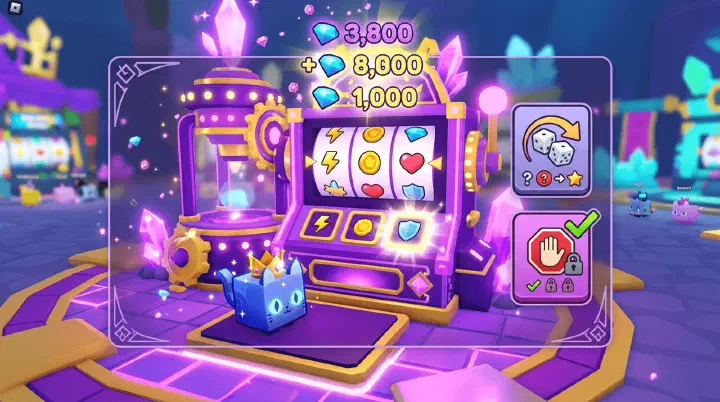
The enchantment machine sits at Area 16. It offers Criticals X, Coins V, Diamonds V, Strength X, and 20 other enchants. You put your best pet in. You click “Roll.” 5,000 Gems vanish. You get “Coins II” — +10% coins. Worthless. You roll again. “Speed I.” Worse. You roll again. 15,000 Gems gone in 30 seconds and your pet now has Coins III, which you’ll replace the moment you can afford another roll.
This is the enchantment trap. The machine is a slot machine disguised as a progression system. The difference between a player who enchants efficiently and one who enchant-gambles is roughly 500,000 Gems over a month of play. Here’s how to be the first player.
The Enchantment Math: What Each Roll Actually Costs
| Enchant Tier | Gems Per Roll | Top Enchant Roll Rate | Avg Rolls for Top Enchant | Avg Gem Cost |
|---|---|---|---|---|
| Basic (I-III) | 500-1,000 | 15-20% for level III | 5-7 | 3,500-5,000 |
| Advanced (IV-VI) | 1,500-2,500 | 8-12% for level VI | 8-12 | 18,000-24,000 |
| Expert (VII-IX) | 3,000-4,000 | 5-8% for level IX | 12-20 | 48,000-60,000 |
| Master (X only) | 5,000 | 3-5% for X | 20-33 | 100,000-165,000 |
The key insight: Master-tier enchants (Criticals X, Strength X, Coins V+) cost roughly 10x what Expert-tier equivalents cost, for roughly 2x the effect. A pet with Criticals IX (~60,000 Gems) does 90% of what Criticals X (~150,000 Gems) does. The last 10% costs 2.5x more than the first 90%.
When to Stop Rolling
This is the framework that saves you hundreds of thousands of Gems: stop rolling when the marginal cost of another upgrade exceeds what that upgrade is worth to you.
| You Currently Have | Next Target | Cost to Upgrade | Worth It? |
|---|---|---|---|
| Criticals VII | Criticals IX | ~80,000 Gems | Yes — the jump from VII to IX is noticeable |
| Criticals IX | Criticals X | ~150,000 Gems | Only if this is your main pet AND you have 300K+ Gems |
| Coins III | Coins V | ~100,000 Gems | Yes — Coins V is 2.5x better than Coins III |
| Coins V on 3 pets | Coins V on a 4th pet | ~100,000 Gems | No — 4th Coins V adds only 14% relative improvement |
The Optimal Enchantment Setup by Game Mode
Coin Farming (5 Pets)
- Pet 1: Criticals X + Coins V
- Pet 2: Criticals X + Coins V
- Pet 3: Criticals X + Coins V
- Pet 4: Criticals X + Magnet III
- Pet 5: Criticals X + Speed V
Why: 3 Coins V for +75% coins. Magnet for pickup radius. Speed for faster break speed. Criticals on all 5 because crit chance doesn’t diminish per-pet.
Clan Battle (5 Pets)
- All 5: Criticals X + Strength X (or Berserker on one pet)
Why: Clan bosses have massive HP. Raw damage is all that matters. Coin enchants are wasted here.
Event Grinding (5 Pets)
- Pet 1: Criticals X + Speed V
- Pet 2: Criticals X + Speed V
- Pet 3: Criticals X + Magnet III
- Pet 4: Criticals X + Magnet III
- Pet 5: Criticals X + Luck V
Why: Events are time-gated. Speed and pickup radius maximize rewards per minute. Luck V on one pet helps event-specific drops.
The “One More Roll” Trap
This is the enchantment equivalent of a slot machine. You’ve spent 80,000 Gems. You haven’t hit Criticals X yet. You think: “It’s due. The next roll has to be it.”
Each roll is independent. The enchant machine does not have a pity timer. After 100 failed rolls, the 101st roll still has exactly 3-5% chance. The machine doesn’t know or care how much you’ve spent.
The hard stop rule: Set a Gem budget before you start enchanting. “I will spend 150,000 Gems on this pet, then stop regardless of outcome.” Write it down. When the budget is gone, stop. You can always earn more Gems and try again tomorrow. The player who stops at their budget and tries again next week has 150,000 Gems toward the next attempt. The player who keeps rolling past their budget has zero Gems and an enchant they could have gotten for 150,000 less if they’d been luckier.
The Enchantment Priority Order by Account Age
Week 1 Account (Under 500K Total Gems Earned)
Don’t enchant anything above Expert tier. The Gems you’d spend on one Master enchant (150,000) could buy 100 Lucky Potions or fund half a Huge pet purchase in the Trading Plaza. Enchant pets to Expert tier (VII-IX) and stop. The marginal gain from Master enchants isn’t worth it until you have a stable Gem income.
Month 1 Account (2-5M Total Gems Earned)
Now you can afford Master enchants on your 3 best pets. Prioritize Criticals X on all 3, then Coins V on 2, then Speed V on 1. This setup maximizes your farming efficiency for the next stage of progression.
Endgame Account (10M+ Total Gems Earned)
Full Master enchants on all 5 main pets. At this stage, the Gem cost is a fraction of your total earnings and the efficiency gain compounds over hundreds of hours of farming. The difference between an Expert-enchanted team and a Master-enchanted team over 100 hours of gameplay is approximately 15-20% more total resources — millions of additional Gems and coins. The enchant investment that seemed expensive at Month 1 has paid for itself 10x over by Month 3.
Enchantment Transfer: When to Move an Enchant to a New Pet
You have Criticals X on a Huge Hell Rock. You just hatched a Huge Robot with better base stats. Should you move the enchant?
Transferring an enchant destroys the source pet. You lose the pet AND the enchant on it. The new pet gets the enchant. This is only worth it if the new pet is a permanent upgrade — you’ll use it for the next 100+ hours of gameplay. Transferring Criticals X from a 20M Huge to a 30M Huge is marginal. Transferring from any Huge to a Titanic is always worth it.
The transfer rule: Only transfer if the target pet is at least 2x the value of the source pet AND you’ll use the target as your main pet for the foreseeable future. Otherwise, keep the enchant where it is and save Gems to enchant the new pet separately.
Related Guides
- PS99 Beginner Guide — Worlds, Pets & First Huge
- PS99 Best Pets Guide — Meta Pets Ranked
- PS99 Team Compositions — Best Builds for Every Mode
- PS99 Rebirth Math — When Each Rebirth Is Worth It
The Bottom Line
Everything in this guide comes down to one principle: the game rewards preparation, not reaction. The players who clear consistently aren’t faster. They’ve already made tomorrow’s decisions today. They know which room has the nearest closet before Rush screams. They know the rebirth costs before the button appears. They know where to place the tower before the wave starts. Preparation looks like luck to the unprepared. It’s not luck. It’s protocol.