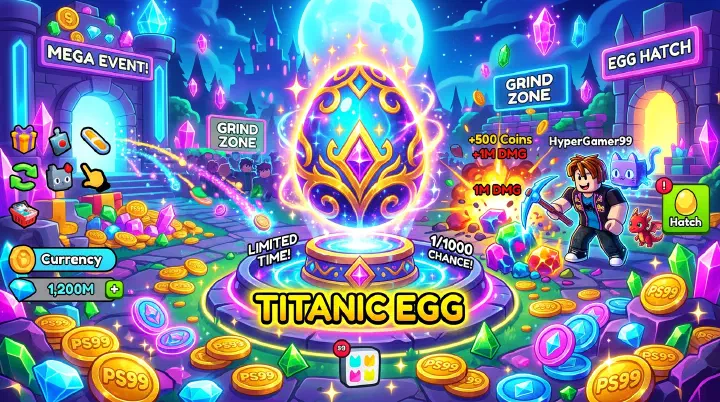
The St. Patrick’s Day event ends in two hours. You’ve been grinding for six straight days. The Titanic chance egg sits at ninety-seven percent completion. Your gems are gone. Your inventory is stuffed with useless mid-tier pets nobody wants. You dump your last five hundred million into event currency, open the final eggs, and watch the bar hit ninety-nine percent… then the event timer hits zero.
You missed it by one percent.
A player in the Discord got the Titanic on day three. Same playtime. Same event. They didn’t spend a single gem on currency. They just farmed one zone you skipped because it looked boring. That’s the difference between grinding smart and grinding hard. This guide is about closing that gap.
Why Most Players Fail Events (And It’s Not About Time)
Here’s the uncomfortable truth. The players who miss event rewards aren’t the casuals who log in for thirty minutes. They’re the dedicated grinders who spread themselves across every zone, every quest, every shiny distraction the event throws at them.
PS99 events are designed to look generous. Five zones! Twelve quests! A battle pass with fifty tiers! It feels like there’s something for everyone. But the math doesn’t work that way. The Titanic drop rate, the secret pet unlocks, the exclusive enchantments — they’re all gated behind concentrated effort in specific activities. Spread yourself thin and you hit every gate at once.
The first failure pattern is patch note blindness. Events launch with hidden drop rates and secret mechanics. The official changelog never tells you which zone has the best event currency per minute. But the community figures it out within six hours. Players who skip Discord, skip Reddit, skip the PS99 wiki — they’re flying blind for the first two days. By the time they realize Zone C is trash, the efficient players have already banked enough currency to buy out the shop.
The second failure pattern is fun-first farming. You see a zone with cool visuals, or a minigame that feels satisfying, and you camp there. But PS99 events don’t reward fun. They reward throughput. The “boring” zone with static coin piles and no enemies often generates twice the event currency of the flashy boss arena with cutscenes and knockback mechanics. Every second spent watching an animation is a second you’re not earning.
The third failure pattern is premature gem spending. Events always include a gem-to-currency conversion because it prints money for the developers. But buying currency with gems is almost always a trap. The exchange rate is brutal, and it teaches you to compensate for bad strategy with your wallet. Players who gem-rush the track on day one run out of currency by day four. Players who farm efficiently never need to convert at all.
The Zone Priority Framework: How to Read Any Event in Five Minutes
Every PS99 event, no matter the theme, breaks down into the same economic structure. If you learn to read it, you can optimize any event in under five minutes without watching a single guide video.
Step one: identify all currency sources. Events have one primary currency. Sometimes there’s a secondary currency for the shop. List every activity that drops it. Don’t guess — open your inventory, hover over the currency icon, and read the tooltip. The game usually tells you exactly where it comes from.
Step two: time each source. Spend exactly five minutes in each zone and measure your currency gain. Write it down. Yes, this is boring. Yes, it takes twenty minutes total. But it saves you from grinding the wrong zone for six days. Most players skip this step because it feels unproductive. Those players are the ones who end up at ninety-seven percent.
Step three: calculate value per minute. Don’t just look at raw currency. Factor in what that currency buys. A zone that gives a hundred currency per minute but only feeds into a low-value track is worse than a zone that gives sixty currency per minute but feeds the Titanic egg directly. Read the shop. Read the reward track. Map currency to outcomes.
Step four: pick one primary zone and one backup zone. The primary zone is your highest value-per-minute source. You farm this for ninety percent of your event playtime. The backup zone is your second-best source, used when the primary is crowded, bugged, or temporarily disabled. That’s it. Two zones. Not five. Not all of them.
Step five: set a daily target. Look at the total currency needed for your goal — usually the Titanic egg or the top battle pass tier. Divide by the number of days remaining. That’s your daily minimum. Hit it every day. If you fall behind, don’t panic-farm for twelve hours. Adjust your target upward by ten percent and stick to the schedule.
Why the Free Track Often Beats Premium (And Other Counter-Intuitive Truths)
Here’s something the PS99 community doesn’t talk about enough. The free event track is often more time-efficient than the premium one.
The premium track costs Robux and promises better rewards. But look at the structure. Premium tiers usually require the same currency grind as free tiers, just with a parallel reward path. You’re not earning faster. You’re just earning extra items alongside the same grind. If your goal is the Titanic, and the Titanic isn’t locked behind premium, you’re spending Robux for cosmetics while your farming efficiency stays flat.
The exception is when premium grants a direct currency multiplier or access to an exclusive high-yield zone. In that case, the math changes. But most events don’t do this. They give you a pet that looks cool and a title nobody reads. Skip it unless the multiplier is real and verifiable.
Another counter-intuitive move: skip the first twenty-four hours entirely.
This sounds like heresy. Events are time-limited! You need every hour! Except you don’t. The first day is chaos. Drop rates are unverified. Zones are overcrowded. Bugs get patched mid-event and reset progress. By waiting one day, you let the community establish the optimal route. You avoid the Day One currency exploit that gets rolled back. You start on Day Two with a tested strategy and zero wasted effort.
I’ve done this for three major events in a row. Each time, I hit the Titanic reward earlier than players who started on launch day. The twenty-four-hour delay isn’t lost time. It’s research time that pays compound interest.
The Event Completion Framework: From Start to Titanic
Here’s the exact sequence I run for every PS99 event now. Adapt it to the specific event, but keep the bones.
Day Zero (Before Launch): Stockpile gems, but do not spend them. Clear inventory space. You need at least two hundred open slots. Event drops fill bags fast, and stopping to manage inventory destroys your flow state.
Day One (Observation): Log in for thirty minutes. Don’t farm seriously. Check the currency sources, read community reports, identify the top two zones. Log out. Do not get sucked into the hype.
Day Two through Four (Execution): Run your primary zone on a strict schedule. I do three forty-five-minute blocks with fifteen-minute breaks. That’s two and a quarter hours of focused farming per day. During breaks, check community data to confirm your zone is still optimal. Events sometimes get stealth-patched and zone values shift.
Day Five (Evaluation): Check your progress against your daily target. If you’re ahead, maintain pace. If you’re behind, switch to your backup zone and verify whether a patch changed drop rates. Do not grind longer. Grind smarter.
Day Six through Seven (Finish): Most events run seven to ten days. By day six, you should be within ten percent of your goal. Use any stockpiled gems only if you’re genuinely behind schedule and the event is ending within forty-eight hours. Most of the time, you won’t need them.
Common Event Types and How to Handle Them
PS99 rotates through a few event archetypes. Here’s how the framework applies to each.
Coin Rush Events: These drop event currency from coin piles across multiple zones. The visual clutter makes it tempting to run everywhere. Don’t. Find the zone with the densest coin spawn and camp it. Movement speed enchants are mandatory here. If you don’t have a maxed speed pet, borrow one from the trading plaza before the event starts.
Boss Spawn Events: These require killing event bosses for drops. The trap is camping the boss spawn point with fifty other players. Instead, identify the second or third most popular spawn. The boss dies slightly slower, but you get more hits in because there’s less competition. Total drops per hour often beat the main camp.
Collection Events: These ask you to gather specific items scattered across the map. The community usually crowdsources spawn maps within hours. Don’t explore. Open the community map, plot the shortest route, and loop it. Treat it like a speedrun, not an adventure.
Minigame Events: These are the most dangerous because they feel like a break from grinding. They’re not. Most minigames have terrible currency-per-minute ratios. Play them once for the one-time rewards, then ignore them unless community data proves otherwise.
The Burnout Problem (And How to Avoid It)
The biggest hidden cost of bad event strategy isn’t missed pets. It’s quitting the game entirely.
PS99 events come fast. If you’re grinding twelve hours a day and still failing, you start to associate the game with frustration. I’ve seen dedicated players burn out during the Halloween event and not come back until spring. The zone-focus framework isn’t just about efficiency. It’s about sustainability.
Two hours a day, focused, beats six hours a day scattered. You hit your targets. You keep your gems. You don’t hate the game. And when the next event drops, you’re rested and ready instead of dreading another marathon.
Set a timer. When it goes off, log out. The Titanic isn’t worth your mental health. The funny thing is, players who set boundaries usually perform better than the no-lifers anyway. Decision fatigue is real. After three hours of grinding, your efficiency drops off a cliff. Better to stop at two and come back fresh tomorrow.
Final Checklist Before Your Next Event
Run through this before every PS99 event launch. It takes two minutes and saves you two weeks of regret.
- Inventory cleared to two hundred slots
- Gems stockpiled, conversion plan set to “emergency only”
- Speed enchant or pet equipped
- Community sources bookmarked (Discord, wiki, Reddit)
- Primary and backup zones identified from community data
- Daily target calculated based on event length and goal
- Timer set for your maximum daily session
That’s it. No complex spreadsheets. No twelve-hour streams. Just a clear plan, a focused zone, and the discipline to stick with it while everyone else chases shiny distractions.
The next time an event launches, watch the global chat. You’ll see players bragging about their gem spending on day one. You’ll see them complaining about drop rates on day four. And you’ll see them rage-quitting at ninety-seven percent when the timer runs out.
Don’t be that player. Be the one who gets the Titanic on day three, logs out, and waits for the next event with a full gem wallet and zero stress.