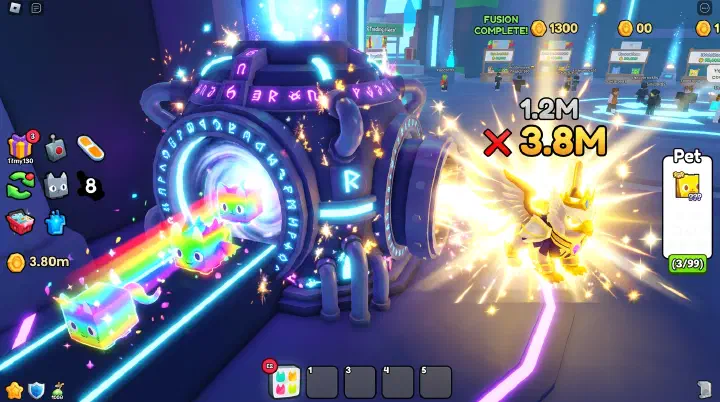
You put three Rainbow Huge Pets into the fusion machine.
Not random event pets. Not trash from an old area. Your best three. The pets that carried your team through chest farming, quest grinding, and trading plaza flex checks.
The machine lights up. The animation takes forever. Blue energy spins around the chamber. You already know what you’re hoping for: one cleaner, stronger pet that frees up team slots and pushes your damage higher.
Then the result appears.
A shiny fused pet with a bigger name, a rarer border, and about 60% of the combined damage you just fed into the machine.
You stare at the number.
Your team DPS dropped. Your break speed dropped. Your gem farming route is slower. And the worst part? You didn’t just lose pets. You lost the 50 million gems you spent getting those pets in the first place.
That sinking feeling is the real fusion tax in Pet Simulator 99.
Fusion looks like progress because the output feels special. Evolution looks safe because the game frames it as an upgrade. But both systems punish players who only look at rarity. If you don’t calculate damage per gem, team slot value, and resale value before pressing the button, you’re gambling with your account.
This guide is not about whether fusion is “good” or “bad.” Fusion is a tool. Evolution is a tool. The question is simple:
Does this action increase your total farming power more than the gems it destroys?
Most players never ask that. That’s why they get weaker.
Why Random Fusing Is Bleeding You Dry
Bad fusing hurts because you’re not comparing one pet to one pet. You’re comparing one new pet to everything you sacrificed.
Let’s use a clean example.
You have three pets:
- Pet A: 10 trillion damage
- Pet B: 9.5 trillion damage
- Pet C: 9 trillion damage
Combined, they add 28.5 trillion damage to your active team if you can equip all three.
You fuse them and receive one pet with 17 trillion damage.
That sounds strong. It may even be your single strongest pet now. But your team lost 11.5 trillion damage.
That’s a 40.3% damage loss from the fuse.
Now add the gem side.
If each pet cost 15 million gems to buy or hatch efficiently, your input cost was 45 million gems. The new pet would need to do one of three things to be worth it:
- Increase total team DPS
- Sell for more than the combined input value
- Unlock a progression breakpoint you couldn’t reach before
If it does none of those, it was a loss with better lighting.
Here’s the mistake most players make: they compare the fused pet to the strongest input pet.
Wrong comparison.
If your best input pet was 10 trillion and the output is 17 trillion, you think, “Nice, I gained 7 trillion.” But if all three input pets were equipped, the real comparison is 17 trillion versus 28.5 trillion.
You didn’t gain 7 trillion.
You lost 11.5 trillion.
That loss matters everywhere:
- Boss chests take longer
- Area farming gives fewer diamonds per hour
- Quest chains slow down
- Rank tasks take more clicks
- Event currency farming drops
- Your team becomes less balanced
If you need help measuring the gem side first, read the PS99 Gems & Coins Farming Guide. Fusion decisions get easier when you know how many gems per hour your current team actually earns.
The Fusion Rule That Saves Accounts
Use this rule before every serious fuse:
Only fuse pets that are not helping your active team, unless the output is likely to replace multiple weak slots with higher total DPS.
That sounds obvious. It isn’t how most people play.
Most players fuse their best pets because they want a better best pet. But Pet Simulator 99 rewards team damage, not ego damage.
A single huge number does not matter if your total lineup gets worse.
Before you fuse, ask four questions:
- Are all input pets currently equipped?
- Would removing them create empty or weaker slots?
- Is the expected output stronger than the total lost damage?
- Could I sell the inputs and buy a better upgrade instead?
If the answer to questions 1 and 2 is yes, the fuse is probably bad.
If question 4 is yes, the fuse is almost always bad.
Trading is boring compared to the fusion animation. Trading also keeps you from deleting value. Check current market logic in the PS99 Trading Values Guide before converting tradable pets into a single uncertain output.
Fusion Priority System: Fuse, Keep, or Evolve
Use this priority system instead of dumping pets into the machine because your inventory looks messy.
Fuse These Pets First
Fuse pets that meet most of these conditions:
- They are outside your active team
- They are duplicates with low resale demand
- They come from old areas and no longer affect break speed
- Their individual trade value is tiny
- You have enough replacements to keep farming speed stable
- The possible output can fill a real team slot
These are “safe fuses.” You’re converting dead inventory into a possible upgrade.
Example: you have 40 extra Rainbow pets from an event egg, but your team only uses the top 20. The bottom 20 don’t farm, don’t sell well, and don’t help your setup. Fusing those extras makes sense.
You are not risking your engine. You’re recycling spare parts.
Keep These Pets
Do not fuse pets that fit these conditions:
- They are in your current team
- They are part of your top 10 damage pets
- They have strong trading demand
- They are event-limited with rising value
- They help you hit a farming breakpoint
- They support a team composition you still use
A “farming breakpoint” means your team can clear a target faster because of that pet.
For example, if your team clears a chest wave in 18 seconds with the pet and 24 seconds without it, keep it. That six-second gap repeats hundreds of times. Over an hour, that can mean thousands of lost diamonds, event drops, and item rolls.
If you’re building around pets, enchants, and farming roles, pair this guide with the PS99 Team Compositions Guide. Fusion should support your team plan, not randomly rewrite it.
Evolve Instead When Stability Matters
Evolution is usually better when you care about predictable growth.
Use evolution when:
- The pet already has strong base damage
- The evolution path gives a known multiplier
- The pet has high trade value after evolving
- You need reliable DPS, not a lottery result
- You don’t want to shrink your active lineup
Evolution works best on pets that are already worth keeping.
Fusion works best on pets that are not worth keeping.
That one sentence prevents most expensive mistakes.
The Gem-to-Damage Efficiency Framework
Don’t ask, “Is this pet rare?”
Ask, “How many gems am I paying per damage gained?”
Use this simple formula:
Gem cost per gained damage = total gem cost / net damage increase
If a fuse costs you 30 million gems in input value and increases your total team damage by 5 trillion, you’re paying 6 million gems per 1 trillion damage.
If buying a pet from the plaza costs 20 million gems and increases your team damage by 8 trillion, you’re paying 2.5 million gems per 1 trillion damage.
The trade is better.
The machine is not automatically the best upgrade path. It is just the flashiest one.
For every fuse or evolution, write down three numbers:
- Input value in gems
- Current total damage from those pets
- Expected output damage or evolved damage
Then calculate net gain.
Not output damage.
Net gain.
That distinction matters.
Quick Efficiency Checks
Use these checkpoints before spending:
- If net gain is negative, don’t do it unless the output has strong resale value.
- If gem cost per damage is worse than buying directly, trade instead.
- If the output replaces one pet but costs three equipped pets, stop.
- If the evolved pet keeps a team slot and gains damage, evolution is safer.
- If the input pets are unused, fusion risk is much lower.
You don’t need a spreadsheet for every small fuse. But once the input value passes 5 million gems, slow down. Once it passes 25 million gems, calculate it. Once it passes 100 million gems, compare market prices first.
The Counter-Intuitive Advice: Stop Fusing Your Best Pets
Common advice says, “Fuse your strongest pets to get even stronger pets.”
That advice is incomplete.
In PS99, your strongest pets are often the pets you should protect the most. They are already producing value. They are already pushing your clear speed. They may also be easier to sell than whatever the machine gives you.
The better play is usually this:
Fuse your 30th to 60th best pets, not your 1st to 10th best pets.
Why?
Because your 1st to 10th pets are your engine. Your 30th to 60th pets are inventory clutter.
If a fuse from clutter hits, great. It enters your team.
If it misses, you lost pets you weren’t using.
This is how high-efficiency players treat fusion. They don’t use it as their main progression system. They use it as an overflow converter after farming, hatching, and trading have already done the main work.
The same logic applies to enchant spending. You don’t throw all your gems at flashy upgrades without checking return. The PS99 Enchantments & Upgrades Guide explains why small multipliers often beat one expensive flex purchase.
Evolution Paths That Actually Increase DPS
Evolution is worth it when the evolved pet stays useful after the cost.
That means the evolved version must beat your replacement options.
A good evolution has three traits:
- The input pet is already close to your team power level
- The evolution boost is large enough to move it up several slots
- The evolved version keeps or increases market demand
A bad evolution looks like this:
- You evolve a weak pet because the button is available
- The evolved version is still below your current team
- You paid gems, items, or pets for no active DPS gain
That is not progression. That’s cosmetic accounting.
Good Evolution Example
You have a Rainbow pet doing 14 trillion damage. Your weakest active team pet does 13 trillion. Evolution pushes the Rainbow pet to 20 trillion.
Result:
- It stays equipped
- It improves team DPS by 6 trillion
- It may improve resale value
- It does not delete multiple strong pets
That’s a good evolution.
Bad Evolution Example
You have an old event pet doing 4 trillion damage. Your weakest active pet does 11 trillion. Evolution pushes the old event pet to 7 trillion.
Result:
- It still doesn’t make the team
- It doesn’t improve farming speed
- It consumed resources
- It may not sell better
That’s a bad evolution.
The evolved pet looks better in your inventory. Your account did not get stronger.
When Fusion Beats Evolution
Fusion can beat evolution when your inventory is wide but shallow.
That happens after:
- Long egg hatching sessions
- Event farming
- Buying cheap bundles from other players
- Area progression where old pets pile up
- Farming alt accounts and transferring pets
In these cases, you may have many pets that are individually useless. Fusion gives them one more chance to become useful.
Fusion is better than evolution when:
- Inputs are not equipped
- Inputs have poor liquidity
- You need a chance at a higher tier pet
- Evolution costs more than the expected upgrade
- You have enough volume to absorb misses
Volume matters. One risky fuse with your best pets is gambling. Twenty low-cost fuses with unused pets is inventory management.
When Evolution Beats Fusion
Evolution wins when you already own a pet worth improving.
Choose evolution when:
- The pet has strong base stats
- You know the evolved output
- You want stable DPS growth
- You are building a long-term farming team
- You care about keeping trade value predictable
Evolution also helps players who hate market timing. Fusion output can be hard to price. Evolved pets are often easier to compare because buyers understand the upgrade path.
If you farm with a consistent setup every day, predictable upgrades are usually better than surprise upgrades.
The 10-Second Fuse Test
Before you press fuse, run this test:
- Remove the input pets from your team.
- Check if your farming speed changes.
- Estimate their combined trade value.
- Compare that value to a direct pet purchase.
- Ask whether the output must be amazing just to break even.
If the fuse needs a perfect outcome to be good, don’t do it.
Good fuses are good even when the result is average.
Bad fuses need luck to survive the math.
Sample Upgrade Plan for Mid-Game Players
If you’re not sure what to do, follow this order:
- Build a full active team with no empty weak slots.
- Sell tradable duplicates that have real demand.
- Fuse only leftovers that don’t affect farming.
- Evolve pets that are already near your active team level.
- Reinvest gains into enchants, team slots, and stronger pets.
- Recheck market prices before any high-value fuse.
This order keeps your farming engine alive.
Most players reverse it. They fuse first, get weaker, then try to farm back the loss with a slower team.
Don’t do that.
Specific Fusion and Evolution Questions
Should I fuse Huge Pets in Pet Simulator 99?
Usually no, unless the Huge Pets are duplicates, low-demand, or outside your serious farming setup. Huge Pets often hold trade value better than random fused outputs. If all three Huge Pets are equipped or easy to sell, trading them toward a better Huge or Titanic path is safer. For high-end pet goals, compare with the PS99 Huge and Titanic Pets Guide before fusing.
Is it worth fusing Rainbow pets?
Yes, but only when they are extras. Rainbow pets are common fusion bait because hatching produces duplicates. The key is whether those Rainbows are active team members. Fuse spare Rainbows. Protect Rainbows that define your current damage floor.
What if the fused pet has higher damage than any single input?
That still may be a bad fuse. Compare the output to the combined active value of all inputs. A 20 trillion pet is not an upgrade if you sacrificed three equipped 12 trillion pets and replaced them with weak backups.
Should I evolve before fusing?
Evolve first only if the evolved pet will be used or sold for a better price. Do not evolve a pet just to make it feel like better fusion material. That adds cost before a risky conversion. If the pet is already unused, fusing the base version may be more efficient.
How do I know if a fusion result is profitable?
A fusion is profitable if the output value is higher than the combined input value or if it increases your farming income enough to recover the lost value quickly. If you spent 40 million gems of input value and gain 2 million extra gems per hour, your payback time is 20 hours. If you won’t farm that much, it wasn’t worth it.
What’s the safest fusion strategy for free-to-play players?
Fuse only unused pets. Free-to-play players recover from mistakes slower, so protecting active DPS matters more. Your best gems should go into reliable upgrades first: stronger team slots, better enchants, and trades with clear value.
Final Rule: Upgrade the Account, Not the Inventory Screen
Pet Simulator 99 constantly tempts you with prettier pets.
Gold looks better than normal. Rainbow looks better than Gold. Fused pets look better than duplicates. Evolved pets look better than base versions.
But the inventory screen lies if you only look at rarity.
Your account is stronger when you farm faster, clear harder content, earn more gems per hour, and hold pets other players still want to buy.
So before every fuse or evolution, ask the only question that matters:
Will my account be stronger 10 minutes after I press this button?
If yes, do it.
If no, keep the pets, sell them, or wait.
The fusion machine isn’t your enemy. Random fusing is.
Use the machine for leftovers. Use evolution for proven pets. Use trading when the math is better.
That’s how you stop turning millions of gems into weaker teams.