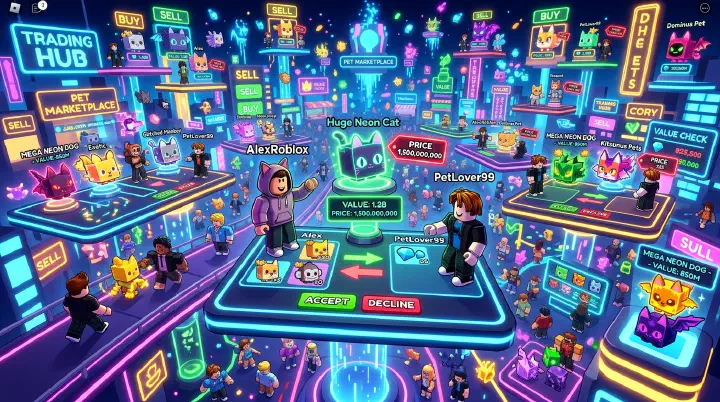
Last updated: August 4, 2026. Trading values fluctuate constantly with each update. This guide focuses on trading mechanics, value tracking tools, and scam prevention — strategies that remain useful regardless of current prices.
You’re standing in the Trading Plaza, scrolling through booths. Someone lists a Titanic for 10B gems. The chat explodes. Your fingers freeze. You know the RAP should be higher — way higher — but you can’t remember the exact number. You buy it anyway because ten other players are already running toward the booth. Ten minutes later, you check Cosmic Values. The pet is worth 50M. You overpaid by 200x because you couldn’t tell a Normal variant from a Rainbow, and you trusted booth hype over actual data.
That’s the PS99 trading economy in one moment: speed, fear, incomplete information, and a lot of players learning expensive lessons the hard way.
Pet Simulator 99 has one of the most aggressive player-driven economies on Roblox. Unlike most games where items are bought from NPCs, PS99 relies on player-to-player trading for the best pets, enchants, and items. Understanding how values actually work — not just what the numbers say — is the difference between building a strong inventory and funding someone else’s retirement.
Understanding the PS99 Trading Economy
The PS99 trading market behaves like a real economy in miniature. Prices move based on supply, demand, hype cycles, and update timing. The same pet can be worth 50M on a Tuesday morning and 80M on a Saturday evening simply because more buyers are online.
What makes this economy different from most games:
- No central pricing authority. BIG Games doesn’t set pet prices. The market does.
- Real-time value shifts. A new update, a YouTuber video, or a Discord rumor can move prices in minutes.
- Information asymmetry. Some players have better data than others. Those players profit.
Your job as a trader is to close the information gap. That starts with understanding the two metrics everyone uses.
The Value System
Pets in PS99 are tracked using two main metrics:
- RAP (Recent Average Price): The average price a pet has recently traded for, calculated from actual transactions. Think of it as the stock ticker for PS99 pets. Updated in real-time by tracking sites like Big Games DB.
- Gem/Diamond Value: The actual currency players demand in live trades. This can differ from RAP because RAP lags behind fast-moving markets, and because some pets trade at a premium due to demand, appearance, or collector status.
RAP is a reference point, not an absolute truth. Popular pets often trade above RAP. Flooded-market pets trade below it. And newly released pets may not have a stable RAP at all — the first few days are the wild west where anyone’s guess is as good as the tracker’s.
Pet Variants and Value
The same pet can have dramatically different values based on its variant. A Titanic Cat (Normal) is not the same item as a Titanic Cat (Rainbow). The variant changes everything:
- Normal (1x base): The standard hatched pet. Most common, lowest value.
- Golden (~4x base): Created by fusing 3 Normal pets of the same type. The cost of fusion — plus the time and gems needed — sets the floor price.
- Rainbow (~8x base): Created by fusing 3 Golden pets. Much rarer because the fusion chain is expensive and time-consuming.
- Shiny (10x+): A special variant from event eggs or trading. Extremely rare, highly collectible, and the buyer pool is smaller because not everyone can afford the premium.
Event-exclusive pets (limited-time eggs, seasonal drops) hold value significantly better than standard pets. Once the egg disappears, new supply stops. The only copies in circulation are the ones already hatched. That’s a supply freeze, and supply freezes are where prices rise.
Best Value Tracking Resources
As of August 2026, these are the most reliable value tracking websites. Check at least two before any trade over 100M gems.
- Cosmic Values (petsimulatorvalues.com): Tracks Huge, Titanic, and Gargantuan pet values with demand indicators. Updated daily. The most widely used third-party tracker.
- Traderie PS99 Values (traderie.com/pet-simulator99/values): Live prices with demand badges and historical charts. Also functions as a moderated peer-to-peer marketplace.
- PS99Values (ps99values.com): Clean trade calculator with Titanic, Huge, and Gargantuan prices. Good for quick second-opinion checks.
- Big Games DB (db.biggames.io): The official database. Shows RAP, existence counts, and real-time trade data. No third-party bias — this is the source of truth.
- PetSimXValues (petsimxvalues.com): Live RAP values and pet existence counts. Useful as a cross-reference to catch outliers.
Always cross-check. If Cosmic Values says 100M and two other sites say 70M, something is off. The discrepancy might be a data delay, or it might be a manipulated market. Either way, you don’t want to be the one paying the higher number.
Where and How to Trade
Trading Plaza
The Trading Plaza is the central hub in the Spawn World. Player booths line the area, each displaying pets for sale with set prices. You can:
- Browse booths to find underpriced pets — the equivalent of bargain hunting
- Set up your own booth to sell pets you don’t need
- Initiate direct trades by approaching another player and opening a trade window
The Plaza is the safest place to trade because the interface shows you exactly what you’re getting. No ambiguity, no last-second swaps (if you double-check), and no need to trust the other person’s word.
Personal Trades
Direct player-to-player negotiations happen anywhere in the game. Approach a player, click “Trade,” and both sides select their offers. These trades are riskier because there’s no booth system to verify listings — you’re relying entirely on your own knowledge and the trade window.
Traderie (External Marketplace)
Traderie (traderie.com/pet-simulator99) is a community-moderated marketplace with verified transactions, price history charts, and searchable listings. It reduces scam risk because the platform tracks reputations. Some users also buy and sell for real money, but this is at your own risk and against Roblox ToS.
Current Titanic Pet Values (August 2026)
These approximate values give you a sense of the market. Prices change frequently — verify before trading. The spread between top-tier and bottom-tier Titanics is enormous, and demand is often more important than the raw number.
High-value Titanics (100B+ gems):
- Titanic Persimmony Cricket — ~700B gems, High demand. Top of the market.
- Titanic Valkyrie Pegasus — ~535B gems, High demand. Strong visual design drives collector interest.
- Titanic Easter Golem — ~498B gems, Medium demand. Event-exclusive with fixed supply.
- Titanic Monkey — ~472B gems, High demand. Classic pet with broad appeal.
Mid-value Titanics (10B-50B gems):
- Titanic Jolly Cat — ~42B gems, Medium demand. Seasonal (Christmas) design.
- Titanic Balloon Monkey — ~38B gems, Medium demand. Event reward.
- Titanic Scary Corgi — ~13.85B gems, Medium demand. Halloween event.
- Titanic Stunt Cat — ~13.8B gems, Medium demand.
- Titanic Jelly Kitsune — ~13.8B gems, Low demand. Beware low liquidity.
Lower-value Titanics (under 100M gems):
- Titanic Cat — ~60M gems, Medium demand. The “entry-level” Titanic.
- Titanic Atlantean Jellyfish — ~42M gems, Medium demand.
- Titanic Fire Dragon — ~50M gems, Low demand. Struggles to find buyers.
- Titanic Cosmic Pegasus — ~34M gems, Low demand.
- Titanic Arcane Void Cat — New (recently released), Very High demand. Price unsettled.
Notice the gap between the top tier (700B) and the bottom (34M). That’s a 20,000x difference. The lesson: “Titanic” is a category, not a value guarantee. A low-demand Titanic can be harder to sell than a high-demand Huge.
How to Get the Best Deals
Rule 1: Know the Value Before You Trade
Never enter a trade without checking the current RAP and recent sale listings for every pet involved. A pet you think is worth 1B gems might actually be worth 10B — or 100M. The 30 seconds you spend checking a tracker can save you weeks of grinding.
Rule 2: Trade Up, Not Sideways
The fastest way to build value is through a series of incremental trades:
- Start with what you have — pets, enchants, potions, anything with value
- Trade for something slightly more valuable (10-20% edge)
- Repeat until you reach your target pet
Even small “trade ups” compound. Five trades with a 15% edge each nearly double your starting value. Most players fail because they get impatient and try to jump from a 50M pet to a 500M pet in one trade. That’s gambling, not trading.
Rule 3: Buy During Downtime, Sell During Peak
Pet values fluctuate with predictable rhythms:
- New updates dump existing pet values as players sell to afford new content
- Events spike event-exclusive pets during the event, then drop them after
- Weekends bring more players, more competition, and higher prices
- After-school hours surge the player base, driving up demand
The best time to buy is weekdays, especially right after a new update when prices are in flux and scared sellers are undercutting. The best time to sell is weekend evenings when casual buyers with full gem stacks are browsing booths.
Rule 4: Sell What You Don’t Need
Every potion, flag, fruit, enchant, and duplicate pet has value. The gems from selling small items add up fast. A player with 50 random enchants worth 5M each is sitting on 250M in liquidatable assets. Convert clutter into gems, then convert gems into one strong pet. Clean inventory, clean mind.
Failure Analysis: Why Players Lose Millions in Trades
Most trading losses happen before the trade window opens. The mistake isn’t the pet. It’s the thinking.
The “RAP Trap” — Trusting One Number Without Context
You see a pet listed at 80M. RAP says 100M. Looks like a 20% discount. You buy it. Then you try to resell it and discover nobody’s buying above 60M. The RAP was inflated by a few unusual trades, or the price was sliding downward and the tracker hadn’t caught up yet.
A single RAP number is a snapshot. You need the trend. Is RAP rising slowly over several days? That’s demand building. Is RAP flat but booths are undercutting each other? That’s supply pressure. Is RAP spiking in a vertical line? That’s probably manipulation or a hype wave about to crash.
Always check the direction, not just the number. And cross-reference with at least one other tracker. If two sites disagree by more than 15%, the market is unstable and you should wait.
The “Variant Blindness” — Trading for the Wrong Version
A player offers you a “Titanic Cat” for your three best Huges. The values line up on paper. You accept. Then you realize you received a Normal Titanic Cat worth 60M, while you thought you were getting a Rainbow variant worth 480M. The trade window showed the pet, but you didn’t check the variant tag.
This happens constantly. The difference between Normal, Golden, Rainbow, and Shiny is not cosmetic — it’s a 1x to 10x+ value multiplier. The variant is displayed in the trade window, but it’s a small text label that’s easy to miss when you’re excited or rushed.
Before every trade: pause, look at the variant tag, confirm it matches what you agreed to. If the other player complains about the delay, that’s a red flag.
The “Hype FOMO” — Buying at the Absolute Top
A new Titanic releases. Chat is screaming. Booths are pricing it at 200B. You buy one because you’re afraid the price will only go up. Three days later, more copies have entered the market, sellers are undercutting, and the same pet is 120B. You’re down 80B because you bought during the hype window.
New releases follow a predictable pattern: launch spike, supply flood, price correction, stabilization. The first 48 hours are the most dangerous. Early sellers price high because nobody knows the real value yet. As more copies hit the market, competition drives prices down. The smart money buys during the correction, not the spike.
Ask yourself before buying a hyped pet: “Who is left to buy above me?” If the answer is “people even more desperate than me,” you’re standing at the top of the candle.
Decision Framework: The 4-Check Trade Protocol
Before any trade over 50M gems, run through these four checks. If the pet fails two or more, walk away. There will always be another trade.
1. Value Check — Is the Price Real?
- Check RAP on at least two tracking sites
- Look at the trend: rising, flat, or falling?
- Scan booth listings for the same pet — are sellers undercutting each other?
- Check recent trades on Traderie or Big Games DB for actual sale prices
If the price looks too good, it probably is. If the price looks too high, it probably is. The sweet spot is a pet trading at or slightly below RAP with stable demand.
2. Liquidity Check — Can You Actually Sell This?
- Search booths for the pet — are there many listings or few?
- Are the listings stale (same booths, same prices, no movement)?
- Check chat — is anyone actively buying this pet?
- Ask yourself: if you needed to sell this pet in 30 minutes, could you?
A pet with few buyers takes longer to sell. Longer sell times mean your gems are locked. A less rare pet with constant demand may make more profit simply because you can flip it faster and redeploy capital.
3. Variant Check — What Exactly Are You Getting?
- Confirm the variant: Normal, Golden, Rainbow, or Shiny?
- Calculate the value based on the variant multiplier
- Verify the variant tag in the trade window before accepting
- If the deal includes multiple pets, check each one individually
This is the check that saves you from the most expensive mistakes. A 10-second variant verification is worth more than hours of grinding.
4. Timing Check — Is This the Right Moment?
- Is an update about to drop? (If yes, prices may fall)
- Is the pet from an event that just ended? (If yes, supply just froze — could be bullish)
- Is it peak hours or off-hours? (Affects who’s selling and at what price)
- Is the pet being hyped on YouTube or Discord right now? (If yes, you’re buying into a wave)
You don’t need perfect timing. But you should know what market pressure you’re buying into. Buying a pet 10 minutes before a major update announcement is a gamble you didn’t need to take.
Counter-Intuitive Truths About PS99 Trading
“Overpaying” Can Be the Smartest Move
If someone offers you five slow-selling pets worth 20M each for your one fast-selling Huge worth 100M, that’s not a fair trade — even if the numbers match. You inherit the problem: now you have to sell five slow pets instead of one fast one. But if you’re the one offering the bundle for a clean, liquid pet, a small overpay (5-10% above RAP) can be worth it. You’re converting clutter into a clean asset. On paper it looks like a loss. In practice, you can sell that clean pet in minutes and move on.
Higher RAP Doesn’t Mean a Better Pet
Two pets can both have 100M RAP. One sells in 10 minutes. The other sits in your booth for three days. The difference is demand velocity. A pet with high demand velocity is worth more than a pet with the same RAP and low demand — even though the trackers show the same number. Always check how fast a pet actually moves, not just what it’s “worth.”
New Pets Are Often the Worst Investment
The first 48 hours of a new pet release are a bloodbath for buyers. Early sellers price high because nobody knows the real value. As more copies enter the market, undercutting begins. Prices slide. The pet might be a great long-term hold, but your entry was terrible. The best time to buy a new pet is 2-3 weeks after release, when the hype has cooled and the price has found a floor.
The Best Traders Don’t Trade Often
The Trading Plaza is designed to make you feel like you should be trading constantly. Booths everywhere. Chat exploding. Deals flying. But the best traders are patient. They wait for the right moment — a panic selloff after an update, a lazy listing during off-hours, a seller who clearly doesn’t know what they have. Trading less often but with better edges beats trading constantly with thin margins.
Cash Is a Position
Holding gems feels unproductive when everyone else is flexing pets in their inventory. But gems give you optionality. When panic hits — and it hits regularly in PS99 — the player with liquid gems gets to choose from the discounted pets. The player fully invested in inventory has to watch. Keep at least 20-30% of your value in gems at all times. The opportunity cost of being fully invested is higher than it looks.
Scam Prevention: Quick Reference
For a complete guide on avoiding scams, see our Pet Simulator 99 Trading Scam Prevention Guide. Here’s the quick version:
- Never do trust trades. Use simultaneous exchange only. Anyone asking you to “go first” is testing your judgment.
- Verify variants in the trade window. Normal, Golden, Rainbow, and Shiny look different. Confirm the tag matches the deal.
- Slow down every trade. Scammers rely on speed. A trade partner who rushes you is a red flag.
- Check values yourself. Don’t let the other person show you a “value screen.” Open your own tracker.
- Watch for last-second swaps. Before accepting, re-check every item in the window. Quick-switch scams are common.
- Use the Trading Plaza when possible. The booth system is safer than direct trades.
If you get scammed, BIG Games does not restore items. Report the player through Roblox, share the username on community Discords to warn others, and learn from the experience. Every veteran trader has a scam story. The goal is to make sure yours is a cheap one.
Frequently Asked Questions
How do I trade in Pet Simulator 99?
Go to the Trading Plaza in the Spawn World. You can browse player booths, set up your own shop, or initiate direct trades with other players. For external trading, use Traderie (traderie.com/pet-simulator99) for moderated peer-to-peer trades with reputation tracking.
What does RAP mean?
RAP stands for Recent Average Price. It tracks the average price that pets have recently traded for in actual player transactions. Use it as a reference point, but always check the trend (rising or falling) behind the number. A single RAP value without context can be misleading.
How do I avoid scams when trading?
Always check live RAP values yourself before every trade. Never do trust trades. Verify pet variants in the trade window before accepting. Use the Trading Plaza booth system when possible. If a deal seems too good to be true, it probably is a scam. Slow down — scammers rely on speed and excitement.
What are the most valuable pets right now?
Gargantuan pets are the most valuable tier, followed by Titanic pets. As of August 2026, the Titanic Persimmony Cricket (~700B gems), Titanic Valkyrie Pegasus (~535B), and Titanic Easter Golem (~498B) are among the most valuable. The newly released Titanic Arcane Void Cat has very high demand but unsettled pricing.
Next Steps
- Pet Simulator 99 Beginner Guide — Complete walkthrough for new players
- Pet Simulator 99 Best Pets Guide — Detailed ranking of every pet
- Pet Simulator 99 Huge and Titanic Pets Guide — Complete guide to the rarest pets
- Pet Simulator 99 Gems and Coins Guide — Best strategies for earning currency fast
- Pet Simulator 99 Exclusive Pets Investment Guide — Buy, hold, and profit from exclusive pets
- Browse all guides — Visit our Guides page for the latest walkthroughs and tips
Disclaimer: Trading values change frequently with each update. Always verify current prices using the resources listed above before making any trade. This guide reflects the market as of August 2026.
Sources: