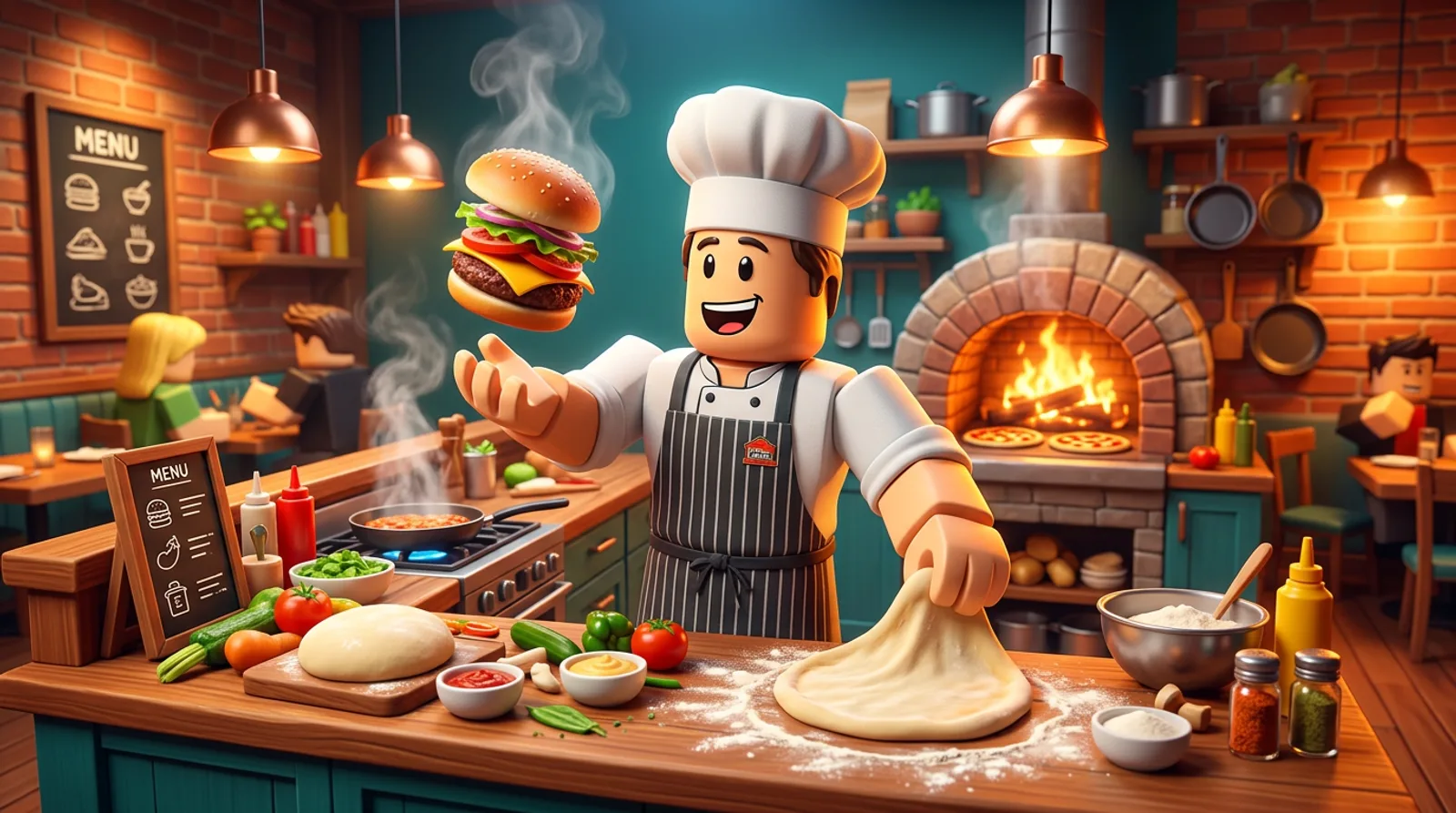
It is 11 PM. You are in a Roblox pizza shop with three friends. One of them is at the oven. One is boxing orders. One is sweeping the floor, badly. You are the one who takes the order from the customer and hands it to the person who can actually make it.
The order is a pepperoni pizza. You have made this pizza 200 times before. You will make it another 200 times tonight.
And yet — this is the exact scenario that made Work at a Pizza Place one of the most played games on the platform ever, with more than 3.4 million upvotes and a live population that has never once dropped to zero. Because the fun is not the pizza. The pizza is the excuse. The fun is that your friend dropped a plate.
Most “best Roblox cooking games” lists get this wrong in a specific way: they rank cooking games by how much food you can see, or by how many recipes they can claim, and they completely ignore the thing that makes a cooking game hold your attention in hour three. Is the cooking the system, or is it the setting?
That distinction decides everything. In Work at a Pizza Place, cooking is a setting — it is the reason two people are standing next to each other. In Craft Food, cooking is the system, and it is deep enough that you will still be finding recipes 40 hours in. Both are good. They will not scratch the same itch.
So here is the ranking: six cooking and restaurant games, judged on what they actually ask of you once the first hour is over. Player counts and vote totals were pulled from the live Roblox index on 3 November 2026.
One thing to clear up before the list, because it trips up almost every other version of this guide: Restaurant Tycoon 2 and Restaurant Tycoon 3 are two different games, and the sequel has already won. Restaurant Tycoon 2 still holds over 1.34 million lifetime upvotes — it is the second-most-upvoted cooking game on Roblox — but it now runs at around 900 concurrent players while Restaurant Tycoon 3 sits near 5,700. A lot of the lists still lead with Tycoon 2 because it is the famous one. It is not the live one.
Why Most “Best Roblox Cooking Games” Lists Mislead You
They rank by how appetising the thumbnail is. Every list leads with the game that looks like a kitchen. That game is usually the shallowest one on the page, because rendering a shiny pizza costs nothing and building a recipe economy costs months. Visual appeal is the cheapest possible differentiator, which is exactly why it dominates.
They treat “cooking game” as one genre. It is not. Roblox cooking splits into at least four unrelated loops: order fulfilment under time pressure, restaurant management, ingredient and recipe crafting, and physics-based physical cooking. A player who loves one of those will often hate the other three. The whole ranking below is built so you can find your loop, not so you can find the “best.”
They ignore the failure state. The genre’s defining tension is that orders arrive faster than you can serve them, and the difference between a great cooking game and a bad one is entirely in how it handles the moment you fall behind. Lists never mention this, and it is the single most important thing to know before you commit an evening.
They do not check whether the game still exists. Roblox cooks games die and get renamed constantly. Every game in this guide was confirmed live and searchable on the Roblox index on the date above. Nothing here is a 2021 memory.
How We Evaluate Roblox Cooking Games
Six factors, weighted the same way I weight every genre ranking on this site, because the underlying question never changes: what is the game actually asking of you, and does it keep asking after the novelty wears off?
1. System depth (25%). How many distinct things can you actually do, and how many of them interact? Is cooking a button you press, or a chain of ingredient decisions? A restaurant game where every order resolves identically is a slot machine with food in it. A game where recipes combine and the recipe tree branches is a game you can lose an evening to without noticing.
2. Pressure design (20%). Does the game create a real constraint — orders stacking, timers running, a conveyor outpacing your hands — and does that constraint stay interesting for a full session? Many cooking games front-load chaos and then flatten out into a wait. Good ones keep the pressure curve moving.
3. Progression shape (15%). Does the game have a curve, or just a pile? Are unlocks sequenced so each stage asks a new question, or do you unlock everything at once and then have nothing to chase? This is where tycoon-style cooking games usually collapse.
4. Multiplayer and social payoff (15%). Cooking is inherently a social genre, and the games that lean into it — shared shifts, eating off the same conveyor — produce the strongest social moments on the platform. But a cooking game that requires a group is a worse recommendation for a solo player, so this factor is weighted lower than it would be for a hangout game.
5. Content volume and update cadence (15%). How many recipes, dishes, levels or cosmetics exist, and how often does new content land? A game with 900+ recipes that adds 30 more every two weeks behaves very differently from a game with 900 recipes that stopped changing a year ago.
6. Monetisation fairness (10%). Can a free player reach the best content? Does Robux buy convenience or power? This genre is generally fair, with a couple of exceptions worth naming.
Notice what is deliberately missing: graphics quality, how fun the food looks, and whether the game is “relaxing.” Those are the metrics cooking listicles lead with, and they predict almost nothing about whether you will still be playing next week.
The Ranking at a Glance
| Rank | Game | Loop Type | Depth | Best For | Play If You Want |
|---|---|---|---|---|---|
| 1 | Work at a Pizza Place | Order fulfilment | Medium | Social play and shared chaos | Cooking with friends, not cooking alone |
| 2 | Restaurant Tycoon 3 | Management tycoon | Medium-High | Running and expanding a business | A restaurant that earns while you sleep |
| 3 | Craft Food | Recipe crafting | Very High | Systems and optimisation | 900+ recipes and an ingredient economy |
| 4 | Conveyor Sushi Restaurant | Logistics puzzle | Medium | Relaxing social sorting | Moving food, not making it |
| 5 | Cook Burgers | Physical cooking | Medium-High | Skill and chaos | Flipping real burgers under pressure |
| 6 | Bake or Die | Horror survival | Medium | Horror and comedy | Zombies, ovens, and bad decisions |
And here is the live data behind those picks, checked on 3 November 2026:
| Game | Playing | Upvotes | Downvotes | Creator | Verified |
|---|---|---|---|---|---|
| Work at a Pizza Place | 2,778 | 3,475,693 | 264,895 | Dued1 | Yes |
| Restaurant Tycoon 3 | 5,724 | 402,029 | 19,864 | Ultraw | Yes |
| Craft Food | 1,088 | 416,901 | 5,851 | Craft Food | Yes |
| Conveyor Sushi Restaurant | 767 | 522,394 | 21,276 | DuoTale Studios | Yes |
| Cook Burgers | 386 | 512,859 | 111,675 | Sssqd | Yes |
| Bake or Die | 3,305 | 146,654 | 12,235 | Big Bakers | Yes |
Now the reasoning, in order.
1. Work at a Pizza Place — The Best Overall Roblox Cooking Game
It has been on Roblox since 2019, it has collected more than 3.47 million upvotes, and it still pulls a few thousand players at any hour of the day. Nothing else in the genre has that combination of age, scale, and staying power.
The loop itself is absurdly simple. You take an order from a customer, you walk to the correct station, you make the food, you box it, you hand it over, you get paid. The game does not add crafting, does not add a recipe tree, does not add equipment management. What it adds is other players, and that turns out to be the deepest thing in the genre.
The shift structure is what makes it work. You pick a job — oven, boxing, orders, sweeping — and the station you picked defines your job for the night. That is it. No skill curve, no unlock tree, no economy. Just a small role in a small machine that only functions because four people are standing in it. A friend who is bad at boxing orders is genuinely funnier than a friend who is good at it, because the game gives them no tools to be good at it.
The progression is also unusual for the genre. Your work earnings buy furniture and upgrades for your house, not for the kitchen. The pizza shop is the job; the house is the reward. That means the game never has to make the restaurant itself interesting, because it is not where the progression lives. The design sidesteps the entire problem that kills most tycoon games — the “what do I even do now” wall.
Where it shines: the social layer. This is the game you put on when three friends are free and nobody wants to think. It runs on a laptop, a phone, or a TV in the background. It is also the most forgiving entry point in the entire genre — the tutorial takes under a minute and there is literally nothing to fail at.
Where it shines less: it is shallow as a game. If you are alone, it is a slow job with no progression. There is no skill expression, no optimisation, and no reason to be good at it. The description on the store page says it plainly: work as a team to fulfil food orders, use your work earnings to upgrade your house and buy furniture. That is the whole design.
Verdict: the best Roblox cooking game for the vast majority of people, and the only one that is really about being in a room with other people. Skip it if you want a system to master. For how it sits against the social-hangout side of the platform, see our social and hangout pillar.
2. Restaurant Tycoon 3 — The Best Roblox Restaurant Management Game
Restaurant Tycoon 3 is the modern flagship of the restaurant-tycoon genre, and it has already taken over from its own predecessor. Around 5,700 players are in it right now — the largest live population of any game on this list — while Restaurant Tycoon 2 has faded to roughly 900 despite holding 1.34 million lifetime votes. If a list tells you Restaurant Tycoon 2 is the best restaurant game in Roblox, that list was written before the sequel shipped.
The core loop is management in the classic Roblox tycoon mould: click to serve customers, cook the dish they ordered, build and upgrade your restaurant, and reinvest. The store description is unembarrassed about it — welcome to Restaurant Tycoon 3, click to serve customers, cook dishes, build and upgrade your restaurant. That is the tutorial, and it is enough, because the underlying tycoon loop is legible.
What lifts it above a generic Roblox tycoon is one specific line in its own description: your restaurant can literally make money while you are offline. Offline income is not a small feature in a genre where the default failure mode is a menu with nothing left on it. It means the game keeps asking you something while you are away, and coming back to a restaurant that grew without you is a genuinely different feeling from coming back to a number that did not move.
Where it shines: the offline economy combined with a real upgrade tree. Your restaurant genuinely changes as you build it out, and the social layer is right there in the middle of it — Restaurant Tycoon 2 was famous for letting you visit your friends’ restaurants and eat from their menus, and that feature carried forward.
Where it shines less: it is still a Roblox tycoon underneath, and tycoon curves are front-loaded. The first two hours move fast and feel great; the curve then flattens until a new content drop arrives. And the genre’s classic weakness applies: the moment your restaurant is fully upgraded and the money only goes up, there is no new question to answer. Compare its shape against the deeper ones in our tycoon pillar, where Restaurant Tycoon 2 gets its own full treatment.
Verdict: the pick if you want to run a business, and the only cooking game here with a meaningful idle progression. The pick for players who like watching a number they built move.
3. Craft Food — The Deepest Roblox Cooking Game
Craft Food is the system-heavy outlier of the group, and if you have ever wanted a Roblox cooking game with a real economy under it, this is the one. The store description is a clean four-step loop: buy ingredients, combine ingredients to unlock new recipes, place food, profit. That last word is doing more work than it looks like.
The headline number is 900+ recipes to unlock. But the recipe count is not the interesting part — the interesting part is that recipes are combined, not just collected. You take what you have bought and merge it into something new, and the merge tree is what creates the optimisation problem. A cheap dish traded for better ingredients is an explicit mechanic in the game, not a metaphor. There is a real market, and the best players work it.
It also updates properly. The October 2026 build added pumpkin, 60 new recipes, a Halloween room, Halloween furniture, and a new island. September added 26 recipes, a furniture colour-change function, and three furniture pieces. September before that added 30 more. That is content landing on a rhythm, which is the single strongest signal that a game will still be interesting in three months.
Where it shines: the systems. Craft Food is the only game here where the recipe tree itself is a puzzle with a hundred branches, and it is the only one where trading is a first-class activity rather than a side effect. It also has the healthiest ratio on this list by a distance — roughly 416,000 upvotes against only about 5,850 downvotes, which works out to under 1.4% negative. That is a community that is broadly happy with what it is playing.
Where it shines less: the opening is genuinely rough. The tutorial does not explain the merge tree and the first twenty minutes can be an hour of confusion if you are not paying attention. It also leans on furniture and cosmetics more than the genre average, so the visible half of the game is decoration-heavy even when the systems are not.
Verdict: the best Roblox cooking game for players who enjoy optimising a system rather than performing a role. It is the deepest thing in the genre and the one most likely to still have a fresh recipe in it months from now.
4. Conveyor Sushi Restaurant — The Best Relaxing Roblox Cooking Game
Conveyor Sushi Restaurant does something no other cooking game on Roblox does: it inverts the loop. You are not the one making the food. You are the one moving it.
The loop, straight from the game’s own description: find a table and sit down, grab sushi from the conveyor or order food and drinks from the order screen, put the food down on the table, and eat with chopsticks. Then earn sushi, explore the city, open prize capsules, and do it with friends. The city exploration and prize capsules are the progression — you are a regular, not an employee.
That inversion is why it lands where it does on this list. A conveyor belt is a logistics puzzle disguised as a restaurant. Plates arrive at the tables on a timer, you carry them across the floor, and the game rewards clean routing. It is closer to a sorting game than to a cooking game, and that is exactly why it feels so different from everything else here. A busy server reads as chaos; in this game it reads as a puzzle you are solving at speed.
It also has a real social layer, which is unusual for a “relaxing” game — the whole point of eating off a conveyor is doing it with other people at the same table. Update 49 added a Manager role with your own menu curation, an exclusive pet, and an office space, plus new foods like macaroni and cheese and burgers, and a real-life merc. The manager role in particular is a good sign — it hands you curation decisions, which is exactly the kind of decision a conveyor logistics game needs to stay interesting.
Where it shines: low friction, real social play, and a loop that is legible in ten seconds. It is also the most mobile-friendly cooking game on the list — you carry plates, you do not perform precise inputs.
Where it shines less: it is not a cooking game in the sense people usually mean, and if you came for recipes or restaurant management you will find nothing here. The active population is also modest at around 770 players, so the multiplayer is not always populated.
Verdict: the pick for a low-stakes evening with friends, and the best conveyor-belt logistics game on the platform. It is the closest thing this genre has to a cozy game — relaxed, pretty, and low-pressure by design.
5. Cook Burgers — The Best Skill-Based Roblox Cooking Game
Cook Burgers is the one on this list where you physically handle the food, and it is the only one with a genuinely hard-to-master verb. The tip line in the game’s own description is the whole tutorial: ingredients will only stick when on a plate, and you hold E or the Flip button to flip whatever you are holding.
That is a physics-flavoured cooking loop. You are not clicking a recipe and watching a result. You are juggling a stack that falls apart if you flip it wrong, over a grill that is cooking while you are busy with something else. It is closer to Burger Cooker-style timing games than to a management sim, and it demands more attention than anything else here.
It is also a management game with teeth. You make your own burgers and manage the restaurant. A CEO Package gamepass exists, along with a bank and a hardware store — the classic Roblox tycoon upsell pattern, and the reason Cook Burgers has a far heavier downvote load than its peers at around 111,700 against roughly 512,800 upvotes. That is nearly 18% negative, by far the highest ratio of any game on this list. Read that as feedback about the monetisation, not about the cooking.
The rats are the best part. The description warns you to watch out for rats, or to find a strange potion and play as a rat yourself. That is a game that knows its comedy comes from systems going wrong, and it builds a hazard layer directly on top of the cooking. It also means the game gets harder — and more interesting — when you are playing alone.
Where it shines: the physical verbs. It is the only Roblox cooking game where you can lose because you flipped badly, and the only one where a failed attempt produces a mess rather than a slower timer.
Where it shines less: the economy leans hardest on Robux, and the live population is thin at roughly 390 players, which means the multiplayer layer you probably want is often not there.
Verdict: the pick if you want cooking as a skill test rather than a routine. The pick for players who liked the physical handling in games like Work at a Pizza Place but wanted it to actually challenge them. Skip it if you want a deep system or a live community.
6. Bake or Die — The Best Roblox Horror Cooking Game
Bake or Die is the genre’s horror entry, and its four-line pitch is the cleanest game design summary you will find on Roblox: kill zombies, bake, explore and save people, will you survive?
That is a genuinely different structure from every other game here. In Work at a Pizza Place, the pressure is a queue. In Cook Burgers, the pressure is a flip. In Bake or Die, the pressure is a horde, and baking is what you do between fighting. The oven is your safe spot and your resource at the same time, which is a nice inversion — the thing keeping you alive is also the thing that takes you off the defence.
The live numbers are the interesting part of this entry. Bake or Die runs at roughly 3,300 concurrent players, which is the second-highest live population of any game on this list, behind only Restaurant Tycoon 3 — with a lifetime vote count of about 146,600, the lowest of the six. In other words, a younger game with a small accumulated footprint has already built a live audience bigger than every cooking game except the tycoon.
Where it shines: the mash-up. Cooking and zombies is a combination that should not work and somehow does, because the horror genre gives cooking games a reason for the pressure curve to spike rather than flatten.
Where it shines less: it is the smallest game here by lifetime votes and the narrowest by content. If the horror hook is not for you, there is nothing else holding it up. And the loop is more demanding than the rest of the list, so it is a bad first Roblox cooking game.
Verdict: the pick if you want horror with a cooking skin, and the best live-player momentum of any game here outside the tycoon. Read it alongside our horror pillar if you want the genre context.
The Failure Retrospective: Three Ways Cooking Games Waste Your First Week
I have watched a lot of people start Roblox cooking games. The stalled accounts cluster into three failures, and in every case the player believed they were grinding efficiently. They were running a loop the game had already priced correctly.
Failure 1: Grading Your Own Performance by Orders Served
In Work at a Pizza Place, I watched a player serve 60 orders in an hour and declare the shift a success. A player next to them served 41 orders in the same hour and was visibly happier, because the 41 were correct and the 60 included six boxes of the wrong pizza that nobody wanted.
The error was measuring the wrong thing. Orders served measures how fast you click, not how much value you produced. In every game on this list the unit that matters is money in the bank at the end of the session, and in a team game it is even worse than that — the wrong order slows down the whole line, not just your score. One player serving incorrect food actively makes the game worse for everyone else in the shop.
The fix: count money, not orders, and check the order before you start moving. Two seconds spent reading the ticket before you start is cheaper than two seconds of thrown-away ingredients plus the time the line waits on you. If you are playing a job game, learn the stations properly before you specialise — the fastest worker in the shop is the one who never makes the customer wait.
Failure 2: Upgrading the Kitchen Before You Understand the Menu
In Restaurant Tycoon 3 I did the classic beginner thing. I bought the first three equipment upgrades, spent my money on kitchen throughput, and then realised I had been serving the cheapest possible dish for forty minutes because I had not checked what the customers were actually ordering. My throughput was excellent. My income was terrible. I had optimised the wrong number.
This is the standard tycoon trap, and cooking games are especially prone to it because the upgrade buttons are bright and the menu data is not. The instinct is “make the kitchen better.” The correct instinct is “make the popular dish faster, then unlock the next popular dish.”
The fix: find your highest-margin item before you buy anything. Watch which dish leaves the pass most often. Check what the customers are asking for before you are ready to serve them. Only then spend. In Craft Food this generalises — find the ingredient combination with the best profit-per-second, and build your buying around that, not around the newest recipe in the tree.
Failure 3: Treating the Pause as a Bug Instead of a Mechanic
A new Craft Food player noticed that combining ingredients takes a moment and started clicking through menus as fast as possible to skip it. They burned through an hour of inventory with nothing to show for it, because they had skipped the part of the game where you decide what to make next.
In this genre, the pause is the game. The recipe tree in Craft Food, the queue of orders in a restaurant sim, the conveyor routing in Conveyor Sushi — all of them are decision surfaces. A player moving at maximum speed is a player not making decisions, and a decision-free hour in a cooking game produces exactly zero progression beyond the raw materials.
The fix: slow down at the branch points. Choose the next dish deliberately, read the order queue before you start cooking, and plan your route around the conveyor instead of reacting to it. Speed is only valuable once you know where you are going.
Quick Pick: If-Then Decision Table
Find your situation. This is the decision frame for the Roblox cooking and restaurant genre, not for any one game.
| If you are… | Then play… | Why |
|---|---|---|
| Playing with friends and want zero friction | Work at a Pizza Place | A minute-long tutorial and a job for every person in the room |
| Alone and want something to relax with | Conveyor Sushi Restaurant | Move food, eat, explore — no timer, no failure state |
| Alone and want to build an actual business | Restaurant Tycoon 3 | Offline income means the restaurant grows while you are away |
| Want the deepest system on Roblox | Craft Food | 900+ recipes with a combination tree and a trade market |
| Want cooking to be a real skill test | Cook Burgers | Ingredients only stick on a plate, and flipping is manual |
| Want horror and cooking together | Bake or Die | Kill zombies, bake between fights, save people |
| Playing with a group of five or more | Work at a Pizza Place | More players means more stations covered and faster orders |
| Want to play on a phone | Conveyor Sushi Restaurant | Carry-and-place inputs with no precision timing |
| Stuck with nothing to do after hour two | Switch to Craft Food | Content keeps landing every few weeks; tycoon curves flatten |
| Bought upgrades before checking your margins | Stop and audit your best dish | Throughput is worthless if you are selling the cheapest item |
How to Progress Efficiently in Cooking Games (Methodology)
Most players approach a cooking game by cooking. They log in, they make the thing, they sell the thing, they make the next thing. That produces a steady trickle that never compounds. The working method runs three tracks in parallel, and you should always know which one you are on before you queue.
Track 1: The margin track (the income track). Find the single dish or recipe with the best profit per minute of your attention, and run it until something better appears. Not the most expensive dish — the best ratio of money to time and mistakes. In a restaurant sim this is a menu audit. In Craft Food it is an ingredient calculation. In a job game like Work at a Pizza Place it is simply the station where you are fastest and least likely to make a mistake, because the whole line waits on you. Every session, run this track first, because it funds everything else.
Track 2: The unlock track (the progression track). Unlock new content deliberately, not passively. The trap in this genre is a huge inventory of half-used content: if you unlock a recipe, use it for at least ten servings before unlocking the next one, so you learn its actual value rather than its theoretical one. Craft Food especially rewards going deep on fewer recipes over going wide on many.
Track 3: The layout track (the efficiency track). In every game here, where things are physically located changes how fast you can work. Which station is closest to the pass. Which route from the order screen to the oven has the fewest turns. Which conveyor direction carries the most traffic. This track costs nothing to develop and it is permanent knowledge — unlike upgrades, it does not get invalidated by the next update. A player who has memorised a layout also plays noticeably calmer during a rush, and calm is what buys you the mistake-free streak that the money is made of.
The rule: pick your track before you queue. A session with no track selected is a session that produced materials and no progress. The players who advance fastest in this genre are not the ones who cook the most — they are the ones who consistently cook the thing that pays, and who have stopped paying attention to the parts of the map that do not affect that.
5 Counter-Intuitive Truths About Roblox Cooking Games
The most popular cooking game on Roblox is not the one with the most players right now. Work at a Pizza Place has more than triple the lifetime votes of Restaurant Tycoon 3 and more than double Craft Food’s, yet its live population is roughly half Restaurant Tycoon 3’s. The old social game has a gigantic memory and a smaller daily crowd; the new tycoon has a modest history and the biggest room. If you are picking by “what should I play tonight,” the popularity ranking is the wrong chart.
The sequel beat the original, and the lists have not caught up. Restaurant Tycoon 2 has 1.34 million upvotes and Restaurant Tycoon 3 has 402,000 — a 3.3x gap in lifetime favour — while their live populations are 904 against 5,724. The original won the first wave; the sequel won the war for actual playtime. This is a useful reminder across Roblox: a lifetime vote count measures how good a game was at launch, not how good it is now.
More recipes does not mean a better game — it means a bigger job. Craft Food’s 900+ recipes sound like depth, and they are, but they also mean a recipe tree you have to read before you can optimise it. Work at a Pizza Place has a menu you could describe from memory in ten seconds and is not one word less fun for it. The measurable question is not how much content exists but how much of it you can act on at any moment.
Being good at a cooking game is mostly about routes, not recipes. Watch an experienced player in Conveyor Sushi Restaurant or Cook Burgers and they are not faster at the recipe — they are walking a path that has no wasted steps. Route knowledge is free, permanent, and applies the moment you join a server. Recipes have to be re-learned every time the game patches them; the route to the oven does not change. This is the same lesson fishing teaches, for the same reason.
Downvotes are a better quality signal than upvotes in this genre. Cook Burgers has roughly 512,000 upvotes and 111,000 downvotes — about 18% negative, the worst ratio on this list by a wide margin, and its monetisation (CEO Package, bank, hardware store) is the most aggressive of the six. Craft Food has 416,000 upvotes and only 5,800 downvotes — under 1.4% negative — and it is the one that ships 30 new recipes every few weeks and gives you a full game to trade in. Big vote counts tell you a game was popular. The gap between up and down tells you whether people are still happy there.
How Cooking Games Compare to the Rest of the Roblox Genre Map
Cooking games borrow from three neighbours and are none of them. They are not tycoon games, even though the biggest ones use tycoon furniture — a tycoon asks you to optimise a business, while a cooking game asks you to perform a service, and the difference shows up in what happens when you make a mistake. They are not simulator games in the collecting sense, because you are not accumulating a large catalogue of items with an escalating value curve. And they are not cozy games, even though a lot of them get filed there, because the best ones have real pressure and real optimisation hiding under the food.
What cooking rewards is the same thing fishing rewards: knowledge accumulated slowly, applied instantly. A player who knows which dish sells, which route to take, and which station to staff is measurably ahead of a player with better gear, and unlike gear, that knowledge never resets. For where cooking sits against the wider platform, see our Best Roblox Games 2026 ranking, the tycoon pillar for the business cousins, the simulator pillar for the collecting cousins, and the cozy pillar for the low-pressure cousins.
Frequently Asked Questions
What is the best Roblox cooking game in 2026?
Work at a Pizza Place for most people — it is the only cooking game where the cooking is a social act rather than a minigame, and it has held a large live population for six years. Craft Food for the deepest system, Restaurant Tycoon 3 to run a business, Cook Burgers for a skill test.
Which Roblox cooking game is best for beginners?
Work at a Pizza Place. The tutorial takes under a minute, every player has a job, and there is nothing to fail at. Restaurant Tycoon 3 is also gentle but slower to reveal itself. Avoid Craft Food first — its recipe tree is the whole game and it does not hold your hand.
Are Roblox cooking games pay-to-win?
Mostly no. Craft Food is nearly fully cosmetic and earns everything through recipes and trading. Restaurant Tycoon 3 sells VIP servers and cosmetics over a fair economy. Cook Burgers is the one to watch, with a CEO Package gamepass and bank upgrades. Nothing here sells you the top-tier recipes.
Which Roblox cooking game has the most recipes?
Craft Food, with 900+ and a stated October 2026 update that added 60 more alongside a Halloween room and a new island. It adds 25-30 recipes most months, which is why its tree still feels alive. The rest of the genre does not compete on count.
Which Roblox cooking game has the biggest community?
Depends on the measure. Work at a Pizza Place has the largest lifetime footprint at over 3.47 million upvotes. Restaurant Tycoon 3 has the largest live population at around 5,700 players, with Bake or Die second at roughly 3,300. This is one of the few Roblox categories where the all-time favourite and the currently-busiest game are different titles.
Can I play Roblox cooking games with friends?
Yes, and you should. Work at a Pizza Place is designed for it — you pick a station each and cover the shop together. Conveyor Sushi Restaurant wants you eating off the same conveyor. Restaurant Tycoon 3 lets you visit friends’ restaurants and eat from their menus. Cook Burgers and Bake or Die both work fine solo.
Which Roblox cooking game is free?
All six are free to play. Some sell VIP servers, cosmetics, gamepasses like Cook Burgers’ CEO Package, and storage or queue conveniences. None gate the core loop behind Robux — you can reach the full recipe list in Craft Food and the whole game in Work at a Pizza Place without spending anything.