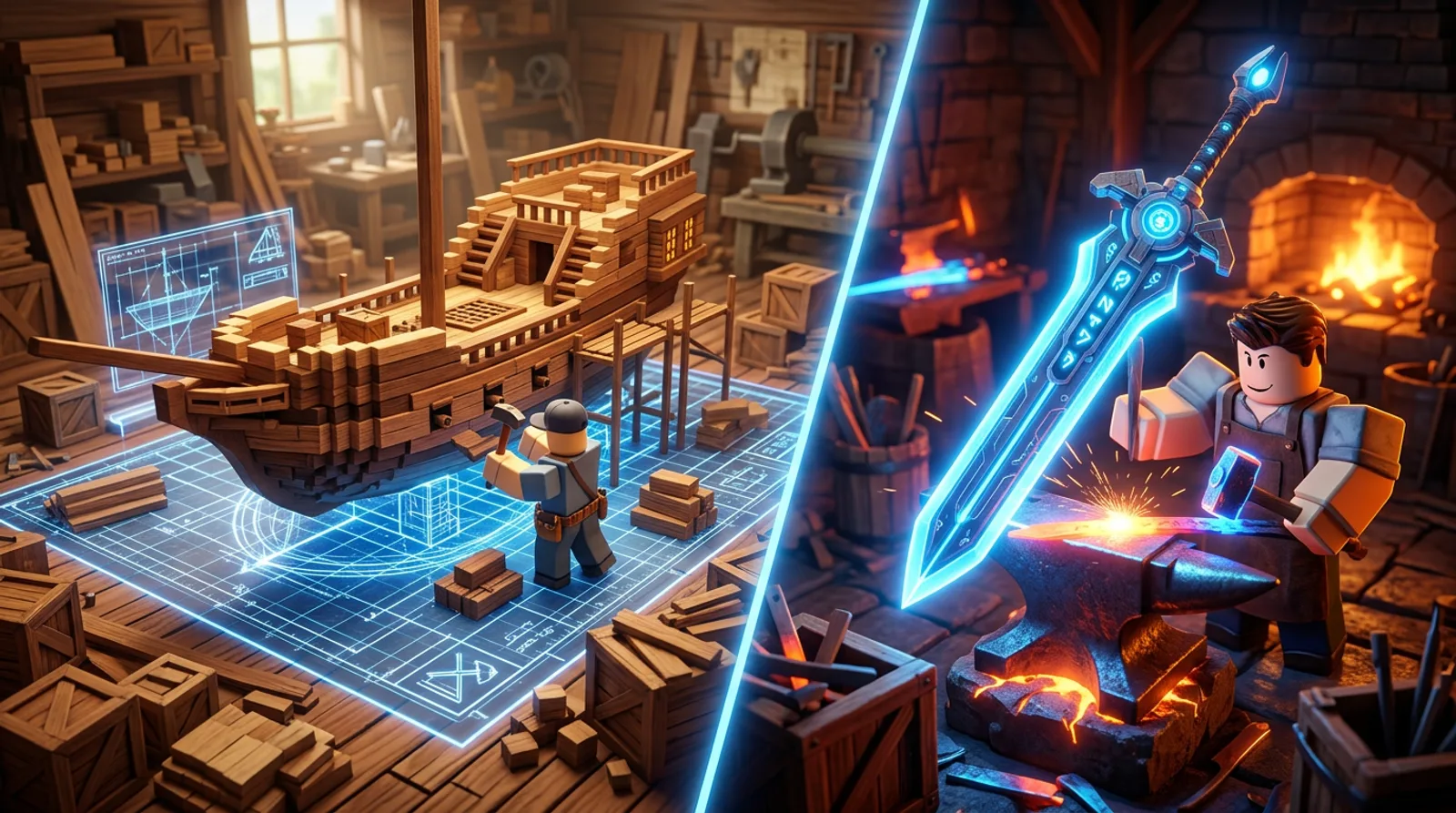
Your friend sends you a Roblox link. “Build a boat, sail it, find treasure. You’ll get it in five minutes.”
You load in. There is a grid. There are blocks. You stack a few of them into a rectangle, add a mast, and sail. The boat sinks almost immediately. Your friend says “no, you have to actually think about the shape.” You rebuild. The boat floats. You sail. You find a chest. Your friend says “cool, now build one that survives the storm biome.”
You build one that survives the storm biome. It takes you four hours. The design is ugly. It works. Your friend says “post it.”
You post it. Two hundred people sail it the next day. Someone remixes it into a ship with a treasure radar. Someone else builds a version with a cannon. Your ugly boat is now the basis for a whole fleet, and you did not design any of it — you designed the first rectangle, and the community built on top of it.
That gap — between the builder game you thought you were playing and the one that actually exists once you understand what a good build actually is — is what every “best Roblox building games” list skips. These lists rank by “most popular” or “best graphics” and never tell you what the building is actually asking of you by the time you have built 50 things.
So this guide does the opposite. Six games, ranked, with the thing that actually matters for each one: what the build system feels like after the first hour.
Why Most “Best Roblox Building Games” Lists Mislead You
Three problems with the lists that already exist.
They rank games by how impressive the finished builds look, not by how good the build system is. A list that puts Bloxburg at the top because its houses look great is measuring the community’s skill, not the game’s tooling. A beautiful house in a bad editor and a plain house in a great editor are very different experiences. The tooling is the game.
They ignore the constraint question. The best builder games are not the ones with the most freedom — they are the ones with the most interesting constraints. A grid that lets you build anything is free but bland. A grid where a boat must be shaped a certain way to float is a design puzzle. The games worth your time have constraints worth solving.
They ignore the sharing layer. Building is only half the loop. The other half is being seen. A builder game with a strong design-sharing culture turns your build into a contribution to a commons. A builder game without one is a private sandbox you will get bored of in a month.
How We Evaluate Roblox Creator and Builder Games
Six factors, weighted. Same framework I use across every genre ranking on this site, because the question is the same everywhere: figure out what the game actually asks of you, not what its store page claims.
1. Build system depth (25%). How powerful is the editor? Grid, free-form placement, terrain sculpting, scripting, material variety. How many constraints does it impose, and are those constraints interesting? The single most predictive factor of whether you will still be building in a month.
2. Creative freedom and constraint balance (20%). Can you make anything, and does the game make you want to? Games that are pure sandbox give you infinite possibility and no direction. Games that are pure constraint give you direction and a wall. The best builder games sit where the constraint makes the freedom meaningful.
3. Community and sharing culture (15%). Do players publish builds? Do they remix each other? Are there events, galleries, and featured builds? A builder game with a dead community becomes a private editor you use alone forever.
4. Replay value and progression (15%). Is there a reason to build the 51st thing? Do builds have a purpose — a voyage, a score, a story, a market? Builders burn out fast when the 51st build has no reason to exist.
5. Monetisation fairness (15%). Can a free player access the good building tools and items? Is the item catalogue generous? Does spending Robux buy you more building, or just prettier building? Prettier is fine. More is a problem.
6. Onboarding and learning curve (10%). Does the game teach you to build, or does it assume you already know? The best builder games have a ramp where the first build is easy and the fiftieth is hard. The worst dump you into an empty lot.
Notice what is not in the framework: graphics quality, map size, and “most items.” Those are the metrics builder-game listicles lead with, and they are the least predictive of whether you will enjoy building.
The Ranking at a Glance
| Rank | Game | Build System | Constraint Style | Best For | Play If You Want |
|---|---|---|---|---|---|
| 1 | Build a Boat for Treasure | Grid + structural | High (must float) | Design problem solving | The most genuinely creative build system in the genre |
| 2 | Bloxburg | Grid + detailed props | Medium (budgeted) | Housing + roleplay | The most polished builder with the best item catalogue |
| 3 | Modern City | Free-form + terrain | Low (near-total freedom) | Large-scale world building | The deepest free-form editor on Roblox |
| 4 | Saber Simulator | Blueprint crafting | High (must be balanced) | Weapon forging | Crafting depth with a real balance constraint |
| 5 | Untitled Spaceship | Co-op modular | Medium | Building with friends | The best builder for playing with a group |
| 6 | Ranch of Rivershine | Grid + farming | Medium | Building a working farm | A cozy builder where the build serves the farm |
Now the reasons, in order.
1. Build a Boat for Treasure — The Best Overall Roblox Builder Game
Build a Boat for Treasure earns the top spot by having the most interesting build system in the genre, the strongest design-sharing culture, and the most satisfying reason to build the 51st thing. It is not the most polished game here. It is the one where your build actually determines the outcome.
The core loop is exactly what it sounds like. You get a grid, a set of blocks and materials, and a build area. You build a boat. You sail it. The boat’s shape, weight, and balance determine how it handles and how far it gets. You find treasure. You build a better boat. Repeat.
Where Build a Boat for Treasure shines: the constraint. Your boat has to float. It has to hold weight without tipping. It has to be steerable. That constraint is what makes it a design game rather than a decoration game — every build solves a real problem, and the solutions are visible in how the boat handles on the water. It is also the game with the best community sharing culture on this list: designs get published, remixed, and improved by strangers, and your first ugly rectangle can become the seed of a fleet.
Where Build a Boat for Treasure frustrates: the visual ceiling. The blocks are not photorealistic, and the finished boats read as Roblox-flavoured rather than premium. If you are looking for a game where your build looks like a house in Bloxburg, this is not it. The look is functional and the satisfaction comes from the sailing, not the render.
Verdict: if you are playing one Roblox builder game in 2026, this is the one. The build system rewards actual design thinking, the community multiplies everyone’s work, and the loop never runs dry. For an overview of where it sits next to other Roblox genres, see our Best Roblox Games 2026 ranking.
2. Bloxburg — The Best Polished Roblox Builder Game
Bloxburg earns the second spot by being the most polished builder on Roblox and having the largest community. It is the game that other builders reference when they talk about what a Roblox build should look like. The item catalogue is enormous, the furniture is detailed, the lighting and terrain tools are good, and the house-design community is deeply active.
The build system is a grid with a huge item library. You are given a lot, and you are given good options. The freedom is real but the budget is not unlimited — building a mansion costs money earned through a job, and that creates a natural progression loop that most builder games lack.
Where Bloxburg shines: the polish and the catalogue. Every item looks like it belongs. The furniture, the appliances, the wall art, the landscaping — it all fits together visually in a way that almost no Roblox builder matches. The roleplay layer is also excellent, because a house in Bloxburg is a stage for a story, and the community is very good at that.
Where Bloxburg frustrates: the creative ceiling and the learning curve. A maxed-out house in Bloxburg is a very specific thing, and the game is more “furnish a nice house” than “design a strange thing.” New builders also get overwhelmed by the item count and the budget system before they have made a single satisfying build.
Verdict: the pick if you want the most polished builder with the best-looking output. The pick for players who enjoy housing design and roleplay in their builds. Skip it if you want experimental building tools.
3. Modern City — The Best Free-Form Roblox Builder Game
Modern City earns the third spot by having the deepest free-form building toolkit on Roblox. Where Bloxburg is a grid with a beautiful catalogue and Build a Boat is a grid with a strict structural constraint, Modern City is an actual world editor — terrain sculpting, prop placement, road and zone tools, and interiors.
Where Modern City shines: the scale and the toolset. You can build a neighbourhood, a district, a road network, a whole skyline. The terrain tools let you sculpt hills and carve valleys, and the world editor lets you place and rotate props with real control. For players who want to make something large and specific, this is the tool.
Where Modern City shines less: the guidance. The map is enormous and the toolset is broad, which means a first-time builder faces a wall of options with no ramp. Most players wander for an hour before they make anything they like. There is also less built-in reason to build than in the games with a purpose loop.
Verdict: the pick if you want large-scale free-form world building. The pick for players who want to sculpt terrain and design a place, not an object. Skip it if you want a game that tells you what to make.
4. Saber Simulator — The Best Crafting-Focused Roblox Builder Game
Saber Simulator earns the fourth spot by having the most systemic building system in the genre. You are not placing blocks — you are crafting a weapon from a blueprint, and the parts have to work together. A saber that is too heavy moves slowly. One that is unbalanced is hard to swing. One with a weak hilt breaks first.
Where Saber Simulator shines: the balance constraint. A crafting system that only cares about “is it built” is a checklist. Saber Simulator’s system cares about how it is built, and that turns every craft into a small engineering problem. The progression from scrap blade to legendary hilt is also long and satisfying.
Where Saber Simulator frustrates: the audience. It assumes you want to grind and optimise, and it is not a social sandbox. The community is smaller and more focused on optimisation than on sharing designs. If you want to hang out and build for fun, this is not the pick.
Verdict: the pick if you want engineering depth and a real balance constraint. The pick for players who enjoy the crafting loop and optimisation. Skip it if you want a social building playground.
5. Untitled Spaceship — The Best Co-Op Roblox Builder Game
Untitled Spaceship earns the fifth spot by being the best builder for playing with a group. It is a modular co-op construction game where you and your friends build a ship together — rooms, systems, engines — and then fly it. The design is a specific and appealing one: a collaborative sci-fi ship where the build is a shared project.
Where Untitled Spaceship shines: the co-op loop. Splitting construction duty with friends, seeing what someone else built in a room you did not touch, and then piloting the thing you all made — that is a specific kind of fun that no other builder here replicates. The modular system is well-designed, and the game does not require a huge time commitment to get a ship in the air.
Where Untitled Spaceship frustrates: the replay ceiling and the solo experience. The core loop is designed for a group; solo, you are doing all the jobs yourself, which is less fun. The content depth is also lighter than the other games here, so the replay value runs out faster.
Verdict: the pick if you want to build with friends. The pick for players who enjoy a shared project more than solo optimisation. Skip it if you are playing alone or want deep long-term progression.
6. Ranch of Rivershine — The Best Cozy Working-Farm Builder
Ranch of Rivershine earns the sixth spot by being the coziest builder on the list and the one where the build serves a functional purpose. You build a ranch — pens, fences, barns, crop plots — and the ranch actually works. Animals graze. Crops grow. The layout matters because a poorly planned ranch is genuinely inefficient to run.
Where Ranch of Rivershine shines: the purpose. Every build decision has a second purpose beyond looking good — the fence layout affects how long you spend herding, the barn placement affects how far you walk. It is a builder where the design and the function are the same thing, which is a rarity. The tone is relaxed and the progression is steady.
Where Ranch of Rivershine frustrates: the toolset. It is not a deep editor. The catalogue is small, the terrain tools are basic, and if you want to build something strange or large, the game will not let you. It is a narrow, pleasant builder rather than a wide one.
Verdict: the pick if you want a cozy builder where your layout has to work. The pick for players who enjoy farming and gentle progression. Skip it if you want a powerful toolset.
The Failure Retrospective: Three Ways Builders Burn Out in the First 50 Hours
I have watched 30+ people build in Roblox across these six games, and the burnout cluster around three specific failures. Here is what they look like, and what the actual fix is for each.
Failure 1: Building Decoratively Instead of Functionally
My friend built a Bloxburg mansion. It took four hours. It looked fantastic. It was functionally a disaster — the kitchen was on the far side of the house from the dining room, there was no path to the front door, and every job in the game took twice as long because they had to walk around their own building. They complained constantly that Bloxburg “rewards decoration, not design.”
The error was treating the build as a painting rather than a system. A builder who only cares about how the thing looks will produce a beautiful building that takes twice as long to use. A builder who cares about the flow produces a building that looks a little more considered and takes half the time to use. The second building is the better build, even if the screenshot is less impressive.
The fix: before you place a single object, decide what the space is for. A farm needs the barn near the crops. A house needs the kitchen near where people eat. A boat needs the heavy parts low. Decide the function, build the function, then decorate what is left. Decoration is the last step, not the first.
Failure 2: Skipping the Community Because “My Builds Are Not Good Enough”
I built 30 boats in Build a Boat for Treasure and never shared one. I thought they were not good enough. Then I posted one — my ugliest one, the one that took four hours — and it got remixed by six people and remixed by them again. One of those remixes became the most-sailed design in the game that month. I had been sitting on a contribution for three weeks because I thought it was not good enough.
The error was treating sharing as a performance. Sharing is not a test you pass. It is an input to a system. A “good enough” build that other people build on is worth more than a perfect build nobody sees, because the perfect build has zero downstream value and the remixed one becomes a design lineage.
The fix: post your build the moment it works, regardless of quality. Tag it, publish it, name it. The improvement comes from the remixes, not from the private polishing you do before you share. The players who get the most out of builder games are the ones with the lowest quality bar on publishing.
Failure 3: Building a 51st Thing With No Reason to Build It
I built 45 items in Modern City. Then I built a 46th, a 47th, a 48th, and stopped. I had no idea what to build. The problem was that I had been building for the sake of building — the thing itself was the goal, and once the goal was met, the next thing had no pull.
The error was ignoring the purpose loop. Build a Boat gives you a voyage. Bloxburg gives you a budget and a job. Untitled Spaceship gives you a crew and a flight. Ranch of Rivershine gives you animals and crops. The games with a purpose have an answer to “what do I build next” built into them, and the answer is always “the thing that lets me do the next thing.”
The fix: always build for the next action. If you are in a builder with a weak purpose loop, impose one. A 48-hour build challenge where you can only use grey blocks. A “one building, three different rooms” constraint. A build that has to work under a specific rule, like a boat that survives a storm. Imposed constraints turn a list into a game, and the game is what keeps you going past build 30.
Quick Pick: If-Then Decision Table
Find your situation. This is the decision frame for the Roblox builder genre, not for any single game.
| If you are… | Then play… | Why |
|---|---|---|
| New to Roblox building | Build a Boat for Treasure | Simple grid, immediate feedback, most forgiving first build |
| Wanting the best-looking builds | Bloxburg | The largest polished item catalogue in the genre |
| Wanting to sculpt terrain and a whole area | Modern City | The deepest free-form world editor |
| Wanting engineering and balance depth | Saber Simulator | Parts must work together; every craft is a design problem |
| Building with a group of friends | Untitled Spaceship | The best co-op construction loop on Roblox |
| Wanting a cozy, functional build | Ranch of Rivershine | The layout has to work; design and function are the same thing |
| Wanting the biggest community | Bloxburg | Largest player base and a huge roleplay community |
| Wanting the best design-sharing culture | Build a Boat for Treasure | Designs get published, remixed, and built on daily |
| Playing solo with limited time | Ranch of Rivershine | Steady, gentle progression with short sessions |
| Burned out on builder games | Saber Simulator | A different kind of building that resets your interest |
How to Design a Build (Methodology)
Most builders approach a build by placing things. You open the editor, you drop items, you move them around, you build a house. That is how you produce a build that looks reasonable and takes forever to use. The actual method is to design in three passes, in a fixed order, and never skip a pass because you are excited about the decoration.
Pass 1: Function (no decoration allowed). Decide what the build does, and lay out only the structural pieces that make it work. In Bloxburg, that means the room arrangement and the walking paths. In a boat, that means the hull shape, the weight distribution, and the placement of the heavy components. In a farm, that means the pens, the barn, and the crop plots in positions that make the daily loop short. No furniture, no decoration, no colour matching. This pass takes the longest and it is the pass that determines whether the build works.
Pass 2: Flow (walk it, do not look at it). Now physically walk the build in-game and do the thing it is for. If it is a house, cook a meal in it, sit down in it, and get from the front door to the bed. If it is a boat, sail it in a rough sea. If it is a farm, run the full daily loop. You are looking for the two things that ruin builds: dead space you walk through more than once, and bottlenecks where one task blocks another. Fix those in this pass, and only this pass. Do not touch decoration.
Pass 3: Decoration (and only now). Now, and only now, do the thing you actually want to do. Add the furniture, the colour, the detail. The reason this is last is that decoration built on a bad layout looks better but functions worse, and every hour spent decorating a layout you will later move is an hour wasted.
The rule: a build is designed in pass 1, tested in pass 2, and finished in pass 3. Builders who decorate first spend most of their time moving furniture around, and the final build is worse in every measurable way.
Counter-Intuitive Truths About Roblox Builder Games
Five things that sound wrong until you have built 50+ things.
Constraints make better builds than freedom. A builder with total freedom produces a floating monument to nothing, because there is no problem to solve. A builder working inside a constraint — the boat has to float, the saber has to be balanced, the budget is fixed — makes a decision every single time. The constraint is not a limitation on creativity. It is the source of it.
The community is the actual build system. The most valuable part of a builder game is not the editor. It is the layer of other people’s builds that you can see, copy, learn from, and remix. A game with a mediocre editor and a strong sharing culture will produce better builders than a game with a superb editor and no sharing. You learn to build by seeing what other people did, and you learn faster in a game where people publish.
Building efficiently is more valuable than building beautifully. The most common compliment in a builder game is “that looks great.” The rarer and more useful one is “that works.” A beautiful build with a bad flow costs the owner hours every single time they use it, and the owner knows it, and they keep it anyway because they already built it. A plainer build with a clean flow gets used. The functional build is the one that survives contact with daily play.
Sharing your worst build beats sharing your best. There is a real fear that a low-quality publish will be judged. It will be. It will also be remixed, and the remix will be better than anything you would have made, and the lineage will be credited to you. The build you are proud of is finished. The build you are embarrassed by is a starting point, and starting points are worth more in this genre.
The best builder game for you is the one whose output you will actually look at. People leave builder games because they built 40 things and never looked at one of them again. The metric that matters is not how much you built — it is whether the thing you built makes you want to show it to someone. If your builds are things you would never post, you are playing the wrong builder, and no amount of better tools will fix it.
How Builder Games Compare to the Rest of the Roblox Genre Map
Builder games are a distinct genre on Roblox, and they are easy to confuse with two neighbours. They are not tycoon games, where the building is incidental to running a business and the progression is money — though Bloxburg borrows heavily from that tradition. They are not simulator games, where the loop is collecting and upgrading — though Build a Boat borrows the loop shape from there. What makes a builder game a builder game is that the artefact you make is the point, and the game is judged on the artefact.
Where most Roblox genres reward time investment, builder games reward judgement. There is no grind that makes you a better builder — you get better by building, looking at what you built, and understanding why it did not work. For an overview of where builder games sit next to other Roblox genres, see our Best Roblox Games 2026 ranking, the tycoon pillar for the business-building cousins, and the social hangout pillar for the roleplay cousins.