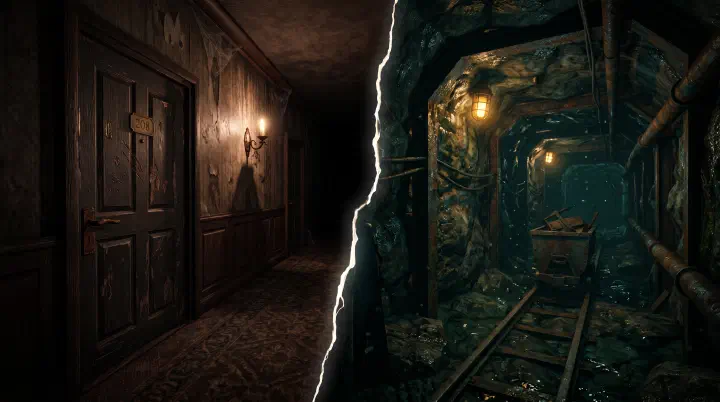
Your friend says “load into DOORS.” You load in. The hotel is dark. You’re in room 1. You’re feeling pretty confident — it’s just a hallway. You walk forward. Room 5. Room 10. “This isn’t scary,” you think.
Then room 14.
The lights flicker. You hear a distant rumble. You don’t know what it means. You keep walking. Rush hits you from behind before you even know to hide in a closet. You jump so hard you knock over your water bottle. Your roommate thinks someone broke into the apartment.
You close the game. You delete the bookmark. “Horror games aren’t for me,” you say.
A week later, you open DOORS again. This time you looked up what the sounds meant. You learn when to hide. You make it to room 30. Then room 50. Then room 70. Then, on your 23rd attempt, you beat the Hotel. And suddenly you’re hooked on every Roblox horror game that exists.
The mistake wasn’t trying DOORS. The mistake was thinking the first jump scare meant you’d never enjoy horror. The right Roblox horror game for you might be Pressure, not DOORS. Or Dark Rooms, not Pressure. The genre is wide. The trick is matching the game to your specific fear trigger.
This guide ranks the five biggest Roblox horror experiences — and explains which one fits which kind of scared player.
How We Evaluate Roblox Horror Games
“Scariest” is meaningless without context. We use six specific dimensions to figure out which horror game fits which player:
- Jump scare intensity — How sudden and frequent are the scares? Some games are jump scare heavy (DOORS), others are dread-driven (Pressure).
- Atmosphere and mood — How much does the setting itself contribute to the fear? Audio design, lighting, environmental storytelling.
- Difficulty curve — How steep is the learning curve? Some games ease you in (DOORS first 20 rooms), others throw you into the deep end (Pressure).
- Story and lore — Is there a narrative thread, or is it pure mechanics-first horror?
- Solo vs. co-op support — Can you play alone, and how much do you lose without a team?
- Replayability — How long does the fear hold up? Are there new modes, modifiers, badges, secrets?
The highest-ranked game isn’t necessarily the one you should play first. Use this guide to find your flavor of fear, not the consensus pick.
The Ranked List at a Glance
| Rank | Game | Fear Type | Jump Scare Intensity | Best For |
|---|---|---|---|---|
| 1 | DOORS | Jump scares + entity variety | 8/10 | New horror players, mechanics learners, speedrunners |
| 2 | Pressure | Atmospheric dread | 5/10 | Players who hate jump scares, atmosphere fans |
| 3 | The Mimic | Psychological + story-driven | 6/10 | Story fans, Japanese horror lovers |
| 4 | Dark Rooms | Liminal + cosmic horror | 4/10 | Backrooms fans, exploration horror |
| 5 | Lethal Company | Co-op comedy-horror | 3/10 | Groups of friends, chaos lovers |
Lethal Company is the exception on this list — it’s a Steam game, not a Roblox game. But it’s on the list because every Roblox horror fan I know also plays it, and it fills a co-op horror niche no Roblox game has matched.
1. DOORS — The Flagship Roblox Horror
DOORS is the biggest Roblox horror game of all time. One hundred rooms in a haunted hotel. No checkpoints. Every door could be your last. The formula is simple: open door, survive another room, repeat until you escape or die.
Why it’s #1. The onboarding is the best in the genre. Rooms 1-20 gently introduce you to one entity at a time — Rush first, then Screech, then Halt. By the time you hit the harder stuff, you understand the core survival loop. New players who survive their first Rush are as likely as veterans to keep coming back.
The entity variety is unmatched. Rush, Ambush, Screech, Eyes, Figure, Seek, Timothy, Jack — each one teaches you a different survival rule. Rush punishes standing in the open. Screech punishes looking at the wrong angle. Eyes punish staring. Figure punishes noise. The game is essentially a 100-room education in horror game survival.
The replayability is layered. Three floors (Hotel, Mines, Outdoors), each with different entities and mechanics. The modifier system (“Bad Electrical Work,” “Wet Floor,” “Battle of Wits”) lets you remix the difficulty. Speedrunning has an active leaderboard community. There’s a reason DOORS has held the top spot for years.
Why it’s not for everyone. The jump scare intensity is high. If loud noises and sudden movements genuinely distress you (not just startle you), DOORS will not be a fun experience. Some players describe the entity AI as predictable after 5-10 runs.
Best for: New horror players, mechanics learners, speedrunners, players who enjoy classic monster-of-the-week variety.
Skip if: Loud jump scares genuinely distress you. You want atmospheric slow-burn instead of sudden shocks.
2. Pressure — The Atmospheric Alternative
Pressure is what happens when horror design focuses on dread instead of shocks. You’re descending into an underwater facility. Oxygen is finite. Entities lurk in flooded corridors. The ocean is trying to kill you.
Why it’s #2. The atmosphere is unmatched in Roblox horror. Water drips. Pipes groan. The ambient soundtrack functions as a character — you hear the ocean pressure above you, the mechanical hum of the facility, distant entities moving through water. It’s horror that builds over time, not jumps that hit you in the moment.
The mechanics are deeper than DOORS. Oxygen management adds a resource layer most Roblox horror games ignore. The Angler doesn’t just chase — it baits, feints, and has variants with different attack patterns. The environment fights back with flooding rooms and collapsing passages. Every decision matters.
The badge system is the deepest in the genre. 50+ badges with unique unlock conditions. Hidden eggs scattered throughout the facility reward exploration. Endless mode for players who want infinite scaling challenge. Cosmetic badges display on your character, creating a visual progression system.
Why it’s not #1. The learning curve is brutal for beginners. Pressure doesn’t ease you in the way DOORS does. Your first run is likely to end in oxygen deprivation or entity ambush before you understand the basic survival rules.
Best for: Players who hate jump scares. Atmosphere fans. Completionists who love badge hunting. Players who enjoyed Subnautica’s thalassophobia.
Skip if: You want gentle onboarding. You need constant action. You prefer jump scare intensity over slow-burn tension.
3. The Mimic — The Story-Driven Choice
The Mimic is Roblox’s answer to Japanese psychological horror. You explore abandoned schools, hospitals, and towns, hunted by entities inspired by Japanese folklore. Less about jump scares and more about building a sustained sense of wrongness.
Why it’s top 3. It has an actual story. Most Roblox horror games are mechanics-first with a thin premise. The Mimic has a full narrative with chapters, lore, and character arcs. If you’ve ever finished a horror game and thought “but what was the point of all that?”, The Mimic is the answer.
The Japanese horror aesthetic hits hard. Long-haired ghosts, cursed videotapes, unsettling school settings. If you loved The Ring or Ju-on, this hits the same notes.
The puzzles and exploration add depth. It’s not just running and hiding. You solve environmental puzzles to progress. The pacing rewards patience.
Why it’s not higher. The slow pacing isn’t for everyone. Jump scares are relatively rare — the horror builds over long sessions. If you want immediate scares, The Mimic will feel boring.
Best for: Story-driven horror fans. Players who want lore and narrative with their scares. People who enjoyed Silent Hill or Fatal Frame.
Skip if: You hate slow pacing or reading story notes. You want frequent scares.
4. Dark Rooms — The Liminal Experience
Dark Rooms taps into a very specific kind of fear. The uncanny feeling of being somewhere that looks normal but is deeply, fundamentally wrong. You navigate procedurally generated rooms that feel familiar but are off — yellow wallpaper, fluorescent lights, endless hallways.
Why it’s on the list. The liminal space aesthetic is genuinely unsettling in a way no other Roblox horror game is. The Backrooms-inspired setting taps into a fear most people don’t even recognize until they feel it. If you’ve ever scrolled through r/backrooms at 2 AM and felt genuinely uneasy, this is your game.
The procedural generation keeps every play fresh. You can’t just memorize the layout — you have to stay alert. The subtle horror design rewards attention to detail.
Why it’s only #4. The pace is genuinely slow. Some players find it boring instead of scary. If you need constant action or jump scares, Dark Rooms will feel empty.
Best for: Liminal space fans. Cosmic horror enthusiasts. Exploration players. People who find the Backrooms aesthetic genuinely terrifying.
Skip if: You need constant action or jump scares. You want story-driven horror.
5. Lethal Company — The Co-op Chaos (Steam)
Lethal Company isn’t on Roblox (it’s $10 on Steam), but it makes the list because every Roblox horror fan I know also plays it. You and up to three coworkers land on abandoned moons to collect scrap. Monsters hunt you. The company demands a quota. You fail. You die. You laugh so hard you snort.
Why it’s on the list. The co-op horror niche isn’t filled by Roblox games. Lethal Company is the only game that delivers “play with friends, get hunted, scream at each other” the way horror fans actually want. Procedural moons, varied monster roster, quota deadlines, and absolutely chaotic voice chat moments.
Best for: Groups of 2-4 friends with voice chat. Comedy-horror fans. Players who want chaotic, replayable horror.
Skip if: You play solo. You want polished mechanics. You want actual scares (it’s more “oh no” than “AHHH”).
Failure Retrospective: My First 23 DOORS Attempts
I downloaded DOORS on a friend’s recommendation. “It’s not that scary,” they said. “You’ll be fine.”
Here’s how my first 23 runs went, and the three biggest mistakes I made that wasted hours of progress.
Mistake 1: I Didn’t Research Before My First Run
I went in blind. I’d heard DOORS was a horror game and that was the full extent of my preparation. I didn’t know Rush was a thing. I didn’t know to listen for the lights flickering. I didn’t know hiding in closets was the survival strategy.
Result: I died on door 14, 8, 22, and 17 in my first four runs. I never made it past door 25. I was convinced the game was unfair.
The fix that worked: I spent 20 minutes reading the DOORS subreddit and watching a beginner guide on YouTube. After that, I made it to door 45 on my first attempt. The game didn’t get easier — I just understood what I was supposed to do.
Lesson: Spend 15-20 minutes researching a new horror game before your first serious run. Watch a beginner guide. Read the wiki. The game won’t teach you everything — and dying without understanding why is a waste of attempts.
Mistake 2: I Quit After a Bad Run
I died on door 50 something like 8 times in a row. I got frustrated. I closed the game. “DOORS is too hard,” I said. I didn’t open it for two weeks.
When I came back, I cleared the Hotel on my first try. The difference wasn’t that the game got easier. The difference was that two weeks of mental reset made me approach each room with fresh patience instead of frustrated rushing.
Lesson: If you hit a frustrating wall in a horror game, take a break. Don’t force runs when you’re tilted. Come back tomorrow with fresh eyes. Most “I can’t beat this” problems are actually “I’m too frustrated to play this properly right now” problems.
Mistake 3: I Played Alone the Whole Time
DOORS is playable solo. Pressure, DiodeAll — all of these games support solo play. But I played my first 30 attempts alone, and I was missing 50% of the fun.
The first time I queued with a partner, we cleared door 100 together. The shared relief of escaping The Figure’s chase while my friend screamed in Discord was the moment horror gaming clicked for me. The game isn’t just about survival. It’s about the shared experience of almost dying together.
Lesson: Even if you can play alone, try co-op. The shared terror and shared relief of co-op horror makes every game better. Find a Discord server, invite a friend, or use the in-game matchmaking. Don’t solo your first 30 attempts like I did.
Mistake 4: I Played Without Headphones
For my first 15 attempts, I played DOORS through laptop speakers. Rush came from behind me and I never heard it coming. Screech appeared in my peripheral vision because I didn’t hear the audio cue first.
Then a friend told me to put them on. Same game. Same settings. The headphones transformed DOORS. I could hear Rush 3 seconds before it arrived. I could hear Seek’s chains before it appeared. I could hear entities I didn’t even know existed.
Audio cues in Roblox horror aren’t decoration. They’re the entire warning system. Without them, you miss 80% of the information the game is sending you.
Lesson: Get headphones before your first serious horror game run. Real headphones, not earbuds. The directional audio in these games is calibrated for stereo over-ear cans. Playing without them isn’t harder — it’s basically playing a different, worse game.
Why Horror Games Are Built for Headphones Specifically
Most Roblox horror games use stereo panning to position entities in space. Rush’s chase comes from a specific direction, not “somewhere.” The Angler’s lure plays from the dark hallway you haven’t checked. Seek’s chains rattle behind you before they appear.
This audio positioning gives you a 2-3 second warning before visual confirmation. That’s enough time to hide, reposition, or brace for the chase. Without headphones, you lose this entire warning system — every entity catches you by surprise.
It’s the single biggest upgrade you can make to your horror game experience. No settings tweak, no graphics upgrade, no skill improvement matters as much as putting on headphones.
The Takeaway From 23 Attempts
Those 23 attempts taught me four things I now treat as horror gospel:
- Research first, then play. A 20-minute beginner guide saves hours of confused frustration.
- Take breaks when tilted. Don’t force runs when you’re frustrated. Come back tomorrow.
- Play co-op when possible. Solo is doable but loses the shared terror of co-op.
- Get real headphones. The audio cues ARE the warning system.
If I could redo those 23 attempts, I’d clear the Hotel in 3-4 attempts using these rules. Same time investment. Radically different experience.
The DOORS Progression Map: What You Learn When
Most new DOORS players die to the same entities in the same order. Here’s the rough progression you should expect, and what each phase teaches you:
Rooms 1-20 (The Tutorial): Rush, Screech, basic hiding mechanics. The game is gentle here. Most players die once or twice but progress steadily.
Rooms 20-50 (The Real Game Begins): Halt, Eyes, ambush events. This is where most players start to feel challenged. You’ll die to ambushes you didn’t see coming. You’ll learn to listen for audio cues. You’ll start timing door opens.
Rooms 50-100 (The Hard Game): Figure, Seek, Timothy, complex room puzzles. This is where DOORS stops being easy. The Library (room 50) requires solving a puzzle while Figure patrols. Room 100 (Figure boss) requires perfect timing.
Three Floors (+ play): After clearing the Hotel, you unlock The Mines and The Outdoors. Each has different entities and mechanics. Expect another 50+ hours of progression here.
This progression is important because it shows you when to expect difficulty spikes. If you die on room 14, you’re not failing — you’re in the tutorial. If you die on room 50, you’ve completed the tutorial and started the real game.
How to Get Better at Roblox Horror (Without Burning Out)
Horror games are skill-based, but the skill is different from other genres. Here are the four training principles that actually work.
Audio Cue Discipline
Every Roblox horror game uses audio cues to telegraph threats. Rush’s rumble, Screech’s distant scream, Angler’s lure. The best players hear these cues 2-3 seconds before visual confirmation, giving them extra seconds to hide, slow down, or pick a defensive position.
Train this by deliberately listening during safe moments. What does the game sound like when nothing is happening? Compare that baseline to the moments before entity appearances — usually there’s a subtle audio shift. The more you internalize the baseline, the faster you’ll catch the cues.
The Hiding Spot Hierarchy
Horror games give you defensive positions — closets, lockers, under desks. But not all hiding spots are equal.
The best hiding spots are deep in the room (not near entryways). They have a clear visual blocking line (closet door, locker door). They’re away from other players (multiple people in one closet makes you easier to detect). And they have an exit alternative in case the hiding spot gets compromised.
Beginners grab the nearest closet. Veterans pick the optimal hiding spot — even if it means a few extra seconds of travel.
The Restart Mindset
DOORS has no checkpoints. You die on door 99, you restart at door 1. Most players treat this as punishment. Veterans treat it as reset.
Every restart is an opportunity to learn. What entity killed you? What was the audio cue? What hiding spot would have saved you? After 5-10 restarts on the same door, you’ve learned the encounter well enough to clear it consistently.
The mental shift that makes players great: restarts aren’t failure. They’re training runs. Your 23rd attempt wasn’t “I failed 22 times.” It was “I ran 22 training sessions and now I’m ready.”
The Co-Op Information Sharing
When you play with a team, your teammates’ audio cues are also your audio cues. If you hear your teammate scream “Rush” before you see it, you have an extra 2-3 seconds to react.
Train this by communicating constantly in co-op. “I hear Rush” before you see it. “Lights flickering” before entity appears. “Hide now” before the chase sequence starts. Teams that communicate consistently clear encounters that solo players can’t.
Quick Pick: If-Then Decision Table
Don’t have time to read the full breakdown? Find your situation and pick accordingly.
| If you want… | Then play… | Why it’s the right pick |
|---|---|---|
| The biggest, most popular Roblox horror | DOORS | Flagship title, best onboarding, biggest community |
| Atmospheric slow-burn instead of jump scares | Pressure | Dread over shock, deeper progression, ocean horror |
| An actual story with your horror | The Mimic | Narrative-driven, Japanese horror aesthetic |
| Liminal space / Backrooms-style horror | Dark Rooms | Cosmic dread, procedural rooms, subtle scares |
| Co-op chaos with friends | Lethal Company | Best co-op horror game period (on Steam) |
| The gentlest introduction to horror | DOORS | First 20 rooms teach mechanics one at a time |
| The hardest mechanical challenge | Pressure | Oxygen management, complex entity behaviors |
| Achievement / badge hunting | Pressure | 50+ badges, hidden eggs, endless mode |
| To play with friends on Roblox | DOORS | Best co-op support among Roblox horror games |
| The most replayable single-player horror | DOORS | Three floors, modifiers, speedrunning community |
Counter-Intuitive Truths About Roblox Horror
These sound wrong until you’ve played enough horror. Then they’re obvious.
The scariest game isn’t the best game. DOORS is scary, sure. But people keep playing it because the mechanics are good — entity variety, modifiers, speedrunning. The scares get you in the door. The gameplay makes you stay. Pick based on what gameplay you’ll enjoy, not how scary the thumbnail appears.
First attempts will not represent the game’s difficulty. If you die on door 14, you’re not bad at horror games. You’re in the tutorial. Difficulty dies on ROUND 50+, after you’ve learned the basics. Don’t judge a horror game by your first 5 attempts.
Jump scares are not the only flavor of fear. Pressure is genuinely unsettling without ever using a jump scare. Dark Rooms builds dread through setting alone. The Mimic creates wrongness through story. If you “hate being scared,” you might actually hate jump scares specifically — atmospheric horror might still work for you.
Co-op makes every horror game better. Most horror games support solo play. Most horror games are also significantly better with 2-4 people. The shared relief of escaping Figure together, the shared terror of Rush approaching, the shared laughter of Lethal Company chaos — this isn’t a minor improvement. It’s a fundamental upgrade.
Quitting a horror game for a week is good training. After a frustrating streak of deaths, most players force themselves to keep trying. This usually leads to worse performance, not better. Take a week off. Come back with fresh patience. You’ll clear encounters that frustrated you before.
Frequently Asked Questions
What is the scariest Roblox horror game in 2026?
It depends on what scares you. DOORS has the most intense jump scares and is the most immediately frightening. Pressure builds the strongest atmospheric dread and is more unsettling over long sessions. The Mimic has the best psychological horror and story. Dark Rooms does liminal space horror better than anything else. There is no single scariest game — only the scariest one for your specific fear triggers.
Which horror game is best for beginners?
Start with DOORS. The first 20 rooms gently introduce you to horror game mechanics one entity at a time. It’s scary but not overwhelming, and the hotel setting is familiar and easy to understand. If you hate jump scares specifically, start with Pressure instead — it’s more about slow-burn dread than sudden shocks.
Can you play Roblox horror games solo?
Yes, all the Roblox games on this list support solo play. Pressure is the most forgiving for solo players due to checkpoints and item availability. DOORS solo runs are significantly harder — every entity is your problem with no one to watch your back. Lethal Company is technically playable solo but loses 80% of its magic without friends.
Are Roblox horror games actually scary?
For someone new to horror, absolutely. DOORS has made millions of players jump out of their seats. Veteran horror fans will find the mechanics familiar but well-executed. The Roblox platform doesn’t hold these games back — they’re as polished and scary as many paid indie horror games. The difference is accessibility, not quality.
Do I need headphones to play these games?
Headphones are strongly recommended. Every game on this list uses audio cues to warn you of threats — you hear Rush coming before you see it, you hear the Angler’s lure before it strikes. Playing without headphones makes the games significantly harder and significantly less scary. Good headphones turn a decent horror game into a great one.
Is Lethal Company on Roblox?
No, Lethal Company is a Steam game (about $10). It’s included in this guide because many Roblox horror fans also play it, and it fills the co-op horror niche that no Roblox game has matched. If you only play Roblox, focus on DOORS, Pressure, The Mimic, and Dark Rooms.
More game comparisons and rankings in the Related Guides section below, or browse our full Best Roblox Games of 2026 list.
Disclaimer: Horror game balance, entity mechanics, and scare intensity change with every major update. This guide reflects the state of Roblox horror as of October 2026. New entities, new maps, and balance patches can shift how scary a game feels — always check the latest update notes before diving in.
Related Guides
- Best Roblox Games of 2026 — All genres ranked and compared
- Best Roblox Survival Games Compared — PvE and PvP survival
- DOORS Complete Guide — Strategies, entities, and room-by-room tips
- Pressure Complete Guide — Tips, badges, and entity breakdowns
- Lethal Company Complete Guide — Co-op strategies and moon tier list