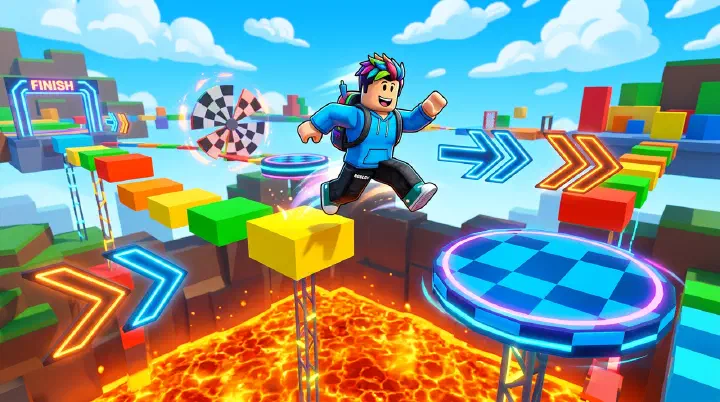
Section 11 of Tower of Hell. 28 minutes in. I’ve died 14 times already but this is the furthest I’ve ever gotten. The next jump is a corner warp onto a half-stud platform. I’ve done this exact jump 100 times in practice — it’s easy. But my hands are shaking because I know what happens if I miss.
I tap W. I flick my mouse. My character lands on the edge — momentum carries forward for one frame — and I slide off.
The screen fades. I respawn. At the bottom. Not section 10. Not section 5. The absolute bottom, staring up at the same neon walls I’ve been staring at for half an hour. No checkpoint. No sympathy. Just the quiet, burning realization that I get to do everything all over again for one more shot at a jump that takes 0.3 seconds.
That was my first real Tower of Hell session. I died 47 times that day. I never beat the tower. I almost uninstalled.
But I came back. And over the next few weeks, I realized something I wish someone had told me sooner: the obby you start with matters more than how much natural talent you have. Tower of Hell looks like the “default” Roblox obby because it’s the most popular, but it’s actually one of the hardest for new players. Start with the wrong game and you’ll conclude you “suck at parkour” when really you just picked a game built for experts.
This guide is everything I’ve learned after 200+ hours across every major Roblox obby. It ranks the best ones not by popularity, but by what they actually test, who they’re for, and whether they’ll make you better or just make you angry.
How We Evaluate Roblox Obby Games
“Obby” is the broadest genre on Roblox. A 1,000-stage casual platformer and a no-checkpoint soul-crushing tower are both “obbies” but they’re completely different experiences. We evaluate across six dimensions:
- Physics fairness — Are the jumps consistent? Do you always jump the same height? Is collision detection reliable? Bad physics turn a skill game into a luck game.
- Checkpoint philosophy — How much progress do you lose when you fall? This is the single biggest factor in how a game feels.
- Difficulty range — Can beginners play it? Can experts be challenged? A game with one difficulty only serves one audience.
- Content volume — How many hours of gameplay are there before you’ve seen everything?
- Skill transfer — Does playing this game make you better at other obbies? Or does it only teach you its own specific tricks?
- Community & updates — Is the developer still updating? Is there an active player base? Dead obbies are dead for a reason.
We also have one hard disqualification: if the game uses glitchy or inconsistent physics as a “difficulty” mechanic, it’s not a good obby. A hard jump that’s consistent is fair. An easy jump that randomly fails because of bad hitboxes is just bad design.
The Ranked List at a Glance
| Rank | Game | Difficulty Range | Best For | Checkpoints | Replayability |
|---|---|---|---|---|---|
| 1 | JToH (Juke’s Towers of Hell) | Easy → Catastrophic | Serious obby players | Varies by tower | Very High |
| 2 | Tower of Hell | Hard → Extreme | Short, intense sessions | None | High |
| 3 | Parkour (hudzell) | Medium → Extreme | Movement mastery | N/A (open world) | Very High |
| 4 | Mega Fun Obby | Very Easy → Medium | Beginners & casual play | Every stage | Medium |
| 5 | Difficulty Chart Obby | Very Easy → Hard | Skill building & training | Every stage | Medium-High |
| 6 | Speed Run 4 | Medium → Extreme | Speedrunning | Per level | High |
1. Juke’s Towers of Hell (JToH) — The Deep End
JToH is not just a Roblox obby — it’s a whole universe of obbies. You start in a hub world called Ring 1, which contains 10+ towers of varying difficulty. Beat enough towers and you unlock Ring 2. Then Ring 3. There are currently 10+ rings with over 100 community-made towers total.
Why it’s the best. Range. No other obby game serves both beginners and experts this well. An Easy tower in JToH is genuinely accessible — wide platforms, forgiving jumps, checkpoints every few floors. A Catastrophic tower is one of the hardest things you can do in any video game — frame-perfect jumps, 30+ minutes of no checkpoints, zero room for error.
The community creation system is what gives it longevity. New towers get added regularly. Some are bad, but the best ones are creative masterpieces — themed worlds, custom mechanics, puzzle elements, even narrative. You’ll never run out of content.
Physics quality. Excellent. JToH uses Roblox’s default physics but tuned for maximum consistency. Every jump is predictable. If you fail, it’s your fault, not the game’s. This is non-negotiable for a game this hard — when you’re 20 minutes into a no-checkpoint tower, the last thing you want is a random physics glitch.
Who should play it. If you’re serious about getting good at Roblox obbies, this is your game. It has the most content, the fairest physics, and the best progression curve. If you want to spend 200+ hours on one obby game, JToH will deliver.
Who should skip it. Casual players who just want 15 minutes of fun. JToH is a commitment — some towers take hours to beat even once. If you want quick, bite-sized sessions, play Tower of Hell instead.
2. Tower of Hell — The Classic Pressure Cooker
Tower of Hell is the most popular obby on Roblox and probably the most famous. A 12-section tower with no checkpoints, procedurally generated sections, and a timer. Fall once and you start over.
Why it works despite being brutal. The tower is short enough that a full reset doesn’t feel devastating. A good player can climb it in 5-10 minutes. Even a mediocre player can do it in 20-30. Compare that to a JToH Soul Crushing tower where one fall costs hours, and ToH starts to look generous.
The procedural generation is both its biggest strength and biggest weakness. Strength: every tower is different, so replayability is high. Weakness: some section combinations are brutal to the point of feeling unfair. You can get a “lucky” tower that’s mostly easy jumps, or an “unlucky” one where every section is max difficulty.
Skill transfer. Moderate. ToH builds consistency under pressure better than any other obby. You learn to stay calm when you’re high up and your hands are shaking. That mental skill transfers to every other obby. But the specific jump types in ToH are somewhat limited — it doesn’t have the variety of JToH.
The beginner trap. This is the #1 mistake new obby players make: they start with Tower of Hell because it’s the most popular, fail repeatedly, and conclude they’re bad at parkour. They’re not bad — they just started with a game that assumes you already know how to do corner clips, wraparounds, and momentum conservation.
Who should play it. Players who want short, intense sessions. People who enjoy the adrenaline of high-stakes platforming. Speedrunners.
Who should skip it. Total beginners (start with Mega Fun Obby or Difficulty Chart Obby). People who rage easily when they lose progress. Players who want lots of content variety.
3. Parkour — The Movement Sandbox
Parkour by hudzell is not a traditional obby. It doesn’t have stages or checkpoints or a clear goal. It’s an open world city where you can wallrun, dive, slide, vault, and climb. It’s less “climb the tower” and more “skateboarding but with Roblox parkour.”
What makes it special. The custom movement system. This isn’t default Roblox physics. The gravity is lower. The movement is faster. You have wallruns, dive rolls, ledge grabs, and more. It feels completely different from every other obby on Roblox — smoother, faster, more fluid.
The open world format means you set your own goals. Want to climb that skyscraper? Go for it. Want to find the fastest route across the city? Time trial it. Want to just mess around with cool movement? No problem.
Learning curve. Steep. The first 5-10 hours feel like you’re learning to walk again. Your Roblox muscle memory works against you. But once it clicks? You’ll move in ways you didn’t think were possible in Roblox.
Skill transfer. Low to other Roblox obbies (because the physics are totally custom), but very high for general movement skill. The timing, precision, and spatial awareness you develop in Parkour do make you better at other games — it just takes time to readjust to default Roblox physics.
Who should play it. Players who love movement for movement’s sake. People who want an open-ended practice space. Anyone who enjoys games like Mirror’s Edge or Titanfall.
Who should skip it. Players who want clear goals, levels, or completion. If you need a “you win” screen, Parkour will feel aimless.
4. Mega Fun Obby — The Casual Marathon
1,000+ stages. Checkpoint after every single stage. No timer. No pressure. Mega Fun Obby is the most relaxed obby experience on this list.
Why it’s underrated. Serious obby players sometimes dismiss Mega Fun Obby as “too easy” or “not a real obby.” That’s a mistake. Easy doesn’t mean bad — it means accessible. For a new player, this game teaches consistency better than any other because you can make steady progress without the fear of losing 20 minutes of work.
The stage-per-stage format means you can pick it up, do 10 stages, and put it down. It’s the perfect obby for playing while listening to a podcast or watching a video on your second monitor.
Limitations. The jump variety is limited. After stage 100 or so, you’ve seen most of the trick types — it just gets harder versions of the same things. The difficulty curve is also inconsistent — some stages feel much harder or easier than their number would suggest.
Who should play it. Total beginners. Casual players. People who want to zone out and make steady progress. Anyone who hates losing progress.
Who should skip it. Players who want a real challenge. People who get bored by repetition. Serious obby enthusiasts — you’ll outgrow it fast.
5. Difficulty Chart Obby — The Hidden Training Mode
The Difficulty Chart Obby (DCO) is exactly what it sounds like: stages arranged by difficulty, from easiest to hardest. Each stage introduces a new jump type or builds on an existing one.
The secret: it’s a structured training program disguised as a game. Most obbies throw random jumps at you and expect you to figure out techniques on your own. DCO teaches them systematically. Stage 1-10: basic jumps. Then: wraparounds, corner clips, truss jumps, headhitters, wallhops, and on and on.
If you work through DCO methodically, you will develop genuinely good obby fundamentals. It’s like having a personal trainer for Roblox platforming.
Why it’s not higher ranked. Once you’ve beaten it, there’s not much reason to come back. No procedural generation, no speedrun mode (well, some people do speedrun it), no real endgame. It’s a training tool that happens to be fun — and that’s exactly what it should be.
Who should play it. Anyone who wants to get better at obbies systematically. Players who feel stuck and don’t know what to practice. Beginners who want to graduate from Mega Fun Obby.
Who should skip it. People who want pure fun rather than skill building. If the idea of structured practice sounds like homework, play something else.
6. Speed Run 4 — Pure Speedrunning
Speed Run 4 is a series of short levels where your goal is simple: finish as fast as possible. Each level has a global leaderboard. Every millisecond matters.
Momentum mechanics. What makes Speed Run 4 unique is its momentum system. Your speed carries between jumps. You can build up speed by chaining jumps perfectly. The fastest routes aren’t the most direct ones — they’re the ones that let you maintain maximum speed.
This adds a layer of optimization that you don’t get in other obbies. It’s not enough to land the jumps. You have to land them in a way that preserves or builds speed.
Limitations. The level count is relatively small compared to JToH or Mega Fun Obby. Once you’ve gotten decent times on all levels, there’s not much new content. It’s very much a “chase the leaderboard” game — if that doesn’t motivate you, it will get boring fast.
Who should play it. Speedrunners. Players who love optimization and leaderboards. People who enjoy short, intense attempts rather than long sessions.
Who should skip it. Players who want exploration or progression. People who hate repeating the same level over and over.
Failure Retrospective: My Tower of Hell 47-Death Streak
Let’s go back to that opening story. 28 minutes into Tower of Hell, fell on section 11, 47 deaths total that day. No tower clears.
I quit after that session feeling frustrated. But the next day, I realized I’d been making three specific mistakes that were making the game 10x harder than it needed to be. Fixing these mistakes got me my first Tower of Hell clear on my third session.
Mistake 1: Skipping the Warmup
I would load into the game and immediately try to climb the tower. First few attempts were always garbage because my hands were cold and my timing was off. I’d die 5-6 times just getting warmed up — and those deaths counted against my mental state.
The fix: 5-minute warmup routine. Before I try to climb seriously, I spend 5 minutes just doing basic jumps at the bottom of the tower. No pressure. No goal. Just warming up my fingers and my timing. This one change cut my death count in half because my first real attempt is already warmed up.
Mistake 2: No Breather Between Attempts
I’d fall, immediately respawn, and immediately start climbing again. No pause. No deep breath. Just go go go.
This is terrible because frustration builds up. Every death makes you a little angrier. Anger makes you rush. Rushing makes you die more. It’s a death spiral — literally.
The fix: the 10-second rule. After every death, I wait 10 seconds before I start climbing again. Ten deep breaths. Ten seconds to reset my focus. Ten seconds to remember what I’m doing. It sounds silly and small — and it is — but it stopped the death spiral.
Mistake 3: Practicing the Whole Tower Instead of Weak Sections
I kept dying on section 8. Every time. So I’d restart, climb through sections 1-7 (which I could do consistently), die on section 8, and repeat. Most of my time was spent practicing things I already knew how to do.
The fix: section-specific practice. If I kept dying on a specific section, I’d stop trying to clear the whole tower. Instead, I’d just practice that one section over and over — dying on purpose after section 7 to get back to section 8 faster. Once I could do section 8 ten times in a row, I’d go back to full runs.
This is the most important lesson I learned about obby practice in general: don’t practice what you’re already good at. Practice what you’re bad at. It sounds obvious, but almost nobody does it. Most players just run the same tower over and over, which is inefficient.
Quick Pick: If-Then Decision Table
Don’t have time to read the full breakdown? Use this table to pick your next obby in 10 seconds.
| If you want… | Then play… | Why it’s the right pick |
|---|---|---|
| The best overall obby game | JToH | 100+ towers, fairest physics, massive difficulty range |
| You’re a total beginner | Mega Fun Obby first | Checkpoint every stage, zero pressure, learn consistency |
| Short, intense 10-minute sessions | Tower of Hell | No checkpoints, fast runs, pure adrenaline |
| You want to get good at obbies | Difficulty Chart Obby → JToH | Structured training then apply it to real towers |
| Movement mastery & freestyle | Parkour | Custom physics, open world, infinite creativity |
| Speedrunning & leaderboards | Speed Run 4 or Tower of Hell | Both have competitive speedrun communities |
| You HATE losing progress | Mega Fun Obby or DCO | Every stage has a checkpoint — max 15 seconds lost |
| 200+ hours of content | JToH | 10 rings, 100+ towers, community content forever |
| You want to play while listening to a podcast | Mega Fun Obby | Low-stakes, can zone out, steady progress |
| You want to train specific techniques | Difficulty Chart Obby | Structured progression, one new skill per stage |
How to Actually Get Better at Roblox Obbies
Reading this guide won’t make you better at parkour. Practice will — but only if you practice the right way. Most people don’t. They just play more of the same thing and wonder why they’re not improving.
Here’s the training method that works.
The Three Core Skills
Every obby tests three fundamental skills. Train all three and you’ll get better at every obby game.
Skill 1: Jump precision. The ability to land exactly where you want to land. Half-stud platforms, corner jumps, wraparounds — these all come down to precision.
Drill: target practice. Find a stage or section with a small platform. Jump to it, jump back, jump to it again. Do this 20 times in a row. If you miss, start the count over. This is boring but it’s the fastest way to build precision. Do 10 minutes a day and you’ll see improvement in a week.
Skill 2: Pattern recognition. The ability to look at a jump and immediately understand what technique to use and how to execute it. This is what separates players who can clear a new tower on their first try from players who need 50 attempts.
Drill: the first-try challenge. Load up a new tower or stage. Your goal is not to beat it. Your goal is to analyze each jump before you attempt it. Look at it, figure out the route, and then try it. Don’t worry about dying — worry about whether you understood the jump before you tried it. This trains the “reading” skill that makes you faster at learning new obbies.
Skill 3: Mental composure. The ability to execute cleanly when the stakes are high. Everyone can land a jump at the bottom of the tower. Can you land it at the top, with 25 minutes of progress on the line?
Drill: high-stakes practice. Play Tower of Hell or a no-checkpoint JToH tower specifically to practice staying calm. The point isn’t to win — it’s to notice when you start getting nervous and consciously calm yourself down. Breathe. Slow down. Focus on the next jump only, not the 10 jumps after it.
The Optimal Practice Routine
If you want to improve as fast as possible, here’s what a good practice session looks like:
- Warm up (5 min) — Easy jumps, basic movement. No pressure. Just get your hands warm.
- Weakness drill (10-15 min) — Work on whatever you’re worst at. Corner clips? Wraparounds? Truss jumps? Spend focused time on just that one thing.
- Main session (20-40 min) — Play whatever you enjoy. JToH towers, Tower of Hell runs, whatever. This is where you apply what you practiced.
- Cool down (5 min) — Easy, fun jumps. End on a high note so you come back tomorrow.
Total session: 40-65 minutes. You’ll improve faster doing this 4 times a week than you will grinding mindlessly for 4 hours on Saturday.
The Plateau Breaker
If you’ve been stuck at the same skill level for weeks, here’s what to do: play a completely different type of obby for one week.
If you’re stuck on Tower of Hell, go play Parkour for a week. It will build movement creativity and spatial awareness that directly translates. When you come back, you’ll see routes you never noticed before.
If you’re stuck on JToH Hard towers, go play the Difficulty Chart Obby from the beginning. It will reinforce fundamentals you’ve probably gotten sloppy about. When you come back, your basic jumps will be cleaner.
This works because when you only play one game, you develop blind spots and bad habits. A different game forces you to think differently and breaks you out of the rut.
Counter-Intuitive Truths About Roblox Obbies
These sound wrong until you’ve put enough hours in. Then they’re obvious.
The hardest obby is not the most rewarding. A Catastrophic JToH tower might take you 10 hours to clear once. That’s 10 hours of the same 20 jumps. Meanwhile, clearing 20 Easy and Medium towers in that same time teaches you more variety, more routing skills, and more confidence. Difficulty does not equal value per hour.
Easier obbies build better fundamentals. This is the one serious players hate to admit. Mega Fun Obby and Difficulty Chart Obby force you to repeat basic jumps hundreds of times, building clean form and consistency. Tower of Hell forces you to attempt hard jumps while stressed, which often means practicing bad form under pressure. Spend your first 20 hours in easy games and you’ll clear hard towers faster than if you started hard.
Speedrunning ruins your first playthrough. The leaderboards are tempting. But your first clear of a tower is the only time you’ll experience it fresh. Once you learn a speedrun route, you stop seeing the level as a spatial puzzle and start seeing it as a sequence of inputs. That first discovery is special. Don’t waste it copying someone else’s frames.
More deaths doesn’t mean more practice. If you die 100 times on the same jump, you’re not practicing — you’re gambling. Practice means understanding why you failed and adjusting. If you’re failing the same jump more than 10 times in a row, stop. Watch a tutorial. Take a break. Switch to something else. Brute force is the least efficient way to learn.
The best players warm up the longest. I used to think good players just sat down and were immediately good. Then I watched top Tower of Hell speedrunners stream. They warm up for 15-30 minutes before they even attempt a serious run. Warmup isn’t for noobs — it’s for people who are serious about performing well.
Frequently Asked Questions
What is the best Roblox obby game overall?
Juke’s Towers of Hell (JToH) is the best overall for serious obby players — it has over 100 community-made towers across every difficulty level from Easy to Catastrophic, the fairest and most consistent physics on Roblox, and years of content. Tower of Hell is the most popular and best for short, intense sessions. Mega Fun Obby is best for beginners and casual play. The right answer depends on your skill level and what you want from an obby.
Which Roblox obby is best for beginners?
Mega Fun Obby is the best starting point for total beginners. It has 1,000+ short stages with a checkpoint after every single one, so failure costs almost no time and you never feel like you’re wasting progress. The Difficulty Chart Obby is also excellent because it teaches fundamentals gradually — each stage introduces a new jump type and ramps up slowly. Start with one of these two, not Tower of Hell.
Does Tower of Hell have checkpoints?
No — Tower of Hell has zero checkpoints. If you fall, you respawn at the very bottom of the tower. That is the entire design. The tower is 12 sections and usually takes 5-30 minutes to climb, so a full reset stings but doesn’t waste hours of progress like some JToH towers. Some private servers or fan versions add checkpoints, but the official YXCeptional version is intentionally brutal.
What is the hardest Roblox obby that is still fair?
Juke’s Towers of Hell (JToH) has the hardest fair content. Its Soul Crushing tier towers (Catastrophic and Horrific difficulty) are extremely demanding — frame-perfect jumps, 30+ minute no-checkpoint runs, pixel-perfect positioning — but they’re built with precision and consistent physics. Unlike cheap obbies that rely on bad hitboxes or glitches for “difficulty,” JToH’s hardest towers are difficult because of genuine execution challenges. Every jump is theoretically possible; you just need to be good enough.
How long does it take to get good at Roblox obbies?
Most players feel competent after 20-30 hours of focused practice. To clear Tower of Hell consistently, expect 10-20 hours. To clear JToH Hard towers, expect 50-100 hours. To beat Soul Crushing towers, hundreds of hours. The fastest way to improve is structured practice — work on specific weak techniques, not just brute-forcing the same tower over and over. 30 minutes of focused practice beats 3 hours of mindless grinding.
Why does movement feel different in every obby game?
Each obby game uses different physics tuning: jump height, walk speed, friction, gravity, and air control all vary. Tower of Hell has tight, predictable default Roblox physics. Parkour uses completely custom movement with wallruns, dives, and lower gravity. Mega Fun Obby uses nearly default Roblox physics. When switching games, give yourself 10-15 minutes to recalibrate your timing before you judge your skill — your muscle memory will lie to you at first.
More game comparisons and rankings in the Related Guides section below, or browse our full Best Roblox Games of 2026 list.
Disclaimer: Obby games receive frequent content updates — new towers, new mechanics, physics tweaks. This guide reflects the state of Roblox obbies as of September 2026. Difficulty ratings and physics can shift with major updates. Always check recent patch notes before diving into a new game.
Related Guides
- Best Roblox Games of 2026 — All genres ranked and compared
- Best Roblox FPS Games Compared — Skill-based games with mechanical depth
- Best Roblox Puzzle Games Compared — Brain training with spatial reasoning
- Best Roblox Fighting Games Compared — More high-skill competitive games
- Best Roblox Survival Games Compared — Pressure and resource management